Get help with Science, Grade 5
Most tutoring makes your child sit through material your child already knows. MapleMind flips that: pick the exact skill that's causing trouble — any of the 61 below — and the tutor teaches just that one, step by step, as many times as it takes. Ask questions in plain words, any time of day, in English, French, or 12 other languages.
The official Prince Edward Island Science, Grade 5 curriculum
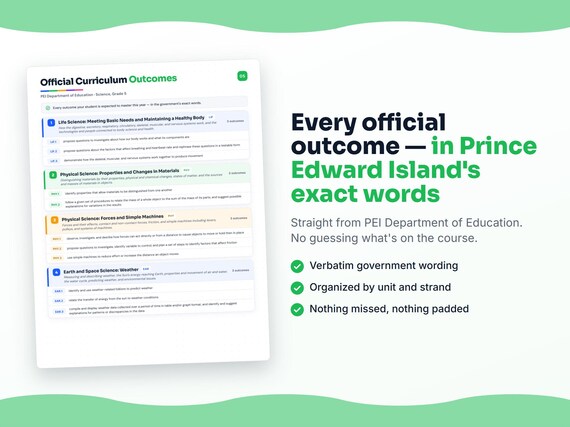
Prince Edward Island defines Science, Grade 5 by strands and outcomes. MapleMind teaches the same curriculum reorganized for one-skill-at-a-time tutoring — the table shows exactly where every official strand lands, and the ministry's own wording is quoted under each unit below.
Official source Prince Edward Island's official curriculumRead it on the government site — princeedwardisland.ca ↗| Official strand | Outcomes | Where MapleMind teaches it |
|---|---|---|
| Strand LS | 10 | Life Science: Meeting Basic Needs and Maintaining a Healthy Body |
| PS-M | 11 | Physical Science: Properties and Changes in Materials |
| PS-F | 19 | Physical Science: Forces and Simple Machines |
| ESS | 21 | Earth and Space Science: Weather |
Every skill below, taught one on one.
 Try the first session free
How MapleMind teaches Science, Grade 5 — every unit, lesson, and skill
Every skill below runs as a short session: a plain-words lesson, a worked example, solving it together, then a five-question skill check that earns up to three stars. Guided Mode keeps it teaching instead of answer-handing — turning it off needs a parent's password.
Unit 1Life Science: Meeting Basic Needs and Maintaining a Healthy BodyOfficial strand · Strand LS
How the digestive, excretory, respiratory, circulatory, skeletal, muscular, and nervous systems work, and the technologies and people connected to body science and health.
The Digestive and Excretory Systems
- Questions about how the body workssci5.1 — Propose questions to investigate about how the body works and its components.
- How saliva starts digestionsci5.2 — Investigate how saliva starts breaking down starch into simple sugars and record observations.
- Technologies for handling wastesci5.3 — Describe products and technologies developed for the disposal and containment of excrement.
The Respiratory and Circulation Systems
- Testable questions about breathing and heartbeatsci5.4 — Propose and rephrase testable questions about factors affecting breathing and heartbeat rate.
- Investigating breathing and heartbeatsci5.5 — Carry out procedures controlling variables and graph data on breathing and heartbeat rate.
- Scientific processes usedsci5.6 — Demonstrate and describe the scientific processes used to investigate breathing and heartbeat rate.
The Skeletal, Muscular, and Nervous Systems
- Systems working together for movementsci5.7 — Demonstrate how the skeletal, muscular, and nervous systems work together to produce movement.
- Canadians in body sciencesci5.8 — Provide examples of Canadians who have contributed to science and technology about body systems and health.
- Exploring response timesci5.9 — Explore response time and explain patterns and discrepancies in the data.
- Medical technologies for movementsci5.10 — Describe medical technologies that arose from the study of how the body moves.
The official wording — 10 outcomes in this unit
- sci5.1
propose questions to investigate about how our body works and what its components are
- sci5.2
carry out procedures to investigate how saliva can start the digestion process, by breaking down substances like starch into simple sugars, and record observations using sentences or charts
- sci5.3
describe examples of the products/technologies that have been developed in response to a need for the disposal, control, and containment of excrement
- sci5.4
propose questions about the factors that affect breathing and heartbeat rate and rephrase these questions in a testable form
- sci5.5
carry out procedures, making sure to control variables, to investigate the factors affecting breathing and heartbeat rate, and compile and display data from these investigations in a graph
- sci5.6
demonstrate and describe the scientific processes used to investigate the factors that affect breathing and heartbeat rate
- sci5.7
demonstrate how the skeletal, muscular, and nervous systems work together to produce movement
- sci5.8
provide examples of Canadians who have contributed to science and technology related to body organs, systems, and health issues
- sci5.9
carry out porcedures to explore response time, and identify and suggest explanations for patterns and discrepancies in the data collected
- sci5.10
describe various medical technologies, such as exercise machines and artifical limbs, that have arisen from the study of how our body moves
Unit 2Physical Science: Properties and Changes in MaterialsOfficial strand · PS-M
Distinguishing materials by their properties, physical and chemical changes, states of matter, and the sources and masses of materials in objects.
Properties, Physical and Chemical Changes
- Properties that distinguish materialssci5.11 — Identify properties that allow materials to be distinguished from one another.
- Physical changessci5.12 — Observe and identify physical changes that change form or size without making new materials.
- Chemical changessci5.13 — Describe chemical changes where materials interact to form new materials, including producing a gas.
- Reversible and non-reversible chemical changessci5.14 — Identify chemical changes to materials that are reversible and some that are not.
- Classifying states of mattersci5.15 — Classify materials as solids, liquids, or gases and chart their properties.
- Reversible and non-reversible physical changessci5.16 — Identify physical changes that are reversible and some that are not.
- Distinguishing materials by chemical propertiessci5.17 — Work with a team to plan and distinguish materials based on their chemical properties.
- Displaying chemical test resultssci5.18 — Compile and display data from chemical tests used to distinguish materials.
Sources and Masses of Materials
- Mass of the whole and its partssci5.19 — Relate the mass of a whole object to the sum of the masses of its parts and explain variations.
- Manufactured materials that improve livingsci5.20 — Describe manufactured materials developed to improve living conditions.
- Tracing materials to their sourcessci5.21 — Identify the source of materials in an object and describe how natural materials are changed to make it.
The official wording — 11 outcomes in this unit
- sci5.11
identify properties that allow materials to be distinguished from one another
- sci5.12
observe and identify physical changes, that can be made to an object, that changes the form or size of the material in the object without producing any new materials
- sci5.13
describe chemical changes, that occur when materials interact with each other to form totally new materials including those that result in the production of a gas
- sci5.14
indentify and describe some chemical changes to materials that are reversible and some that are not
- sci5.15
classify materials as solids, liquids, or gases, and illustrate this classification in a chart that shows their properties
- sci5.16
identify and describe some physical changes that are reversible and some that are not
- sci5.17
work with team members to develop and carry out a plan to systematically distinguish a material based on its chemical properties
- sci5.18
compile and display data to present the results of chemical tests used to distinguish materials from each other
- sci5.19
follow a given set of procedures to relate the mass of a whole object to the sum of the mass of its parts, and suggest possible explanations for variations in the results
- sci5.20
describe examples of manufactured materials that have been developed to improve their living conditions
- sci5.21
identify the source of the materials found in an object, and use a variety of sources and technologies to gather information to describe the changes to the natural materials required to make the object
Unit 3Physical Science: Forces and Simple MachinesOfficial strand · PS-F
Forces and their effects, contact and non-contact forces, friction, and simple machines including levers, pulleys, and systems of machines.
Forces and Their Effects
- How forces actsci5.22 — Observe and describe how forces can act directly or from a distance to move or hold objects.
- Contact and non-contact forcessci5.23 — Describe forces as contact or non-contact forces.
- Changing the amount of forcesci5.24 — Demonstrate the effect of increasing and decreasing the force applied to an object.
Friction
- Planning a friction investigationsci5.25 — Propose questions, identify variables to control, and plan steps to find factors affecting friction.
- Comparing friction on surfacessci5.26 — Investigate and compare the effect of friction on objects over different surfaces.
- Describing force in words and numberssci5.27 — Make observations to describe force qualitatively and quantitatively.
- Estimating the force to move a loadsci5.28 — Estimate the force needed to lift or pull a load in standard or non-standard units.
- Rollers, wheels, and axlessci5.29 — Demonstrate the use of rollers, wheels, and axles in moving objects.
- Products that change frictionsci5.30 — Describe how understanding friction led to products that reduce or enhance friction.
Simple Machines
- Using simple machinessci5.31 — Use simple machines to reduce effort or increase the distance an object moves.
- Comparing manual and machine effortsci5.32 — Compare the force needed to move a load manually with the effort using a simple machine.
- The effort problemsci5.33 — Identify the problem of the large effort needed to move heavy or distant objects.
- Parts of a leversci5.34 — Differentiate the fulcrum, load, and effort force when using a lever.
- Designing an efficient leversci5.35 — Design the most efficient lever to accomplish a given task.
- Pulleys and pulley systemssci5.36 — Compare single and multiple pulley systems and predict the effect of adding a pulley.
- Designing a system of machinessci5.37 — Design a system of machines to solve a task.
- How simple machines improved livingsci5.38 — Describe examples of how simple machines have improved living conditions.
- Sharing and improving machine designssci5.39 — Communicate ideas and suggest improvements to classmates' machine systems.
- Machines developed over timesci5.40 — Identify sources of information about machines used in the past and how they developed.
The official wording — 19 outcomes in this unit
- sci5.22
observe, investigate, and desribe how forces can act directly or from a distance to cause objects to move or hold then in place
- sci5.23
describe forces as contact or non-contact forces
- sci5.24
demonstrate and describe the effect of increasing and decreasing the amount of force applied to an object
- sci5.25
propose questions to investigate, identify variable to control, and plan a set of steps to identify factors that affect friction
- sci5.26
investigate and compare the effect of friction on the movement of objects over a variety of surfaces
- sci5.27
make observations in order to describe force qualitatively and quantitatively
- sci5.28
estimate the force needed to lift or pull a given load in standard or nonstandard units
- sci5.29
demonstrate the use of rollers, wheels, and axles in moving objects
- sci5.30
describe how the understanding of the concept of friction has led to the development of products that reduce and enhance friction
- sci5.31
use simple machines to reduce effort or increase the distance an object moves
- sci5.32
compare the force needed to lift or move a load manually with the effort required to lift it using a simple machine
- sci5.33
identify the problem of the large amount of effort needed to lift or move heavy objects small distances, or smaller objects long distances, that arises from the study of forces
- sci5.34
differentiate between the position of the fulcrum, the load, and the effort force when using a lever to accomplish a particular task
- sci5.35
design the most efficient lever to accomplish a given task
- sci5.36
compare the force needed to lift a load using a pulley system with that needed to lift it using a multiple pulley system, and predict the effect of adding another pulley on load-lifting capacity
- sci5.37
design a system of machines to solve a task
- sci5.38
describe examples of how simple machines have improved living conditions
- sci5.39
communicate questions, ideas, and intentions, listen to other, and suggest improvements to the systems of machines designed by students in the class
- sci5.40
identify examples of sources such as books, software and the Internet, of machines that have been used in the past, and have developed over time
Unit 4Earth and Space Science: WeatherOfficial strand · ESS
Measuring and describing weather, the Sun's energy reaching Earth, properties and movement of air and water, the water cycle, predicting weather, and environmental issues.
Measuring and Describing Weather
- Weather folkloresci5.41 — Identify and use weather-related folklore to predict weather.
- Weather measuring instrumentssci5.42 — Identify, construct, and use instruments for measuring weather information.
- Weather terms and instrumentssci5.43 — Use appropriate terminology in naming weather instruments and collecting data.
- Recording weather observationssci5.44 — Record observations to describe weather by temperature, wind, precipitation, and cloud cover.
- Classifying cloudssci5.45 — Classify clouds as stratus, cumulus, cirrus, or other and compare results.
- Features of weather systemssci5.46 — Use sources to describe the key features of a variety of weather systems.
- Estimating weather measurementssci5.47 — Estimate weather measurements for various times or weather systems.
- Weather innovations across culturessci5.48 — Identify weather-related innovations developed by various cultures.
The Sun's Energy, Air, and Water
- The Sun's energy and weathersci5.49 — Relate the transfer of energy from the Sun to weather conditions.
- Measuring how light heats materialssci5.50 — Measure the temperature of soil and water after exposing them to light and draw conclusions.
- Properties of airsci5.51 — Describe situations showing that air takes up space, has mass, and expands when heated.
- When air or water masses meetsci5.52 — Draw a conclusion about air or water flow patterns when masses of different temperatures meet.
- Patterns in air movementsci5.53 — Identify patterns in indoor and outdoor air movement.
- The water cyclesci5.54 — Relate the circulation of water on Earth to evaporation, condensation, and precipitation.
Predicting Weather and Environmental Issues
- Displaying and explaining weather datasci5.55 — Compile and display weather data over time and explain patterns and discrepancies.
- How the community predicts weathersci5.56 — Ask people in the community how they predict weather and compare their tools and techniques.
- Uses of weather forecastssci5.57 — Provide examples of ways weather forecasts are used by people in the community.
- Predicting local weather patternssci5.58 — Describe and predict patterns of change in local weather conditions.
- Weather phenomena being studiedsci5.59 — Identify examples of weather phenomena currently being studied.
- Effects of technology on weathersci5.60 — Identify positive and negative effects of technologies that affect weather and the environment.
- Environmental issues and changesci5.61 — Describe how studying ozone depletion, global warming, and acid rain led to inventions and regulations.
The official wording — 21 outcomes in this unit
- sci5.41
identify and use weather-related folklore to predict weather
- sci5.42
identify and/or construct, and use instruments for measuring weather information
- sci5.43
use appropriate terminology in naming weather instruments and collecting weather data
- sci5.44
record observations using measuring instruments in order to describe weather in terms of temperature, wind speed, wind direction, precipitation, and cloud cover
- sci5.45
classify clouds as stratus, cumulus, cirrus, or “other”, compare results with others, and recognize that results may vary
- sci5.46
use a variety of sources to gather information to describe the key features of a variety of weather systems
- sci5.47
estimate weather measurements for various times of the day, week, or for weather systems
- sci5.48
identify weather-related technological innovations and products that have been developed by various cultures in response to weather conditions
- sci5.49
relate the transfer of energy from the sun to weather conditions
- sci5.50
identify and use appropriate tools, measuring instruments and materials to measure the temperature of soil and water after exposing them to light and draw conclusions
- sci5.51
describe situations demonstrating that air takes up space, has mass, and expands when heated
- sci5.52
draw a conclusion, based on evidence gathered through research and observation, about the patterns of air and/or water flow that result when two air or water masses of different temperature meet
- sci5.53
identify patterns in indoor and outdoor air movement
- sci5.54
relate the constant circulation of water on Earth to the processes of evaporation, condensation, and precipitation
- sci5.55
compile and display weather data collected over a period of time in table and/or graph format, and identify and suggest explanations for patterns or discrepancies in the data
- sci5.56
ask different people in the community and region for advice on how to predict weather, and compare the tools and techniques they use to make predictions
- sci5.57
provide examples of ways that weather forecasts are used by various people in their community
- sci5.58
describe and predict patterns of change in local weather conditions
- sci5.59
identify examples of weather phenomena that are currently being studied
- sci5.60
identify positive and negative effects of technologies that affect weather and the environment
- sci5.61
describe how studies of the depletion of the ozone layer, global warming and the increase in acid rain have led to new inventions and stricter regulations on emissions from cars, factories, and other polluting technologies
Printable workbook · A keepsake of the year
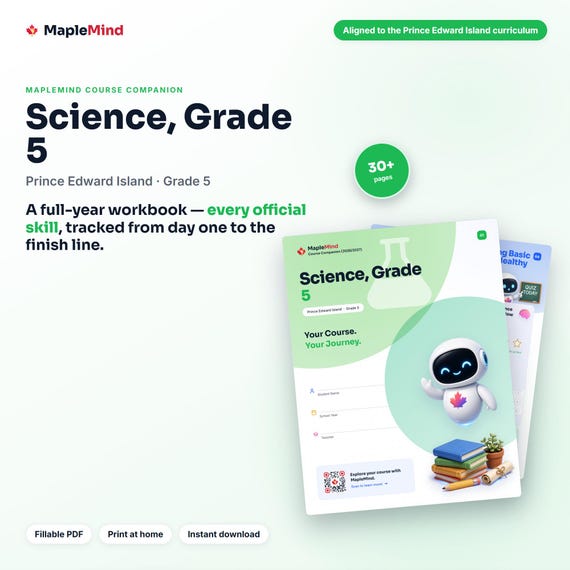
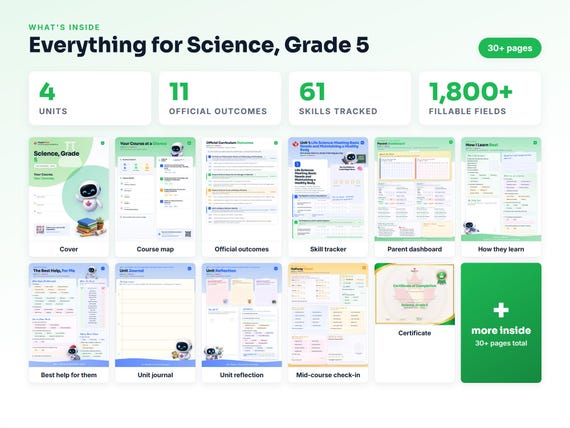
A Science, Grade 5 workbook worth keeping
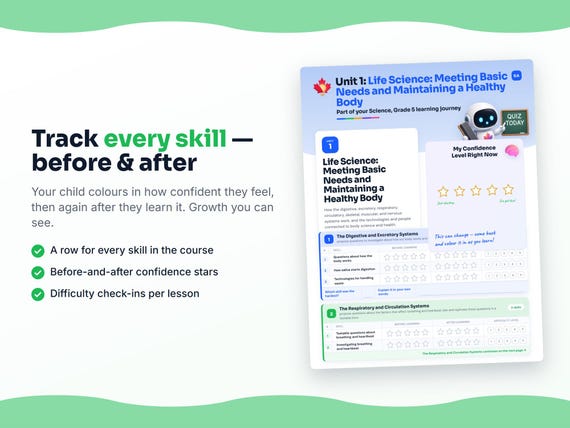
Built from the same official curriculum as this page. Before and after each skill above, your student colours in how sure they feel — so the two of you can see, on one page, what's clicking and what needs another look. It's a quiet way to follow how the year is really going.
By June it's full of their own handwriting: units worked through, confidence grown, a mid-year check-in, notes from parent-teacher night, and a certificate at the end. Less a worksheet, more a record of the year worth keeping on the shelf.
Instant download · see every page, reviews and the full description · five or more workbooks are $2.99 each
What it looks like in the app



Common questions
Can MapleMind help my child with Science, Grade 5?
Yes. MapleMind's AI tutor covers all 61 skills in Prince Edward Island's Science, Grade 5 — your child picks the exact skill, and the tutor teaches it step by step: a short lesson, a worked example, solving together, then a skill check to show it stuck.
Is MapleMind aligned to Prince Edward Island's official curriculum?
Yes. Every skill in this course maps to an official outcome code from Prince Edward Island's Grade 5 Science curriculum, and the ministry's own wording is quoted under each unit on this page — with the official government source linked so you can check it yourself.
What does MapleMind cost?
It's free to start — 5 tutoring chats and a practice quiz every day, no credit card. A Pro subscription ($9.99/month or $49.99/year CAD, 7-day free trial) unlocks unlimited tutoring, practice, and exam simulations.
What if my child is stuck on just one topic?
That's the point of skill-level tutoring: open Science, Grade 5 in the app, tap the exact skill from the list on this page, and the tutor teaches just that — no wading through lessons your child doesn't need.
Does MapleMind work in French or other languages?
Yes — 14 languages, including French. Both the app and the tutor's explanations switch to the language your child chooses.
Where can I see the official Prince Edward Island curriculum for Science, Grade 5?
The official source is linked on this page — Prince Edward Island's official curriculum. The outline here follows it: every MapleMind skill carries its official outcome code, and the ministry's own wording is quoted under each unit.
Keep exploring
Ready when you are
Pick a skill from this page and see it taught properly — free, in the browser, in under a minute.