Get help with Science, Grade 4
Most tutoring makes your child sit through material your child already knows. MapleMind flips that: pick the exact skill that's causing trouble — any of the 21 below — and the tutor teaches just that one, step by step, as many times as it takes. Ask questions in plain words, any time of day, in English, French, or 12 other languages.
The official Prince Edward Island Science, Grade 4 curriculum
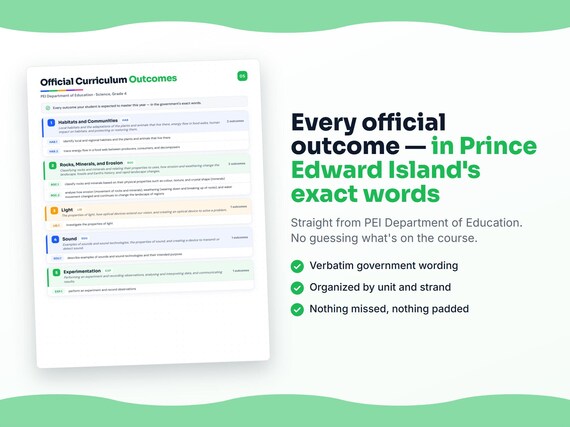
Prince Edward Island defines Science, Grade 4 by strands and outcomes. MapleMind teaches the same curriculum reorganized for one-skill-at-a-time tutoring — the table shows exactly where every official strand lands, and the ministry's own wording is quoted under each unit below.
Official source Prince Edward Island's official curriculumRead it on the government site — princeedwardisland.ca ↗| Official strand | Outcomes | Where MapleMind teaches it |
|---|---|---|
| DK1 | 7 | Habitats and Communities |
| DK2 | 5 | Rocks, Minerals, and Erosion |
| DK3 | 3 | Light |
| DK4 | 3 | Sound |
| DK5 | 3 | Experimentation |
Every skill below, taught one on one.
 Try the first session free
How MapleMind teaches Science, Grade 4 — every unit, lesson, and skill
Every skill below runs as a short session: a plain-words lesson, a worked example, solving it together, then a five-question skill check that earns up to three stars. Guided Mode keeps it teaching instead of answer-handing — turning it off needs a parent's password.
Unit 1Habitats and CommunitiesOfficial strand · DK1
Local habitats and the adaptations of the plants and animals that live there, energy flow in food webs, human impact on habitats, and protecting or restoring them.
Habitats and Adaptations
- Identifying local habitatssci4.DK1.C1 — Identify local and regional habitats and the plants and animals that live there.
- Adaptations for survivalsci4.DK1.C2 — Compare physical and behavioural adaptations that help plants and animals survive.
Food Webs and Protecting Habitats
- Energy flow in a food websci4.DK1.C3 — Trace energy flow in a food web between producers, consumers, and decomposers.
- When a population changessci4.DK1.C4 — Predict what might happen to an ecosystem if a population is removed or added.
- Human impact on habitatssci4.DK1.C5 — Analyse human impact on local habitats.
- Protecting and restoring habitatssci4.DK1.C6 — Evaluate steps individuals and communities can take to protect or restore habitats.
- Indigenous knowledge and caring for habitatssci4.DK1.C7 — Describe Indigenous knowledge and practices that help keep habitats healthy over time.
The official wording — 7 outcomes in this unit
- sci4.DK1.C1
identify local and regional habitats and the plants and animals that live there
- sci4.DK1.C2
compare adaptations of plants and animals (physical and behavioural adaptions) that enable them to survive and thrive within their habitats
- sci4.DK1.C3
trace energy flow in a food web between producers, consumers, and decomposers
- sci4.DK1.C4
predict what might happen to an ecosystem if a plant or animal population is removed or added
- sci4.DK1.C5
analyse human impact on local habitats
- sci4.DK1.C6
evaluate actionable steps individuals and communities can take to protect or restore local habitats
- sci4.DK1.C7
describe Indigenous knowledge and practices related to the sustainability of habitats
Unit 2Rocks, Minerals, and ErosionOfficial strand · DK2
Classifying rocks and minerals and relating their properties to uses, how erosion and weathering change the landscape, fossils and Earth's history, and rapid landscape changes.
Rocks and Minerals
- Classifying rocks and mineralssci4.DK2.C1 — Classify rocks and minerals by physical properties like colour, texture, and crystal shape.
- Rocks, minerals, and their usessci4.DK2.C2 — Relate the characteristics of rocks and minerals to their uses.
The Changing Landscape
- Erosion and weatheringsci4.DK2.C3 — Analyse how erosion, weathering, and water movement change the landscape.
- Fossils and Earth's historysci4.DK2.C4 — Explain the significance of rock formation, like fossils and layers, in understanding Earth's history.
- Rapid changes to the landsci4.DK2.C5 — Explain how natural phenomena cause rapid changes to the landscape.
The official wording — 5 outcomes in this unit
- sci4.DK2.C1
classify rocks and minerals based on their physical properties such as colour, texture, and crystal shape (minerals)
- sci4.DK2.C2
relate the characteristics of rocks and minerals to their uses (e.g., granite for countertops, limestone for cement, diamonds for jewellery and as a cutting tool)
- sci4.DK2.C3
analyse how erosion (movement of rocks and minerals), weathering (wearing down and breaking up of rocks), and water movement changed and continues to change the landscape of regions
- sci4.DK2.C4
explain the significance of rock formation (e.g., fossils, sedimentary layers) in better understanding Earth’s history
- sci4.DK2.C5
explain how natural phenomena cause rapid and significant changes to the landscape (e.g., flooding, storm surges, earthquakes, volcanic eruptions)
Unit 3LightOfficial strand · DK3
The properties of light, how optical devices extend our vision, and creating an optical device to solve a problem.
Light and Optical Devices
- Properties of lightsci4.DK3.C1 — Investigate the properties of light.
- Optical devices extend our visionsci4.DK3.C2 — Describe how optical devices extend our ability to observe the world.
- Creating an optical devicesci4.DK3.C3 — Create an optical device that solves a practical problem using a design process.
The official wording — 3 outcomes in this unit
- sci4.DK3.C1
investigate the properties of light
- sci4.DK3.C2
describe how human-made optical devices (e.g., telescopes, glasses, periscopes, kaleidoscopes, microscopes) extend our ability to observe and interact with the world
- sci4.DK3.C3
create an optical device that solves a practical problem using an engineering design process (e.g., redirecting light, magnifying objects)
Unit 4SoundOfficial strand · DK4
Examples of sounds and sound technologies, the properties of sound, and creating a device to transmit or detect sound.
Sound and Sound Devices
- Sounds and sound technologiessci4.DK4.C1 — Describe examples of sounds and sound technologies and their purposes.
- Properties of soundsci4.DK4.C2 — Investigate the properties of sound.
- Creating a sound devicesci4.DK4.C3 — Create a sound device using an engineering design process.
The official wording — 3 outcomes in this unit
- sci4.DK4.C1
describe examples of sounds and sound technologies and their intended purpose
- sci4.DK4.C2
investigate the properties of sound
- sci4.DK4.C3
create a sound device using an engineering design process
Unit 5ExperimentationOfficial strand · DK5
Performing an experiment and recording observations, analysing and interpreting data, and communicating results.
Doing an Experiment
- Performing an experimentsci4.DK5.C1 — Perform an experiment and record observations.
- Analysing and interpreting datasci4.DK5.C2 — Analyse and interpret data from an experiment.
- Communicating resultssci4.DK5.C3 — Communicate the results of an experiment.
The official wording — 3 outcomes in this unit
- sci4.DK5.C1
perform an experiment and record observations
- sci4.DK5.C2
analyse and interpret data
- sci4.DK5.C3
communicate the results of an experiment
Printable workbook · A keepsake of the year
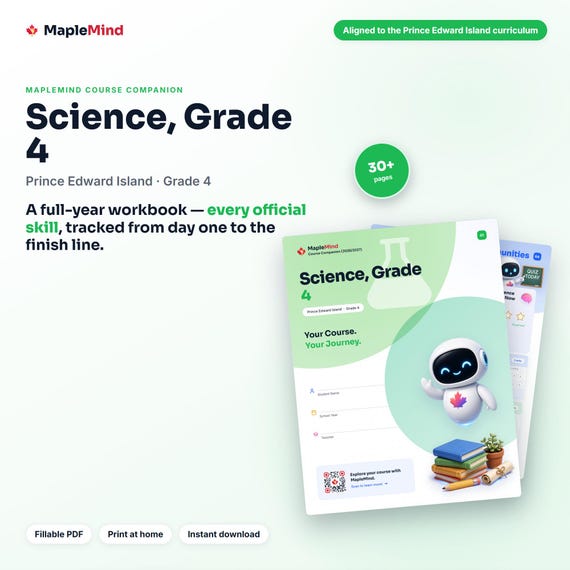
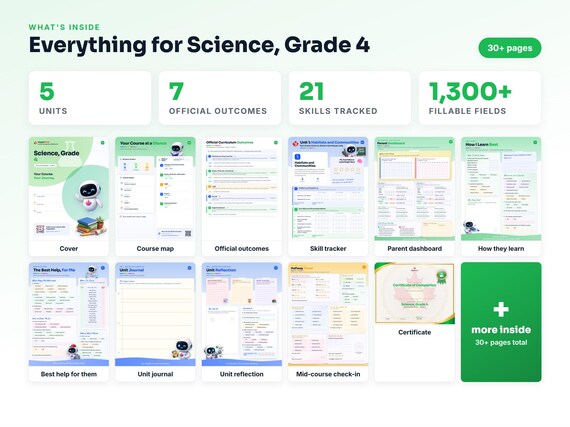
A Science, Grade 4 workbook worth keeping
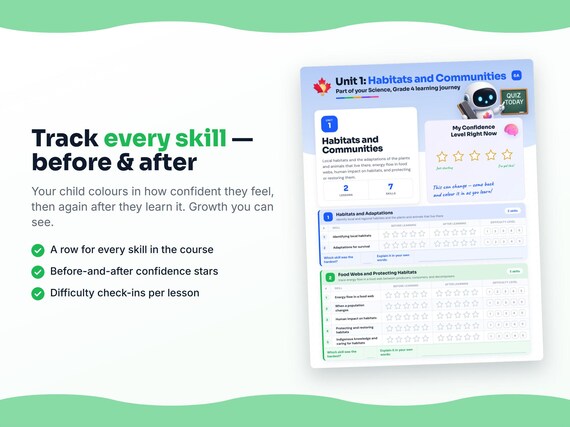
Built from the same official curriculum as this page. Before and after each skill above, your student colours in how sure they feel — so the two of you can see, on one page, what's clicking and what needs another look. It's a quiet way to follow how the year is really going.
By June it's full of their own handwriting: units worked through, confidence grown, a mid-year check-in, notes from parent-teacher night, and a certificate at the end. Less a worksheet, more a record of the year worth keeping on the shelf.
Instant download · see every page, reviews and the full description · five or more workbooks are $2.99 each
What it looks like in the app



Common questions
Can MapleMind help my child with Science, Grade 4?
Yes. MapleMind's AI tutor covers all 21 skills in Prince Edward Island's Science, Grade 4 — your child picks the exact skill, and the tutor teaches it step by step: a short lesson, a worked example, solving together, then a skill check to show it stuck.
Is MapleMind aligned to Prince Edward Island's official curriculum?
Yes. Every skill in this course maps to an official outcome code from Prince Edward Island's Grade 4 Science curriculum, and the ministry's own wording is quoted under each unit on this page — with the official government source linked so you can check it yourself.
What does MapleMind cost?
It's free to start — 5 tutoring chats and a practice quiz every day, no credit card. A Pro subscription ($9.99/month or $49.99/year CAD, 7-day free trial) unlocks unlimited tutoring, practice, and exam simulations.
What if my child is stuck on just one topic?
That's the point of skill-level tutoring: open Science, Grade 4 in the app, tap the exact skill from the list on this page, and the tutor teaches just that — no wading through lessons your child doesn't need.
Does MapleMind work in French or other languages?
Yes — 14 languages, including French. Both the app and the tutor's explanations switch to the language your child chooses.
Where can I see the official Prince Edward Island curriculum for Science, Grade 4?
The official source is linked on this page — Prince Edward Island's official curriculum. The outline here follows it: every MapleMind skill carries its official outcome code, and the ministry's own wording is quoted under each unit.
Keep exploring
Ready when you are
Pick a skill from this page and see it taught properly — free, in the browser, in under a minute.