Get help with Science, Grade 3
Most tutoring makes your child sit through material your child already knows. MapleMind flips that: pick the exact skill that's causing trouble — any of the 55 below — and the tutor teaches just that one, step by step, as many times as it takes. Ask questions in plain words, any time of day, in English, French, or 12 other languages.
The official Prince Edward Island Science, Grade 3 curriculum
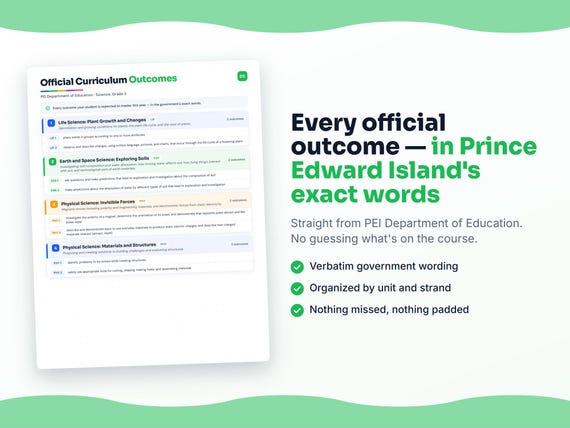
Prince Edward Island defines Science, Grade 3 by strands and outcomes. MapleMind teaches the same curriculum reorganized for one-skill-at-a-time tutoring — the table shows exactly where every official strand lands, and the ministry's own wording is quoted under each unit below.
Official source Prince Edward Island's official curriculumRead it on the government site — princeedwardisland.ca ↗| Official strand | Outcomes | Where MapleMind teaches it |
|---|---|---|
| Strand LS | 13 | Life Science: Plant Growth and Changes |
| ESS | 14 | Earth and Space Science: Exploring Soils |
| PS-IF | 14 | Physical Science: Invisible Forces |
| PS-MS | 14 | Physical Science: Materials and Structures |
Every skill below, taught one on one.
 Try the first session free
How MapleMind teaches Science, Grade 3 — every unit, lesson, and skill
Every skill below runs as a short session: a plain-words lesson, a worked example, solving it together, then a five-question skill check that earns up to three stars. Guided Mode keeps it teaching instead of answer-handing — turning it off needs a parent's password.
Unit 1Life Science: Plant Growth and ChangesOfficial strand · Strand LS
Germination and growing conditions for plants, the plant life cycle, and the uses of plants.
Germination and Growing Conditions
- Grouping seedssci3.1 — Place seeds in groups according to one or more attributes.
- Questions about growing conditionssci3.2 — Ask questions to investigate growing conditions for plants.
- Predicting best growing conditionssci3.3 — Make predictions about which conditions will be best for plant growth.
- Recording plant growthsci3.4 — Make and record observations and measurements of plant growth.
- Graphing plant growthsci3.5 — Construct and label bar graphs showing plant growth under different conditions.
- Inferring plant needssci3.6 — Draw inferences about plant life needs and how conditions affect plants.
- Parts of plants and their functionssci3.7 — Identify and describe parts of plants and their general functions.
- Explaining growth differencessci3.8 — Identify and suggest explanations for patterns in the growth of plants in different conditions.
The Life Cycle and Uses of Plants
- The life cycle of a plantsci3.9 — Observe and describe changes through the life cycle of a flowering plant.
- Estimating plant measurementssci3.10 — Estimate measurements of the plant as it grows.
- Why plants are importantsci3.11 — Describe ways plants are important to living things and the environment.
- Useful products from plantssci3.12 — Identify plant parts that give useful products and how supply is replenished.
- Sharing ideas about plant usessci3.13 — Respond to others' ideas about the uses and replenishing of plants.
The official wording — 13 outcomes in this unit
- sci3.1
place seeds in groups according to one or more attributes
- sci3.2
ask questions to investigate related to growing conditions for plants
- sci3.3
make predictions about which conditions will be the best for plant growth
- sci3.4
make and record relevant observations and measurements of plant growth during their investigations
- sci3.5
construct and label bar graphs that show plant growth under different conditions
- sci3.6
draw inferences that identify and investigate life needs of plants and describe how plants are affected by the conditions in which they grow
- sci3.7
identify and describe parts of plants and their general function
- sci3.8
identify and suggest explanations for patterns and discrepancies in the growth rate of similar plants grown in varying conditions
- sci3.9
observe and describe changes, using written language, pictures, and charts, that occur through the life cycle of a flowering plant
- sci3.10
estimate measurements of the plant as it grows
- sci3.11
describe ways in which plants are important to living things and the environment
- sci3.12
identify parts of different plants that provide humans with useful products, and describe the preparation that is required to obtain these products and how our supply of useful plants is replenished
- sci3.13
respond to the ideas and actions of others and acknowledge their ideas about the uses and replenishing of plants
Unit 2Earth and Space Science: Exploring SoilsOfficial strand · ESS
Investigating soil composition and water absorption, how moving water affects soil, how living things interact with soil, and technological uses of earth materials.
Investigating Soil Composition
- Questions about soil compositionsci3.14 — Ask questions and make predictions about the composition of soil.
- Describing different soilssci3.15 — Explore and describe a variety of soils and find similarities and differences.
- Investigating soil components with toolssci3.16 — Investigate and describe soil components using appropriate tools.
- Recording soil observationssci3.17 — Make and record observations and measurements about soil composition.
- Answering the soil questionsci3.18 — Propose an answer to the initial question about soil composition based on investigation.
Soil, Water, and Living Things
- Predicting water absorptionsci3.19 — Make predictions about the absorption of water by different types of soil.
- Graphing water absorptionsci3.20 — Construct and label bar graphs showing water absorbed by soil samples.
- Ordering soils by absorptionsci3.21 — Place containers of soil in order of their ability to absorb water.
- Sharing absorption resultssci3.22 — Communicate procedures and results of the water absorption investigation.
- Moving water and soilsci3.23 — Observe and describe the effects of moving water on different types of soil.
- Living things and soilssci3.24 — Investigate and describe how living things affect and are affected by soils.
- Making objects from earth materialssci3.25 — Demonstrate and describe ways of using earth materials to make useful objects.
- Finding out about soils and living thingssci3.26 — Use a variety of sources to gather information about how living things affect soils.
- Sharing ideas while making objectssci3.27 — Communicate questions, ideas, and intentions while using earth materials.
The official wording — 14 outcomes in this unit
- sci3.14
ask questions and make predictions that lead to exploration and investigation about the composition of soil
- sci3.15
explore and describe a variety of soils and find similarities and differences among them
- sci3.16
investigate and describe soil components using appropriate tools such as spoons, magnifying glasses, jars, and filters
- sci3.17
make and record observations and measurements in investigations related to soil composition
- sci3.18
propose an answer to initial question related to soil composition based on their investigations
- sci3.19
make predictions about the absorption of water by different types of soil that lead to exploration and investigation
- sci3.20
construct and label bar graphs to show the amount of water absorbed by the different soils samples
- sci3.21
place containers of soil in order of their ability to absorb water
- sci3.22
communicate procedures and results of investigations related to test water absorption of soils, using drawings, demonstrations, and/ or written and oral descriptions
- sci3.23
observe and describe the effects of moving water on different types of soil
- sci3.24
investigate and describe how living things affect and are affected by soils
- sci3.25
demonstrate and describe ways of using earth materials to make useful objects
- sci3.26
identify and use a variety of sources of science information to gather information about how living things affect and are affected by soils
- sci3.27
communicate questions, ideas, and intentions while using earth materials to make useful objects
Unit 3Physical Science: Invisible ForcesOfficial strand · PS-IF
Magnetic forces including polarity and magnetizing materials, and electrostatic forces from static electricity.
Magnetic Forces
- Magnet polessci3.28 — Investigate a magnet's polarity and that opposite poles attract and like poles repel.
- Sorting magnetic materialssci3.29 — Group materials that can be magnetized or are attracted by magnets versus those that are not.
- Magnetizing materialssci3.30 — Follow a procedure to make and test a temporary magnet.
- Problems about magnetizingsci3.31 — Identify problems to be solved related to magnetizing materials.
- Answering magnetizing questionssci3.32 — Propose answers to questions raised about magnetizing materials.
- Predicting magnet strengthsci3.33 — Make predictions about how many objects a magnet can pick up under different conditions.
- Recording magnet strengthsci3.34 — Record observations to identify conditions that affect a magnet's force.
- Uses of magnetssci3.35 — Identify familiar uses of magnets.
- Building a magnetic toysci3.36 — Construct and evaluate a toy moved by magnetic forces.
Static Electricity
- Producing static chargessci3.37 — Use everyday materials to produce static charges and describe how charged materials interact.
- Choosing materials to test staticsci3.38 — Identify materials and suggest ways to investigate conditions affecting static electricity.
- Recording static observationssci3.39 — Record observations and draw conclusions about conditions affecting static electricity.
- New questions about staticsci3.40 — Identify new questions from what was learned about static electricity.
- Static in daily lifesci3.41 — Describe effects of static electricity in daily life and how to use it safely or avoid it.
The official wording — 14 outcomes in this unit
- sci3.28
investigate the polarity of a magnet, determine the orientation of its poles, and demonstrate that opposite poles attract and like poles repel
- sci3.29
investigate to identify and group materials that can be magnetized and materials that are attracted by magnets, and distinguish these from materials that are not attracted to magnets
- sci3.30
follow a simple procedure where instructions are given one step at a time to increase and test the strength of a temporary magnet by stroking it or storing it next to a stronger magnet
- sci3.31
identify problems to be solved related to magnetizing materials
- sci3.32
propose answers to questions raised related to magnetizing materials
- sci3.33
make predictions about the number of objects that can be picked up by a magnet under different conditions
- sci3.34
make and record relevant observations in investigations on the number of objects that can be picked up by a magnet under different conditions, and use the observations to identify conditions that affect the force of magnets
- sci3.35
identify familiar uses of magnets
- sci3.36
in cooperative groups, construct and evaluate a toy that is moved by attractive or repulsive magnetic forces
- sci3.37
describe and demonstrate ways to use everyday materials to produce static electric charges, and describe how charged materials interact (attract, repel)
- sci3.38
identify materials to be used to investigate conditions affecting the force of static electricity, and suggest ways to use them in their investigations
- sci3.39
make and record relevant observations in investigations related to identify conditions that affect the force of static electricity, and draw simple conclusions that identify these conditions
- sci3.40
identify new questions from what has been learned about static electricity
- sci3.41
describe examples of the effects of static electricity in their daily lives, and identify ways in which static electricity can be used safely or avoided
Unit 4Physical Science: Materials and StructuresOfficial strand · PS-MS
Proposing and creating solutions to building challenges and evaluating structures.
Proposing Building Solutions
- Identifying building problemssci3.42 — Identify problems to be solved while creating structures.
- Properties and suitability of materialssci3.43 — Describe properties of common materials and evaluate their suitability for building.
- Joining materialssci3.44 — Investigate ways to join materials and identify the most appropriate methods.
- Strong shapes in structuressci3.45 — Identify shapes in natural and human-built structures and how they give strength.
- Planning which materials to usesci3.46 — Identify materials to solve a building problem and plan how to use them.
Building and Evaluating Structures
- Using tools safelysci3.47 — Safely use tools for cutting, shaping, making holes, and assembling materials.
- Following safety rulessci3.48 — Follow safety procedures while building and explain why they are needed.
- Estimating and selecting materialssci3.49 — Estimate measurements to select the required materials for a structure.
- Building the structuresci3.50 — Manipulate materials purposefully to create the structure.
- Working with a partnersci3.51 — Respond to a partner's ideas and make changes to the structure as needed.
- Testing and improving strengthsci3.52 — Test the strength and stability of a structure and identify ways to improve it.
- Finding weak partssci3.53 — Identify materials or parts of a structure that failed and suggest why.
- Judging a structuresci3.54 — Evaluate whether simple structures are effective, efficient, and appropriate.
- Illustrating the building processsci3.55 — Illustrate the construction process and describe the structure built.
The official wording — 14 outcomes in this unit
- sci3.42
identify problems to be solved while creating structures
- sci3.43
describe the properties of some common materials, and evaluate their suitability for use in building structures
- sci3.44
investigate ways to join materials and identify the most appropriate methods for the materials to be joined
- sci3.45
identify shapes that are part of natural and human-built structures, and describe ways these shapes help provide strength, stability, or balance
- sci3.46
identify materials that could be used to solve the problem posed, and suggest a plan for how they will be used
- sci3.47
safely use appropriate tools for cutting, shaping, making holes, and assembling materials
- sci3.48
follow given safety procedures and rules while constructing structures and explain why they are needed
- sci3.49
estimate measurements in order to select the required materials for the structure
- sci3.50
manipulate materials purposefully in order to create the structure
- sci3.51
respond to the ideas of partners while constructing the structure, acknowledge their ideas and contributions, and make changes in the structure as deemed necessary
- sci3.52
test the strength and stability of personally built structures, and identify ways of modifying a structure to increase its strength, stability, form and function
- sci3.53
identify materials or parts of a structure that failed and suggest why
- sci3.54
evaluate simple structures to determine if they are effective and safe, if they make efficient use of materials, and if they are appropriate to the user and the environment
- sci3.55
illustrate their construction process, using drawings with explanations, demonstrations, and written and/or oral descriptions, and describe the structures and components of structures they have built
Printable workbook · A keepsake of the year
A Science, Grade 3 workbook worth keeping
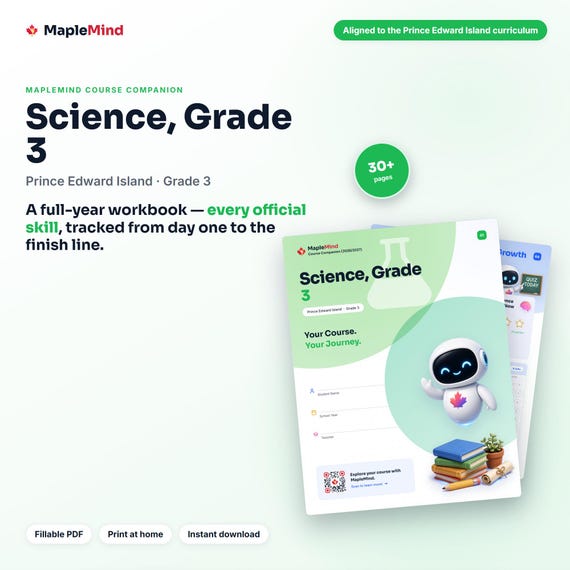
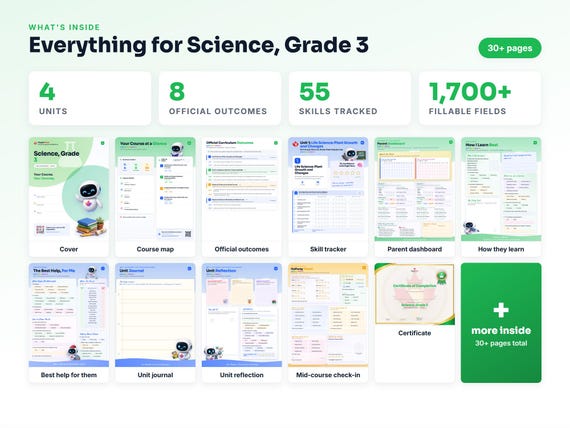
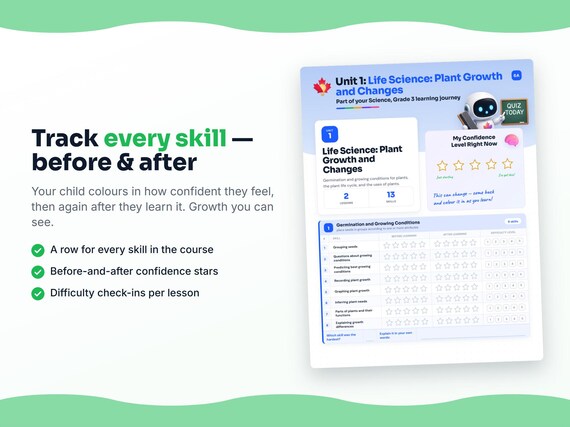
Built from the same official curriculum as this page. Before and after each skill above, your student colours in how sure they feel — so the two of you can see, on one page, what's clicking and what needs another look. It's a quiet way to follow how the year is really going.
By June it's full of their own handwriting: units worked through, confidence grown, a mid-year check-in, notes from parent-teacher night, and a certificate at the end. Less a worksheet, more a record of the year worth keeping on the shelf.
Instant download · see every page, reviews and the full description · five or more workbooks are $2.99 each
What it looks like in the app



Common questions
Can MapleMind help my child with Science, Grade 3?
Yes. MapleMind's AI tutor covers all 55 skills in Prince Edward Island's Science, Grade 3 — your child picks the exact skill, and the tutor teaches it step by step: a short lesson, a worked example, solving together, then a skill check to show it stuck.
Is MapleMind aligned to Prince Edward Island's official curriculum?
Yes. Every skill in this course maps to an official outcome code from Prince Edward Island's Grade 3 Science curriculum, and the ministry's own wording is quoted under each unit on this page — with the official government source linked so you can check it yourself.
What does MapleMind cost?
It's free to start — 5 tutoring chats and a practice quiz every day, no credit card. A Pro subscription ($9.99/month or $49.99/year CAD, 7-day free trial) unlocks unlimited tutoring, practice, and exam simulations.
What if my child is stuck on just one topic?
That's the point of skill-level tutoring: open Science, Grade 3 in the app, tap the exact skill from the list on this page, and the tutor teaches just that — no wading through lessons your child doesn't need.
Does MapleMind work in French or other languages?
Yes — 14 languages, including French. Both the app and the tutor's explanations switch to the language your child chooses.
Where can I see the official Prince Edward Island curriculum for Science, Grade 3?
The official source is linked on this page — Prince Edward Island's official curriculum. The outline here follows it: every MapleMind skill carries its official outcome code, and the ministry's own wording is quoted under each unit.
Keep exploring
Ready when you are
Pick a skill from this page and see it taught properly — free, in the browser, in under a minute.