Get help with Science, Grade 2
Most tutoring makes your child sit through material your child already knows. MapleMind flips that: pick the exact skill that's causing trouble — any of the 55 below — and the tutor teaches just that one, step by step, as many times as it takes. Ask questions in plain words, any time of day, in English, French, or 12 other languages.
The official Prince Edward Island Science, Grade 2 curriculum
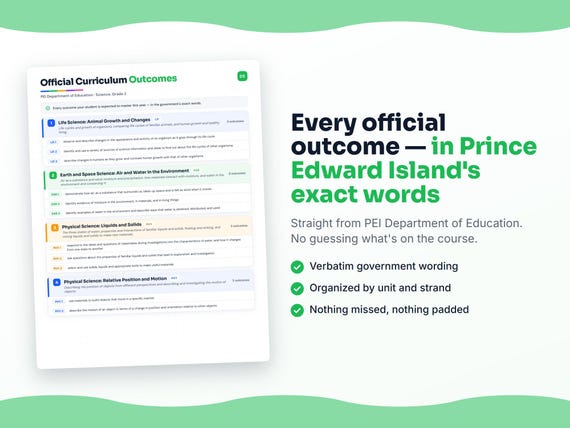
Prince Edward Island defines Science, Grade 2 by strands and outcomes. MapleMind teaches the same curriculum reorganized for one-skill-at-a-time tutoring — the table shows exactly where every official strand lands, and the ministry's own wording is quoted under each unit below.
Official source Prince Edward Island's official curriculumRead it on the government site — princeedwardisland.ca ↗| Official strand | Outcomes | Where MapleMind teaches it |
|---|---|---|
| Strand LS | 16 | Life Science: Animal Growth and Changes |
| ESS | 14 | Earth and Space Science: Air and Water in the Environment |
| PS-LS | 15 | Physical Science: Liquids and Solids |
| PS-PM | 10 | Physical Science: Relative Position and Motion |
Every skill below, taught one on one.
 Try the first session free
How MapleMind teaches Science, Grade 2 — every unit, lesson, and skill
Every skill below runs as a short session: a plain-words lesson, a worked example, solving it together, then a five-question skill check that earns up to three stars. Guided Mode keeps it teaching instead of answer-handing — turning it off needs a parent's password.
Unit 1Life Science: Animal Growth and ChangesOfficial strand · Strand LS
Life cycles and growth of organisms, comparing life cycles of familiar animals, and human growth and healthy living.
Watching an Organism's Life Cycle
- Changes through a life cyclesci2.1 — Observe and describe how an organism's appearance and activity change as it goes through its life cycle.
- Setting up an observationsci2.2 — Select and use materials to carry out an exploration observing an organism's life cycle.
- Asking questions about an organismsci2.3 — Ask questions about an organism's needs and growth that lead to exploration.
- Recording what we observesci2.4 — Record observations of an organism's changes using written language and charts.
- Constant and changing traitssci2.5 — Identify which traits stay the same and which change as an organism grows.
- Sharing ideas about an organismsci2.6 — Respond to other students' ideas about an organism's needs and growth.
- Naming the stages of developmentsci2.7 — Recognize the stages of an organism's development using proper terms.
- Meeting needs and drawing conclusionssci2.8 — Propose ways to meet an organism's needs and draw conclusions from observations.
- Communicating the investigationsci2.9 — Communicate the procedures and results of the life-cycle investigation.
- New questions to exploresci2.10 — Identify new questions about the needs and growth of other organisms.
Comparing Life Cycles
- Finding out about life cyclessci2.11 — Use a variety of sources to find out about the life cycles of other organisms.
- Comparing and grouping life cyclessci2.12 — Compare the life cycles of familiar animals and group them by similarities and differences.
- Environments that support animalssci2.13 — Describe natural and human-made environments that support familiar animals' health and growth.
- Predicting life-cycle stagessci2.14 — Predict the stages in a life cycle based on a pattern seen in a similar organism.
Human Growth and Development
- How humans grow and changesci2.15 — Describe changes in humans as they grow and contrast with other organisms.
- Food groups and healthy choicessci2.16 — Identify the basic food groups and describe choices that support a healthy lifestyle.
The official wording — 16 outcomes in this unit
- sci2.1
observe and describe changes in the appearance and activity of an organism as it goes through its life cycle
- sci2.2
select and use materials to carry out their own explorations for observing the life cycle of an organism
- sci2.3
ask questions about an organism’s needs and changes in growth patterns that lead to exploration and investigation
- sci2.4
record relevant observations of changes in the appearance and activity of an organism as it goes through its life cycle, using written language, and/or charts
- sci2.5
identify constant and changing traits in organisms as they grow and develop
- sci2.6
respond to other students’ ideas about an organism’s needs and changes in growth patterns
- sci2.7
recognize the stages of development of the organism, using applicable terminology and language
- sci2.8
propose suggestions for meeting the needs of the organism being investigated, and draw conclusions about its growth patterns or stages based on observations
- sci2.9
communicate procedures and results of the investigation into the life cycle of an organism, using drawings, demonstrations, and/or written and oral descriptions
- sci2.10
identify new questions about the needs and growth patterns of other organisms
- sci2.11
identify and use a variety of sources of science information and ideas to find out about the life cycles of other organisms
- sci2.12
compare the life cycles of familiar animals and group them according to the similarities and differences of their life cycles
- sci2.13
describe features of natural and human- made environments that support the health and growth of some familiar animals
- sci2.14
make predictions about the stages in a life cycle of an organism, based on an observed pattern of stages in a similar organism
- sci2.15
describe changes in humans as they grow, and contrast human growth with that of other organisms
- sci2.16
identify the basic food groups and describe actions and decisions that support a healthy lifestyle
Unit 2Earth and Space Science: Air and Water in the EnvironmentOfficial strand · ESS
Air as a substance and wind, moisture and precipitation, how materials interact with moisture, and water in the environment and conserving it.
Air and Wind
- Air takes up spacesci2.17 — Demonstrate that air is a substance that surrounds us, takes up space, and is felt as wind.
- Questions and ideas about airsci2.18 — Communicate questions and ideas about air while exploring.
- Measuring windsci2.19 — Use tools to build a device to measure the speed and direction of wind.
- Observing air conditionssci2.20 — Observe and describe changes in air conditions indoors and outdoors.
Moisture and Materials
- Evidence of moisturesci2.21 — Identify evidence of moisture in the environment, materials, and living things.
- Measuring precipitationsci2.22 — Use tools to measure the amount of precipitation over time.
- Changes in moisturesci2.23 — Describe changes in the location, amount, and form of moisture and what affects them.
- Questions about materials and moisturesci2.24 — Ask questions to investigate how materials interact with moisture.
- Testing absorbency and waterproofingsci2.25 — Predict and test which materials are more absorbent, waterproof, or dry quickly.
- Ordering materials by water responsesci2.26 — Put tested materials in order by their ability to absorb, repel, or dry.
- Sharing material test resultssci2.27 — Communicate the procedures and results of testing materials.
- Weather and protecting thingssci2.28 — Describe the effects of weather and ways to protect things in different conditions.
Protecting Our Water Sources
- Water in the environmentsci2.29 — Identify examples of water in the environment and how it is obtained and used.
- Clean water and conserving itsci2.30 — Identify the importance of clean water and suggest ways to conserve it.
The official wording — 14 outcomes in this unit
- sci2.17
demonstrate how air, as a substance that surrounds us, takes up space and is felt as wind when it moves
- sci2.18
communicate questions and ideas about air while conducting explorations
- sci2.19
use appropriate tools in constructing a device to measure the speed and direction wind
- sci2.20
observe changes in air conditions in indoor and outdoor environments, and describe and interpret these changes
- sci2.21
identify evidence of moisture in the environment, in materials, and in living things
- sci2.22
use appropriate tools to measure amount of precipitation for a period of time
- sci2.23
describe changes in the location, amount, and form of moisture, and investigate and identify conditions that can affect these changes
- sci2.24
ask questions to investigate how various materials interact with moisture
- sci2.25
make predictions about which materials are more absorbent, or waterproof, or dry more quickly, and select and use materials and tools to test their predictions
- sci2.26
put tested materials in a sequence according to their ability to absorb water, be waterproof, and/or dry
- sci2.27
communicate the procedures and results of their tests of materials, using drawings, notes, and/or oral descriptions
- sci2.28
describe the effects of weather and ways to protect things under different weather conditions
- sci2.29
identify examples of water in the environment and describe ways that water is obtained, distributed, and used
- sci2.30
identify the importance of clean water for humans, and suggest ways they could conserve water
Unit 3Physical Science: Liquids and SolidsOfficial strand · PS-LS
The three states of water, properties and interactions of familiar liquids and solids, floating and sinking, and mixing liquids and solids to make new materials.
The Three States of Water
- Sharing ideas about watersci2.31 — Respond to classmates' ideas and questions about water and how it changes state.
- Ice, water, and water vapoursci2.32 — Describe the three states of water and predict changes from one state to another.
Properties of Liquids and Solids
- Questions about liquids and solidssci2.33 — Ask questions about the properties of familiar liquids and solids.
- Comparing propertiessci2.34 — Investigate and compare properties of familiar liquids and solids.
- Interactions of liquids and solidssci2.35 — Investigate and describe how familiar liquids and solids interact.
- Recording interactionssci2.36 — Make and record observations during investigations of liquids and solids.
- Grouping floating and sinkingsci2.37 — Group objects by the type of liquid in which they float or sink.
- Solving a floating problemsci2.38 — Show understanding of floating and sinking by solving a practical problem.
- Comparing floating solutionssci2.39 — Compare and evaluate solutions to a floating-and-sinking problem.
- Sharing the floating solutionsci2.40 — Communicate the procedures used to solve the floating-and-sinking problem.
Mixing to Make New Materials
- Choosing materials and toolssci2.41 — Select and use solids, liquids, and tools to make useful materials.
- Sharing ideas while mixingsci2.42 — Communicate questions, ideas, and intentions while mixing materials.
- Making a new materialsci2.43 — Investigate mixing materials to create a new material with different characteristics.
- Getting ideas from sourcessci2.44 — Use a variety of sources to get ideas for creating new materials.
- Using materials to stay clean and healthysci2.45 — Describe how knowledge of solids and liquids helps keep a clean, healthy environment.
The official wording — 15 outcomes in this unit
- sci2.31
respond to the ideas and questions of classmates during investigations into the characteristics of water, and how it changes from one state to another
- sci2.32
describe the characteristics of the three states of water (ice, water, water vapor) and predict changes from one state to another
- sci2.33
ask questions about the properties of familiar liquids and solids that lead to exploration and investigation
- sci2.34
investigate and compare properties of familiar liquids and solids
- sci2.35
investigate and describe the interactions of familiar liquids and solids
- sci2.36
make and record relevant observations during investigations of interactions of liquids and solids, using written language, pictures, and charts
- sci2.37
place objects in groups according to the type of liquid in which they will float or sink
- sci2.38
demonstrate an understanding of sinking and floating objects by identifying and solving a related practical problem
- sci2.39
compare and evaluate solutions to the practical problem related to sinking and floating
- sci2.40
communicate procedures used to solve the practical problem related to sinking and floating, using drawings, demonstrations, and written and/or oral descriptions
- sci2.41
select and use solids, liquids and appropriate tools to make useful materials
- sci2.42
communicate questions, ideas, and intentions to classmates while mixing and combining liquids and solids to form new and useful materials
- sci2.43
investigate mixing materials to create a new material with characteristics that are different from the original components
- sci2.44
identify and use a variety of sources to get ideas for creating new materials
- sci2.45
describe and demonstrate ways we use our knowledge of solids and liquids to maintain a clean and healthy environment
Unit 4Physical Science: Relative Position and MotionOfficial strand · PS-PM
Describing the position of objects from different perspectives and describing and investigating the motion of objects.
Position
- Building objects that movesci2.46 — Use materials to build objects that move in a specific manner.
- Describing an object's positionsci2.47 — Describe an object's position relative to other objects using position words.
- Position from different viewssci2.48 — Describe the position of objects from different perspectives.
- Working out accurate descriptionssci2.49 — Identify questions about differing perspectives and cooperate to make accurate descriptions.
Motion
- Describing motionsci2.50 — Describe the motion of an object as a change in position and orientation.
- Following movement instructionssci2.51 — Follow a simple procedure to move a person or object in a certain way.
- Questions about what affects motionsci2.52 — Ask questions about factors affecting an object's motion and identify factors to investigate.
- Predicting how factors affect motionsci2.53 — Make predictions about how various factors will affect an object's motion.
- Testing motion with toolssci2.54 — Use terms like faster and slower and tools to test motion predictions.
- Comparing how objects movesci2.55 — Compare and evaluate the ability of a constructed object to move.
The official wording — 10 outcomes in this unit
- sci2.46
use materials to build objects that move in a specific manner
- sci2.47
describe the position of an object relative to other objects, using language such as “to the left of”, “on top”, “beside”, or “two giant steps behind”, or to an identified space, and place an object in an identified position
- sci2.48
describe the position of objects from different perspectives
- sci2.49
identify questions that arise about how different students view the same object from different perspectives, and cooperate with these students to make up accurate descriptions
- sci2.50
describe the motion of an object in terms of a change in position and orientation relative to other objects
- sci2.51
follow a simple procedure where instructions are given to move a person or object in a certain way, or in a specified direction
- sci2.52
ask questions about the factors that affect the motion of an object, and identify factors to investigate
- sci2.53
make predictions about how various factors will affect the motion of an object
- sci2.54
use terms like “faster” or “slower”, and tools such as rulers, string and stopwatches to test these predictions
- sci2.55
compare and evaluate the abilities of their constructed object to move
Printable workbook · A keepsake of the year
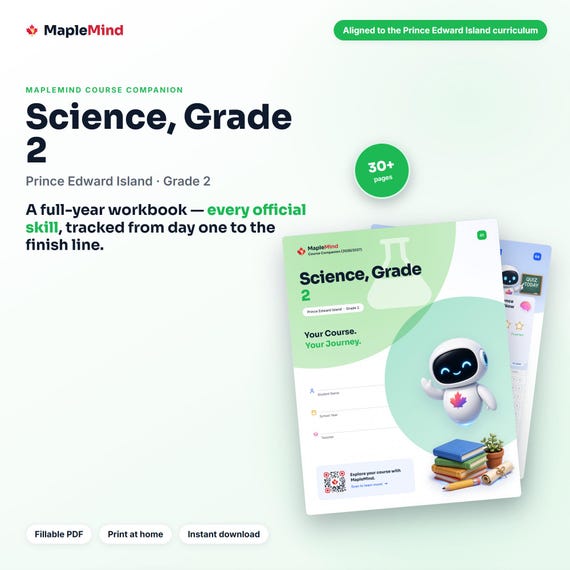
A Science, Grade 2 workbook worth keeping
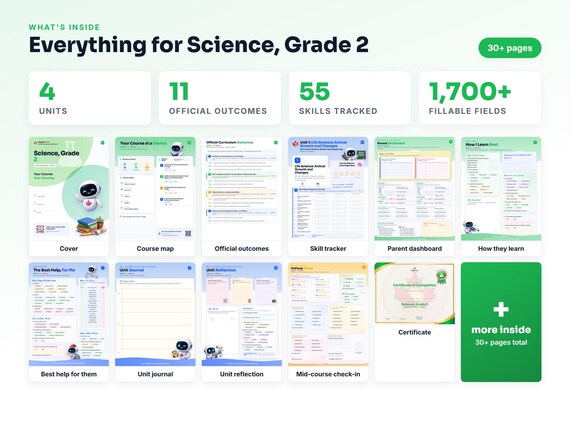
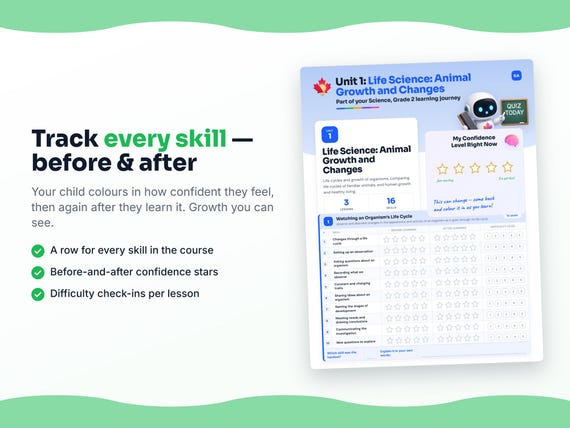
Built from the same official curriculum as this page. Before and after each skill above, your student colours in how sure they feel — so the two of you can see, on one page, what's clicking and what needs another look. It's a quiet way to follow how the year is really going.
By June it's full of their own handwriting: units worked through, confidence grown, a mid-year check-in, notes from parent-teacher night, and a certificate at the end. Less a worksheet, more a record of the year worth keeping on the shelf.
Instant download · see every page, reviews and the full description · five or more workbooks are $2.99 each
What it looks like in the app
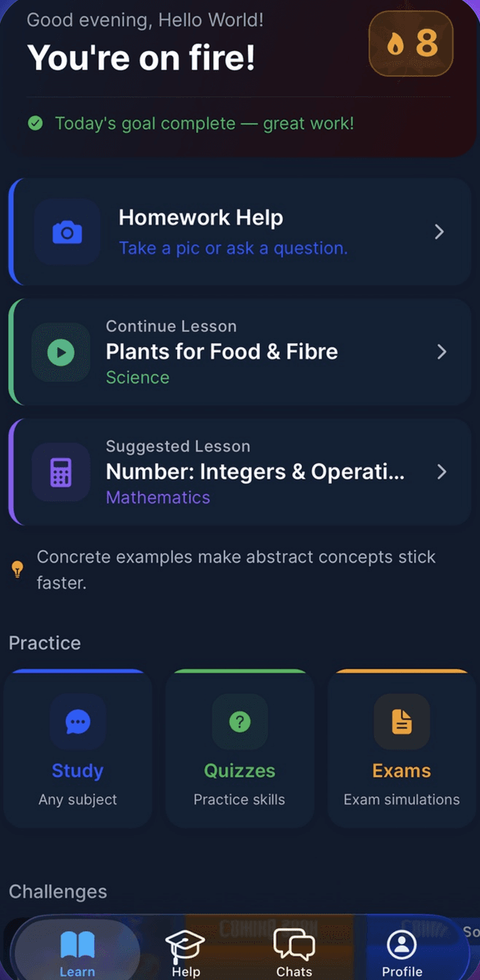
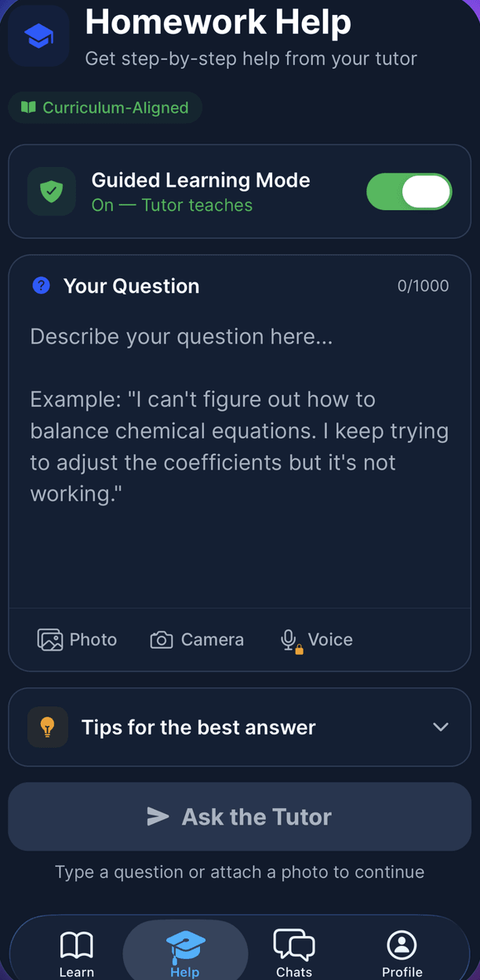
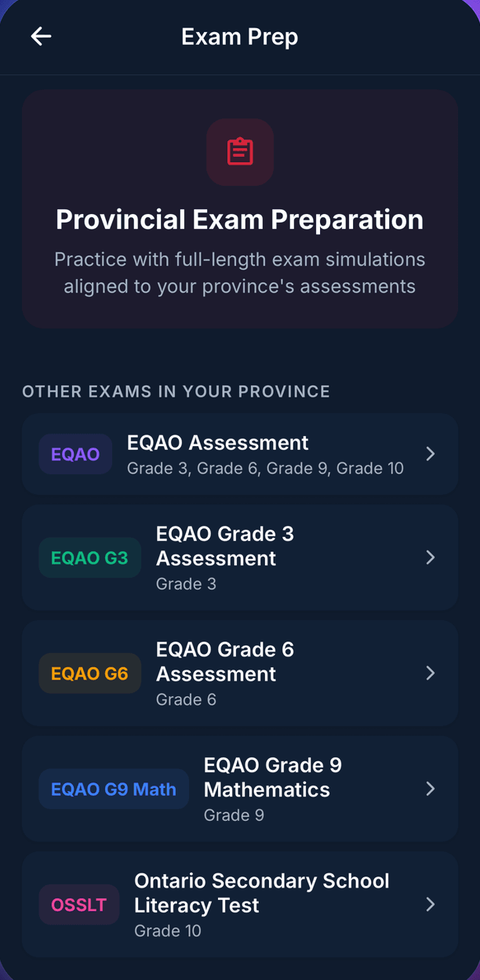
Common questions
Can MapleMind help my child with Science, Grade 2?
Yes. MapleMind's AI tutor covers all 55 skills in Prince Edward Island's Science, Grade 2 — your child picks the exact skill, and the tutor teaches it step by step: a short lesson, a worked example, solving together, then a skill check to show it stuck.
Is MapleMind aligned to Prince Edward Island's official curriculum?
Yes. Every skill in this course maps to an official outcome code from Prince Edward Island's Grade 2 Science curriculum, and the ministry's own wording is quoted under each unit on this page — with the official government source linked so you can check it yourself.
What does MapleMind cost?
It's free to start — 5 tutoring chats and a practice quiz every day, no credit card. A Pro subscription ($9.99/month or $49.99/year CAD, 7-day free trial) unlocks unlimited tutoring, practice, and exam simulations.
What if my child is stuck on just one topic?
That's the point of skill-level tutoring: open Science, Grade 2 in the app, tap the exact skill from the list on this page, and the tutor teaches just that — no wading through lessons your child doesn't need.
Does MapleMind work in French or other languages?
Yes — 14 languages, including French. Both the app and the tutor's explanations switch to the language your child chooses.
Where can I see the official Prince Edward Island curriculum for Science, Grade 2?
The official source is linked on this page — Prince Edward Island's official curriculum. The outline here follows it: every MapleMind skill carries its official outcome code, and the ministry's own wording is quoted under each unit.
Keep exploring
Ready when you are
Pick a skill from this page and see it taught properly — free, in the browser, in under a minute.