Get help with Science, Grade 1
Most tutoring makes your child sit through material your child already knows. MapleMind flips that: pick the exact skill that's causing trouble — any of the 18 below — and the tutor teaches just that one, step by step, as many times as it takes. Ask questions in plain words, any time of day, in English, French, or 12 other languages.
The official Prince Edward Island Science, Grade 1 curriculum
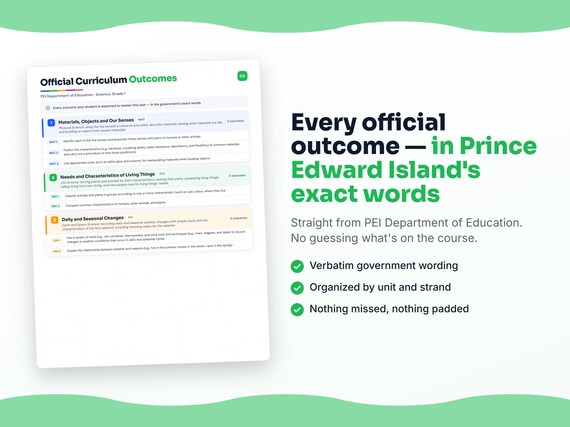
Prince Edward Island defines Science, Grade 1 by strands and outcomes. MapleMind teaches the same curriculum reorganized for one-skill-at-a-time tutoring — the table shows exactly where every official strand lands, and the ministry's own wording is quoted under each unit below.
Official source Prince Edward Island's official curriculumRead it on the government site — princeedwardisland.ca ↗| Official strand | Outcomes | Where MapleMind teaches it |
|---|---|---|
| Strand PS | 8 | Materials, Objects and Our Senses |
| Strand LS | 5 | Needs and Characteristics of Living Things |
| ESS | 5 | Daily and Seasonal Changes |
Every skill below, taught one on one.
 Try the first session free
How MapleMind teaches Science, Grade 1 — every unit, lesson, and skill
Every skill below runs as a short session: a plain-words lesson, a worked example, solving it together, then a five-question skill check that earns up to three stars. Guided Mode keeps it teaching instead of answer-handing — turning it off needs a parent's password.
Unit 1Materials, Objects and Our SensesOfficial strand · Strand PS
Physical Science: using the five senses to observe and safely describe materials, testing what materials are like, and building an object from reused materials.
Using Our Senses
- The five sensessci1.PS1.C1 — Name the five senses and the body part that goes with each.
- Describing words for each sensesci1.PS1.C2 — Use describing words to tell what each sense notices, like smooth, loud, or sweet.
- Senses keep us safesci1.PS1.C3 — Explain how the senses help us use materials safely and notice danger.
What Materials Are Like
- Predicting and testing materialssci1.PS2.C1 — Predict a material's characteristics and carry out a test to check.
- Material and objectsci1.PS2.C2 — Tell the difference between the material something is made of and the object itself.
Building From Reused Materials
- Using safe tools to buildsci1.PS3.C1 — Use safe tools like glue and scissors to join materials when building.
- Reduce, reuse, recyclesci1.PS3.C2 — Show ways to reduce, reuse, and recycle materials while learning.
- Designing and building a productsci1.PS3.C3 — Create a working product by safely choosing, combining, and changing materials.
The official wording — 8 outcomes in this unit
- sci1.PS1.C1
Identify each of the five senses and associate those senses with parts of humans or other animals
- sci1.PS1.C2
Identify characteristics used to describe the range of observations related to each sense (such as: smooth, rough, bright, dull, sour, sweet, loud, quiet
- sci1.PS1.C3
Recognize how each of the senses helps us to identify, describe, and safely use materials, and recognize potential dangers in the environment
- sci1.PS2.C1
Predict the characteristics (e.g., hardness, insulating ability, water resistance, absorbency, and flexibility) of common materials and carry out a procedure to test those predictions
- sci1.PS2.C2
Distinguish between the materials used to construct an object and the object itself
- sci1.PS3.C1
Use appropriate tools, such as safety glue and scissors, for manipulating materials when building objects
- sci1.PS3.C2
Demonstrate ways to reduce, reuse, and recycle materials during classroom learning experiences
- sci1.PS3.C3
Create a product that is functional and aesthetically pleasing to the user by safely selecting, combining, and modifying materials
Unit 2Needs and Characteristics of Living ThingsOfficial strand · Strand LS
Life Science: sorting plants and animals by their characteristics, naming their parts, comparing living things, telling living from non-living, and how people care for living things' needs.
What Makes Living Things Unique
- Sorting plants and animalssci1.LS1.C1 — Group animals and plants by a characteristic like size, colour, or where they live.
- Naming parts of living thingssci1.LS1.C2 — Use common terms for the parts of humans, animals, and plants.
Needs of Living Things
- Comparing living thingssci1.LS2.C1 — Compare common characteristics of humans, other animals, and plants.
- Living and non-livingsci1.LS2.C2 — Observe similarities and differences between living and non-living things.
- Caring for living thingssci1.LS2.C3 — Describe how people use what they know to meet living things' needs.
The official wording — 5 outcomes in this unit
- sci1.LS1.C1
Classify animals and plants in groups according to one or more characteristic (such as: size, colour, where they live
- sci1.LS1.C2
Identify and use common terms for parts of humans, other animals, and plants
- sci1.LS2.C1
Compare common characteristics of humans, other animals, and plants
- sci1.LS2.C2
Observe and identify similarities and differences in living and non-living things
- sci1.LS2.C3
Describe ways that humans use their knowledge of living things in meeting their own needs and the needs of plants and animals
Unit 3Daily and Seasonal ChangesOfficial strand · ESS
Earth and Space Science: recording daily and seasonal weather changes with simple tools, and the characteristics of the four seasons, including dressing safely for the weather.
Watching the Weather Change
- Tools for recording weathersci1.ESS1.C1 — Use simple tools and charts to record daily and seasonal weather.
- Changes through the seasonssci1.ESS1.C2 — Illustrate changes in the environment across the seasons.
The Four Seasons
- Weather and the seasonssci1.ESS2.C1 — Explain how the weather is connected to each season.
- Predicting weather for a seasonsci1.ESS2.C2 — Predict the kind of weather a season will bring, based on patterns you have noticed.
- Dressing safely for the weathersci1.ESS2.C3 — Explain how to dress for the weather and why it keeps us safe.
The official wording — 5 outcomes in this unit
- sci1.ESS1.C1
Use a variety of tools (e.g., rain container, thermometer, and wind sock and techniques (e.g., chart, diagram, and table) to record changes in weather conditions that occur in daily and seasonal cycles
- sci1.ESS1.C2
Illustrate and record changes that occur in the environment throughout the seasons (e.g., flowers blooming, snow melting, leaves falling, puddles freezing)
- sci1.ESS2.C1
Explain the relationship between weather and seasons (e.g., hot in the summer, snows in the winter, rains in the spring)
- sci1.ESS2.C2
Predict the types of weather for a certain season, based on their observations of the patterns of weather during the year (e.g., length of day, type of precipitation, temperature)
- sci1.ESS2.C3
Explain safety procedures related to dressing appropriately for the weather and why they are needed (e.g., wearing hats and mitts in the winter, rain gear when it is raining)
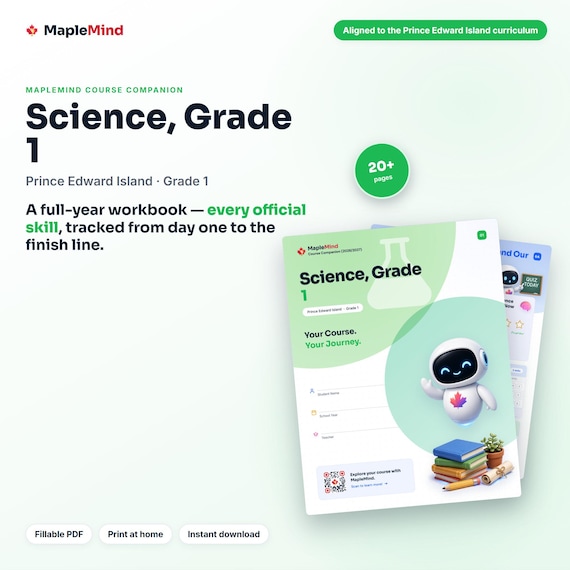
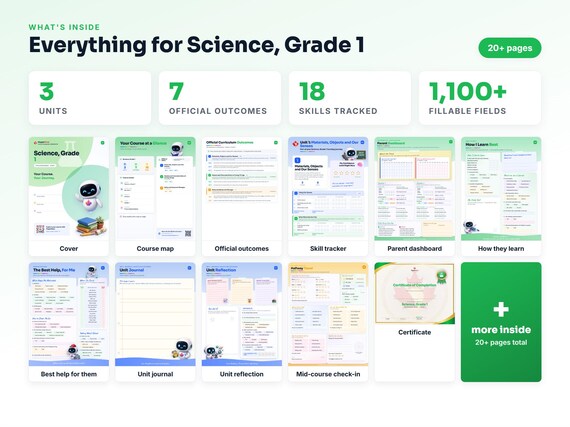
Printable workbook · A keepsake of the year
A Science, Grade 1 workbook worth keeping
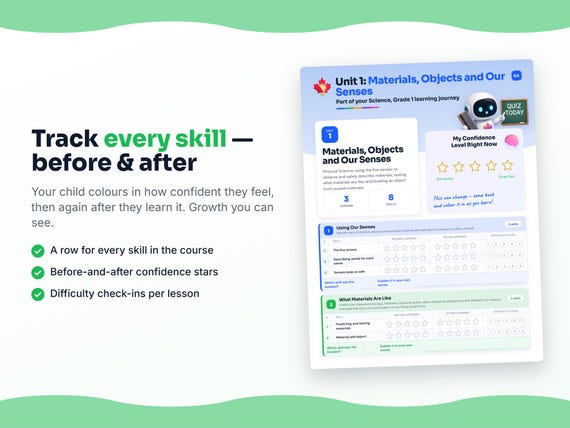
Built from the same official curriculum as this page. Before and after each skill above, your student colours in how sure they feel — so the two of you can see, on one page, what's clicking and what needs another look. It's a quiet way to follow how the year is really going.
By June it's full of their own handwriting: units worked through, confidence grown, a mid-year check-in, notes from parent-teacher night, and a certificate at the end. Less a worksheet, more a record of the year worth keeping on the shelf.
Instant download · see every page, reviews and the full description · five or more workbooks are $2.99 each
What it looks like in the app
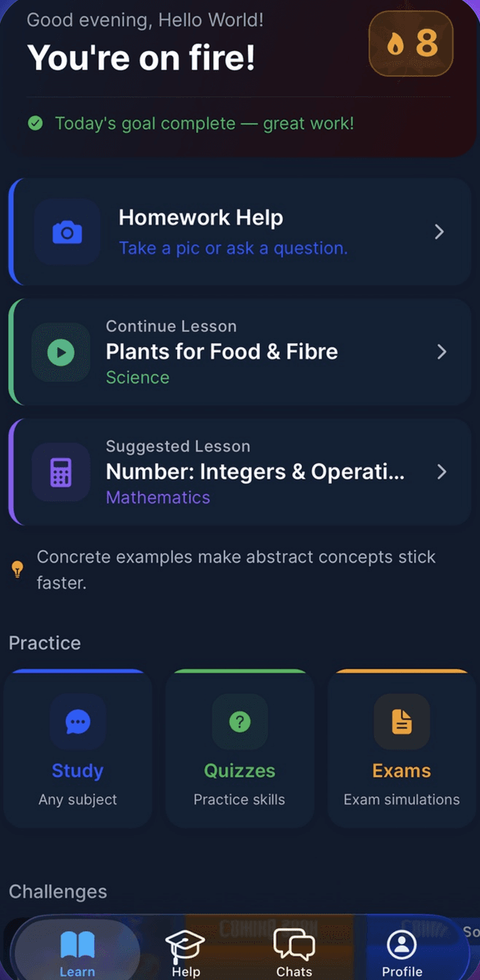
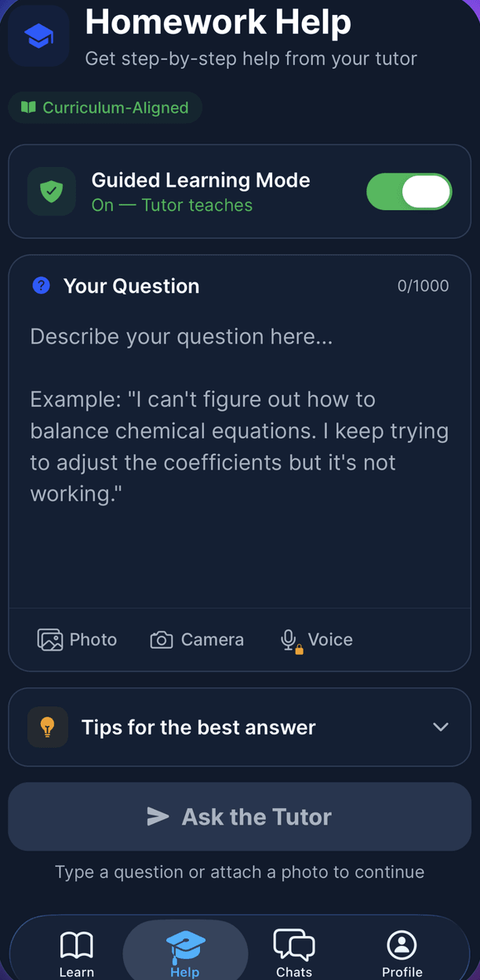
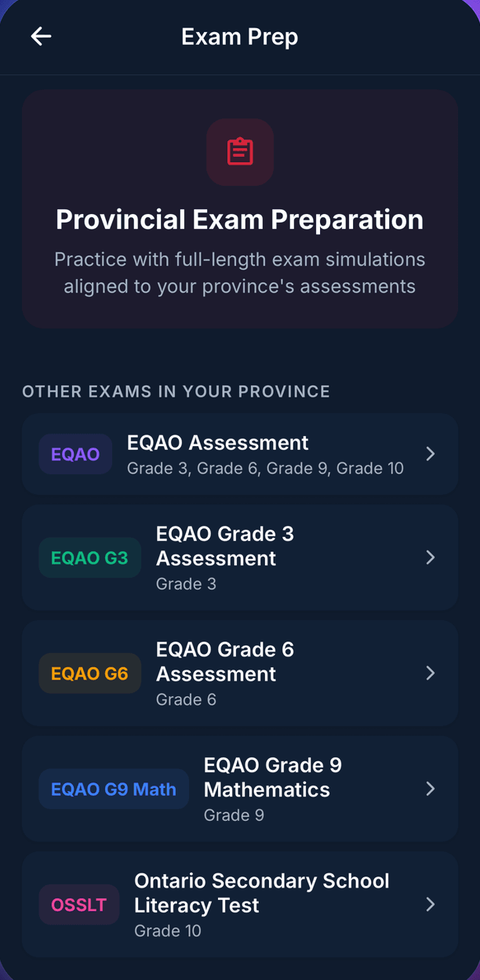
Common questions
Can MapleMind help my child with Science, Grade 1?
Yes. MapleMind's AI tutor covers all 18 skills in Prince Edward Island's Science, Grade 1 — your child picks the exact skill, and the tutor teaches it step by step: a short lesson, a worked example, solving together, then a skill check to show it stuck.
Is MapleMind aligned to Prince Edward Island's official curriculum?
Yes. Every skill in this course maps to an official outcome code from Prince Edward Island's Grade 1 Science curriculum, and the ministry's own wording is quoted under each unit on this page — with the official government source linked so you can check it yourself.
What does MapleMind cost?
It's free to start — 5 tutoring chats and a practice quiz every day, no credit card. A Pro subscription ($9.99/month or $49.99/year CAD, 7-day free trial) unlocks unlimited tutoring, practice, and exam simulations.
What if my child is stuck on just one topic?
That's the point of skill-level tutoring: open Science, Grade 1 in the app, tap the exact skill from the list on this page, and the tutor teaches just that — no wading through lessons your child doesn't need.
Does MapleMind work in French or other languages?
Yes — 14 languages, including French. Both the app and the tutor's explanations switch to the language your child chooses.
Where can I see the official Prince Edward Island curriculum for Science, Grade 1?
The official source is linked on this page — Prince Edward Island's official curriculum. The outline here follows it: every MapleMind skill carries its official outcome code, and the ministry's own wording is quoted under each unit.
Keep exploring
Ready when you are
Pick a skill from this page and see it taught properly — free, in the browser, in under a minute.