Prince Edward Island · For parents

What your child learns in Grade 2 in Prince Edward Island

Every subject, unit by unit, from Prince Edward Island’s curriculum: 120 skills in plain words.

Subjects
4
Skills
120
Provincial exams
None
Official curriculum
princeedwardisland.ca

Math in Grade 2

Mathematics, Grade 2

4 units · 34 skills

  1. Unit 1

    Number

    Skip-counting means counting in equal jumps, like 5, 10, 15, 20.

    • Skip-counting by 2s, 5s, and 10s from multiples
    • Skip-counting from other starting points
    • Even and odd numbers
    14 more skills
    • First, second, third
    • Showing numbers to 100
    • Tens and ones
    • Comparing and ordering to 100
    • Estimating to 100
    • Adding and subtracting zero
    • Personal strategies for adding to 100
    • Personal strategies for subtracting to 100
    • Solving addition and subtraction problems
    • Order does not change a sum
    • Order can change a difference
    • Doubles and building on a double
    • Making 10 and one or two more or less
    • Using addition to subtract
  2. Unit 2

    Patterns and Relations

    An increasing pattern gets larger by a set amount each step.

    • Describing increasing patterns
    • Reproducing, extending, and creating increasing patterns
    • The meaning of equal and not equal
    1 more skill
    • Writing the equal and not-equal signs
  3. Unit 3

    Shape and Space

    There are 7 days in a week and 12 months in a year.

    • Days in a week and months in a year
    • Bigger length units, fewer needed
    • Bigger mass units, fewer needed
    8 more skills
    • Comparing and ordering by length and height
    • Comparing and ordering by mass
    • Measuring with many copies of a unit
    • Measuring with one unit moved along
    • Describing and comparing 3-D objects
    • Building 3-D objects
    • Describing and comparing 2-D shapes
    • Building 2-D shapes
  4. Unit 4

    Statistics and Probability

    Data is information we collect to answer a question.

    • Gathering and recording data
    • Making and reading graphs

Science in Grade 2

Science, Grade 2

4 units · 55 skills

  1. Unit 1

    Life Science: Animal Growth and Changes

    A life cycle is the stages a living thing goes through as it grows.

    • Changes through a life cycle
    • Setting up an observation
    • Asking questions about an organism
    13 more skills
    • Recording what we observe
    • Constant and changing traits
    • Sharing ideas about an organism
    • Naming the stages of development
    • Meeting needs and drawing conclusions
    • Communicating the investigation
    • New questions to explore
    • Finding out about life cycles
    • Comparing and grouping life cycles
    • Environments that support animals
    • Predicting life-cycle stages
    • How humans grow and change
    • Food groups and healthy choices
  2. Unit 2

    Earth and Space Science: Air and Water in the Environment

    Air is a substance even though we cannot see it.

    • Air takes up space
    • Questions and ideas about air
    • Measuring wind
    11 more skills
    • Observing air conditions
    • Evidence of moisture
    • Measuring precipitation
    • Changes in moisture
    • Questions about materials and moisture
    • Testing absorbency and waterproofing
    • Ordering materials by water response
    • Sharing material test results
    • Weather and protecting things
    • Water in the environment
    • Clean water and conserving it
  3. Unit 3

    Physical Science: Liquids and Solids

    We share and discuss ideas during investigations.

    • Sharing ideas about water
    • Ice, water, and water vapour
    • Questions about liquids and solids
    12 more skills
    • Comparing properties
    • Interactions of liquids and solids
    • Recording interactions
    • Grouping floating and sinking
    • Solving a floating problem
    • Comparing floating solutions
    • Sharing the floating solution
    • Choosing materials and tools
    • Sharing ideas while mixing
    • Making a new material
    • Getting ideas from sources
    • Using materials to stay clean and healthy
  4. Unit 4

    Physical Science: Relative Position and Motion

    We can build objects that move.

    • Building objects that move
    • Describing an object's position
    • Position from different views
    7 more skills
    • Working out accurate descriptions
    • Describing motion
    • Following movement instructions
    • Questions about what affects motion
    • Predicting how factors affect motion
    • Testing motion with tools
    • Comparing how objects move

English in Grade 2

English Language Arts, Grade 2

3 units · 17 skills

  1. Unit 1

    Speaking and Listening

    Describing means giving details so others can picture it.

    • Describing experiences and explaining opinions
    • Keeping a conversation going and giving instructions
    • Turn-taking, kind words, and the right voice
  2. Unit 2

    Reading and Viewing

    Punctuation has a purpose — periods, question marks, and commas do jobs.

    • Using print features and choosing texts
    • Combining clues to predict and self-monitor
    • Self-correcting and cross-checking your reading
    4 more skills
    • Strategies to understand a story
    • Doing simple research
    • Making connections and supporting opinions
    • Text types and thinking critically
  3. Unit 3

    Writing and Representing

    Writing does jobs: to ask, to inform, to express feelings, to record.

    • Writing for different jobs and making notes
    • Choosing text forms for an audience
    • Prewriting and drafting your ideas
    4 more skills
    • Revising, editing, and publishing
    • Spelling with sounds
    • Sentences, punctuation, and capitals
    • Using technology and combining information

Social studies in Grade 2

Social Studies, Grade 2

2SOCA · 4 units · 14 skills

  1. Unit 1

    People

    Change means things becoming different over time.

    • Changes in my life and how I reacted
    • How individuals and groups contribute to change
    • How decisions result in change
    1 more skill
    • Predicting and shaping my community's future
  2. Unit 2

    Technology

    Technology is a tool or invention people use to do something.

    • Describing and evaluating technology
    • How people changed technology over time
  3. Unit 3

    Economics

    A consumer is someone who buys goods and services.

    • How families make consumer decisions
    • How supply and demand affect price
    • Comparing work then and now
    1 more skill
    • Paid, unpaid, and volunteer work
  4. Unit 4

    Environment

    Physical environments change naturally over time.

    • How nature changes the environment
    • How people change the environment
    • Changing interactions with the environment
    1 more skill
    • Sustainable development and our future

MapleMind

See Grade 2 in MapleMind

Real screens from the app your child would use.

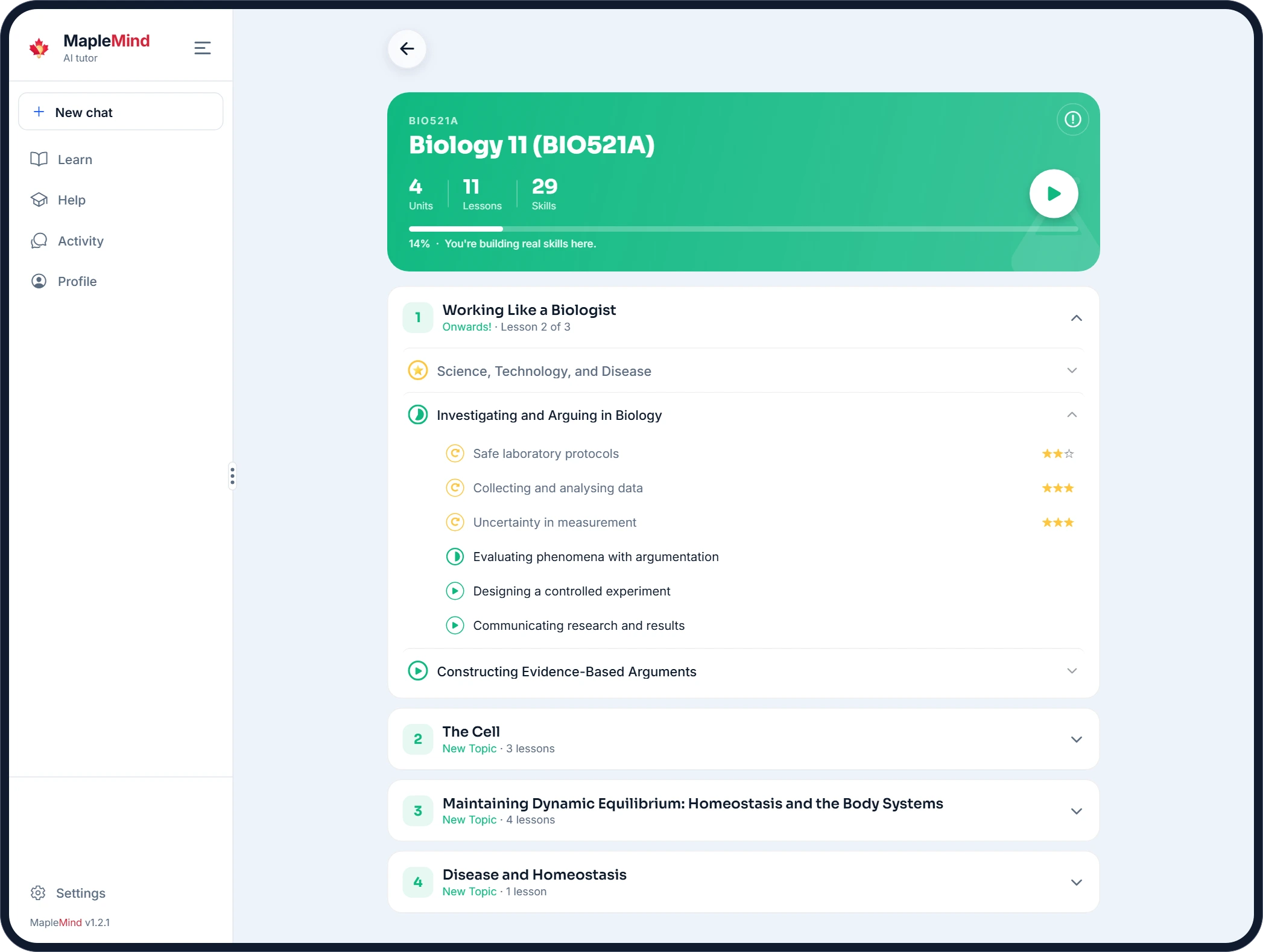
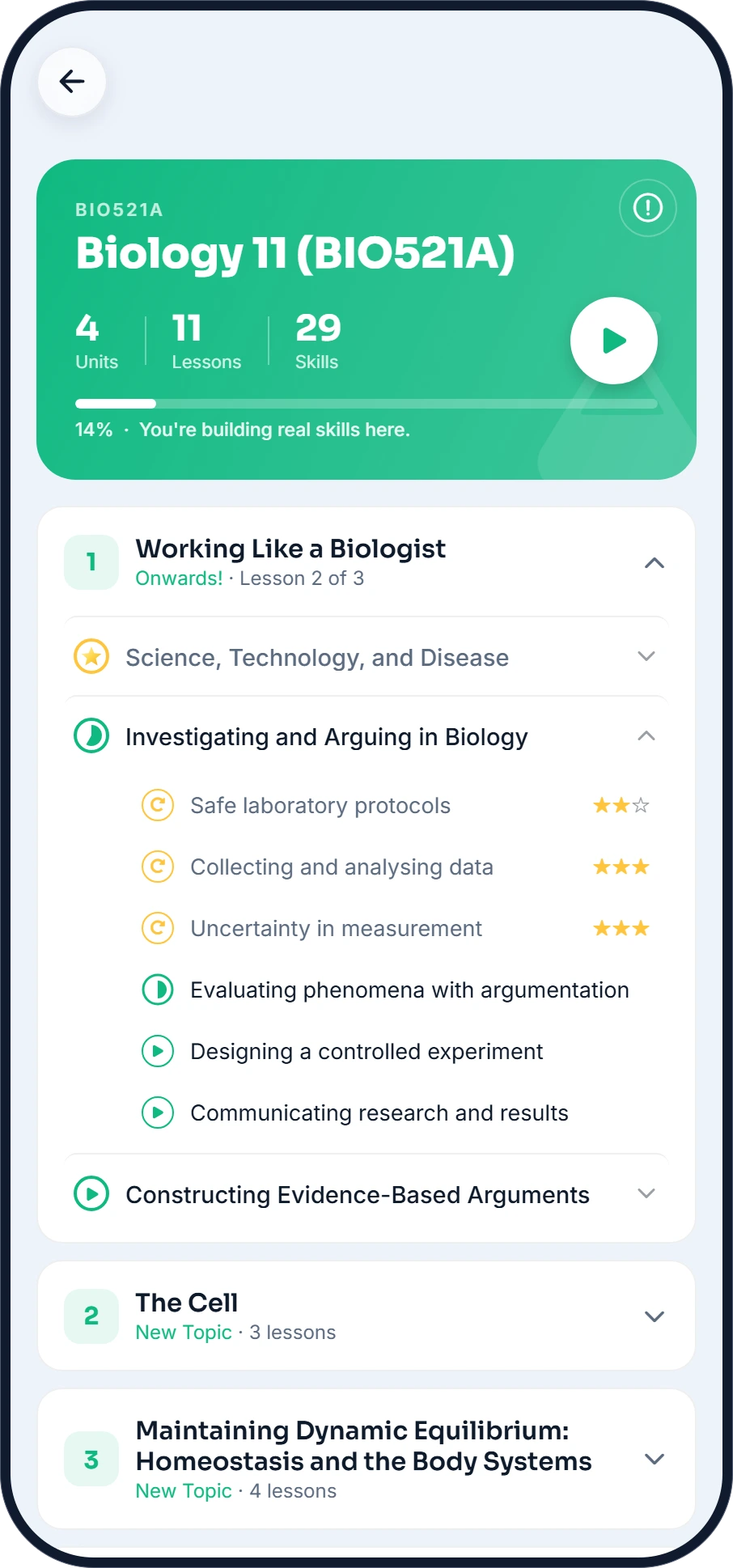
Biology 11 (BIO521A) in MapleMind on a tablet: its units and lessons in order, a student partway through.Biology 11 (BIO521A) in MapleMind on a phone: its units and lessons in order, a student partway through.
Their course, unit by unit, the way Prince Edward Island teaches it.Shown: Biology 11 (BIO521A)
Homework Help on a tablet: a photo of a worksheet, the tutor’s worked example of a two-step equation, and a question back to the student.Homework Help on a phone: a photo of a worksheet, the tutor’s worked example of a two-step equation, and a question back to the student.
Homework Help: they take a photo of the question, and the tutor works through it with them.
The Parent Dashboard on a tablet: a student’s days studied, streak, lessons, quiz average and recent activity.The Parent Dashboard on a phone: a student’s days studied, streak, lessons, quiz average and recent activity.
The Parent Dashboard: how each child’s week went, in lessons, quizzes and days studied.
A Grade 9 provincial mathematics exam on a tablet: a readiness score, the exam’s time and its next sitting.A Grade 9 provincial mathematics exam on a phone: a readiness score, the exam’s time and its next sitting.
A provincial exam: a practice sitting under the real time, and how ready they are.
The Learn tab on a tablet: a four-day streak, the week’s days, Homework Help, the next lesson and a review.The Learn tab on a phone: a four-day streak, the week’s days, Homework Help, the next lesson and a review.
The Learn tab: their week so far, and the next thing to do.

Help at home

Questions parents ask

What will my child learn in Grade 2 in Prince Edward Island?

Math: Mathematics, Grade 2. Science: Science, Grade 2. English: English Language Arts, Grade 2. Social studies: Social Studies, Grade 2. That’s 120 skills in all, from Prince Edward Island’s curriculum.

Does my child write a provincial exam in Grade 2?

No. Prince Edward Island has no provincial exam in Grade 2.

Where does this list come from?

From Prince Edward Island’s official curriculum, the documents its education ministry publishes for each course. Each skill here is one of their expectations, written in plain words.

Can MapleMind help my child in Grade 2?

Yes. Every course on this page is in MapleMind, with lessons, practice and a tutor that works through each step with them. A free account gets 30 messages and 4 activities a day.

Help with Grade 2, one skill at a time.

Every course on this page is in MapleMind, free with daily limits.