Get help with English Language Arts, Grade 2
Most tutoring makes your child sit through material your child already knows. MapleMind flips that: pick the exact skill that's causing trouble — any of the 17 below — and the tutor teaches just that one, step by step, as many times as it takes. Ask questions in plain words, any time of day, in English, French, or 12 other languages.
The official Prince Edward Island English Language Arts, Grade 2 curriculum
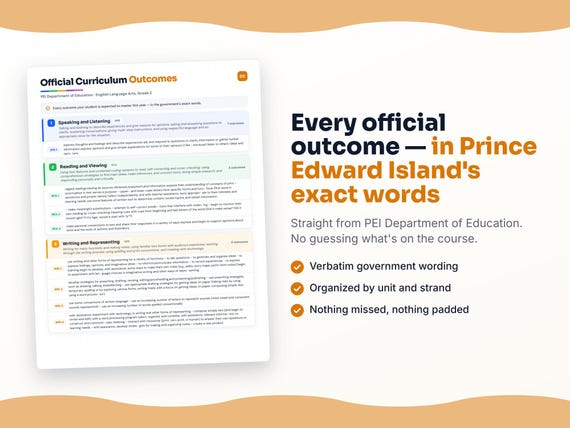
Prince Edward Island defines English Language Arts, Grade 2 by strands and outcomes. MapleMind teaches the same curriculum reorganized for one-skill-at-a-time tutoring — the table shows exactly where every official strand lands, and the ministry's own wording is quoted under each unit below.
Official source Prince Edward Island's official curriculumRead it on the government site — princeedwardisland.ca ↗| Official strand | Outcomes | Where MapleMind teaches it |
|---|---|---|
| Strand SL | 3 | Speaking and Listening |
| Strand RV | 5 | Reading and Viewing |
| Strand WR | 5 | Writing and Representing |
Every skill below, taught one on one.
 Try the first session free
How MapleMind teaches English Language Arts, Grade 2 — every unit, lesson, and skill
Every skill below runs as a short session: a plain-words lesson, a worked example, solving it together, then a five-question skill check that earns up to three stars. Guided Mode keeps it teaching instead of answer-handing — turning it off needs a parent's password.
Unit 1Speaking and ListeningOfficial strand · Strand SL
Talking and listening to describe experiences and give reasons for opinions; asking and answering questions to clarify; sustaining conversations; giving multi-step instructions; and using respectful language and an appropriate voice for the situation.
Sharing reasons and joining discussions
- Describing experiences and explaining opinionsPEI-ELA-2.SL.1 — Express thoughts and feelings, describe experiences, ask and answer questions to clarify or gather information, give simple reasons for opinions, and listen to others' ideas.
- Keeping a conversation going and giving instructionsPEI-ELA-2.SL.2 — Sustain one-to-one conversations and contribute to group interactions, use intonation and gestures, give and follow two- or three-step instructions, and take part in informal oral presentations.
- Turn-taking, kind words, and the right voicePEI-ELA-2.SL.3 — Show awareness of social conventions like turn-taking and politeness, recognize hurtful vocabulary and choose words that affirm, and adjust volume to the situation.
The official wording — 3 outcomes in this unit
- PEI-ELA-2.SL.1
express thoughts and feelings and describe experiences ask and respond to questions to clarify information or gather further information express opinions and give simple explanations for some of their opinions (I like … because) listen to others’ ideas and opin- ions
- PEI-ELA-2.SL.2
sustain one-to-one conversations and contribute to small- and large-groupinteractions use intonation, facial expressions, and gestures to communicate ideas and feelings respond to and give instructions or directions that include two or three components engage in informal oral presenta- tions and respond to a variety of oral presentations and other texts
- PEI-ELA-2.SL.3
demonstrate a growing awareness of social conventions such as turn-taking and politeness in conversation and co-operative play recognize some examples of unfair and hurtful vocabulary, and begin to make vocabulary choices that affirm rather than hurt people recognize that volume of voice needs to be adjusted according to the situation, (e.g., playground, classroom)
Unit 2Reading and ViewingOfficial strand · Strand RV
Using text features and combined cueing systems to read; self-correcting and cross-checking; using comprehension strategies to find main ideas, make inferences, and connect texts; doing simple research; and responding personally and critically.
Reading with print features and clues
- Using print features and choosing textsPEI-ELA-2.RV.1 — Regard reading as enjoyment and information, expand concepts of print (punctuation and letter case), select texts independently, and use text features to locate information.
- Combining clues to predict and self-monitorPEI-ELA-2.RV.1 — Use a combination of cues (semantic, syntactic, graphophonic, pragmatic) to sample, predict, and monitor or self-correct, predicting on the basis of meaning, sound, and print.
Understanding and thinking about texts
- Self-correcting and cross-checking your readingPEI-ELA-2.RV.2 — Make meaningful substitutions, attempt to self-correct predictions that interfere with meaning, and monitor reading by cross-checking meaning cues with beginning and last letters.
- Strategies to understand a storyPEI-ELA-2.RV.2 — Use strategies to create meaning: identify main idea, predict using text and personal knowledge, make inferences, identify character traits from clues, and make connections between texts.
- Doing simple researchPEI-ELA-2.RV.3 — With assistance, engage in the research process: generate questions to guide research, locate appropriate information, and interact with the information.
Responding personally and critically
- Making connections and supporting opinionsPEI-ELA-2.RV.4 — Make personal connections to text and share responses in a variety of ways, and express and begin to support opinions about texts and the work of authors and illustrators.
- Text types and thinking criticallyPEI-ELA-2.RV.5 — Identify different types of print and media texts and their conventions, and respond critically by formulating questions and understandings and developing respect for diversity.
The official wording — 5 outcomes in this unit
- PEI-ELA-2.RV.1
regard reading/viewing as sources ofinterest,enjoyment,and information expand their understanding of concepts of print - punctuation in text serves a purpose - upper- and lower-case letters have specific forms and func- tions (first word in sentences and proper names) select independently, and with teacher assistance, texts appropri- ate to their interests and learning needs use some features of written text to determine content, locate topics, and obtain information
- PEI-ELA-2.RV.2
- make meaningful substitutions - attempt to self-correct predic- tions that interfere with mean- ing - begin to monitor their own reading by cross-checking meaning cues with cues from beginning and last letters of the word (Did it make sense? Did it sound right? If it’s tiger, would it start with “p”?)
- PEI-ELA-2.RV.3
engage in the research process with assistance - generate questions to guide research - locate appropriate information with assistance (classroom, library, home, community) - interact with the information
- PEI-ELA-2.RV.4
make personal connections to text and share their responses in a variety of ways express and begin to support opinions about texts and the work of authors and illustrators
- PEI-ELA-2.RV.5
use their experiences with a range of texts to identify some different types of print and media texts, recognizing some of their lan- guage conventions and text characteristics respond critically to texts - formulate questions as well as understandings - develop an understanding and respect for diversity
Unit 3Writing and RepresentingOfficial strand · Strand WR
Writing for many functions and making notes; using familiar text forms with audience awareness; working through the writing process; using spelling and print conventions; and creating with technology.
Writing for a purpose and a reader
- Writing for different jobs and making notesPEI-ELA-2.WR.1 — Use writing and representing for a variety of functions, begin to make simple notes (webs, story maps, point form), and experiment with language choices in imaginative writing.
- Choosing text forms for an audiencePEI-ELA-2.WR.2 — Use a variety of familiar text forms and media, show awareness of audience and purpose by choosing forms and editing for sharing, and consider readers' responses.
The writing process, step by step
- Prewriting and drafting your ideasPEI-ELA-2.WR.3 — Use prewriting strategies such as drawing, talking, and reflecting, and use drafting strategies to get ideas on paper, taking risks with temporary spelling and exploring forms.
- Revising, editing, and publishingPEI-ELA-2.WR.3 — Use simple revision strategies to create a meaningful message, use simple editing strategies for spelling and punctuation, and use a variety of techniques for publishing and presenting.
Spelling and sentence conventions
- Spelling with soundsPEI-ELA-2.WR.4 — Use an increasing number of letters to represent sounds (most vowel and consonant sounds) and spell an increasing number of words conventionally.
- Sentences, punctuation, and capitalsPEI-ELA-2.WR.4 — Use conventional spacing between words, simple sentence structures, punctuation (periods, question marks, exclamation marks), and capital letters for proper names, the pronoun I, and sentence beginnings.
Creating with technology and research
- Using technology and combining informationPEI-ELA-2.WR.5 — With assistance, experiment with technology for writing and representing, and select, organize, and combine relevant information to construct meaning and create a new product.
The official wording — 5 outcomes in this unit
- PEI-ELA-2.WR.1
use writing and other forms of representing for a variety of functions - to ask questions - to generate and organize ideas - to express feelings, opinions, and imaginative ideas - to inform/communicate information - to record experiences - to explore learning begin to develop, with assistance, some ways to make their own notes (e.g., webs, story maps, point-form notes) begin to experiment with lan- guage choices in imaginative writing and other ways of repre- senting
- PEI-ELA-2.WR.2
use a variety of familiar text forms andothermedia(messages, letters, lists, recounts, stories, poems, records of observations, role-plays,ReadersTheatre) demonstrate some awareness of audience and purpose - choose particular forms for specific audiences and purposes - realize that work to be shared with an audience needs editing consider their readers’/ viewers’/ listeners’ questions/ comments and begin to use such responses to assess and extend their learning
- PEI-ELA-2.WR.3
develop strategies for prewriting, drafting, revising, editing/proofreading,and presenting/publishing - use prewriting strategies, such as drawing, talking, andreflecting - use appropriate drafting strategies for getting ideas on paper (taking risks by using temporary spelling or by exploring various forms, writing freely with a focus on getting ideas on paper, composing simple text using a word proces- sor)
- PEI-ELA-2.WR.4
use some conventions of written language - use an increasing number of letters to represent sounds (most vowel and consonant sounds represented) - use an increasing number of words spelled conventionally
- PEI-ELA-2.WR.5
with assistance, experiment with technology in writing and other forms of representing - compose simple text (and begin to revise and edit) with a word processing program select, organize, and combine, with assistance, relevant informa- tion to construct and communi- cate meaning - interact with resources (print, non-print, or human) to answer their own questions or learning needs - with assistance, develop strate- gies for making and organizing notes - create a new product
Printable workbook · A keepsake of the year
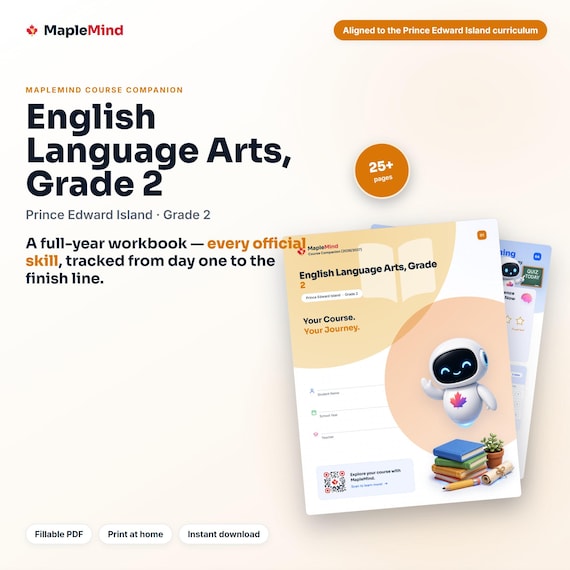
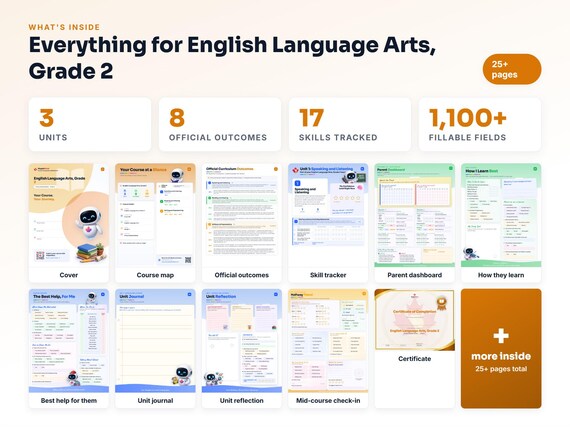
A English Language Arts, Grade 2 workbook worth keeping
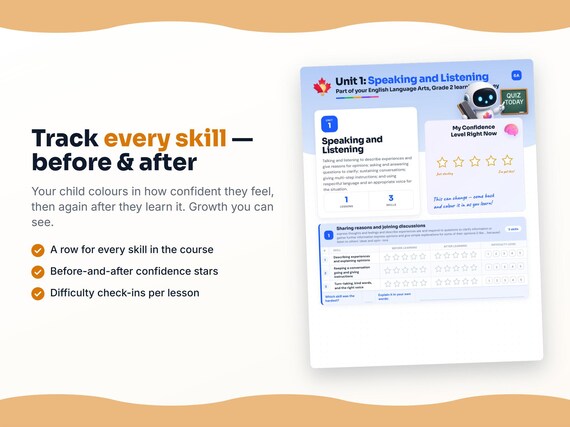
Built from the same official curriculum as this page. Before and after each skill above, your student colours in how sure they feel — so the two of you can see, on one page, what's clicking and what needs another look. It's a quiet way to follow how the year is really going.
By June it's full of their own handwriting: units worked through, confidence grown, a mid-year check-in, notes from parent-teacher night, and a certificate at the end. Less a worksheet, more a record of the year worth keeping on the shelf.
Instant download · see every page, reviews and the full description · five or more workbooks are $2.99 each
What it looks like in the app
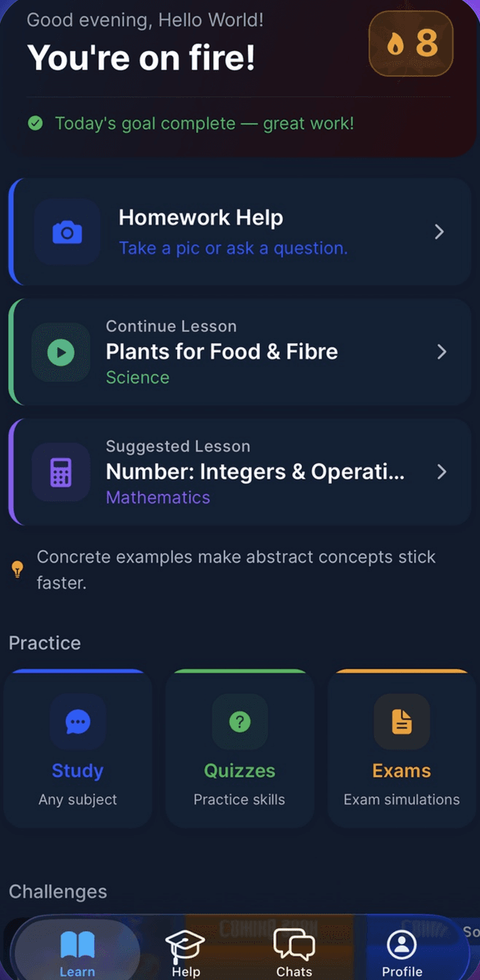
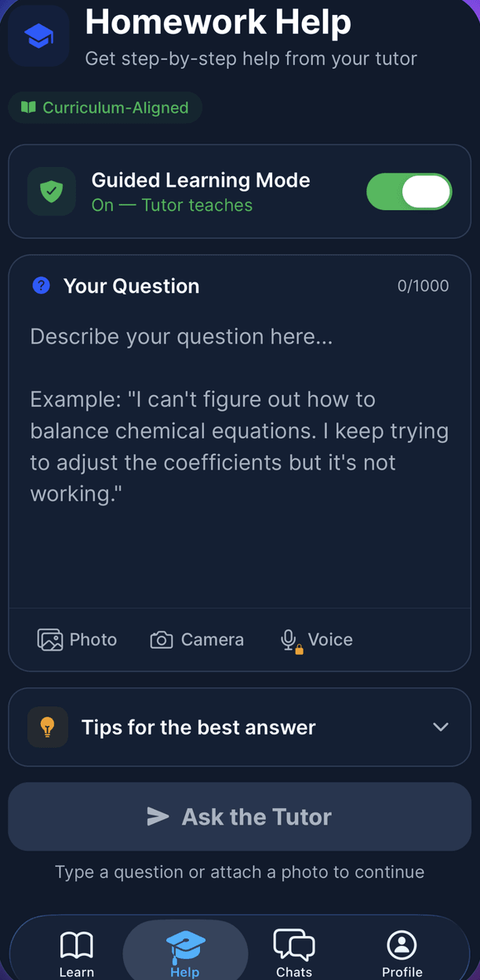
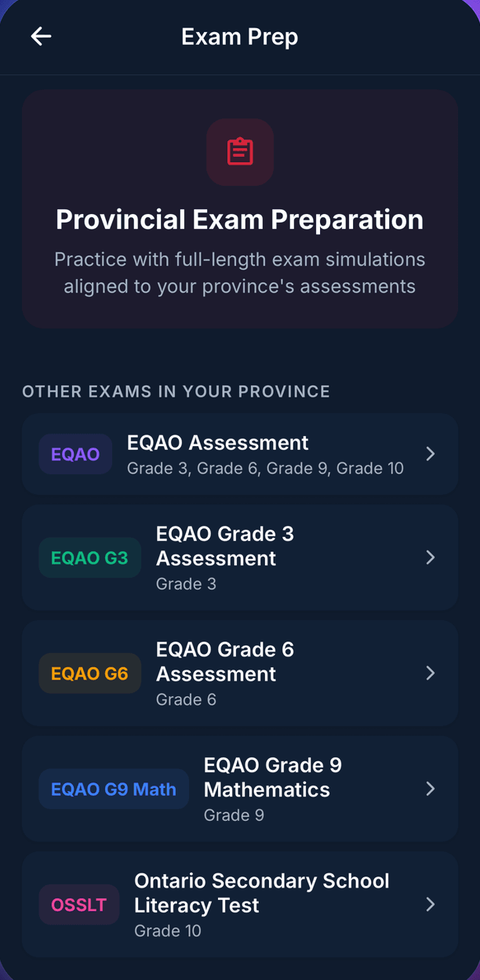
Common questions
Can MapleMind help my child with English Language Arts, Grade 2?
Yes. MapleMind's AI tutor covers all 17 skills in Prince Edward Island's English Language Arts, Grade 2 — your child picks the exact skill, and the tutor teaches it step by step: a short lesson, a worked example, solving together, then a skill check to show it stuck.
Is MapleMind aligned to Prince Edward Island's official curriculum?
Yes. Every skill in this course maps to an official outcome code from Prince Edward Island's Grade 2 English Language Arts curriculum, and the ministry's own wording is quoted under each unit on this page — with the official government source linked so you can check it yourself.
What does MapleMind cost?
It's free to start — 5 tutoring chats and a practice quiz every day, no credit card. A Pro subscription ($9.99/month or $49.99/year CAD, 7-day free trial) unlocks unlimited tutoring, practice, and exam simulations.
What if my child is stuck on just one topic?
That's the point of skill-level tutoring: open English Language Arts, Grade 2 in the app, tap the exact skill from the list on this page, and the tutor teaches just that — no wading through lessons your child doesn't need.
Does MapleMind work in French or other languages?
Yes — 14 languages, including French. Both the app and the tutor's explanations switch to the language your child chooses.
Where can I see the official Prince Edward Island curriculum for English Language Arts, Grade 2?
The official source is linked on this page — Prince Edward Island's official curriculum. The outline here follows it: every MapleMind skill carries its official outcome code, and the ministry's own wording is quoted under each unit.
Keep exploring
Ready when you are
Pick a skill from this page and see it taught properly — free, in the browser, in under a minute.