Get help with English Language Arts, Grade 1
Most tutoring makes your child sit through material your child already knows. MapleMind flips that: pick the exact skill that's causing trouble — any of the 19 below — and the tutor teaches just that one, step by step, as many times as it takes. Ask questions in plain words, any time of day, in English, French, or 12 other languages.
The official Prince Edward Island English Language Arts, Grade 1 curriculum
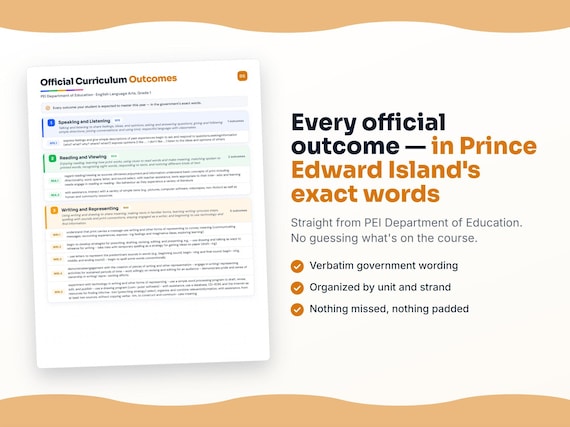
Prince Edward Island defines English Language Arts, Grade 1 by strands and outcomes. MapleMind teaches the same curriculum reorganized for one-skill-at-a-time tutoring — the table shows exactly where every official strand lands, and the ministry's own wording is quoted under each unit below.
Official source Prince Edward Island's official curriculumRead it on the government site — princeedwardisland.ca ↗| Official strand | Outcomes | Where MapleMind teaches it |
|---|---|---|
| Strand SL | 3 | Speaking and Listening |
| Strand RV | 5 | Reading and Viewing |
| Strand WR | 8 | Writing and Representing |
Every skill below, taught one on one.
 Try the first session free
How MapleMind teaches English Language Arts, Grade 1 — every unit, lesson, and skill
Every skill below runs as a short session: a plain-words lesson, a worked example, solving it together, then a five-question skill check that earns up to three stars. Guided Mode keeps it teaching instead of answer-handing — turning it off needs a parent's password.
Unit 1Speaking and ListeningOfficial strand · Strand SL
Talking and listening to share feelings, ideas, and opinions; asking and answering questions; giving and following simple directions; joining conversations; and using kind, respectful language with classmates.
Sharing ideas and joining conversations
- Sharing feelings, asking questions, and giving opinionsPEI-ELA-1.SL.1 — Express feelings and simple descriptions of experiences, begin to ask and answer questions to seek information, share opinions, and listen to the ideas of others.
- Talking in groups and sharing out loudPEI-ELA-1.SL.2 — Participate in small- and whole-group conversation, begin to use gestures and tone, give and follow simple directions, and take part in simple oral presentations.
- Kind words and getting alongPEI-ELA-1.SL.3 — Become aware of social conventions in group work and play, develop feelings vocabulary and the idea that some words can hurt, and notice that different language fits different situations.
The official wording — 3 outcomes in this unit
- PEI-ELA-1.SL.1
express feelings and give simple descriptions of past experiences begin to ask and respond to questions,seekinginformation (who? what? why? where? when?) express opinions (I like … ; I don’t like … ) listen to the ideas and opinions of others
- PEI-ELA-1.SL.2
participate in conversation and in small- and whole-group discussion begin to use gestures and tone to convey meaning respond to and give simple directions or instructions engage in simple oral presenta- tions and respond to oral presen- tations and other texts
- PEI-ELA-1.SL.3
demonstrate that they are becom- ing aware of social conventions in group work and co-operative play develop the concepts/vocabulary of feelings and an awareness that some vocabulary choices can hurt people demonstrate a growing awareness that different kinds of language are appropriate to different situations
Unit 2Reading and ViewingOfficial strand · Strand RV
Enjoying reading, learning how print works, using clues to read words and make meaning, matching spoken to printed words, recognizing sight words, responding to texts, and noticing different kinds of text.
How print works and reading clues
- Enjoying reading and knowing concepts of printPEI-ELA-1.RV.1 — Regard reading and viewing as sources of enjoyment and information, understand basic concepts of print, choose texts with help, and engage in reading-like behaviour.
- Using clues to read new wordsPEI-ELA-1.RV.1 — Use meaning cues, oral-language patterns, and beginning sound-symbol knowledge to predict, confirm, and self-correct while reading.
- Matching words and knowing sight wordsPEI-ELA-1.RV.2 — Begin to match one spoken word to one printed word and begin to recognize some high-frequency sight words.
Exploring texts and sharing what you think
- Exploring many kinds of simple textsPEI-ELA-1.RV.3 — With assistance, interact with a variety of simple texts such as pictures, software, videos, and non-fiction, as well as people and community resources.
- Sharing what you think about a textPEI-ELA-1.RV.4 — Respond personally to texts in a variety of ways and express opinions about texts and the work of authors and illustrators.
- Noticing kinds and parts of textsPEI-ELA-1.RV.5 — Recognize some basic types of texts and their components such as author, illustrator, and title, begin to ask questions of text, and begin to develop respect for diversity.
The official wording — 5 outcomes in this unit
- PEI-ELA-1.RV.1
regard reading/viewing as sources ofinterest,enjoyment,and information understand basic concepts of print including directionality, word, space, letter, and sound select, with teacher assistance, texts appropriate to their inter- ests and learning needs engage in reading or reading- like behaviour as they experience a variety of literature
- PEI-ELA-1.RV.2
- begin to match one-to-one spoken to printed word - begin to recognize some high frequency sight words
- PEI-ELA-1.RV.3
with assistance, interact with a variety of simple texts (e.g., pictures, computer software, videotapes, non-fiction) as well as human and community resources
- PEI-ELA-1.RV.4
respond personally to texts in a variety of ways express opinions about texts and the work of authors and illustra- tors
- PEI-ELA-1.RV.5
recognize some basic types of texts (e.g., videos, poems, posters, letters, true and imaginary texts) recognize some basic components of texts such as author, illustrator, and title begin to ask questions of text begin to develop an understand- ing and respect for diversity
Unit 3Writing and RepresentingOfficial strand · Strand WR
Using writing and drawing to share meaning, making texts in familiar forms, learning writing-process steps, spelling with sounds and print conventions, staying engaged as a writer, and beginning to use technology and find information.
Writing and drawing to share meaning
- Making texts for a readerPEI-ELA-1.WR.2 — Create written and media texts in familiar forms, show a beginning awareness of audience and purpose, and begin to consider readers' questions and comments.
How writers work: from idea to sharing
- Getting your ideas down (rehearsing and drafting)PEI-ELA-1.WR.3 — Begin to develop prewriting and drafting strategies: use drawing and talking to rehearse for writing, and take risks with temporary spelling to get ideas on paper.
- Making writing better and sharing itPEI-ELA-1.WR.3 — Confer with others and add on to revise, use simple editing such as adding letters or periods, and share writing with others.
Letters, sounds, and print conventions
- Using sounds to spell wordsPEI-ELA-1.WR.4 — Use letters to represent the predominant sounds in words (beginning, ending, then middle sounds) and begin to spell some words conventionally.
- Directionality, spacing, and sentencesPEI-ELA-1.WR.4 — Use drawings, letters, and approximations to record meaning; develop directionality and spacing; write complete sentences; and experiment with punctuation and upper- and lower-case letters.
Loving to write
- Sticking with writing and taking pridePEI-ELA-1.WR.5 — Show engagement with creating pieces of writing: work for sustained periods, revise and edit willingly for an audience, and take pride and ownership in the work.
- Choosing to write every dayPEI-ELA-1.WR.6 — Show engagement with writing and representing every day: choose to write, take risks to express self, write in play, and share willingly with others.
Writing with technology and finding information
- Trying technology to write and combine informationPEI-ELA-1.WR.7 — Experiment with technology in writing and representing (recorder, word processor, drawing program, Internet) and, with assistance, select and combine relevant information from sources without copying.
- Finding and sharing informationPEI-ELA-1.WR.8 — With assistance, use technology and the research process to interact with simple texts and resources, record information in simple ways, and share it with others.
The official wording — 8 outcomes in this unit
- PEI-ELA-1.WR.1
understand that print carries a message use writing and other forms of representing to convey meaning (communicating messages, recounting experiences, express- ing feelings and imaginative ideas, exploring learning)
- PEI-ELA-1.WR.2
create written and media texts using some familiar forms (e.g., lists, letters, personal narratives, retellings, messages, finger plays, drawings, puppetry) demonstrate a beginning aware- ness of audience and purpose begin to consider readers’/ listeners’/viewers’ questions/ comments about their work
- PEI-ELA-1.WR.3
begin to develop strategies for prewriting, drafting, revising, editing, and presenting, e.g., - use drawing and talking as ways to rehearse for writing - take risks with temporary spelling as a strategy for getting ideas on paper (draft- ing)
- PEI-ELA-1.WR.4
- use letters to represent the predominant sounds in words (e.g., beginning sound; begin- ning and final sound; begin- ning, middle, and ending sound) - begin to spell some words conventionally
- PEI-ELA-1.WR.5
demonstrateengagement with the creation of pieces of writing and other representation - engage in writing/ representing activities for sustained periods of time - work willingly on revising and editing for an audience - demonstrate pride and sense of ownership in writing/ repre- senting efforts
- PEI-ELA-1.WR.6
demonstrate engagement with writing and other forms of representation - choose to write when given a choice of activities - take risks to express self in writing - write in play situations (e.g., making grocery lists, making signs, playing school, preparing menus) - engage in writing and repre- senting activities every day - share writing and other repre- sentations willingly with others
- PEI-ELA-1.WR.7
experiment with technology in writing and other forms of representing - use a simple word processing program to draft, revise, edit, and publish - use a drawing program (com- puter software) - with assistance, use a database, CD-ROM, and the Internet as resources for finding informa- tion (prewriting strategy) select, organize, and combine relevantinformation, with assistance, from at least two sources, without copying verba- tim, to construct and communi- cate meaning
- PEI-ELA-1.WR.8
with assistance, engage in the research process to construct and communicatemeaning - interact with a variety of simple texts (e.g., pictures, computer software, videotapes, easy fiction and non-fiction), as well as human and community resources - record information in simple ways (e.g., drawings, labels, predesigned booklets, short pieces of writing) - share information with others in a variety of ways
Printable workbook · A keepsake of the year
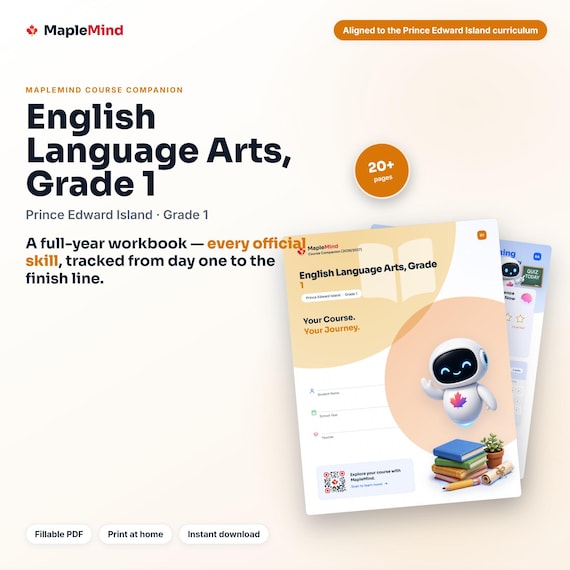
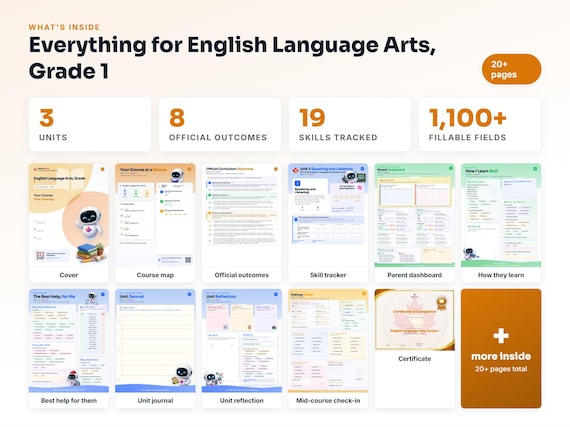
A English Language Arts, Grade 1 workbook worth keeping
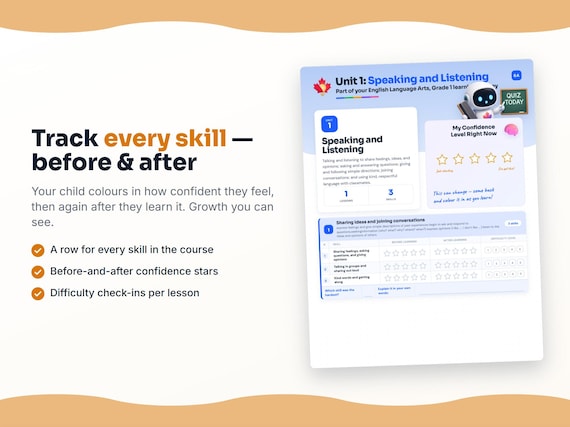
Built from the same official curriculum as this page. Before and after each skill above, your student colours in how sure they feel — so the two of you can see, on one page, what's clicking and what needs another look. It's a quiet way to follow how the year is really going.
By June it's full of their own handwriting: units worked through, confidence grown, a mid-year check-in, notes from parent-teacher night, and a certificate at the end. Less a worksheet, more a record of the year worth keeping on the shelf.
Instant download · see every page, reviews and the full description · five or more workbooks are $2.99 each
What it looks like in the app



Common questions
Can MapleMind help my child with English Language Arts, Grade 1?
Yes. MapleMind's AI tutor covers all 19 skills in Prince Edward Island's English Language Arts, Grade 1 — your child picks the exact skill, and the tutor teaches it step by step: a short lesson, a worked example, solving together, then a skill check to show it stuck.
Is MapleMind aligned to Prince Edward Island's official curriculum?
Yes. Every skill in this course maps to an official outcome code from Prince Edward Island's Grade 1 English Language Arts curriculum, and the ministry's own wording is quoted under each unit on this page — with the official government source linked so you can check it yourself.
What does MapleMind cost?
It's free to start — 5 tutoring chats and a practice quiz every day, no credit card. A Pro subscription ($9.99/month or $49.99/year CAD, 7-day free trial) unlocks unlimited tutoring, practice, and exam simulations.
What if my child is stuck on just one topic?
That's the point of skill-level tutoring: open English Language Arts, Grade 1 in the app, tap the exact skill from the list on this page, and the tutor teaches just that — no wading through lessons your child doesn't need.
Does MapleMind work in French or other languages?
Yes — 14 languages, including French. Both the app and the tutor's explanations switch to the language your child chooses.
Where can I see the official Prince Edward Island curriculum for English Language Arts, Grade 1?
The official source is linked on this page — Prince Edward Island's official curriculum. The outline here follows it: every MapleMind skill carries its official outcome code, and the ministry's own wording is quoted under each unit.
Keep exploring
Ready when you are
Pick a skill from this page and see it taught properly — free, in the browser, in under a minute.