Get help with English Language Arts, Grade 5
Most tutoring makes your child sit through material your child already knows. MapleMind flips that: pick the exact skill that's causing trouble — any of the 50 below — and the tutor teaches just that one, step by step, as many times as it takes. Ask questions in plain words, any time of day, in English, French, or 12 other languages.
The official Prince Edward Island English Language Arts, Grade 5 curriculum
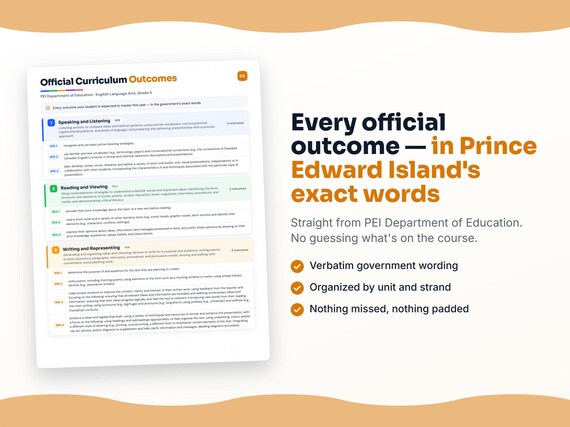
Prince Edward Island defines English Language Arts, Grade 5 by strands and outcomes. MapleMind teaches the same curriculum reorganized for one-skill-at-a-time tutoring — the table shows exactly where every official strand lands, and the ministry's own wording is quoted under each unit below.
Official source Prince Edward Island's official curriculumRead it on the government site — princeedwardisland.ca ↗| Official strand | Outcomes | Where MapleMind teaches it |
|---|---|---|
| Strand O | 15 | Speaking and Listening |
| Strand R | 21 | Reading and Viewing |
| Strand W | 14 | Writing and Representing |
Every skill below, taught one on one.
 Try the first session free
How MapleMind teaches English Language Arts, Grade 5 — every unit, lesson, and skill
Every skill below runs as a short session: a plain-words lesson, a worked example, solving it together, then a five-question skill check that earns up to three stars. Guided Mode keeps it teaching instead of answer-handing — turning it off needs a parent's password.
Unit 1Speaking and ListeningOfficial strand · Strand O
Listening actively to compare ideas and defend opinions; using precise vocabulary, correct grammar, organizational patterns, and levels of language; and preparing and delivering presentations with a process approach.
Listening, comparing, and defending opinions
- Using active listening strategiesPEI-ELA-5.O-1.1 — Recognize and use basic active listening strategies.
- Setting a purpose for listening and viewingPEI-ELA-5.O-1.2 — Set a purpose for listening and viewing, such as to identify important ideas, compare opinions, or retell details and events.
- Identifying and comparing important ideasPEI-ELA-5.O-1.3 — Identify and compare the important ideas, information, and messages in various oral and oral-visual communications.
- Contributing ideas with courtesyPEI-ELA-5.O-1.4 — Contribute ideas and opinions to formal and informal discussions, and respond with courtesy and respect to the contributions of others.
- Defending opinions with evidencePEI-ELA-5.O-1.5 — Express opinions about the ideas and views in oral and oral-visual communications and defend those opinions on the basis of evidence and their own prior knowledge, experience, values, beliefs, and observations.
Speaking with correct language
- Using vocabulary and conversational conventionsPEI-ELA-5.O-2.1 — Use familiar and new vocabulary and conversational conventions correctly in formal and informal classroom discussions and presentations.
- Using varied sentences and subject-verb agreementPEI-ELA-5.O-2.2 — Use simple and compound sentences, correct subject-verb agreement, and a variety of connecting words when contributing to discussions and making presentations.
- Using organizational patterns to communicatePEI-ELA-5.O-2.3 — Use simple organizational patterns, such as point-by-point development or chronological order, to communicate ideas, information, and opinions clearly.
- Using correct pronunciation, intonation, and volumePEI-ELA-5.O-2.4 — Use correct pronunciation and appropriate intonation and volume when speaking.
- Distinguishing and adapting levels of languagePEI-ELA-5.O-2.5 — Distinguish among different levels of language (formal, informal, colloquial) and begin to adapt their level of language to their purpose and audience.
- Reading aloud with fluency and expressionPEI-ELA-5.O-2.6 — Read aloud with increasing fluency and expression, focusing on correct pronunciation and appropriate intonation, pace, and volume.
Preparing and delivering presentations
- Planning and delivering a presentationPEI-ELA-5.O-3.1 — Plan, develop, review, revise, rehearse, and deliver a variety of short oral and oral-visual presentations, independently or collaboratively, using the characteristics and techniques of each type.
- Using strategies for different audiencesPEI-ELA-5.O-3.2 — Use strategies of effective presentation appropriate for different purposes and audiences that help clarify their message.
- Using visual aids to enhance a presentationPEI-ELA-5.O-3.3 — Use a variety of visual aids to enhance their presentations.
- Reflecting on presentation strengths and goalsPEI-ELA-5.O-3.4 — Identify, with the teacher's assistance, their presentation strengths, the areas where they have problems, and the areas to focus on to improve.
The official wording — 15 outcomes in this unit
- PEI-ELA-5.O-1.1
recognize and use basic active listening strategies ;
- PEI-ELA-5.O-1.2
set a purpose for listening and viewing (e.g., to identify the important ideas in a presentation; to compare opinions; to retell details, events, or situations described);
- PEI-ELA-5.O-1.3
identify and compare the important ideas, information, and/or messages in various oral and oral-visual communications;
- PEI-ELA-5.O-1.4
contribute ideas and opinions to formal and informal discussions, and respond with courtesy and respect to the contributions of others;
- PEI-ELA-5.O-1.5
express opinions about the ideas and views presented in oral and oral-visual communications, and defend those opinions on the basis of evidence in the communication and their own prior knowledge, experience, values, beliefs, and observations
- PEI-ELA-5.O-2.1
use familiar and new vocabulary (e.g., terminology, jargon) and conversational conventions (e.g., the conventions of Standard Canadian English) correctly in formal and informal classroom discussions and presentations;
- PEI-ELA-5.O-2.2
use simple and compound sentences, correct subject-verb agreement, and a variety of connecting words (e.g., then, if, because) when contributing to classroom discussions and making presentations;
- PEI-ELA-5.O-2.3
use simple organizational patterns (e.g., point-by-point development, chronological order) to communicate ideas, information, and opinions clearly and coherently;
- PEI-ELA-5.O-2.4
use correct pronunciation and appropriate intonation and volume when speaking;
- PEI-ELA-5.O-2.5
distinguish among the different levels of language (e.g., formal: “I do not understand”; informal: “I don’t understand”; colloquial: “Don’t have a clue”), and begin to adapt their level of language to their purpose and audience
- PEI-ELA-5.O-2.6
read aloud with increasing fluency and expression, focusing on correct pronunciation and appropriate intonation, pace, and volume ;
- PEI-ELA-5.O-3.1
plan, develop, review, revise, rehearse, and deliver a variety of short oral and/or oral-visual presentations, independently or in collaboration with other students, incorporating the characteristics of and techniques associated with the particular type of presentation;
- PEI-ELA-5.O-3.2
use strategies of effective presentation that are appropriate for different purposes and audiences and that help clarify their message;
- PEI-ELA-5.O-3.3
use a variety of visual aids to enhance their presentations;
- PEI-ELA-5.O-3.4
identify, with the teacher’s assistance, their presentation strengths, the areas in which they are experiencing problems, and the areas on which they need to focus to improve.
Unit 2Reading and ViewingOfficial strand · Strand R
Using comprehension strategies to understand unfamiliar words and important ideas; identifying the form, structure, and elements of novels, poems, scripts, expository texts, magazines, interviews, procedures, and media; and demonstrating critical literacy.
Understanding words and ideas in texts
- Activating prior knowledge before readingPEI-ELA-5.R-1.1 — Activate their prior knowledge about the topic of a new text before reading.
- Setting a purpose and choosing a textPEI-ELA-5.R-1.2 — Set a purpose for reading and choose a text that is appropriate for that purpose.
- Predicting a text's ending or messagePEI-ELA-5.R-1.3 — Make predictions about a text's ending or message on the basis of clues and information at the beginning of the text.
- Using text features to search for informationPEI-ELA-5.R-1.4 — Use common text features to become familiar with the general contents of a text and to begin to search for specific information.
- Applying French language knowledge to readingPEI-ELA-5.R-1.5 — Apply their knowledge of French vocabulary, grammar, and sentence structure to help understand English texts, including recognizing similar words and identifying a variety of sentence structures.
- Using word-solving strategiesPEI-ELA-5.R-1.6 — Use word-solving strategies to decode and pronounce unfamiliar words, including letter patterns, syllables, root words, prefixes, suffixes, compound words, and dictionaries.
- Using visualization to understand textsPEI-ELA-5.R-1.7 — Use visualization strategies to help understand ideas, information, and messages in texts.
- Monitoring and revising comprehensionPEI-ELA-5.R-1.8 — Monitor and, where necessary, revise their comprehension of a text.
- Reading at an appropriate rate and expressionPEI-ELA-5.R-1.9 — Read texts appropriate for their reading level at a sufficient rate and with sufficient precision and expression to convey the sense of the text.
Forms and elements of texts
- Identifying elements of narrative textsPEI-ELA-5.R-2.1 — Read a short novel and a variety of other narrative texts and identify their elements such as characters, conflicts, and settings.
- Identifying the form and elements of poemsPEI-ELA-5.R-2.2 — Read a variety of poems and identify their form, structure, and common and distinctive elements such as metre and alliteration.
- Identifying elements of scriptsPEI-ELA-5.R-2.3 — Read a variety of scripts and identify their elements such as dialogue, scenes, and stage directions.
- Identifying the structure of expository paragraphsPEI-ELA-5.R-2.4 — Read a variety of expository paragraphs and identify their purpose, audience, and structure, including topic, developing, and concluding sentences.
- Explaining how magazine contents fit their purposePEI-ELA-5.R-2.5 — Read and view a variety of children's magazines, identify their purpose, audience, and contents, and explain how the contents relate to the purpose and audience.
- Identifying characteristics of interviewsPEI-ELA-5.R-2.6 — Read a variety of interviews and identify their purpose, audience, and common characteristics such as brief introductions, open-ended questions, and summary questions.
- Identifying elements of procedural textsPEI-ELA-5.R-2.7 — Read a variety of procedural texts and identify their purpose, audience, and elements.
- Identifying elements and techniques of media textsPEI-ELA-5.R-2.8 — Read and view short media texts in a variety of forms and identify their purpose, audience, and the elements and techniques characteristic of each form.
Thinking critically about texts
- Justifying opinions about textsPEI-ELA-5.R-3.1 — Express their opinions about ideas, information, and messages in texts and justify those opinions by drawing on prior knowledge, experience, values, beliefs, and observations.
- Analysing how advertisements influence choicesPEI-ELA-5.R-3.2 — Select advertisements from various media forms and describe how they influence their choices, preferences, and desires.
- Analysing language and visual effectsPEI-ELA-5.R-3.3 — Identify how language and visual elements are used to communicate meaning and enhance the effect of texts and media works on readers and viewers.
- Drawing inferences and alternative perspectivesPEI-ELA-5.R-3.4 — Draw inferences about the ideas and messages in a text on the basis of evidence and prior knowledge, and present a possible alternative perspective.
The official wording — 21 outcomes in this unit
- PEI-ELA-5.R-1.1
activate their prior knowledge about the topic of a new text before reading;
- PEI-ELA-5.R-1.2
set a purpose for reading (e.g., for pleasure, to write a book report), and choose a text that is appropriate for that purpose;
- PEI-ELA-5.R-1.3
make predictions about a text’s ending or message on the basis of clues and information at the beginning of the text;
- PEI-ELA-5.R-1.4
use common text features to become familiar with the general contents of a text and to begin to search for specific information;
- PEI-ELA-5.R-1.5
apply their knowledge of French vocabulary, grammar, and sentence structure in a variety of ways, including the following, to help them understand texts: recognize words that are similar in both languages (e.g., separate/séparer); identify a variety of sentence structures;
- PEI-ELA-5.R-1.6
use word-solving strategies, including the following, to decode and pronounce unfamiliar words: identify common letter patterns (e.g., knight, knit, knot); break words into syllables; identify root words, prefixes, suffixes, and compound words; consult a variety of print and electronic dictionaries;
- PEI-ELA-5.R-1.7
use visualization strategies to help them understand ideas, information, and messages in texts;
- PEI-ELA-5.R-1.8
monitor and, where necessary, revise their comprehension of a text
- PEI-ELA-5.R-1.9
read texts that are appropriate for their reading level at a sufficient rate and with sufficient precision and expression to convey the sense of the text readily to the reader and to an audience;
- PEI-ELA-5.R-2.1
read a short novel and a variety of other narrative texts (e.g., comic books, graphic novels, short stories) and identify their elements (e.g., characters, conflicts, settings);
- PEI-ELA-5.R-2.2
read a variety of poems and identify their form (e.g., rhyming), their structure (e.g., stanzas), and some of their basic common and distinctive elements (e.g., common elements such as metre, distinctive elements such as the use of alliteration);
- PEI-ELA-5.R-2.3
read a variety of scripts (e.g., short dramas, humorous skits) and identify their elements (e.g., dialogue, scenes, stage directions);
- PEI-ELA-5.R-2.4
read a variety of expository paragraphs and identify their purpose, audience, and structure (e.g., topic sentence; developing sentences that add facts, details, or examples; and concluding sentence);
- PEI-ELA-5.R-2.5
read and view a variety of children’s magazines, identify their purpose, audience, and contents, and explain how the contents are related to the purpose and audience
- PEI-ELA-5.R-2.6
read a variety of interviews (e.g., with a local volunteer in a newspaper, with a movie star in a teen magazine) and identify their purpose, audience, and common characteristics (e.g., brief introductions, open-ended questions in a logical order, summary questions);
- PEI-ELA-5.R-2.7
read a variety of procedural texts and identify their purpose, audience, and elements (e.g., elements common to recipes include a list of ingredients followed by step-by-step instructions in the form of imperative sentences);
- PEI-ELA-5.R-2.8
read and view short media texts in a variety of forms (e.g., classified ads, posters) and identify their purpose, their audience, and the elements and techniques that are characteristic of each form (e.g., precise vocabulary in a classified ad, catchy headings and varied font sizes in a poster);
- PEI-ELA-5.R-3.1
express their opinions about ideas, information, and messages presented in texts, and justify those opinions by drawing on their prior knowledge, experience, values, beliefs, and observations;
- PEI-ELA-5.R-3.2
select advertisements from various media forms (e.g., teen magazine, television show), and describe how these advertisements influence their choices, preferences, and desires (e.g., clothing choices, music preferences, desire for a particular lifestyle);
- PEI-ELA-5.R-3.3
identify the ways in which language (e.g., figurative language, including similes and metaphors) and visual elements (e.g., pictures that accompany recipes, fonts that vary according to emphasis) are used to communicate meaning and to enhance the effect of texts and media works on readers and viewers;
- PEI-ELA-5.R-3.4
draw inferences about the ideas and messages in a text on the basis of evidence in the text and their prior knowledge (e.g., a book about children’s hockey that does not include girls playing the game may be promoting stereotypes about gender), and present a possible alternative perspective (e.g., dramatize a text, reversing the stereotypes presented in it).
Unit 3Writing and RepresentingOfficial strand · Strand W
Generating and organizing ideas and choosing devices to write for a purpose and audience; writing poems, scripts, expository paragraphs, interviews, procedures, and persuasive media; revising and editing with conventions; and publishing work.
Planning what to write
- Determining purpose and audiencePEI-ELA-5.W-1.1 — Determine the purpose of and audience for the text they are planning to create.
- Using pre-writing strategies to generate ideasPEI-ELA-5.W-1.2 — Use a variety of pre-writing strategies independently and in groups to generate and develop ideas and select an appropriate topic or form.
- Sorting ideas for purpose and audiencePEI-ELA-5.W-1.3 — Sort and classify the material they have gathered, listing ideas and information in a logical order while keeping purpose and audience in mind.
- Choosing literary and media devicesPEI-ELA-5.W-1.4 — Identify a variety of literary and stylistic devices and media techniques appropriate to the form and choose the ones that best suit their purpose and audience.
Writing in different forms
- Writing poems with literary devicesPEI-ELA-5.W-2.1 — Write poems, including rhyming poems, using elements of the form such as a rhyme scheme or metre and simple literary devices.
- Writing a script for a short dramaPEI-ELA-5.W-2.2 — Write the script for a short drama using dialogue and other elements of the form such as scenes, stage directions, and a basic plot.
- Writing an expository paragraphPEI-ELA-5.W-2.3 — Write an expository paragraph with a topic sentence, developing sentences that add facts, details, and examples in logical order, and a concluding sentence.
- Writing interview questionsPEI-ELA-5.W-2.4 — Write the text of questions for an interview, with a brief introduction, well-formulated open-ended questions, and a logical sequence.
- Writing procedural textsPEI-ELA-5.W-2.5 — Write procedural texts, setting out the procedure in a logical sequence, using subheadings as organizers and imperative verbs.
- Producing persuasive media textsPEI-ELA-5.W-2.6 — Produce short persuasive media texts using literary and stylistic devices and technological resources to enhance persuasiveness.
Revising and editing
- Revising for coherence and word choicePEI-ELA-5.W-3.1 — Make simple revisions to improve content, clarity, and interest, ensuring ideas progress logically and coherently, and using new words, synonyms, antonyms, prefixes, and suffixes.
- Editing and proofreading with conventionsPEI-ELA-5.W-3.2 — Edit and proofread their written work using reference material and teacher guidelines and applying the grade's language conventions.
Publishing and reflecting
- Producing a clean, legible final draftPEI-ELA-5.W-4.1 — Produce a clean and legible final draft using a variety of techniques and resources to format and enhance presentation, including headings, emphasis, and integrated visuals with labels.
- Reflecting on writing strengths and goalsPEI-ELA-5.W-4.2 — Identify, with the teacher's assistance, their writing strengths, the areas where they have problems, and the parts of the writing process to focus on to improve.
The official wording — 14 outcomes in this unit
- PEI-ELA-5.W-1.1
determine the purpose of and audience for the text they are planning to create;
- PEI-ELA-5.W-1.2
use a variety of pre-writing strategies independently and in groups to generate and develop ideas and to select an appropriate topic or form for their writing
- PEI-ELA-5.W-1.3
sort and classify the material they have gathered, listing the ideas and information they intend to present in a logical order, keeping their purpose and audience in mind;
- PEI-ELA-5.W-1.4
identify a variety of literary/stylistic devices, and/or media techniques appropriate to the form of text they are planning to create, then choose the ones that best suit their purpose and audience;
- PEI-ELA-5.W-2.1
write poems, including rhyming poems: using elements of the form such as a rhyming scheme or metre; using simple literary devices (e.g., assonance, similes);
- PEI-ELA-5.W-2.2
write the script for a short drama (e.g., a skit): using dialogue; using other elements of the form (e.g., scenes, stage directions, a basic plot);
- PEI-ELA-5.W-2.3
write an expository paragraph: with a topic sentence that introduces the main idea; with developing sentences that add facts, details, and examples in a logical order; with a concluding sentence that summarizes the main idea;
- PEI-ELA-5.W-2.4
write the text of the questions for an interview (e.g., with the principal, with a local community worker): with a brief introduction; with well-formulated, open-ended questions; with the questions presented in a logical sequence;
- PEI-ELA-5.W-2.5
write procedural texts (e.g., a recipe, instructions for changing a bicycle tire): setting out the procedure in a logical sequence (e.g., list a recipe’s ingredients in the order in which they are to be used); using subheadings as organizers; using imperative verbs;
- PEI-ELA-5.W-2.6
produce short, persuasive media texts in various forms (e.g., classified ads, posters), using literary/stylistic devices and technological resources (e.g., catchy headings, precise vocabulary, a variety of colours and font sizes) to enhance the persuasiveness of the text;
- PEI-ELA-5.W-3.1
make simple revisions to improve the content, clarity, and interest of their written work, using feedback from the teacher and focusing on the following: ensuring that all relevant ideas and information are included, and deleting unnecessary ideas and information; ensuring that their ideas progress logically and that the text is coherent; introducing new words from their reading into their writing; using synonyms (e.g., big/huge) and antonyms (e.g., long/short); using prefixes (e.g., unfriendly) and suffixes (e.g., friendship) correctly;
- PEI-ELA-5.W-3.2
edit and proofread their written work, using reference material (e.g., print and electronic dictionaries, checklists) and guidelines developed by the teacher (e.g., an editing checklist specific to the writing task, a posted class writing guideline), and applying the language conventions set out on page 51;
- PEI-ELA-5.W-4.1
produce a clean and legible final draft, using a variety of techniques and resources to format and enhance the presentation, with a focus on the following: using headings and subheadings appropriately to help organize the text; using underlining, colour, and/or a different style of lettering (e.g., printing, cursive writing, a different font) to emphasize certain elements of the text; integrating clip art, photos, and/or diagrams to supplement and help clarify information and messages; labelling diagrams accurately;
- PEI-ELA-5.W-4.2
identify, with the teacher’s assistance, their writing strengths, the areas in which they are experiencing problems, and the parts of the writing process on which they need to focus in order to improve
Printable workbook · A keepsake of the year
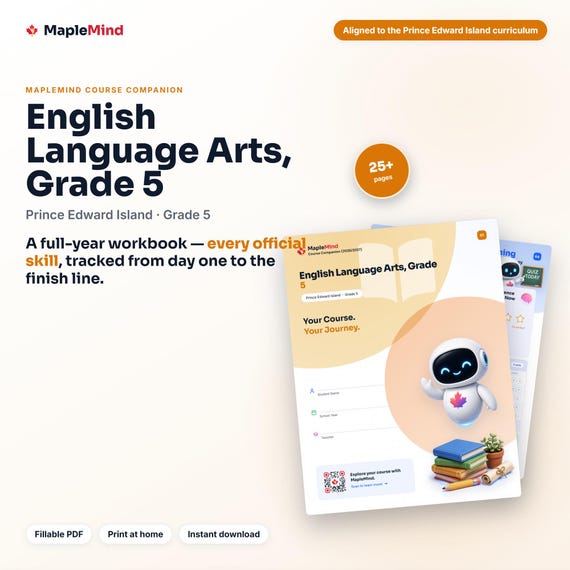
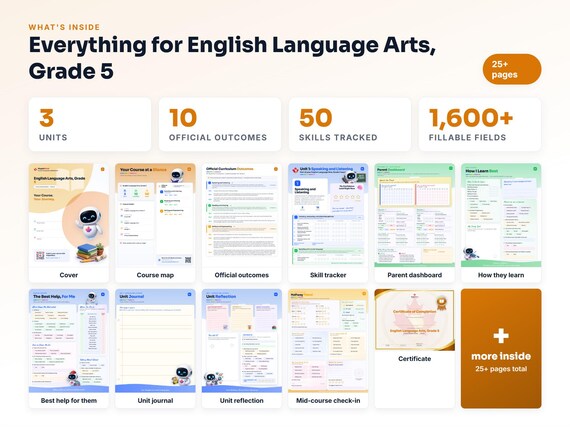
A English Language Arts, Grade 5 workbook worth keeping
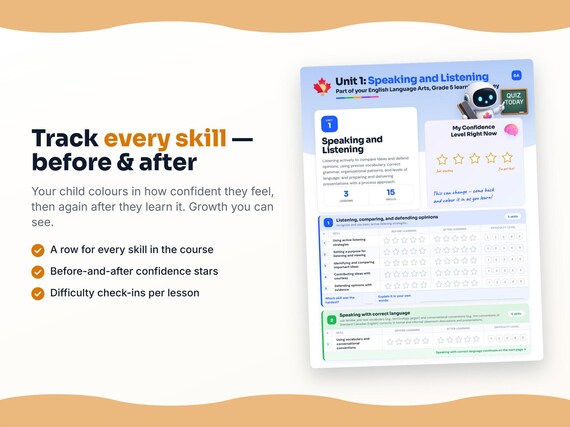
Built from the same official curriculum as this page. Before and after each skill above, your student colours in how sure they feel — so the two of you can see, on one page, what's clicking and what needs another look. It's a quiet way to follow how the year is really going.
By June it's full of their own handwriting: units worked through, confidence grown, a mid-year check-in, notes from parent-teacher night, and a certificate at the end. Less a worksheet, more a record of the year worth keeping on the shelf.
Instant download · see every page, reviews and the full description · five or more workbooks are $2.99 each
What it looks like in the app



Common questions
Can MapleMind help my child with English Language Arts, Grade 5?
Yes. MapleMind's AI tutor covers all 50 skills in Prince Edward Island's English Language Arts, Grade 5 — your child picks the exact skill, and the tutor teaches it step by step: a short lesson, a worked example, solving together, then a skill check to show it stuck.
Is MapleMind aligned to Prince Edward Island's official curriculum?
Yes. Every skill in this course maps to an official outcome code from Prince Edward Island's Grade 5 English Language Arts curriculum, and the ministry's own wording is quoted under each unit on this page — with the official government source linked so you can check it yourself.
What does MapleMind cost?
It's free to start — 5 tutoring chats and a practice quiz every day, no credit card. A Pro subscription ($9.99/month or $49.99/year CAD, 7-day free trial) unlocks unlimited tutoring, practice, and exam simulations.
What if my child is stuck on just one topic?
That's the point of skill-level tutoring: open English Language Arts, Grade 5 in the app, tap the exact skill from the list on this page, and the tutor teaches just that — no wading through lessons your child doesn't need.
Does MapleMind work in French or other languages?
Yes — 14 languages, including French. Both the app and the tutor's explanations switch to the language your child chooses.
Where can I see the official Prince Edward Island curriculum for English Language Arts, Grade 5?
The official source is linked on this page — Prince Edward Island's official curriculum. The outline here follows it: every MapleMind skill carries its official outcome code, and the ministry's own wording is quoted under each unit.
Keep exploring
Ready when you are
Pick a skill from this page and see it taught properly — free, in the browser, in under a minute.