Get help with English Language Arts, Grade 6
Most tutoring makes your child sit through material your child already knows. MapleMind flips that: pick the exact skill that's causing trouble — any of the 49 below — and the tutor teaches just that one, step by step, as many times as it takes. Ask questions in plain words, any time of day, in English, French, or 12 other languages.
The official Prince Edward Island English Language Arts, Grade 6 curriculum
Prince Edward Island defines English Language Arts, Grade 6 by strands and outcomes. MapleMind teaches the same curriculum reorganized for one-skill-at-a-time tutoring — the table shows exactly where every official strand lands, and the ministry's own wording is quoted under each unit below.
Official source Prince Edward Island's official curriculumRead it on the government site — princeedwardisland.ca ↗| Official strand | Outcomes | Where MapleMind teaches it |
|---|---|---|
| Strand O | 15 | Speaking and Listening |
| Strand R | 20 | Reading and Viewing |
| Strand W | 14 | Writing and Representing |
Every skill below, taught one on one.
 Try the first session free
How MapleMind teaches English Language Arts, Grade 6 — every unit, lesson, and skill
Every skill below runs as a short session: a plain-words lesson, a worked example, solving it together, then a five-question skill check that earns up to three stars. Guided Mode keeps it teaching instead of answer-handing — turning it off needs a parent's password.
Unit 1Speaking and ListeningOfficial strand · Strand O
Listening to summarize, identify point of view, and compare and defend views; using specialized vocabulary, varied tenses, organizational patterns, and levels of language; and preparing and delivering presentations with a process approach.
Summarizing, comparing, and defending views
- Using active listening strategiesPEI-ELA-6.O-1.1 — Use active listening strategies.
- Setting a purpose for listening and viewingPEI-ELA-6.O-1.2 — Set a purpose for listening and viewing, such as to identify and understand both sides of an argument or to follow detailed verbal instructions.
- Summarizing and identifying point of viewPEI-ELA-6.O-1.3 — Summarize the ideas and information in oral and oral-visual communications and identify the point of view expressed.
- Contributing, comparing, and defending opinionsPEI-ELA-6.O-1.4 — Contribute and compare ideas, views, and opinions, defending opinions on the basis of evidence and prior knowledge, and respond constructively to others' contributions.
- Comparing your views to a message's viewsPEI-ELA-6.O-1.5 — Compare their own views to the views and messages presented in oral and oral-visual communications, defending their opinions on the basis of evidence and prior knowledge.
Speaking with precise language
- Using specialized vocabulary for purpose and audiencePEI-ELA-6.O-2.1 — Incorporate new and specialized vocabulary regularly into classroom discussions and presentations, keeping in mind their purpose and audience.
- Using varied sentences, tenses, and connectivesPEI-ELA-6.O-2.2 — Use a variety of simple and compound sentences, past, present, and future verb tenses, and a variety of connecting words when contributing to discussions and presentations.
- Using organizational patterns to communicatePEI-ELA-6.O-2.3 — Use a variety of organizational patterns, such as comparison or a list of reasons with supporting evidence, to communicate ideas, information, and opinions clearly.
- Using strategies of effective speakingPEI-ELA-6.O-2.4 — Use most of the strategies of effective speaking.
- Using the appropriate level of languagePEI-ELA-6.O-2.5 — Distinguish among the different levels of language (formal, informal, colloquial) and use the level appropriate for their purpose and audience.
- Reading aloud with fluency and expressionPEI-ELA-6.O-2.6 — Read aloud with increasing fluency and expression, pronouncing clearly, varying intonation, and adjusting pace and volume to the text.
Preparing and delivering presentations
- Planning and delivering a presentationPEI-ELA-6.O-3.1 — Plan, develop, review, revise, rehearse, and deliver a variety of oral and oral-visual presentations, independently or collaboratively, using the characteristics and techniques of each type.
- Using strategies to clarify the messagePEI-ELA-6.O-3.2 — Use strategies of effective presentation appropriate for their purpose and audience that help clarify their message.
- Using visual and multimedia aidsPEI-ELA-6.O-3.3 — Use a variety of visual and/or multimedia aids to enhance their presentations.
- Reflecting and setting presentation goalsPEI-ELA-6.O-3.4 — Identify, with the teacher's assistance, their presentation strengths, areas of difficulty, and areas to focus on to improve, and set personal goals for improvement.
The official wording — 15 outcomes in this unit
- PEI-ELA-6.O-1.1
use active listening strategies
- PEI-ELA-6.O-1.2
set a purpose for listening and viewing (e.g., to identify and understand both sides of an argument in a debate, to understand and be able to follow detailed verbal instructions);
- PEI-ELA-6.O-1.3
summarize the ideas and information in oral and oral-visual communications, and identify the point of view expressed
- PEI-ELA-6.O-1.4
contribute and compare ideas, views and opinions, defending their opinions on the basis of evidence in the communication as well as their own prior knowledge, experience, and observations to formal and informal discussions, and respond constructively to others’ contributions
- PEI-ELA-6.O-1.5
compare their own views to the views and messages presented in oral and oral-visual communications, defending their opinions on the basis of evidence in the communication as well as their own prior knowledge, experience, and observations;
- PEI-ELA-6.O-2.1
incorporate new and specialized vocabulary regularly into classroom discussions and presentations, keeping in mind their purpose and audience;
- PEI-ELA-6.O-2.2
use a variety of simple and compound sentences, the past, present, and future tenses of verbs, and a variety of connecting words when contributing to classroom discussions and making presentations, keeping their purpose and audience in mind;
- PEI-ELA-6.O-2.3
use a variety of organizational patterns (e.g., comparison, a list of reasons with supporting evidence for each reason) to communicate ideas, information, and opinions clearly and coherently
- PEI-ELA-6.O-2.4
use most of the strategies of effective speaking
- PEI-ELA-6.O-2.5
distinguish among the different levels of language (i.e., formal, informal, colloquial), and use the level that is appropriate for their purpose and audience;
- PEI-ELA-6.O-2.6
read aloud with increasing fluency and expression, focusing on pronouncing clearly and correctly, varying their intonation, adjusting the pace of their delivery (e.g., in response to punctuation), and adjusting the volume of their voice (e.g., to appropriately convey the mood of a poem);
- PEI-ELA-6.O-3.1
plan, develop, review, revise, rehearse, and deliver a variety of oral and/or oral visual presentations, independently or in collaboration with other students, incorporating the characteristics of and techniques associated with the particular type of presentation
- PEI-ELA-6.O-3.2
use strategies of effective presentation that are appropriate for their purpose and audience and that help clarify their message
- PEI-ELA-6.O-3.3
use a variety of visual and/or multimedia aids to enhance their presentations
- PEI-ELA-6.O-3.4
identify, with the teacher’s assistance, their presentation strengths, the areas in which they are experiencing problems, and the areas on which they need to focus in order to improve, and set personal goals for improvement.
Unit 2Reading and ViewingOfficial strand · Strand R
Using comprehension strategies to understand unfamiliar words and important ideas; identifying the form, structure, and elements of fantasy novels, poems, persuasive paragraphs, magazines, event summaries, biographies, and pamphlets; and demonstrating critical literacy.
Understanding words and ideas in texts
- Activating prior knowledge before readingPEI-ELA-6.R-1.1 — Activate their prior knowledge about the topic of a new text before reading.
- Setting a purpose and choosing a reading speedPEI-ELA-6.R-1.2 — Set a purpose and determine an appropriate speed (such as skimming or reading closely) for reading by previewing the content and structure of texts.
- Predicting content from text cluesPEI-ELA-6.R-1.3 — Make predictions about the content of a text before and during reading on the basis of clues provided in the text.
- Using text features to locate informationPEI-ELA-6.R-1.4 — Use text features such as a glossary or index to become familiar with the general contents of a text and to locate specific information.
- Applying French language knowledge to readingPEI-ELA-6.R-1.5 — Apply their knowledge of French vocabulary, grammar, sentence structure, and syntax to help understand English texts, including pronouncing unfamiliar words and identifying the function of a word.
- Using word-solving strategies for words and phrasesPEI-ELA-6.R-1.6 — Use word-solving strategies to decode and pronounce unfamiliar words and phrases, using context, word structure, and dictionaries and thesauruses.
- Using visualization to understand textsPEI-ELA-6.R-1.7 — Use visualization strategies to help understand ideas, information, and messages in texts.
- Monitoring and revising comprehensionPEI-ELA-6.R-1.8 — Monitor and, where necessary, revise their comprehension of a text.
- Reading at an appropriate rate and expressionPEI-ELA-6.R-1.9 — Read texts appropriate for their reading level at a sufficient rate and with sufficient precision and expression to convey the sense of the text.
Forms and elements of texts
- Identifying elements of fantasy and short fictionPEI-ELA-6.R-2.1 — Read a short fantasy novel and other forms of short fiction and identify their elements such as characters, plot, and theme.
- Identifying the form and elements of poemsPEI-ELA-6.R-2.2 — Read a variety of poems and identify their form, structure, and common and distinctive elements such as figurative language and image patterns.
- Identifying the structure of persuasive paragraphsPEI-ELA-6.R-2.3 — Read a variety of persuasive paragraphs, identify their purpose, audience, and point of view, and describe their structure.
- Describing how magazine contents address their audiencePEI-ELA-6.R-2.4 — Read a variety of magazines, identify their purpose, audience, and contents, and describe how the contents address the purpose and audience.
- Identifying elements of event summariesPEI-ELA-6.R-2.5 — Read a variety of event summaries and identify their elements, such as the five W's.
- Identifying characteristics of biographiesPEI-ELA-6.R-2.6 — Read a variety of short biographies and identify their purpose and common characteristics, such as chronological order and the use of primary sources.
- Identifying the purpose and elements of pamphletsPEI-ELA-6.R-2.7 — Read and view a variety of pamphlets and identify their purpose, audience, and elements, such as catchy slogans, attractive visuals, and precise vocabulary.
Thinking critically about texts
- Justifying opinions across textsPEI-ELA-6.R-3.1 — Express opinions about a topic after reading a variety of texts, and justify opinions by connecting what they have read, their prior knowledge and experience, and their observations.
- Analysing how ad placement targets audiencesPEI-ELA-6.R-3.2 — Explain how the placement of particular advertisements in particular media forms targets and attempts to persuade particular audiences.
- Assessing techniques that create mood and imagesPEI-ELA-6.R-3.3 — Assess the effectiveness of specific techniques used in a variety of texts to create mood and evoke images in the minds of readers and viewers.
- Inferring purpose and offering alternativesPEI-ELA-6.R-3.4 — Draw inferences about the purpose of a text and the opinions it conveys on the basis of evidence, and present a possible alternative perspective.
The official wording — 20 outcomes in this unit
- PEI-ELA-6.R-1.1
activate their prior knowledge about the topic of a new text before reading
- PEI-ELA-6.R-1.2
set a purpose and determine an appropriate speed (e.g., skimming, reading closely) for reading by previewing the content and structure of texts;
- PEI-ELA-6.R-1.3
make predictions about the content of a text before and during reading on the basis of clues provided in the text (e.g., “Based on the author’s description of the house, I think that it will turn out to be haunted”);
- PEI-ELA-6.R-1.4
use text features (e.g., glossary, index) to become familiar with the general contents of a text and to locate specific information;
- PEI-ELA-6.R-1.5
apply their knowledge of French vocabulary, grammar, sentence structure, and syntax in a variety of ways, including the following, to help them understand texts: identify and pronounce unfamiliar words (e.g., use their knowledge that ph is pronounced like f to pronounce the word elephant); identify the function of a word (e.g., a descriptive word next to a verb [usually an adverb] modifies the meaning of the verb);
- PEI-ELA-6.R-1.6
use word-solving strategies, including the following, to decode and pronounce unfamiliar words and phrases: use the context of the word or phrase; use their knowledge of the structure of words (e.g., words can consist of root words plus a prefix and/or suffix, compound words consist of two words); consult a variety of print and electronic dictionaries and other resources, including thesauruses;
- PEI-ELA-6.R-1.7
use visualization strategies to help them understand ideas, information, and messages in texts
- PEI-ELA-6.R-1.8
monitor and, where necessary, revise their comprehension of a text
- PEI-ELA-6.R-1.9
read texts that are appropriate for their reading level at a sufficient rate and with sufficient precision and expression to convey the sense of the text readily to the reader and to an audience;
- PEI-ELA-6.R-2.1
read a short fantasy novel and other forms of short fiction (e.g., short stories, fables, legends) and identify their elements (e.g., characters, plot, theme);
- PEI-ELA-6.R-2.2
read a variety of poems and identify their form (e.g., free verse, diamante), their structure (e.g., the diamond shape of a diamante poem), and their common and distinctive elements (e.g., common elements such as the use of figurative language, distinctive elements such as image patterns in free verse or rhymes in a rhyming poem);
- PEI-ELA-6.R-2.3
read a variety of persuasive paragraphs; identify their purpose, audience, and point of view; and describe their structure;
- PEI-ELA-6.R-2.4
read a variety of magazines, identify their purpose, audience, and contents, and describe how the contents address the purpose and audience (e.g., articles about, pictures of, and advertisements for high-powered cars in a teen magazine are intended to persuade teens that these cars are desirable);
- PEI-ELA-6.R-2.5
read a variety of event summaries (e.g., reports of sports events, cultural events, field trips) and identify their elements (e.g., the 5 W’s – who, what, when, where, why);
- PEI-ELA-6.R-2.6
read a variety of short biographies and identify their purpose and common characteristics (e.g., chronological order of events; the author’s use of primary sources such as diaries, letters, and eyewitness accounts);
- PEI-ELA-6.R-2.7
read and view a variety of pamphlets and identify their purpose (e.g., to inform, to persuade), their audience, and their elements (e.g., catchy slogans, attractive visuals, precise vocabulary);
- PEI-ELA-6.R-3.1
express their opinions about a topic after reading a variety of texts on that topic, and justify their opinions by making connections among what they have read, their prior knowledge and experience, and their observations;
- PEI-ELA-6.R-3.2
explain how the placement of particular advertisements in particular media forms (e.g., toy commercials in Saturday morning cartoons, car advertisements in financial magazines) targets and attempts to persuade particular audiences;
- PEI-ELA-6.R-3.3
assess the effectiveness of specific techniques used in a variety of texts (e.g., sentence patterns and imagery in fiction, dark colours in horror movie posters) to create mood and to evoke images in the minds of readers and viewers;
- PEI-ELA-6.R-3.4
draw inferences about the purpose of a text, and the opinions it conveys, on the basis of evidence in the text (e.g., by depicting an honest but poor character stealing food, the author may be suggesting that poverty can change people’s behaviour), and present a possible alternative perspective (e.g., that stealing is never justified).
Unit 3Writing and RepresentingOfficial strand · Strand W
Generating, planning, and choosing devices to write for a purpose and audience; writing fiction, poems, persuasive paragraphs, event summaries, biographies, and pamphlets; revising and editing with conventions; and using publishing and production skills to present work.
Planning what to write
- Determining purpose and audiencePEI-ELA-6.W-1.1 — Determine the purpose of and audience for the text they are planning to create.
- Using pre-writing strategies to generate ideasPEI-ELA-6.W-1.2 — Use a variety of pre-writing strategies independently and collaboratively to generate and develop ideas and select an appropriate topic and form.
- Planning writing with outlinesPEI-ELA-6.W-1.3 — Plan their writing using simple outline formats to sort information and to list and organize their ideas in a logical manner.
- Choosing literary and media devicesPEI-ELA-6.W-1.4 — Identify a variety of literary and stylistic devices and media techniques appropriate to the form and choose the ones that best suit their purpose and audience.
Writing in different forms
- Writing fiction and personal narrativesPEI-ELA-6.W-2.1 — Write short pieces of fiction and personal narratives with plot, setting, and characters, focusing on coherence throughout the text.
- Writing free-verse and diamante poemsPEI-ELA-6.W-2.2 — Write a variety of poems, including free-verse and diamante poems, applying elements of the form and using literary devices with descriptive vocabulary.
- Writing persuasive or argumentative paragraphsPEI-ELA-6.W-2.3 — Write persuasive or argumentative paragraphs with a specific audience, a topic sentence stating an opinion, three supporting arguments, and a conclusion.
- Writing an event summaryPEI-ELA-6.W-2.4 — Write an event summary using the five W's to organize information, with an introduction, a development section with details, and a conclusion.
- Writing a short biographyPEI-ELA-6.W-2.5 — Write a short biography combining narration and description, with an introduction, body, and conclusion, using at least one primary source.
- Producing a promotional pamphletPEI-ELA-6.W-2.6 — Produce a promotional pamphlet with a specific audience, clear vocabulary, short sentences, and literary and technological resources to enhance persuasiveness.
Revising and editing
- Revising for content, sentence variety, and word choicePEI-ELA-6.W-3.1 — Make revisions to improve content, clarity, and interest, following an outline, adding details, introducing new words, using specialized language, sentence variety, and effective adverbs.
- Editing and proofreading with conventionsPEI-ELA-6.W-3.2 — Edit and proofread their written work using a variety of reference materials and teacher guidelines and applying the grade's language conventions.
Publishing and reflecting
- Producing a clean, legible final draftPEI-ELA-6.W-4.1 — Produce a clean and legible final draft using a variety of techniques and resources to format and enhance presentation, including headings, emphasis, and integrated captioned or labelled visuals.
- Reflecting on writing and setting goalsPEI-ELA-6.W-4.2 — Identify, with the teacher's assistance, their writing strengths, areas of difficulty, and parts of the writing process to focus on to improve, and set personal goals for improvement.
The official wording — 14 outcomes in this unit
- PEI-ELA-6.W-1.1
determine the purpose of and audience for the text they are planning to create;
- PEI-ELA-6.W-1.2
use a variety of pre-writing strategies independently and collaboratively to generate and develop ideas and to select an appropriate topic and form for their writing
- PEI-ELA-6.W-1.3
plan their writing, using simple outline formats to sort information and to list and organize their ideas in a logical manner;
- PEI-ELA-6.W-1.4
identify a variety of literary/stylistic devices and/or media techniques appropriate to the form of text they are planning to create, then choose the ones that best suit their purpose and audience;
- PEI-ELA-6.W-2.1
write short pieces of fiction and/or personal narratives: fiction: with a simple plot, setting, and characters; personal narratives: with a brief account of a personal experience, and descriptions of the setting and people involved; with a focus on ensuring coherence throughout the text
- PEI-ELA-6.W-2.2
write a variety of poems, including simple free-verse and diamante poems: applying elements of the form (e.g., the characteristic structure of a diamante poem); using literary devices (e.g., imagery, onomatopoeia); with a focus on using descriptive vocabulary;
- PEI-ELA-6.W-2.3
write persuasive or argumentative paragraphs: with a specific audience in mind; with a topic sentence that clearly states an opinion; with three arguments in support of the opinion; with a conclusion that restates the opinion;
- PEI-ELA-6.W-2.4
write an event summary (e.g., of a sports event, field trip): using the five W’s (who, what, when, where, why) to organize the information; with a catchy introduction and a conclusion; with a development section that describes simple facts and provides details and/or examples;
- PEI-ELA-6.W-2.5
write a short (e.g., five-paragraph) biography: combining narration and description; with an introduction, a body, and a conclusion; using at least one primary source (e.g., interview, eyewitness account, memoir);
- PEI-ELA-6.W-2.6
produce a promotional pamphlet (e.g., promoting a product or service): with a specific audience in mind; using clear and precise vocabulary; using short sentences to convey the desired information; using literary/stylistic devices and technological resources (e.g., a catchy slogan, lists of benefits or advantages, attractive visual elements such as clip art and different fonts) to enhance the persuasiveness of the text and to produce a clean and appealing document;
- PEI-ELA-6.W-3.1
make revisions to improve the content, clarity, and interest of their written work, using feedback from the teacher and focusing on the following: following their outline and revising it if necessary; adding details that clarify or support their intended meaning, or that would appeal to their target audience; introducing new words and expressions from their reading into their writing; using specialized or technical language or jargon when appropriate to the subject and audience; using a variety of sentence structures; selecting and using the most effective adverbs for their purpose (e.g., Julian cautiously placed the crystal vase on the glass table);
- PEI-ELA-6.W-3.2
edit and proofread their written work, using a variety of reference materials (e.g., and guidelines developed by the teacher (e.g., an editing checklist specific to the writing task), and applying the language conventions set out on page 67;
- PEI-ELA-6.W-4.1
produce a clean and legible final draft, using a variety of techniques and resources to format and enhance the presentation, with a focus on the following: using headings and subheadings appropriately to help organize the text; using underlining, colour, and/or varied styles of lettering appropriately for different purposes (e.g., use eye-catching colours in a promotional pamphlet); integrating clip art, photos with appropriate captions, and/or accurately labelled diagrams to supplement or reinforce information and messages;
- PEI-ELA-6.W-4.2
identify, with the teacher’s assistance, their writing strengths, the areas in which they are experiencing problems, and the parts of the writing process on which they need to focus in order to improve, and set personal goals for improvement.
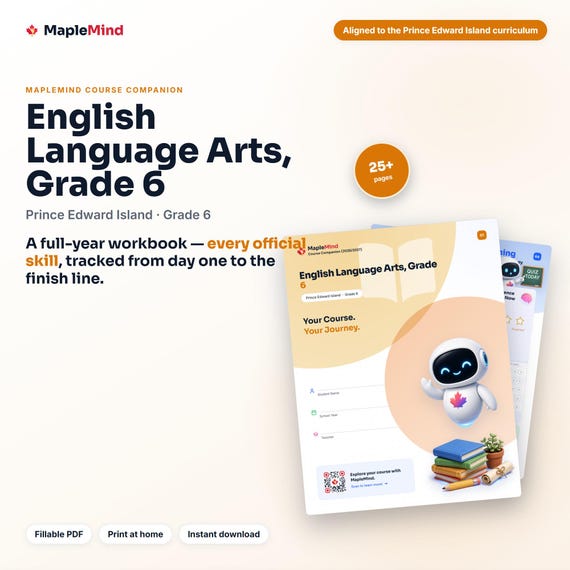
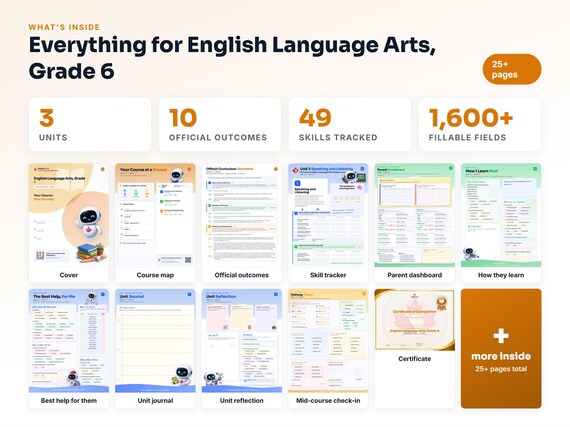
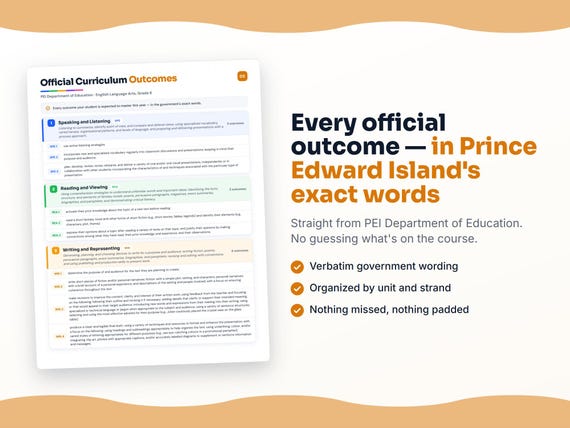
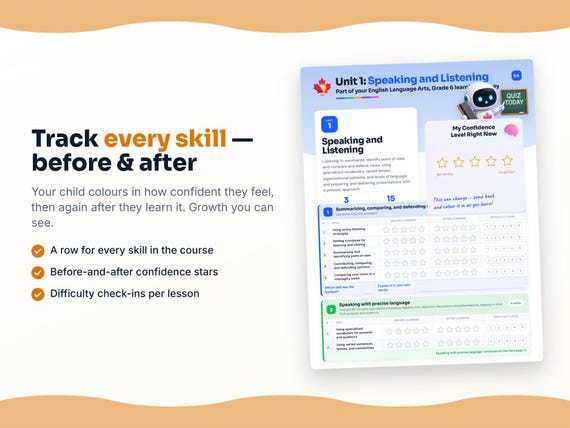
Printable workbook · A keepsake of the year
A English Language Arts, Grade 6 workbook worth keeping
Built from the same official curriculum as this page. Before and after each skill above, your student colours in how sure they feel — so the two of you can see, on one page, what's clicking and what needs another look. It's a quiet way to follow how the year is really going.
By June it's full of their own handwriting: units worked through, confidence grown, a mid-year check-in, notes from parent-teacher night, and a certificate at the end. Less a worksheet, more a record of the year worth keeping on the shelf.
Instant download · see every page, reviews and the full description · five or more workbooks are $2.99 each
What it looks like in the app
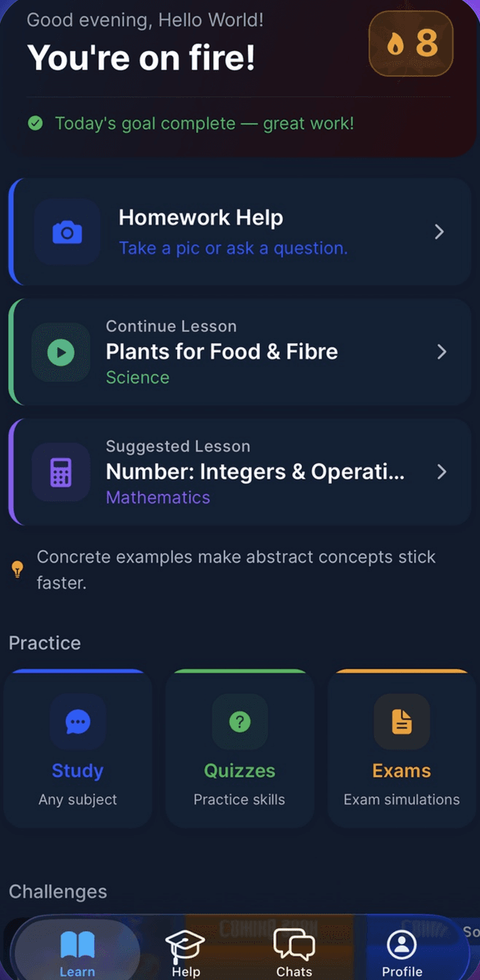
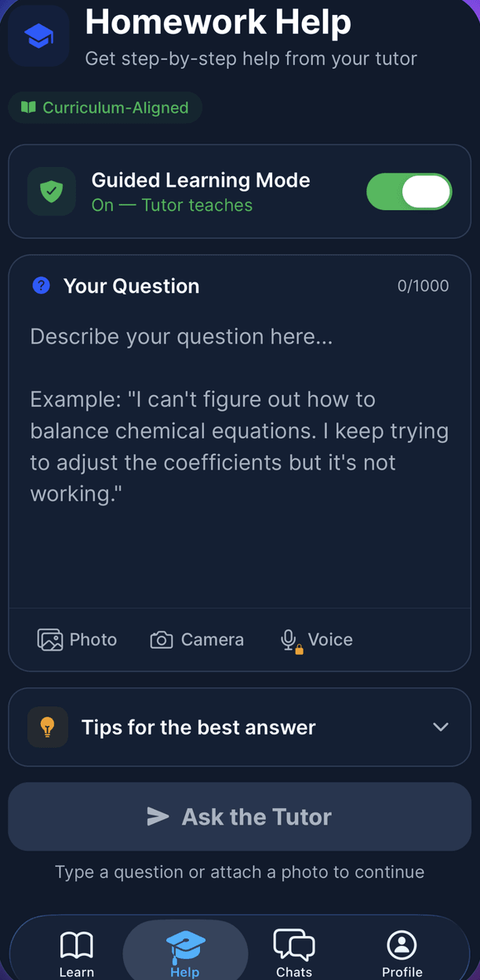
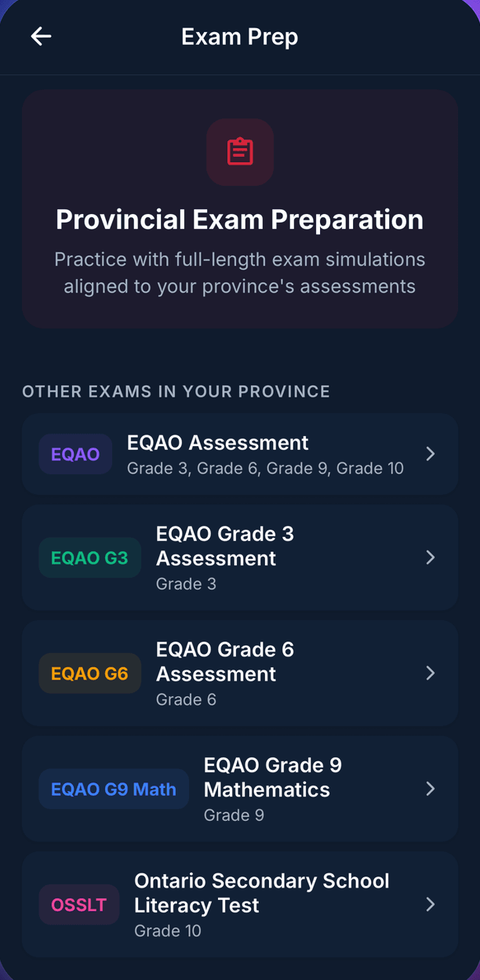
Common questions
Can MapleMind help my child with English Language Arts, Grade 6?
Yes. MapleMind's AI tutor covers all 49 skills in Prince Edward Island's English Language Arts, Grade 6 — your child picks the exact skill, and the tutor teaches it step by step: a short lesson, a worked example, solving together, then a skill check to show it stuck.
Is MapleMind aligned to Prince Edward Island's official curriculum?
Yes. Every skill in this course maps to an official outcome code from Prince Edward Island's Grade 6 English Language Arts curriculum, and the ministry's own wording is quoted under each unit on this page — with the official government source linked so you can check it yourself.
What does MapleMind cost?
It's free to start — 5 tutoring chats and a practice quiz every day, no credit card. A Pro subscription ($9.99/month or $49.99/year CAD, 7-day free trial) unlocks unlimited tutoring, practice, and exam simulations.
What if my child is stuck on just one topic?
That's the point of skill-level tutoring: open English Language Arts, Grade 6 in the app, tap the exact skill from the list on this page, and the tutor teaches just that — no wading through lessons your child doesn't need.
Does MapleMind work in French or other languages?
Yes — 14 languages, including French. Both the app and the tutor's explanations switch to the language your child chooses.
Where can I see the official Prince Edward Island curriculum for English Language Arts, Grade 6?
The official source is linked on this page — Prince Edward Island's official curriculum. The outline here follows it: every MapleMind skill carries its official outcome code, and the ministry's own wording is quoted under each unit.
Keep exploring
Ready when you are
Pick a skill from this page and see it taught properly — free, in the browser, in under a minute.