Get help with English Language Arts, Grade 4
Most tutoring makes your child sit through material your child already knows. MapleMind flips that: pick the exact skill that's causing trouble — any of the 46 below — and the tutor teaches just that one, step by step, as many times as it takes. Ask questions in plain words, any time of day, in English, French, or 12 other languages.
The official Prince Edward Island English Language Arts, Grade 4 curriculum
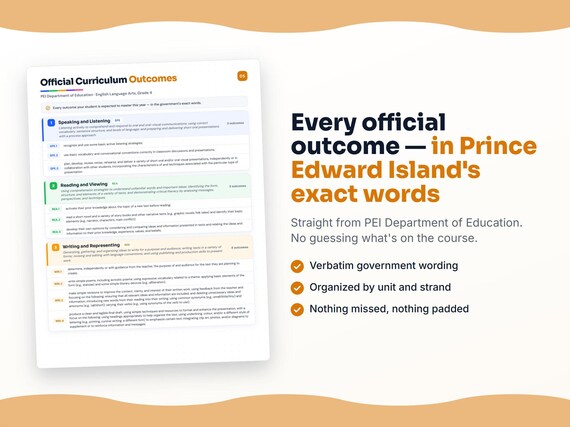
Prince Edward Island defines English Language Arts, Grade 4 by strands and outcomes. MapleMind teaches the same curriculum reorganized for one-skill-at-a-time tutoring — the table shows exactly where every official strand lands, and the ministry's own wording is quoted under each unit below.
Official source Prince Edward Island's official curriculumRead it on the government site — princeedwardisland.ca ↗| Official strand | Outcomes | Where MapleMind teaches it |
|---|---|---|
| Strand O | 15 | Speaking and Listening |
| Strand R | 19 | Reading and Viewing |
| Strand W | 12 | Writing and Representing |
Every skill below, taught one on one.
 Try the first session free
How MapleMind teaches English Language Arts, Grade 4 — every unit, lesson, and skill
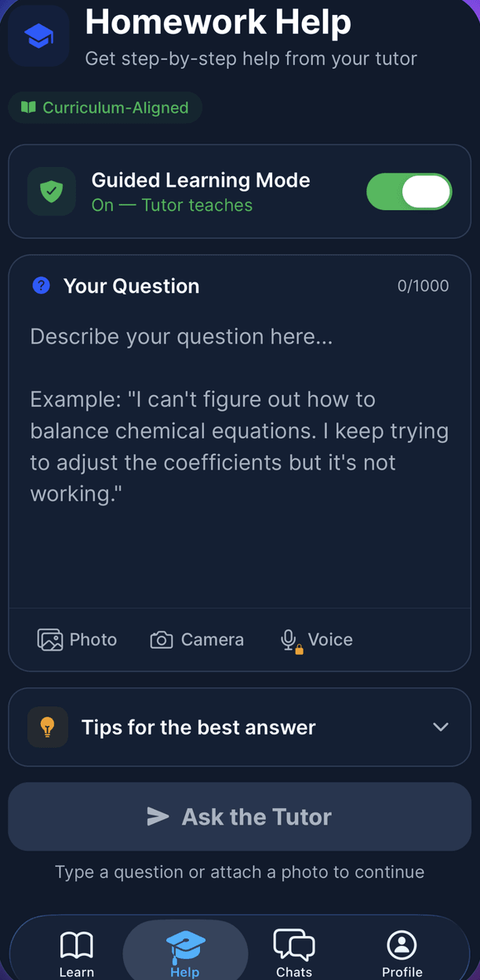
Every skill below runs as a short session: a plain-words lesson, a worked example, solving it together, then a five-question skill check that earns up to three stars. Guided Mode keeps it teaching instead of answer-handing — turning it off needs a parent's password.
Unit 1Speaking and ListeningOfficial strand · Strand O
Listening actively to comprehend and respond to oral and oral-visual communications; using correct vocabulary, sentence structure, and levels of language; and preparing and delivering short oral presentations with a process approach.
Listening and responding to what you hear
- Using active listening strategiesPEI-ELA-4.O-1.1 — Recognize and use some basic active listening strategies.
- Identifying the purpose of what you hearPEI-ELA-4.O-1.2 — Recognize that oral and oral-visual communications have a purpose, and identify that purpose when listening and viewing.
- Restating the important ideasPEI-ELA-4.O-1.3 — Identify the important ideas, information, and messages in oral and oral-visual communications, restating them in their own words.
- Contributing ideas with courtesyPEI-ELA-4.O-1.4 — Contribute ideas and opinions to formal and informal discussions, and respond with courtesy and respect to the contributions of others.
- Expressing thoughts and feelings about what you hearPEI-ELA-4.O-1.5 — Express thoughts and feelings about the ideas and information presented in oral and oral-visual communications, drawing on prior knowledge, experience, values, and beliefs.
Speaking clearly and correctly
- Using correct vocabulary and conversational conventionsPEI-ELA-4.O-2.1 — Use basic vocabulary and conversational conventions correctly in classroom discussions and presentations.
- Using sentence structures and connecting wordsPEI-ELA-4.O-2.2 — Use basic sentence structures, simple verb tenses, and simple connecting words when contributing to discussions and making presentations.
- Communicating ideas in a logical sequencePEI-ELA-4.O-2.3 — Use a simple, logical sequence to communicate ideas, information, and opinions clearly and coherently.
- Distinguishing sounds and pronouncing words correctlyPEI-ELA-4.O-2.4 — Identify and distinguish among sounds in spoken language, and imitate models of correct pronunciation of familiar vocabulary when speaking.
- Using formal and informal language appropriatelyPEI-ELA-4.O-2.5 — Use formal and informal language appropriately in classroom settings.
- Reading aloud with fluencyPEI-ELA-4.O-2.6 — Read aloud with some fluency, focusing on correct pronunciation, intonation, and pace.
Preparing and delivering presentations
- Planning and delivering a presentationPEI-ELA-4.O-3.1 — Plan, develop, review, revise, rehearse, and deliver a variety of short oral and oral-visual presentations, independently or collaboratively, using the characteristics and techniques of each type.
- Using effective presentation strategiesPEI-ELA-4.O-3.2 — Use strategies of effective presentation that are appropriate for the intended purpose.
- Using visual aids to enhance a presentationPEI-ELA-4.O-3.3 — Use a variety of visual aids to enhance their presentations, such as objects to demonstrate a process or basic recording technology.
- Reflecting on presentation strengths and goalsPEI-ELA-4.O-3.4 — Identify, with the teacher's assistance, their presentation strengths, the areas where they are having problems, and the areas to focus on to improve.
The official wording — 15 outcomes in this unit
- PEI-ELA-4.O-1.1
recognize and use some basic active listening strategies;
- PEI-ELA-4.O-1.2
recognize that oral and oral-visual communications have a purpose, and identify that purpose (e.g., to obtain information, to follow simple verbal instructions, to respond to comprehension questions) when listening and viewing;
- PEI-ELA-4.O-1.3
identify the important ideas, information, and/or messages in oral and oral-visual communications, restating them in their own words;
- PEI-ELA-4.O-1.4
contribute ideas and opinions to formal and informal discussions, and respond with courtesy and respect to the contributions of others;
- PEI-ELA-4.O-1.5
express their thoughts and feelings about the ideas and information presented in oral and oral- visual communications, drawing on their own prior knowledge, experience, values, and beliefs
- PEI-ELA-4.O-2.1
use basic vocabulary and conversational conventions correctly in classroom discussions and presentations;
- PEI-ELA-4.O-2.2
use basic sentence structures, simple verb tenses, and simple connecting words when contributing to classroom discussions and making presentations;
- PEI-ELA-4.O-2.3
use a simple, logical sequence to communicate ideas, information, and opinions clearly and coherently;
- PEI-ELA-4.O-2.4
identify and distinguish among sounds in spoken language, and imitate models of correct pronunciation of familiar vocabulary when speaking;
- PEI-ELA-4.O-2.5
use formal and informal language appropriately in classroom settings;
- PEI-ELA-4.O-2.6
read aloud with some fluency, focusing on correct pronunciation, intonation, and pace
- PEI-ELA-4.O-3.1
plan, develop, review, revise, rehearse, and deliver a variety of short oral and/or oral visual presentations, independently or in collaboration with other students, incorporating the characteristics of and techniques associated with the particular type of presentation
- PEI-ELA-4.O-3.2
use strategies of effective presentation that are appropriate for the intended purpose;
- PEI-ELA-4.O-3.3
use a variety of visual aids to enhance their presentations (e.g., use appropriate objects to demonstrate a process, use basic video or audio recording technology);
- PEI-ELA-4.O-3.4
identify, with the teacher’s assistance, their presentation strengths, the areas in which they are experiencing problems, and the areas on which they need to focus in order to improve
Unit 2Reading and ViewingOfficial strand · Strand R
Using comprehension strategies to understand unfamiliar words and important ideas; identifying the form, structure, and elements of a variety of texts; and demonstrating critical literacy by analysing messages, perspectives, and techniques.
Understanding words and ideas in texts
- Activating prior knowledge before readingPEI-ELA-4.R-1.1 — Activate their prior knowledge about the topic of a new text before reading.
- Identifying purposes for readingPEI-ELA-4.R-1.2 — Identify different purposes for reading and describe the types of texts most appropriate for these purposes.
- Predicting content from illustrationsPEI-ELA-4.R-1.3 — Make predictions about the content of a text before and during reading on the basis of illustrations and other graphic elements.
- Using text features to preview a textPEI-ELA-4.R-1.4 — Use simple text features such as the cover, illustrations, and table of contents to become familiar with the general contents of a text.
- Applying French language knowledge to readingPEI-ELA-4.R-1.5 — Apply their knowledge of French vocabulary and grammar to help understand English texts, including recognizing words that are similar in both languages and finding the verb in a sentence.
- Using word-solving strategiesPEI-ELA-4.R-1.6 — Use basic word-solving strategies to decode and pronounce unfamiliar words, including identifying common letter patterns, sound-symbol relationships, and consulting a visual dictionary.
- Using visualization to understand textsPEI-ELA-4.R-1.7 — Use visualization strategies to predict the meaning of unfamiliar words and to help understand the main ideas, information, and messages in texts.
- Monitoring and revising comprehensionPEI-ELA-4.R-1.8 — Monitor and, where necessary, revise their comprehension of a text.
- Reading at an appropriate rate and expressionPEI-ELA-4.R-1.9 — Read texts appropriate for their reading level at a sufficient rate and with sufficient precision and expression to convey the sense of the text.
Forms and elements of texts
- Identifying elements of narrative textsPEI-ELA-4.R-2.1 — Read a short novel and a variety of story books and other narrative texts and identify their basic elements such as narrator, characters, and main conflict.
- Describing the form and structure of poemsPEI-ELA-4.R-2.2 — Read a variety of poems and describe their form and structure.
- Identifying elements of narrative and descriptive paragraphsPEI-ELA-4.R-2.3 — Read a variety of narrative and descriptive paragraphs and identify their purpose, structure, and common characteristics.
- Identifying common elements of children's magazinesPEI-ELA-4.R-2.4 — Read a variety of children's magazines and identify their common elements.
- Identifying elements of procedural textsPEI-ELA-4.R-2.5 — Read a variety of simple procedural texts and identify their common elements.
- Identifying elements of friendly messages in mediaPEI-ELA-4.R-2.6 — Read and view a variety of simple friendly messages in different media forms and identify elements and techniques characteristic of each form.
Thinking critically about texts
- Developing opinions by comparing ideasPEI-ELA-4.R-3.1 — Develop their own opinions by considering and comparing ideas and information in texts and relating them to their prior knowledge, experience, values, and beliefs.
- Noticing the influence of advertisementsPEI-ELA-4.R-3.2 — Identify examples of advertisements in various media they encounter and describe the influence those advertisements have on them.
- Analysing word and image choicesPEI-ELA-4.R-3.3 — Identify the words, expressions, and comparisons authors choose to evoke clear mental images and impressions in readers.
- Drawing inferences about messagesPEI-ELA-4.R-3.4 — Draw inferences about the ideas and messages in a text on the basis of evidence and prior knowledge, and present a possible alternative perspective.
The official wording — 19 outcomes in this unit
- PEI-ELA-4.R-1.1
activate their prior knowledge about the topic of a new text before reading;
- PEI-ELA-4.R-1.2
identify different purposes for reading (e.g., for pleasure, to obtain information), and describe the types of texts that are most appropriate for these purposes;
- PEI-ELA-4.R-1.3
make predictions about the content of a text before and during reading on the basis of illustrations and other graphic elements in the text;
- PEI-ELA-4.R-1.4
use simple text features (e.g., cover, illustrations, table of contents) to become familiar with the general contents of a text;
- PEI-ELA-4.R-1.5
apply their knowledge of French vocabulary and grammar in a variety of ways, including the following, to help them understand texts: recognize words that are similar in both languages (e.g., table/table); find the verb in a sentence;
- PEI-ELA-4.R-1.6
use basic word-solving strategies, including the following, to decode and pronounce unfamiliar words: identify common letter patterns (e.g., ing in thing and living); identify sound-symbol relationships (e.g., the various ways in which “ough” is pronounced in English, as in tough, through, and doughnut); consult a visual dictionary;
- PEI-ELA-4.R-1.7
use visualization strategies to predict the meaning of unfamiliar words and to help them understand the main ideas, information, and messages in texts;
- PEI-ELA-4.R-1.8
monitor and, where necessary, revise their comprehension of a text;
- PEI-ELA-4.R-1.9
read texts that are appropriate for their reading level at a sufficient rate and with sufficient precision and expression to convey the sense of the text readily to the reader and to an audience;
- PEI-ELA-4.R-2.1
read a short novel and a variety of story books and other narrative texts (e.g., graphic novels, folk tales) and identify their basic elements (e.g., narrator, characters, main conflict);
- PEI-ELA-4.R-2.2
read a variety of poems and describe their form and structure;
- PEI-ELA-4.R-2.3
read a variety of narrative and descriptive paragraphs and identify their purpose, their structure, and some of the characteristics common to each form;
- PEI-ELA-4.R-2.4
read a variety of children’s magazines and identify their common elements;
- PEI-ELA-4.R-2.5
read a variety of simple procedural texts (e.g., instructions for a treasure hunt, directions to the school cafeteria) and identify their common elements;
- PEI-ELA-4.R-2.6
read and view a variety of simple friendly messages produced in different media forms (e.g., postcards, greeting cards, e-invitations), and identify elements and techniques that are characteristic of each form
- PEI-ELA-4.R-3.1
develop their own opinions by considering and comparing ideas and information presented in texts and relating the ideas and information to their prior knowledge, experience, values, and beliefs;
- PEI-ELA-4.R-3.2
identify examples of advertisements in various media that they encounter in their daily lives, and describe the influence those advertisements have on them;
- PEI-ELA-4.R-3.3
identify the words and expressions (e.g., descriptive language in poetry) and the comparisons (e.g., similes, metaphors) chosen by authors to evoke clear mental images and impressions in the minds of readers;
- PEI-ELA-4.R-3.4
draw inferences about the ideas and messages in a text on the basis of evidence in the text and their prior knowledge (e.g., violence in a cartoon may imply that violence is acceptable in general), and present a possible alternative perspective.
Unit 3Writing and RepresentingOfficial strand · Strand W
Generating, gathering, and organizing ideas to write for a purpose and audience; writing texts in a variety of forms; revising and editing with language conventions; and using publishing and production skills to present work.
Planning what to write
- Determining purpose and audiencePEI-ELA-4.W-1.1 — Determine, independently or with guidance, the purpose of and audience for the text they are planning to create.
- Using pre-writing strategies to generate ideasPEI-ELA-4.W-1.2 — Use a variety of simple pre-writing strategies to generate and develop ideas and select an appropriate topic or form.
- Sorting and ordering ideasPEI-ELA-4.W-1.3 — Sort and classify their ideas and information, listing those they intend to present in a logical order.
Writing in different forms
- Writing simple poemsPEI-ELA-4.W-2.1 — Write simple poems, including acrostic poems, using expressive vocabulary related to a theme and applying basic elements and simple literary devices.
- Writing narrative paragraphsPEI-ELA-4.W-2.2 — Write narrative paragraphs, relating events in chronological order and using connecting words to indicate the passage of time.
- Writing descriptive paragraphsPEI-ELA-4.W-2.3 — Write descriptive paragraphs using an appropriate structure and descriptive vocabulary.
- Writing procedural textsPEI-ELA-4.W-2.4 — Write simple procedural texts using imperative verbs, detailed information, and a logical order.
- Producing friendly messages in media formsPEI-ELA-4.W-2.5 — Produce simple friendly messages in a variety of media forms using elements and techniques characteristic of the form selected.
Revising and editing
- Revising to improve content and clarityPEI-ELA-4.W-3.1 — Make simple revisions to improve content, clarity, and interest, using feedback and focusing on relevant ideas, new words, synonyms and antonyms, and varied verbs.
- Editing and proofreading with conventionsPEI-ELA-4.W-3.2 — Edit and proofread their written work using reference material and teacher guidelines and applying the grade's language conventions.
Publishing and reflecting
- Producing a clean, legible final draftPEI-ELA-4.W-4.1 — Produce a clean and legible final draft using simple techniques and resources to format and enhance presentation, including headings, emphasis, and integrated visuals.
- Reflecting on writing strengths and goalsPEI-ELA-4.W-4.2 — Identify, with the teacher's assistance, their writing strengths, the areas where they have problems, and the parts of the writing process to focus on to improve.
The official wording — 12 outcomes in this unit
- PEI-ELA-4.W-1.1
determine, independently or with guidance from the teacher, the purpose of and audience for the text they are planning to create;
- PEI-ELA-4.W-1.2
use a variety of simple pre-writing strategies independently and as a class to generate and develop ideas and to select an appropriate topic or form for their writing;
- PEI-ELA-4.W-1.3
sort and classify their ideas and information, listing those they intend to present in a logical order;
- PEI-ELA-4.W-2.1
write simple poems, including acrostic poems: using expressive vocabulary related to a theme; applying basic elements of the form (e.g., stanzas) and some simple literary devices (e.g., alliteration);
- PEI-ELA-4.W-2.2
write narrative paragraphs: relating events in chronological order; using connecting words to indicate the passage of time;
- PEI-ELA-4.W-2.3
write descriptive paragraphs (e.g., describing a person, place, or thing): using an appropriate structure; using descriptive vocabulary;
- PEI-ELA-4.W-2.4
write simple procedural texts (e.g., instructions for a treasure hunt, directions to the cafeteria): using imperative verbs; including simple but detailed information; following a logical order;
- PEI-ELA-4.W-2.5
produce simple friendly messages in a variety of media forms (e.g., postcards, greeting cards, e-invitations), using elements and techniques (e.g., greetings, good wishes, illustrations, clip art) that are characteristic of the form selected;
- PEI-ELA-4.W-3.1
make simple revisions to improve the content, clarity, and interest of their written work, using feedback from the teacher and focusing on the following: ensuring that all relevant ideas and information are included, and deleting unnecessary ideas and information; introducing new words from their reading into their writing; using common synonyms (e.g., small/little/tiny) and antonyms (e.g., tall/short); varying their verbs (e.g., using synonyms of the verb to use);
- PEI-ELA-4.W-3.2
edit and proofread their written work, using reference material and guidelines developed by the teacher, and applying the language conventions set out on page 34;
- PEI-ELA-4.W-4.1
produce a clean and legible final draft, using simple techniques and resources to format and enhance the presentation, with a focus on the following: using headings appropriately to help organize the text; using underlining, colour, and/or a different style of lettering (e.g., printing, cursive writing, a different font) to emphasize certain text; integrating clip art, photos, and/or diagrams to supplement or to reinforce information and messages;
- PEI-ELA-4.W-4.2
identify, with the teacher’s assistance, their writing strengths, the areas in which they are experiencing problems, and the parts of the writing process on which they need to focus in order to improve
Printable workbook · A keepsake of the year
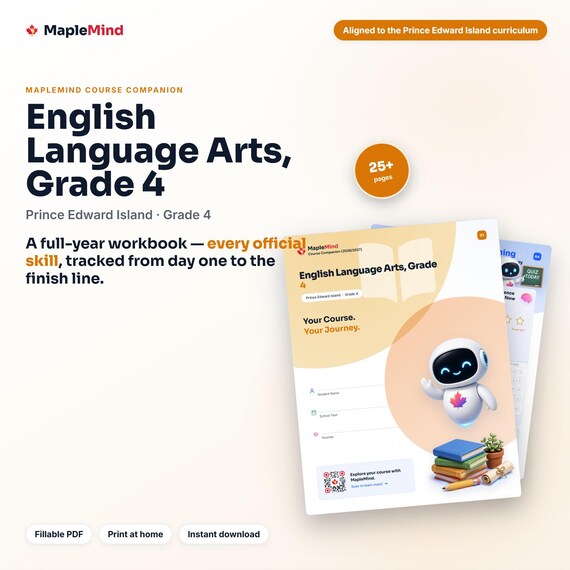
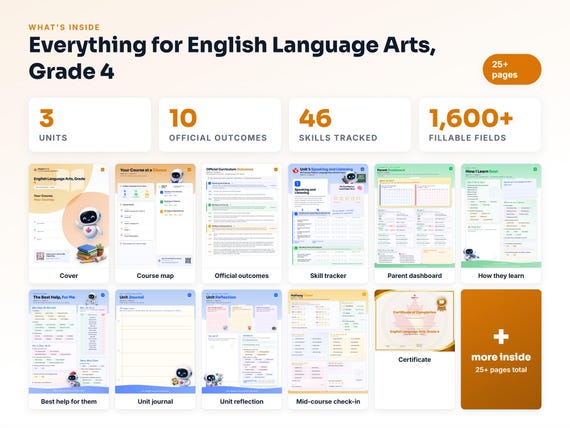
A English Language Arts, Grade 4 workbook worth keeping
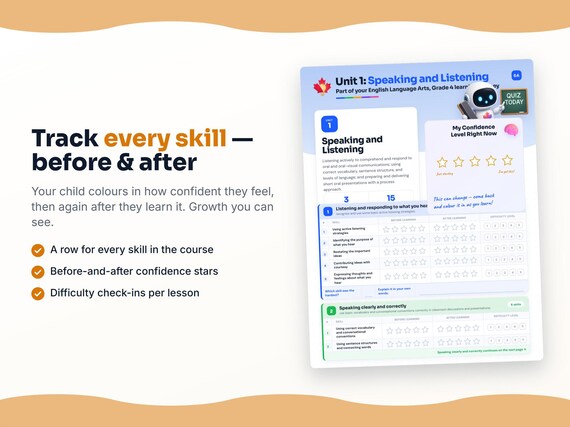
Built from the same official curriculum as this page. Before and after each skill above, your student colours in how sure they feel — so the two of you can see, on one page, what's clicking and what needs another look. It's a quiet way to follow how the year is really going.
By June it's full of their own handwriting: units worked through, confidence grown, a mid-year check-in, notes from parent-teacher night, and a certificate at the end. Less a worksheet, more a record of the year worth keeping on the shelf.
Instant download · see every page, reviews and the full description · five or more workbooks are $2.99 each
What it looks like in the app

Common questions
Can MapleMind help my child with English Language Arts, Grade 4?
Yes. MapleMind's AI tutor covers all 46 skills in Prince Edward Island's English Language Arts, Grade 4 — your child picks the exact skill, and the tutor teaches it step by step: a short lesson, a worked example, solving together, then a skill check to show it stuck.
Is MapleMind aligned to Prince Edward Island's official curriculum?
Yes. Every skill in this course maps to an official outcome code from Prince Edward Island's Grade 4 English Language Arts curriculum, and the ministry's own wording is quoted under each unit on this page — with the official government source linked so you can check it yourself.
What does MapleMind cost?
It's free to start — 5 tutoring chats and a practice quiz every day, no credit card. A Pro subscription ($9.99/month or $49.99/year CAD, 7-day free trial) unlocks unlimited tutoring, practice, and exam simulations.
What if my child is stuck on just one topic?
That's the point of skill-level tutoring: open English Language Arts, Grade 4 in the app, tap the exact skill from the list on this page, and the tutor teaches just that — no wading through lessons your child doesn't need.
Does MapleMind work in French or other languages?
Yes — 14 languages, including French. Both the app and the tutor's explanations switch to the language your child chooses.
Where can I see the official Prince Edward Island curriculum for English Language Arts, Grade 4?
The official source is linked on this page — Prince Edward Island's official curriculum. The outline here follows it: every MapleMind skill carries its official outcome code, and the ministry's own wording is quoted under each unit.
Keep exploring
Ready when you are
Pick a skill from this page and see it taught properly — free, in the browser, in under a minute.