Get help with Pre-Calculus Elective
Most tutoring makes you sit through material you already know. MapleMind flips that: pick the exact skill that's causing trouble — any of the 34 below — and the tutor teaches just that one, step by step, as many times as it takes. Ask questions in plain words, any time of day, in English, French, or 12 other languages.
The official Prince Edward Island Pre-Calculus Elective curriculum
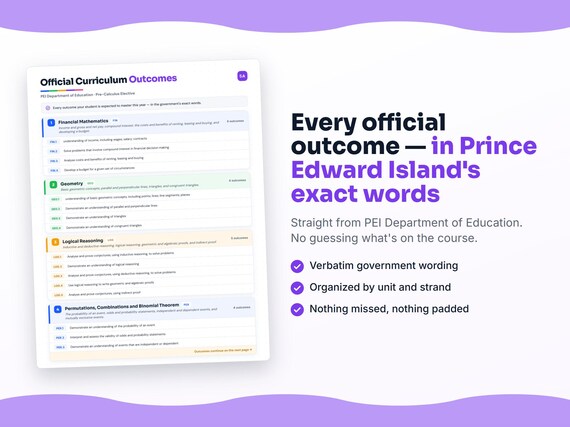
Prince Edward Island defines Pre-Calculus Elective by strands and outcomes. MapleMind teaches the same curriculum reorganized for one-skill-at-a-time tutoring — the table shows exactly where every official strand lands, and the ministry's own wording is quoted under each unit below.
Official source Prince Edward Island's official curriculumRead it on the government site — princeedwardisland.ca ↗| Official strand | Outcomes | Where MapleMind teaches it |
|---|---|---|
| Strand FM | 4 | Financial Mathematics |
| Strand G | 4 | Geometry |
| Strand LR | 5 | Logical Reasoning |
| Strand P | 4 | Permutations, Combinations and Binomial Theorem |
Every skill below, taught one on one.
 Try the first session free
How MapleMind teaches Pre-Calculus Elective — every unit, lesson, and skill
Every skill below runs as a short session: a plain-words lesson, a worked example, solving it together, then a five-question skill check that earns up to three stars. Guided Mode keeps it teaching instead of answer-handing — turning it off needs a parent's password.
Unit 1Financial MathematicsOfficial strand · Strand FM
Income and gross and net pay, compound interest, the costs and benefits of renting, leasing and buying, and developing a budget.
Earning income
- Wages, salary and contractsFM1 — Calculate earnings from hourly wages, salaries, and contract pay, including overtime.
- Commission and pieceworkFM1 — Calculate earnings from commission and piecework pay structures.
- Gross and net payFM1 — Calculate gross pay and net pay by applying deductions such as income tax, CPP, and EI.
Compound interest
- Calculating compound interestFM2 — Calculate the future value of an investment or loan using compound interest.
- Using compound interest in decisionsFM2 — Compare financial options using compound interest, considering rate, time, and compounding frequency.
Renting, leasing and buying
- Comparing the costs of renting, leasing and buyingFM3 — Compute and compare the total costs of renting, leasing, and buying.
- Weighing the benefits of renting, leasing and buyingFM3 — Analyse the non-cost benefits and trade-offs of renting, leasing, and buying.
Developing a budget
- Building a budgetFM4 — Develop a budget by listing income and categorized expenses for a given situation.
- Adjusting a budget to circumstancesFM4 — Adjust a budget to meet a savings goal or a change in circumstances.
The official wording — 4 outcomes in this unit
- FM1
understanding of income, including wages; salary; contracts
- FM2
Solve problems that involve compound interest in financial decision making
- FM3
Analyse costs and benefits of renting, leasing and buying
- FM4
Develop a budget for a given set of circumstances
Unit 2GeometryOfficial strand · Strand G
Basic geometric concepts, parallel and perpendicular lines, triangles, and congruent triangles.
Basic geometric concepts
- Points, lines, segments and planesG1 — Identify and describe points, lines, line segments, and planes.
- Angles and 2-D figuresG1 — Identify and describe angles and two-dimensional figures.
Parallel and perpendicular lines
- Identifying parallel and perpendicular linesG2 — Identify parallel and perpendicular lines and describe their properties.
- Angle relationships from parallel and perpendicular linesG2 — Use the angle relationships created by parallel and perpendicular lines to solve problems.
Triangles
- Classifying trianglesG3 — Classify triangles by their sides and angles and apply the angle-sum property.
- Side and angle relationships in trianglesG3 — Use side and angle relationships, including the exterior-angle and triangle-inequality properties, to solve problems.
Congruent triangles
- Congruence conditionsG4 — Identify congruent triangles using the SSS, SAS, ASA, and AAS conditions.
- Solving problems with congruent trianglesG4 — Use triangle congruence to find unknown measures and justify geometric results.
The official wording — 4 outcomes in this unit
- G1
understanding of basic geometric concepts, including points; lines; line segments; planes
- G2
Demonstrate an understanding of parallel and perpendicular lines
- G3
Demonstrate an understanding of triangles
- G4
Demonstrate an understanding of congruent triangles
Unit 3Logical ReasoningOfficial strand · Strand LR
Inductive and deductive reasoning, logical reasoning, geometric and algebraic proofs, and indirect proof.
Inductive reasoning
- Making conjectures inductivelyLR1 — Use inductive reasoning to observe patterns and make conjectures.
- Testing conjectures and solving problemsLR1 — Test conjectures across cases and use inductive reasoning to solve problems.
Logical reasoning
- Conditional statements and their formsLR2 — Analyse conditional statements and form their converse, inverse, and contrapositive.
- Valid arguments and reasoning errorsLR2 — Judge whether an argument is valid and identify reasoning errors.
Deductive reasoning
- Proving conjectures deductivelyLR3 — Use deductive reasoning to prove a conjecture from accepted facts.
- Deductive reasoning in problem solvingLR3 — Apply deductive reasoning to solve logic problems using elimination and case analysis.
Geometric and algebraic proofs
- Writing geometric proofsLR4 — Write geometric proofs using logical reasoning in two-column or paragraph form.
- Writing algebraic proofsLR4 — Write algebraic proofs of identities and general number properties using logical reasoning.
Indirect proof
- Proof by contradictionLR5 — Analyse and prove conjectures using indirect proof (proof by contradiction).
The official wording — 5 outcomes in this unit
- LR1
Analyse and prove conjectures, using inductive reasoning, to solve problems
- LR2
Demonstrate an understanding of logical reasoning
- LR3
Analyse and prove conjectures, using deductive reasoning, to solve problems
- LR4
Use logical reasoning to write geometric and algebraic proofs
- LR5
Analyse and prove conjectures, using indirect proof
Unit 4Permutations, Combinations and Binomial TheoremOfficial strand · Strand P
The probability of an event, odds and probability statements, independent and dependent events, and mutually exclusive events.
Probability of an event
- Theoretical probability of an eventP1 — Find the theoretical probability of an event from equally likely outcomes.
- Experimental probabilityP1 — Find experimental probability from data and compare it to theoretical probability.
Odds and probability statements
- Odds and probabilityP2 — Interpret odds and convert between odds and probability.
- Assessing probability statementsP2 — Assess the validity of odds and probability statements, including common misconceptions.
Independent and dependent events
- Independent eventsP3 — Find the probability of independent events using the multiplication rule.
- Dependent eventsP3 — Find the probability of dependent events using conditional probability.
Mutually exclusive events
- Mutually exclusive eventsP4 — Find the probability of mutually exclusive events using the addition rule.
- Events that are not mutually exclusiveP4 — Find the probability of events that are not mutually exclusive using the general addition rule.
The official wording — 4 outcomes in this unit
- P1
Demonstrate an understanding of the probability of an event
- P2
Interpret and assess the validity of odds and probability statements
- P3
Demonstrate an understanding of events that are independent or dependent
- P4
Demonstrate an understanding of events that are mutually exclusive and not mutually exclusive
Printable workbook · A keepsake of the year
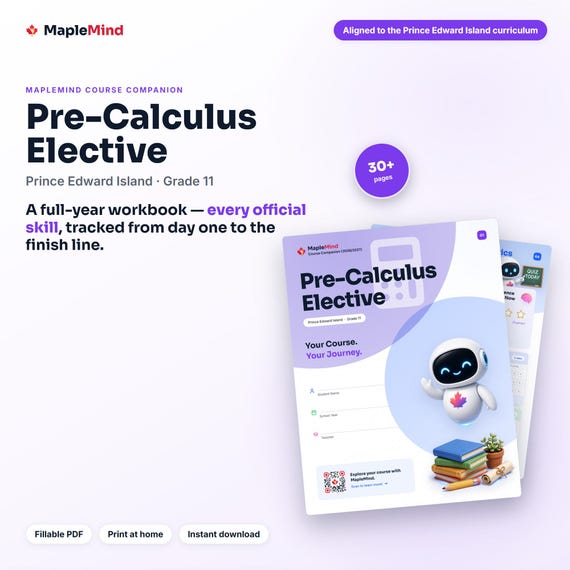
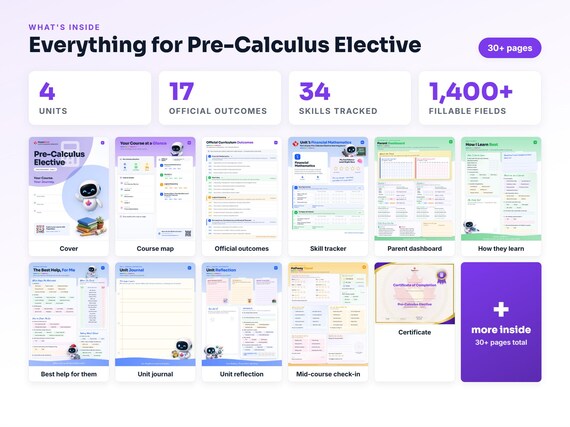
A Pre-Calculus Elective workbook worth keeping
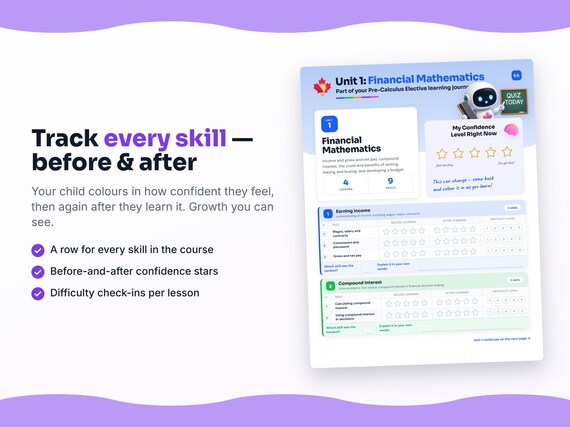
Built from the same official curriculum as this page. Before and after each skill above, your student colours in how sure they feel — so the two of you can see, on one page, what's clicking and what needs another look. It's a quiet way to follow how the year is really going.
By June it's full of their own handwriting: units worked through, confidence grown, a mid-year check-in, notes from parent-teacher night, and a certificate at the end. Less a worksheet, more a record of the year worth keeping on the shelf.
Instant download · see every page, reviews and the full description · five or more workbooks are $2.99 each
What it looks like in the app



Common questions
Can MapleMind help me with Pre-Calculus Elective?
Yes. MapleMind's AI tutor covers all 34 skills in Prince Edward Island's Pre-Calculus Elective — you pick the exact skill, and the tutor teaches it step by step: a short lesson, a worked example, solving together, then a skill check to show it stuck.
Is MapleMind aligned to Prince Edward Island's official curriculum?
Yes. Every skill in this course maps to an official outcome code from Prince Edward Island's Grade 11 Mathematics curriculum, and the ministry's own wording is quoted under each unit on this page — with the official government source linked so you can check it yourself.
What does MapleMind cost?
It's free to start — 5 tutoring chats and a practice quiz every day, no credit card. A Pro subscription ($9.99/month or $49.99/year CAD, 7-day free trial) unlocks unlimited tutoring, practice, and exam simulations.
What if I'm stuck on just one topic?
That's the point of skill-level tutoring: open Pre-Calculus Elective in the app, tap the exact skill from the list on this page, and the tutor teaches just that — no wading through lessons you don't need.
Does MapleMind work in French or other languages?
Yes — 14 languages, including French. Both the app and the tutor's explanations switch to the language you choose.
Where can I see the official Prince Edward Island curriculum for Pre-Calculus Elective?
The official source is linked on this page — Prince Edward Island's official curriculum. The outline here follows it: every MapleMind skill carries its official outcome code, and the ministry's own wording is quoted under each unit.
Keep exploring
Ready when you are
Pick a skill from this page and see it taught properly — free, in the browser, in under a minute.