Get help with Applied Mathematics
Most tutoring makes you sit through material you already know. MapleMind flips that: pick the exact skill that's causing trouble — any of the 46 below — and the tutor teaches just that one, step by step, as many times as it takes. Ask questions in plain words, any time of day, in English, French, or 12 other languages.
The official Prince Edward Island Applied Mathematics curriculum
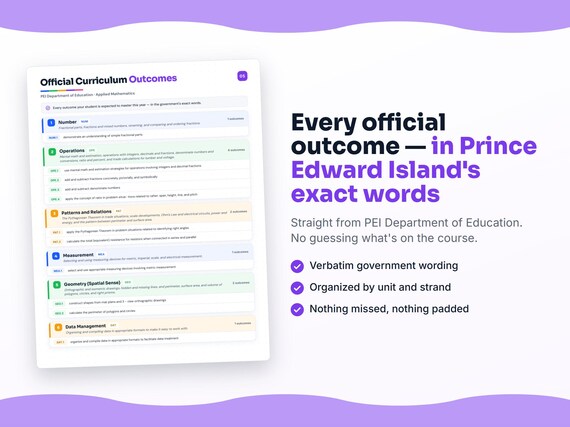
Prince Edward Island defines Applied Mathematics by strands and outcomes. MapleMind teaches the same curriculum reorganized for one-skill-at-a-time tutoring — the table shows exactly where every official strand lands, and the ministry's own wording is quoted under each unit below.
Official source Prince Edward Island's official curriculumRead it on the government site — princeedwardisland.ca ↗| Official strand | Outcomes | Where MapleMind teaches it |
|---|---|---|
| Strand A | 4 | Number |
| Strand B | 16 | Operations |
| Strand C | 10 | Patterns and Relations |
| Strand D | 4 | Measurement |
| Strand E | 11 | Geometry (Spatial Sense) |
| Strand F | 1 | Data Management |
Every skill below, taught one on one.
 Try the first session free
How MapleMind teaches Applied Mathematics — every unit, lesson, and skill
Every skill below runs as a short session: a plain-words lesson, a worked example, solving it together, then a five-question skill check that earns up to three stars. Guided Mode keeps it teaching instead of answer-handing — turning it off needs a parent's password.
Unit 1NumberOfficial strand · Strand A
Fractional parts, fractions and mixed numbers, renaming, and comparing and ordering fractions.
Working with fractions
- Simple fractional partsA1 — Understand simple fractional parts of a whole and of a set.
- Fractions and mixed numbersA2 — Identify and describe fractions and mixed numbers concretely, pictorially, and symbolically.
- Renaming fractionsA3 — Rename fractions to equivalent forms, including simplifying and finding common denominators.
- Comparing and ordering fractionsA4 — Compare and order fractions using common denominators or benchmarks.
The official wording — 4 outcomes in this unit
- A1
demonstrate an understanding of simple fractional parts
- A2
identify and describe factions and mixed numbers concretely, pictorially, and symbolically
- A3
rename fractions
- A4
compare and order fractions
Unit 2OperationsOfficial strand · Strand B
Mental math and estimation, operations with integers, decimals and fractions, denominate numbers and conversions, ratio and percent, and trade calculations for lumber and voltage.
Mental math and estimation
- Mental math and estimation strategiesB1 — Use mental math and estimation strategies for operations involving integers and decimal fractions.
- Applying estimation in problemsB2 — Apply mental math and estimation strategies in problem situations when appropriate.
- Operations with integers and decimalsB3 — Perform operations involving integers and decimal fractions using the most appropriate method.
Fractions and decimals
- Adding and subtracting fractionsB4 — Add and subtract fractions concretely, pictorially, and symbolically.
- Fraction problemsB5 — Add and subtract fractions in problem situations using the most appropriate method.
- Common fractions to decimalsB6 — Convert common fractions to decimal fractions.
- Decimals to sixteenthsB7 — Convert decimal fractions to the nearest common sixteenth fraction.
Denominate numbers and conversions
- Adding and subtracting denominate numbersB8 — Add and subtract denominate numbers such as feet and inches.
- Multiplying and dividing denominate numbersB9 — Multiply and divide denominate numbers by whole numbers.
- Converting measurements mentallyB10 — Convert between measurements mentally when appropriate.
- Converting measurements using rateB11 — Convert between measurements within or between systems using the concept of rate.
Ratio, percent, and job estimates
- Ratio and rafter proportionsB12 — Apply the concept of ratio in problem situations related to a rafter's span, height, line, and pitch.
- Estimating materials and costB13 — Estimate material quantities and cost in problem situations.
- Percent in problemsB14 — Apply percent in problem situations.
- Lineal feet and board feetB15 — Calculate lumber quantities using lineal feet and board feet.
- Dry cells in series and parallelB16 — Calculate total voltage for dry cells connected in series and parallel.
The official wording — 16 outcomes in this unit
- B1
use mental math and estimation strategies for operations involving integers and decimal fractions
- B2
apply mental math and estimation strategies in problem situations when appropriate
- B3
perform operations involving integers and decimal fractions in practice and problem situations using the most appropriate method
- B4
add and subtract fractions concretely, pictorially, and symbolically
- B5
add and subtract fractions in problem situations using the most appropriate method
- B6
convert common fractions to decimal fractions
- B7
convert decimal fractions to a common 16th fraction
- B8
add and subtract denominate numbers
- B9
multiply and divide denominate numbers by whole numbers
- B10
convert between measurements mentally when appropriate
- B11
convert between measurements within, or between, systems of measurement using the concept of rate
- B12
apply the concept of ratio in problem situa- tions related to rafter: span, height, line, and pitch
- B13
estimate material quantities and cost in prob- lem situations
- B14
apply percent in problem situations
- B15
calculate lumber quantities using lineal feet and board feet
- B16
calculate total voltage for dry cells connected in series and parallel
Unit 3Patterns and RelationsOfficial strand · Strand C
The Pythagorean Theorem in trade situations, scale developments, Ohm's Law and electrical circuits, power and energy, and the pattern between perimeter and surface area.
The Pythagorean Theorem on the job
- Identifying right anglesC1 — Apply the Pythagorean Theorem to identify right angles in problem situations.
- Scale developmentsC2 — Analyse, explain, and construct developments involving real-number operations and the concept of scale.
- Rafter length with PythagorasC3 — Apply the Pythagorean Theorem to rafter span, height, and line.
- Solving for a side with PythagorasC4 — Solve for single variables in problem situations using the Pythagorean Theorem.
Circuits, Ohm's Law, power and energy
- Equivalent resistanceC5 — Calculate the total equivalent resistance for resistors connected in series and parallel.
- Ohm's LawC6 — Solve for single variables in problem situations using Ohm's Law.
- Analysing series and parallel circuitsC7 — Analyse series and parallel circuits to determine the voltage, current, and resistance at any device using the most appropriate method.
- Electrical powerC8 — Solve for single variables in problem situations involving electrical power.
- Electrical energyC9 — Solve for single variables in problem situations involving electrical energy.
- Perimeter and surface area patternsC10 — Identify and describe patterns between perimeter and surface area.
The official wording — 10 outcomes in this unit
- C1
apply the Pythagorean Theorem in problem situations related to identifying right angles
- C2
analyse, explain, and construct developments in problem situations pertaining to real number operations and the concept of scale
- C3
apply the Pythagorean Theorem in problem situations related to rafter: span, height, and line
- C4
solve for single variables in problem situations using the Pythagorean Theorem
- C5
calculate the total (equivalent) resistance for resistors when connected in series and parallel
- C6
solve for single variables in problem situations using Ohm’s Law
- C7
analyse series and parallel ciruits to determine the voltage, current, and resistance at any devise (resistor) using the most appropriate method
- C8
solve for single variables in problem situations involving electrical power
- C9
solve for single variables in problem situations involving electrical energy
- C10
identify and describe patterns between perim- eter and surface area
Unit 4MeasurementOfficial strand · Strand D
Selecting and using measuring devices for metric, imperial, scale, and electrical measurement.
Measuring devices
- Metric measuring devicesD1 — Select and use appropriate measuring devices involving metric measurement.
- Imperial measuring devicesD2 — Select and use appropriate measuring devices involving imperial measurement.
- Scale measuring devicesD3 — Construct and use appropriate measuring devices related to the concept of scale.
- Electrical measuring devicesD4 — Select and use appropriate measuring devices involving electrical quantities.
The official wording — 4 outcomes in this unit
- D1
select and use appropriate measuring devices involving metric measurement
- D2
select and use appropriate measuring devices involving imperial measurement
- D3
construct and use appropriate measuring devices related to the concept of scale
- D4
select and use appropriate measuring devices involving electrical quantitites
Unit 5Geometry (Spatial Sense)Official strand · Strand E
Orthographic and isometric drawings, hidden and missing lines, and perimeter, surface area, and volume of polygons, circles, and right prisms.
Orthographic and isometric drawing
- Shapes from mat plans and orthographic drawingsE1 — Construct shapes from mat plans and 3-view orthographic drawings.
- Orthographic drawings from mat plansE2 — Create 3-view orthographic drawings from mat plans and vice versa.
- Isometric drawings from mat plansE3 — Create isometric drawings from mat plans.
- Identifying composite isometric drawingsE4 — Identify isometric drawings from a combination of composite isometric drawings.
- Isometric and orthographic conversionE6 — Create isometric drawings from 3-view orthographic drawings and vice versa.
Perimeter, area, and volume
- Perimeter of polygons and circlesE7 — Calculate the perimeter of polygons and circles.
- Surface areas of polygons, circles and prismsE8 — Calculate the surface areas of polygons, circles, and right prisms.
- Volumes of right prismsE9 — Calculate the volumes of right prisms.
- Surface area and volume patternsE10 — Identify and describe patterns between surface area and volume of right prisms.
- Constructing right prismsE11 — Construct right prisms from component polygons, circles, and nets.
The official wording — 11 outcomes in this unit
- E1
construct shapes from mat plans and 3 - view orthographic drawings
- E2
create 3-view orthographic drawings from mat plans and vice versa
- E3
create isometric drawings from mat plans
- E4
identify isometric drawings from a combination of composite isometric drawings
- E5
identify and draw hidden and missing lines on a 3-view orthographic drawing
- E6
create isometric drawings from 3-view ortho- graphic drawings and vice versa
- E7
calculate the perimeter of polygons and circles
- E8
calculate the surface areas of polygons, circles and right prisms
- E9
calculate the volumes of right prisms
- E10
identify and describe patterns between surface area and volume of right prisms.
- E11
construct right prisms from component polygons/circles and nets
Unit 6Data ManagementOfficial strand · Strand F
Organizing and compiling data in appropriate formats to make it easy to work with.
Organizing data
- Organizing and compiling dataF1 — Organize and compile data in appropriate formats to facilitate data treatment.
The official wording — 1 outcome in this unit
- F1
organize and compile data in appropriate formats to facilitate data treatment

Printable workbook · A keepsake of the year
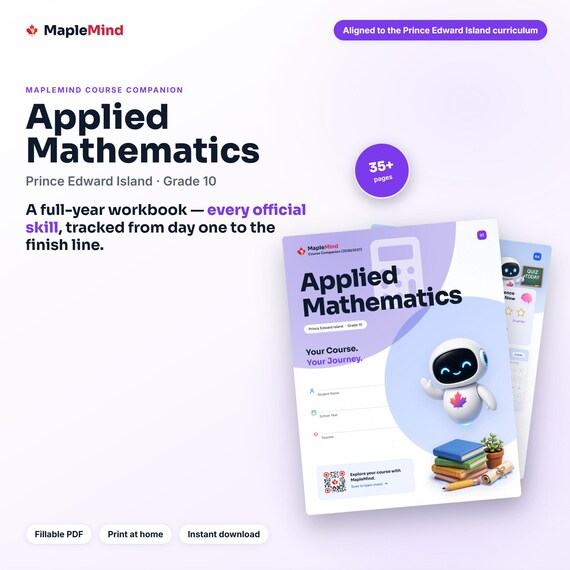
A Applied Mathematics workbook worth keeping
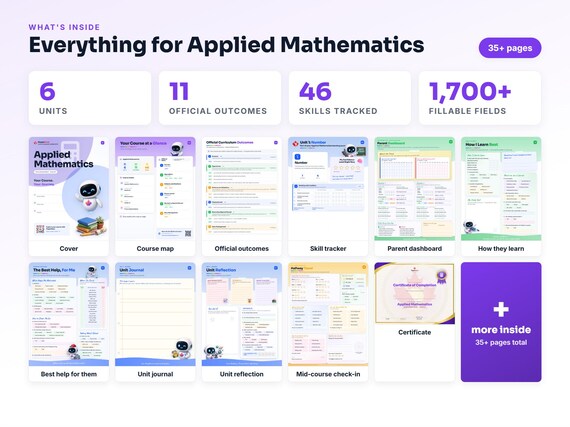
Built from the same official curriculum as this page. Before and after each skill above, your student colours in how sure they feel — so the two of you can see, on one page, what's clicking and what needs another look. It's a quiet way to follow how the year is really going.
By June it's full of their own handwriting: units worked through, confidence grown, a mid-year check-in, notes from parent-teacher night, and a certificate at the end. Less a worksheet, more a record of the year worth keeping on the shelf.
Instant download · see every page, reviews and the full description · five or more workbooks are $2.99 each
What it looks like in the app



Common questions
Can MapleMind help me with Applied Mathematics?
Yes. MapleMind's AI tutor covers all 46 skills in Prince Edward Island's Applied Mathematics — you pick the exact skill, and the tutor teaches it step by step: a short lesson, a worked example, solving together, then a skill check to show it stuck.
Is MapleMind aligned to Prince Edward Island's official curriculum?
Yes. Every skill in this course maps to an official outcome code from Prince Edward Island's Grade 10 Mathematics curriculum, and the ministry's own wording is quoted under each unit on this page — with the official government source linked so you can check it yourself.
What does MapleMind cost?
It's free to start — 5 tutoring chats and a practice quiz every day, no credit card. A Pro subscription ($9.99/month or $49.99/year CAD, 7-day free trial) unlocks unlimited tutoring, practice, and exam simulations.
What if I'm stuck on just one topic?
That's the point of skill-level tutoring: open Applied Mathematics in the app, tap the exact skill from the list on this page, and the tutor teaches just that — no wading through lessons you don't need.
Does MapleMind work in French or other languages?
Yes — 14 languages, including French. Both the app and the tutor's explanations switch to the language you choose.
Where can I see the official Prince Edward Island curriculum for Applied Mathematics?
The official source is linked on this page — Prince Edward Island's official curriculum. The outline here follows it: every MapleMind skill carries its official outcome code, and the ministry's own wording is quoted under each unit.
Keep exploring
Ready when you are
Pick a skill from this page and see it taught properly — free, in the browser, in under a minute.