Get help with Apprenticeship and Workplace Mathematics 10
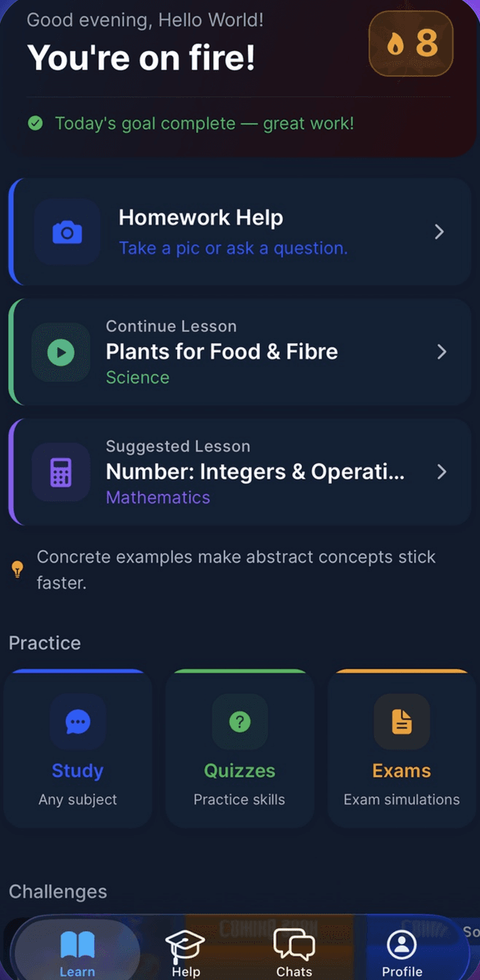
Most tutoring makes you sit through material you already know. MapleMind flips that: pick the exact skill that's causing trouble — any of the 30 below — and the tutor teaches just that one, step by step, as many times as it takes. Ask questions in plain words, any time of day, in English, French, or 12 other languages.
The official Prince Edward Island Apprenticeship and Workplace Mathematics 10 curriculum
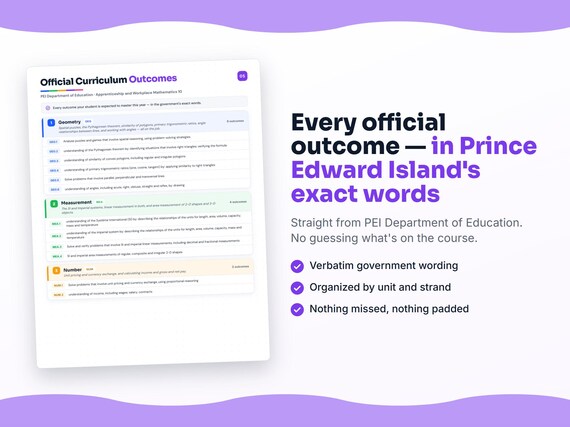
Prince Edward Island defines Apprenticeship and Workplace Mathematics 10 by strands and outcomes. MapleMind teaches the same curriculum reorganized for one-skill-at-a-time tutoring — the table shows exactly where every official strand lands, and the ministry's own wording is quoted under each unit below.
Official source Prince Edward Island's official curriculumRead it on the government site — princeedwardisland.ca ↗| Official strand | Outcomes | Where MapleMind teaches it |
|---|---|---|
| Strand G | 6 | Geometry |
| Strand M | 4 | Measurement |
| Strand N | 2 | Number |
Every skill below, taught one on one.
 Try the first session free
How MapleMind teaches Apprenticeship and Workplace Mathematics 10 — every unit, lesson, and skill
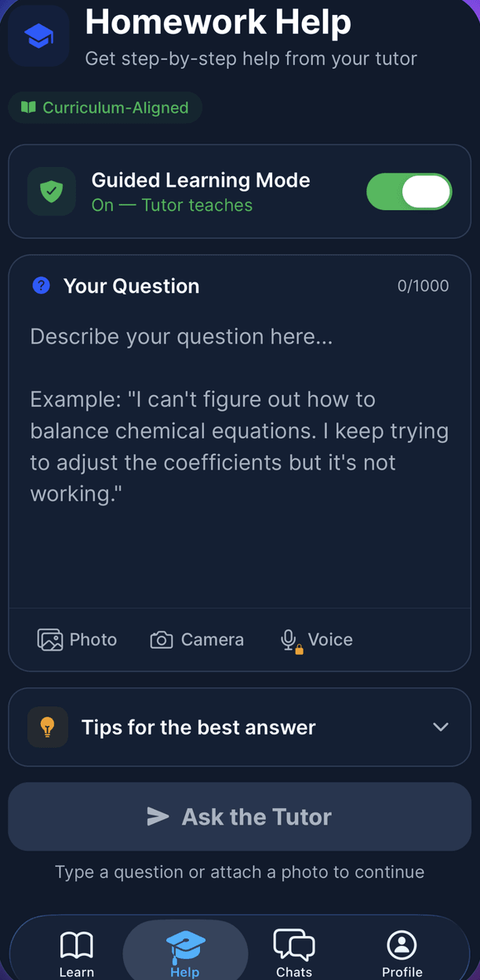
Every skill below runs as a short session: a plain-words lesson, a worked example, solving it together, then a five-question skill check that earns up to three stars. Guided Mode keeps it teaching instead of answer-handing — turning it off needs a parent's password.
Unit 1GeometryOfficial strand · Strand G
Spatial puzzles, the Pythagorean theorem, similarity of polygons, primary trigonometric ratios, angle relationships between lines, and working with angles — all on the job.
Puzzles and games with spatial reasoning
- Analysing spatial puzzles and gamesG1 — Use problem-solving strategies to analyse puzzles and games that involve spatial reasoning.
The Pythagorean theorem on the job
- Recognizing and verifying the Pythagorean theoremG2 — Identify situations that involve right triangles and verify the Pythagorean relationship.
- Applying the Pythagorean formulaG2 — Apply the Pythagorean theorem to find an unknown side of a right triangle.
- Solving job problems with the Pythagorean theoremG2 — Solve contextual job-site right-triangle problems using the Pythagorean theorem.
Similarity of polygons
- Recognizing similar polygonsG3 — Recognize similar convex polygons, including regular and irregular polygons, by equal angles and proportional sides.
- Solving problems with similar polygonsG3 — Use similarity and the scale factor to find unknown lengths in similar polygons.
Primary trigonometric ratios
- Similar right triangles and constant ratiosG4 — Apply similarity to right triangles as the basis of the trigonometric ratios.
- Generalizing the ratio patternsG4 — Generalize patterns from similar right triangles to define sine, cosine, and tangent.
- Applying the primary trigonometric ratiosG4 — Apply sine, cosine, and tangent to find unknown sides and angles in right triangles.
- Solving job problems with trigonometryG4 — Solve real trades problems, such as heights and distances, using the primary trigonometric ratios.
Angle relationships between lines
- Parallel, perpendicular and transversal linesG5 — Identify parallel, perpendicular, and transversal lines and the setups they create.
- Angle pairs between linesG5 — Solve problems involving the pairs of angles formed between parallel, perpendicular, and transversal lines.
Working with angles
- Drawing angles of every typeG6 — Draw acute, right, obtuse, straight, and reflex angles with a protractor.
- Replicating and constructing anglesG6 — Replicate and construct angles using a compass and straightedge.
- Bisecting anglesG6 — Bisect angles into two equal halves using construction.
- Solving problems with anglesG6 — Solve problems that involve identifying, measuring, and combining angles of different types.
The official wording — 6 outcomes in this unit
- G1
Analyse puzzles and games that involve spatial reasoning, using problem-solving strategies
- G2
understanding of the Pythagorean theorem by: identifying situations that involve right triangles; verifying the formula
- G3
understanding of similarity of convex polygons, including regular and irregular polygons
- G4
understanding of primary trigonometric ratios (sine, cosine, tangent) by: applying similarity to right triangles
- G5
Solve problems that involve parallel, perpendicular and transversal lines
- G6
understanding of angles, including acute, right, obtuse, straight and reflex, by: drawing
Unit 2MeasurementOfficial strand · Strand M
The SI and Imperial systems, linear measurement in both, and area measurement of 2-D shapes and 3-D objects.
The SI (metric) system
- SI units and their relationshipsM1 — Describe the SI units for length, area, volume, capacity, mass, and temperature and the relationships among them.
- Converting SI units to ImperialM1 — Apply strategies to convert SI units to Imperial units.
The Imperial system
- Imperial units and their relationshipsM2 — Describe the Imperial units for length, area, volume, capacity, mass, and temperature and the relationships among them.
- American and British capacity unitsM2 — Compare the American and British Imperial units for capacity.
- Converting Imperial units to SIM2 — Apply strategies to convert Imperial units to SI units.
Linear measurement in SI and Imperial
- Solving linear measurement problemsM3 — Solve problems involving SI and Imperial linear measurements, including decimal and fractional measurements.
- Verifying linear measurement solutionsM3 — Verify linear measurement solutions by estimation and by re-measuring or converting.
Area of 2-D shapes and 3-D objects
- Area of regular and composite 2-D shapesM4 — Solve area problems for regular and composite 2-D shapes, including decimal and fractional measurements.
- Area of irregular 2-D shapesM4 — Estimate the area of irregular 2-D shapes using grids and approximating shapes.
- Surface area of 3-D objectsM4 — Solve and verify area (surface-area) problems for 3-D objects, including decimal and fractional measurements.
The official wording — 4 outcomes in this unit
- M1
understanding of the Système International (SI) by: describing the relationships of the units for length, area, volume, capacity, mass and temperature
- M2
understanding of the imperial system by: describing the relationships of the units for length, area, volume, capacity, mass and temperature
- M3
Solve and verify problems that involve SI and imperial linear measurements, including decimal and fractional measurements
- M4
SI and imperial area measurements of regular, composite and irregular 2-D shapes
Unit 3NumberOfficial strand · Strand N
Unit pricing and currency exchange, and calculating income and gross and net pay.
Unit pricing and currency exchange
- Unit pricing and currency exchangeN1 — Use proportional reasoning to find unit prices, compare best buys, and convert currencies.
Earning income
- Wages, salary and contractsN2 — Calculate earnings from hourly wages, salaries, and contract pay, including overtime.
- Commission and pieceworkN2 — Calculate earnings from commission and piecework pay structures.
- Gross and net payN2 — Calculate gross pay and net pay by applying deductions such as income tax, CPP, and EI.
The official wording — 2 outcomes in this unit
- N1
Solve problems that involve unit pricing and currency exchange, using proportional reasoning
- N2
understanding of income, including wages; salary; contracts
Printable workbook · A keepsake of the year
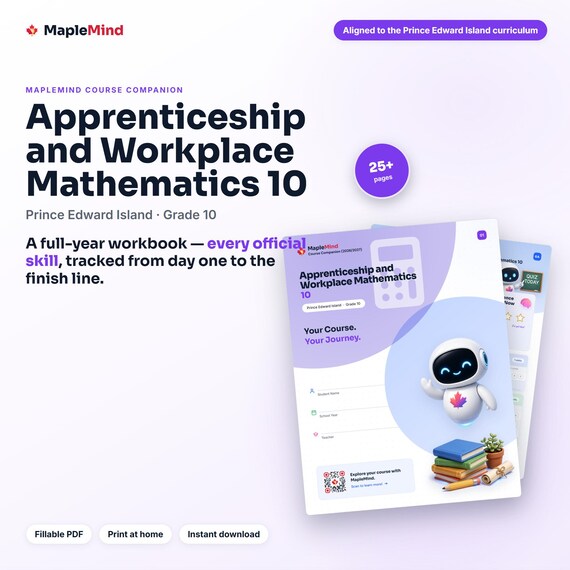
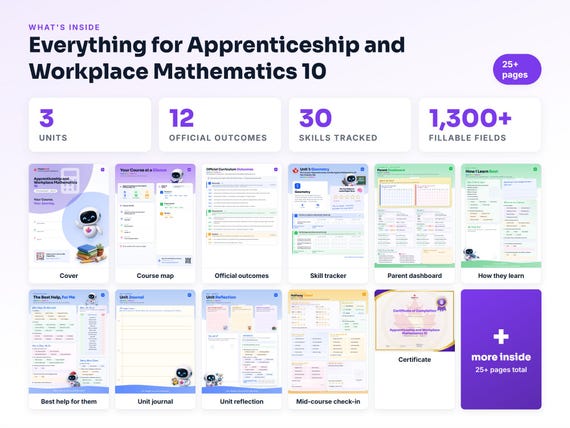
A Apprenticeship and Workplace Mathematics 10 workbook worth keeping
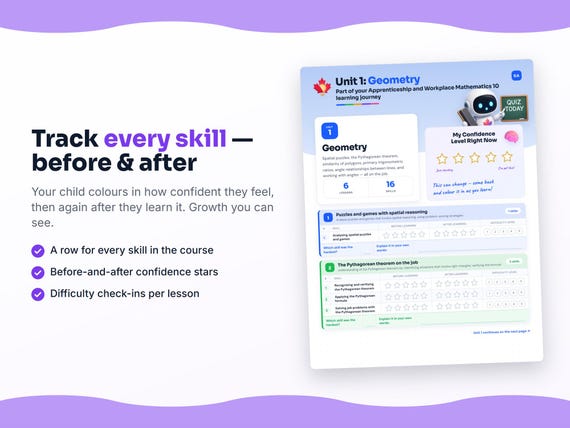
Built from the same official curriculum as this page. Before and after each skill above, your student colours in how sure they feel — so the two of you can see, on one page, what's clicking and what needs another look. It's a quiet way to follow how the year is really going.
By June it's full of their own handwriting: units worked through, confidence grown, a mid-year check-in, notes from parent-teacher night, and a certificate at the end. Less a worksheet, more a record of the year worth keeping on the shelf.
Instant download · see every page, reviews and the full description · five or more workbooks are $2.99 each
What it looks like in the app
Common questions
Can MapleMind help me with Apprenticeship and Workplace Mathematics 10?
Yes. MapleMind's AI tutor covers all 30 skills in Prince Edward Island's Apprenticeship and Workplace Mathematics 10 — you pick the exact skill, and the tutor teaches it step by step: a short lesson, a worked example, solving together, then a skill check to show it stuck.
Is MapleMind aligned to Prince Edward Island's official curriculum?
Yes. Every skill in this course maps to an official outcome code from Prince Edward Island's Grade 10 Mathematics curriculum, and the ministry's own wording is quoted under each unit on this page — with the official government source linked so you can check it yourself.
What does MapleMind cost?
It's free to start — 5 tutoring chats and a practice quiz every day, no credit card. A Pro subscription ($9.99/month or $49.99/year CAD, 7-day free trial) unlocks unlimited tutoring, practice, and exam simulations.
What if I'm stuck on just one topic?
That's the point of skill-level tutoring: open Apprenticeship and Workplace Mathematics 10 in the app, tap the exact skill from the list on this page, and the tutor teaches just that — no wading through lessons you don't need.
Does MapleMind work in French or other languages?
Yes — 14 languages, including French. Both the app and the tutor's explanations switch to the language you choose.
Where can I see the official Prince Edward Island curriculum for Apprenticeship and Workplace Mathematics 10?
The official source is linked on this page — Prince Edward Island's official curriculum. The outline here follows it: every MapleMind skill carries its official outcome code, and the ministry's own wording is quoted under each unit.
Keep exploring
Ready when you are
Pick a skill from this page and see it taught properly — free, in the browser, in under a minute.