Get help with Biology 11 (BIO521A)
Most tutoring makes you sit through material you already know. MapleMind flips that: pick the exact skill that's causing trouble — any of the 29 below — and the tutor teaches just that one, step by step, as many times as it takes. Ask questions in plain words, any time of day, in English, French, or 12 other languages.
The official Prince Edward Island Biology 11 (BIO521A) curriculum
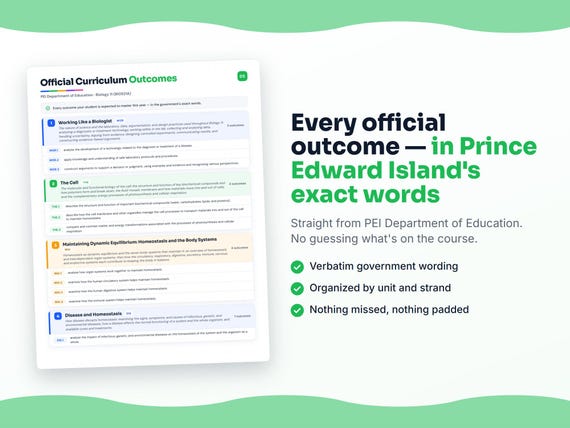
Prince Edward Island defines Biology 11 (BIO521A) by strands and outcomes. MapleMind teaches the same curriculum reorganized for one-skill-at-a-time tutoring — the table shows exactly where every official strand lands, and the ministry's own wording is quoted under each unit below.
Official source Prince Edward Island's official curriculumRead it on the government site — princeedwardisland.ca ↗| Official strand | Outcomes | Where MapleMind teaches it |
|---|---|---|
| Strand PK | 8 | Working Like a Biologist |
| Strand CK | 12 | The Cell · Maintaining Dynamic Equilibrium: Homeostasis and the Body Systems · Disease and Homeostasis |
Every skill below, taught one on one.
 Try the first session free
How MapleMind teaches Biology 11 (BIO521A) — every unit, lesson, and skill
Every skill below runs as a short session: a plain-words lesson, a worked example, solving it together, then a five-question skill check that earns up to three stars. Guided Mode keeps it teaching instead of answer-handing — turning it off needs a parent's password.
Unit 1Working Like a BiologistOfficial strand · Strand PK
The nature of science and the laboratory, data, argumentation, and design practices used throughout Biology 11: analysing a diagnostic or treatment technology, working safely in the lab, collecting and analysing data, handling uncertainty, arguing from evidence, designing controlled experiments, communicating results, and constructing evidence-based arguments.
Science, Technology, and Disease
- Analysing a diagnostic or treatment technologybio11.NoS.1 — Analyse the development of a technology related to the diagnosis or treatment of a disease.
Investigating and Arguing in Biology
- Safe laboratory protocolsbio11.PK1 — Apply knowledge and understanding of safe laboratory protocols and procedures.
- Collecting and analysing databio11.PK.2 — Apply appropriate techniques, procedures, and technologies for collecting and analysing data to solve problems.
- Uncertainty in measurementbio11.PK.3 — Use uncertainty in data measurement and data processing.
- Evaluating phenomena with argumentationbio11.PK.4 — Evaluate scientific phenomena using argumentation.
- Designing a controlled experimentbio11.PK.5 — Design an experiment identifying and controlling major variables.
- Communicating research and resultsbio11.PK.6 — Use appropriate language, visual aids, and formatting conventions to communicate plans, procedures, data, results, and conclusions.
Constructing Evidence-Based Arguments
- Constructing an argument from evidence and perspectivesbio11.DP.1 — Construct arguments to support a decision or judgment, using examples and evidence and recognizing various perspectives.
The official wording — 8 outcomes in this unit
- bio11.NoS.1
analyse the development of a technology related to the diagnosis or treatment of a disease.
- bio11.PK1
apply knowledge and understanding of safe laboratory protocols and procedures.
- bio11.PK.2
apply appropriate techniques, procedures, and technologies for collecting and analysing data to solve problems.
- bio11.PK.3
use uncertainty in data measurement and data processing.
- bio11.PK.4
evaluate scientific phenomena using argumentation.
- bio11.PK.5
design an experiment identifying and controlling major variables.
- bio11.PK.6
use appropriate language, visual aids, and formatting conventions to effectively communicate plans, procedures, data, results, and conclusions of research and experimentation.
- bio11.DP.1
construct arguments to support a decision or judgment, using examples and evidence and recognising various perspectives.
Unit 2The CellOfficial strand · Strand CK
The molecular and functional biology of the cell: the structure and function of key biochemical compounds and how polymers form and break down, the fluid-mosaic membrane and how materials move into and out of cells, and the complementary energy processes of photosynthesis and cellular respiration.
The Biochemistry of Life
- Water and the biochemical compoundsbio11.CK.1.1 — Describe the structure and properties of water and the basic structure and function of carbohydrates, lipids, and proteins.
- Polymers: synthesis and hydrolysisbio11.CK.1.1 — Explain how monomers build into polymers by dehydration synthesis and are broken down by hydrolysis.
The Cell Membrane and Transport
- The membrane and passive transportbio11.CK.1.2 — Explain the fluid-mosaic membrane and how materials move by diffusion and osmosis across a selectively permeable membrane.
- Active transport and bulk transportbio11.CK.1.2 — Explain active transport and bulk transport (protein pumps, endocytosis, exocytosis) and contrast them with passive transport.
Photosynthesis and Cellular Respiration
- Photosynthesis, respiration, and the energy cyclebio11.CK.1.3 — Explain the ATP energy cycle and how photosynthesis and cellular respiration are complementary processes at cellular and global scales.
The official wording — 3 outcomes in this unit
- bio11.CK.1.1
describe the structure and function of important biochemical compounds (water, carbohydrates, lipids, and proteins).
- bio11.CK.1.2
describe how the cell membrane and other organelles manage the cell processes to transport materials into and out of the cell to maintain homeostasis.
- bio11.CK.1.3
compare and contrast matter and energy transformations associated with the processes of photosynthesis and cellular respiration.
Unit 3Maintaining Dynamic Equilibrium: Homeostasis and the Body SystemsOfficial strand · Strand CK
Homeostasis as dynamic equilibrium and the seven body systems that maintain it: an overview of homeostasis and interdependent organ systems, then how the circulatory, respiratory, digestive, excretory, immune, nervous, and endocrine systems each contribute to keeping the body in balance.
Homeostasis and Interdependent Systems
- Homeostasis and interdependent organ systemsbio11.CK.2.1 — Define homeostasis as dynamic equilibrium and analyse how organ systems depend on one another to maintain it.
The Circulatory and Respiratory Systems
- The heart and blood flowbio11.CK.2.2 — Identify the parts of the heart, trace blood flow through the pulmonary and systemic pathways, and explain how the SA and AV nodes control the heartbeat.
- Blood vessels, blood, and homeostasisbio11.CK.2.2 — Describe the structure and function of blood vessels and blood, blood pressure, and how the circulatory system maintains homeostasis.
- Respiratory parts and the mechanics of breathingbio11.CK.2.3 — Explain the characteristics of a respiratory surface, the parts of the respiratory system, and the mechanics of breathing.
- Gas transport, lung volumes, and homeostasisbio11.CK.2.3 — Explain how respiratory gases are transported in the blood, describe lung volumes, and explain how the respiratory system maintains homeostasis.
The Digestive and Excretory Systems
- Mechanical and chemical digestionbio11.CK.2.4 — Explain the purpose of the digestive system, distinguish mechanical from chemical digestion, and identify the major digestive organs and glands.
- Absorption, enzymes, and homeostasisbio11.CK.2.4 — Trace the pathway of food, explain absorption by structures like villi and the role of enzymes and the microbiome, and how the digestive system maintains homeostasis.
- Excretory organs and the kidneybio11.CK.2.5 — Explain the excretory roles of the lungs, skin, and liver and the structure and role of the kidney and urinary system.
- The nephron and homeostasisbio11.CK.2.5 — Explain how the nephron filters blood and how the excretory system maintains homeostasis by removing wastes and balancing water.
The Immune, Nervous, and Endocrine Systems
- Immune barriers and defensive cellsbio11.CK.2.6 — Compare the body's physical and chemical barriers and the inflammatory response, and describe the roles of phagocytes and lymphocytes.
- Antibodies, immunity, and homeostasisbio11.CK.2.6 — Explain antigens and antibodies, distinguish passive from acquired immunity, and explain how the immune system maintains homeostasis.
- Neurons and signal transmissionbio11.CK.2.7 — Describe neuron types and structure and how a signal is transmitted along a neuron and across a synapse.
- The nervous system and homeostasisbio11.CK.2.7 — Explain the central and peripheral nervous systems and how the nervous system maintains homeostasis by coordinating responses.
- Hormones and endocrine glandsbio11.CK.2.8 — Compare endocrine and nervous communication and explain hormones, target cells, and the principal endocrine glands.
- Negative feedback and homeostasisbio11.CK.2.8 — Explain how hormones and negative feedback loops keep the body in balance and how the endocrine system maintains homeostasis.
The official wording — 8 outcomes in this unit
- bio11.CK.2.1
analyse how organ systems work together to maintain homeostasis.
- bio11.CK.2.2
examine how the human circulatory system helps maintain homeostasis.
- bio11.CK.2.3
examine how the human respiratory system helps maintain homeostasis.
- bio11.CK.2.4
examine how the human digestive system helps maintain homeostasis.
- bio11.CK.2.5
examine how the excretory system helps maintain homeostasis.
- bio11.CK.2.6
examine how the immune system helps maintain homeostasis.
- bio11.CK.2.7
examine how the nervous system helps maintain homeostasis.
- bio11.CK.2.8
examine how the endocrine system helps maintain homeostasis.
Unit 4Disease and HomeostasisOfficial strand · Strand CK
How disease disrupts homeostasis: examining the signs, symptoms, and causes of infectious, genetic, and environmental diseases, how a disease affects the normal functioning of a system and the whole organism, and available cures and treatments.
How Disease Disrupts Homeostasis
- Disease and its impact on homeostasisbio11.CK.3 — Examine the signs, symptoms, and causes of infectious, genetic, and environmental diseases and analyse how disease disrupts a body system and the whole organism.
The official wording — 1 outcome in this unit
- bio11.CK.3
analyse the impact of infectious, genetic, and environmental diseases on the homeostasis of the system and the organism as a whole.
Printable workbook · A keepsake of the year
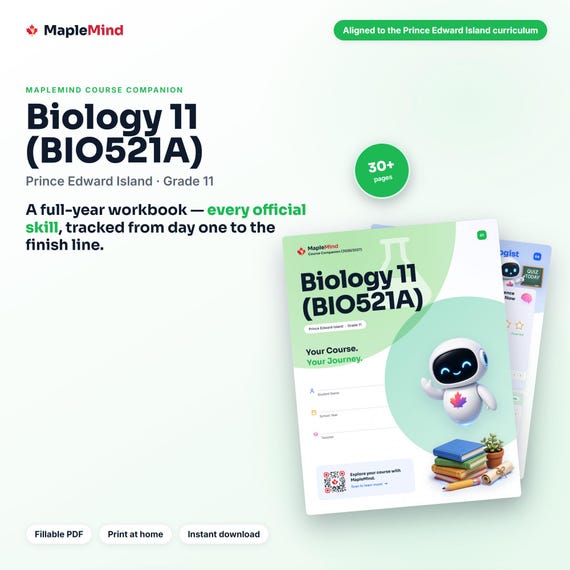
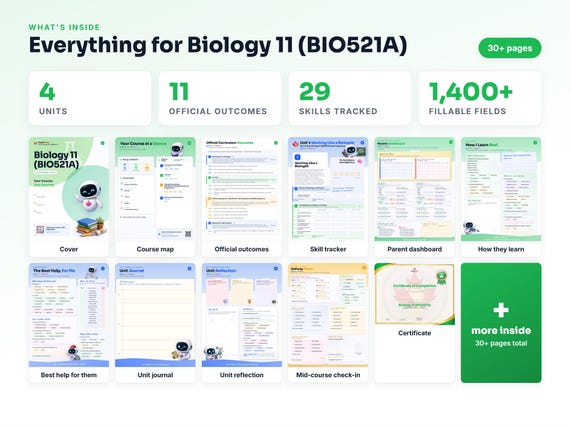
A Biology 11 (BIO521A) workbook worth keeping
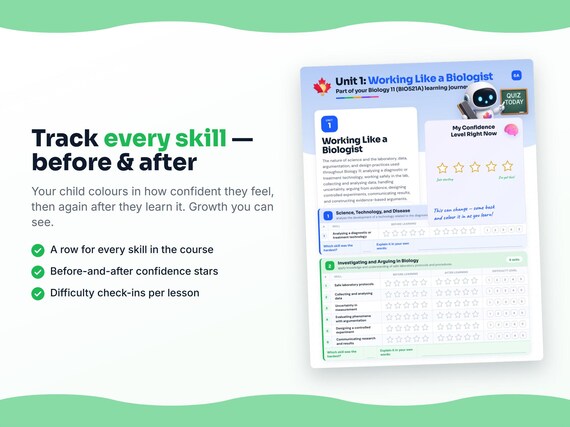
Built from the same official curriculum as this page. Before and after each skill above, your student colours in how sure they feel — so the two of you can see, on one page, what's clicking and what needs another look. It's a quiet way to follow how the year is really going.
By June it's full of their own handwriting: units worked through, confidence grown, a mid-year check-in, notes from parent-teacher night, and a certificate at the end. Less a worksheet, more a record of the year worth keeping on the shelf.
Instant download · see every page, reviews and the full description · five or more workbooks are $2.99 each
What it looks like in the app



Common questions
Can MapleMind help me with Biology 11 (BIO521A)?
Yes. MapleMind's AI tutor covers all 29 skills in Prince Edward Island's Biology 11 (BIO521A) — you pick the exact skill, and the tutor teaches it step by step: a short lesson, a worked example, solving together, then a skill check to show it stuck.
Is MapleMind aligned to Prince Edward Island's official curriculum?
Yes. Every skill in this course maps to an official outcome code from Prince Edward Island's Grade 11 Science curriculum, and the ministry's own wording is quoted under each unit on this page — with the official government source linked so you can check it yourself.
What does MapleMind cost?
It's free to start — 5 tutoring chats and a practice quiz every day, no credit card. A Pro subscription ($9.99/month or $49.99/year CAD, 7-day free trial) unlocks unlimited tutoring, practice, and exam simulations.
What if I'm stuck on just one topic?
That's the point of skill-level tutoring: open Biology 11 (BIO521A) in the app, tap the exact skill from the list on this page, and the tutor teaches just that — no wading through lessons you don't need.
Does MapleMind work in French or other languages?
Yes — 14 languages, including French. Both the app and the tutor's explanations switch to the language you choose.
Where can I see the official Prince Edward Island curriculum for Biology 11 (BIO521A)?
The official source is linked on this page — Prince Edward Island's official curriculum. The outline here follows it: every MapleMind skill carries its official outcome code, and the ministry's own wording is quoted under each unit.
Keep exploring
Ready when you are
Pick a skill from this page and see it taught properly — free, in the browser, in under a minute.