Get help with Science 10 Academic (SCI421A)
Most tutoring makes you sit through material you already know. MapleMind flips that: pick the exact skill that's causing trouble — any of the 23 below — and the tutor teaches just that one, step by step, as many times as it takes. Ask questions in plain words, any time of day, in English, French, or 12 other languages.
The official Prince Edward Island Science 10 Academic (SCI421A) curriculum
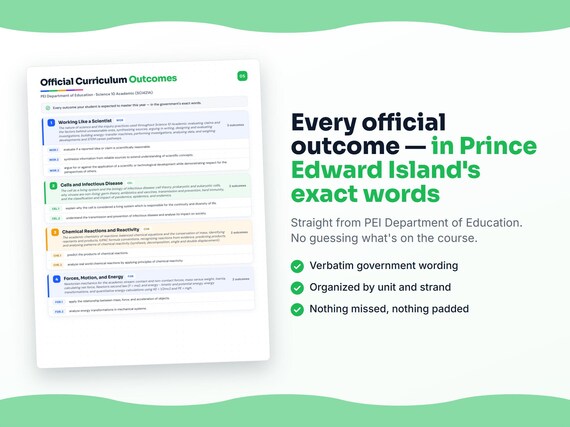
Prince Edward Island defines Science 10 Academic (SCI421A) by strands and outcomes. MapleMind teaches the same curriculum reorganized for one-skill-at-a-time tutoring — the table shows exactly where every official strand lands, and the ministry's own wording is quoted under each unit below.
Official source Prince Edward Island's official curriculumRead it on the government site — princeedwardisland.ca ↗| Official strand | Outcomes | Where MapleMind teaches it |
|---|---|---|
| Strand PK | 10 | Working Like a Scientist |
| Strand CK | 6 | Cells and Infectious Disease · Chemical Reactions and Reactivity · Forces, Motion, and Energy |
Every skill below, taught one on one.
 Try the first session free
How MapleMind teaches Science 10 Academic (SCI421A) — every unit, lesson, and skill
Every skill below runs as a short session: a plain-words lesson, a worked example, solving it together, then a five-question skill check that earns up to three stars. Guided Mode keeps it teaching instead of answer-handing — turning it off needs a parent's password.
Unit 1Working Like a ScientistOfficial strand · Strand PK
The nature of science and the inquiry practices used throughout Science 10 Academic: evaluating claims and the factors behind unreasonable ones, synthesizing sources, arguing in writing, designing and evaluating investigations, building energy-transfer machines, performing investigations, analysing data, and weighing developments and STEM career pathways.
Judging Scientific Claims
- Evaluating whether a claim is reasonablesci10b.NoS.1 — Evaluate whether a reported idea or claim is scientifically reasonable.
- Why people accept unreasonable claimssci10b.NoS.2 — Analyse the factors that influence decisions to accept scientifically unreasonable claims.
Investigating, Building, and Communicating
- Synthesizing information from sourcessci10b.PK.1 — Synthesize information from reliable sources to extend understanding of scientific concepts.
- Writing a scientific argumentsci10b.PK.2 — Compose written arguments that effectively communicate scientific reasoning.
- Designing and evaluating an investigationsci10b.PK.3 — Design and evaluate a scientific investigation that examines a cause-and-effect relationship.
- Building an energy-transfer machinesci10b.PK.4 — Create a machine that uses several transfers of energy to perform a simple task using an engineering design process.
- Performing investigationssci10b.PK.5 — Perform investigations that examine the microscopic structure of cells, chemical reactivity, and the relationship between energy, forces, and matter.
- Analysing data for patternssci10b.PK.6 — Analyse data to determine patterns, trends, and causal relationships.
Developments and Career Pathways
- Arguing for or against a developmentsci10b.DP.1 — Argue for or against the application of a scientific or technological development while respecting the perspectives of others.
- Skills for STEM career pathwayssci10b.DP.2 — Demonstrate skills and characteristics necessary for career pathways related to science, technology, engineering, or math.
The official wording — 10 outcomes in this unit
- sci10b.NoS.1
evaluate if a reported idea or claim is scientifically reasonable.
- sci10b.NoS.2
analyze factors that influence decisions to accept scientifically unreasonable claims.
- sci10b.PK.1
synthesize information from reliable sources to extend understanding of scientific concepts.
- sci10b.PK.2
compose written arguments which effectively communicate scientific reasoning.
- sci10b.PK.3
design and evaluate a scientific investigation which examines a cause and effect relationship.
- sci10b.PK.4
create a machine that utilizes several transfers of energy to perform a simple task using an engineering design process.
- sci10b.PK.5
perform investigations that examine the microscopic structure of cells, chemical reactivity, and the relationship between energy, forces, and matter.
- sci10b.PK.6
analyze data to determine patterns, trends, and causal relationships.
- sci10b.DP.1
argue for or against the application of a scientific or technological development while demonstrating respect for the perspectives of others.
- sci10b.DP.2
demonstrate skills and characteristics necessary for career pathways related to science, technology, engineering, or math.
Unit 2Cells and Infectious DiseaseOfficial strand · Strand CK
The cell as a living system and the biology of infectious disease: cell theory, prokaryotic and eukaryotic cells, why viruses are non-living; germ theory, antibiotics and vaccines, transmission and prevention, herd immunity, and the classification and impact of pandemics, epidemics, and endemics.
The Cell as a Living System
- Cell vocabulary and living vs non-livingsci10b.CK.1.1 — Use cell vocabulary, distinguish living from non-living things, and describe how a cell is both a system and part of a larger system.
- Cell types and why viruses are non-livingsci10b.CK.1.1 — Compare eukaryotic and prokaryotic cells, identify cell types under a microscope, and explain why viruses are considered non-living.
Infectious Disease and Society
- Germ theory, antibiotics, and vaccinessci10b.CK.1.2 — Explain how germ theory developed, compare bacterial and viral diseases, and compare the use of antibiotics and vaccines.
- Transmission, prevention, and herd immunitysci10b.CK.1.2 — Describe how infectious disease is transmitted and prevented and relate herd immunity to disease outbreaks.
- Pandemics, epidemics, endemics, and societysci10b.CK.1.2 — Distinguish pandemics, epidemics, and endemics and examine the social and economic impact of outbreaks.
The official wording — 2 outcomes in this unit
- sci10b.CK.1.1
explain why the cell is considered a living system which is responsible for the continuity and diversity of life.
- sci10b.CK.1.2
understand the transmission and prevention of infectious disease and analyse its impact on society.
Unit 3Chemical Reactions and ReactivityOfficial strand · Strand CK
The academic chemistry of reactions: balanced chemical equations and the conservation of mass, identifying reactants and products, IUPAC formula conventions, recognizing reactions from evidence, predicting products, and analysing patterns of chemical reactivity (synthesis, decomposition, single and double displacement).
Chemical Equations and Conservation of Mass
- Balanced equations and conservation of masssci10b.CK.2.1 — Identify reactants and products, apply IUPAC conventions, and use the law of conservation of mass to write balanced chemical equations.
- Recognizing reactions from evidencesci10b.CK.2.1 — Recognize a chemical reaction from observable evidence and energy changes, and deduce the products of simple reactions.
- Classifying reactions by typesci10b.CK.2.1 — Classify chemical reactions by type - synthesis, decomposition, single and double displacement, and combustion - by the pattern in which reactant atoms rearrange.
Analysing Chemical Reactivity
- Analysing real-world reactionssci10b.CK.2.2 — Apply the principles of chemical reactivity to identify, deconstruct, and analyse novel real-world chemical reactions.
The official wording — 2 outcomes in this unit
- sci10b.CK.2.1
predict the products of chemical reactions.
- sci10b.CK.2.2
analyze real world chemical reactions by applying principles of chemical reactivity.
Unit 4Forces, Motion, and EnergyOfficial strand · Strand CK
Newtonian mechanics for the academic stream: contact and non-contact forces, mass versus weight, inertia, calculating net force, Newton's second law (F = ma); and energy - kinetic and potential energy, energy transformations, and quantitative energy calculations using KE = 1/2mv2 and PE = mgh.
Forces and Newton's Second Law
- Forces, mass, weight, and inertiasci10b.CK.3.1 — Distinguish contact and non-contact forces, relate mass and weight, and compare the inertia of objects of different masses.
- Net force and Newton's second lawsci10b.CK.3.1 — Calculate net force and apply Newton's second law (F = ma) to solve problems, using the correct units.
Energy and Its Transformations
- Kinetic, potential energy, and transformationssci10b.CK.3.2 — Compare kinetic and potential energy, identify types of energy, and illustrate energy transformations within a system.
- Calculating energy: KE and PEsci10b.CK.3.2 — Apply the equations KE = 1/2mv2 and PE = mgh to calculate changes in energy within a closed system.
The official wording — 2 outcomes in this unit
- sci10b.CK.3.1
apply the relationship between mass, force, and acceleration of objects.
- sci10b.CK.3.2
analyze energy transformations in mechanical systems.
Printable workbook · A keepsake of the year
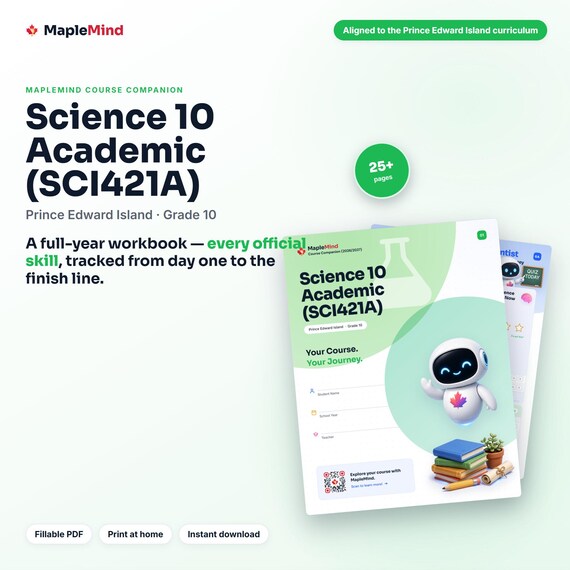
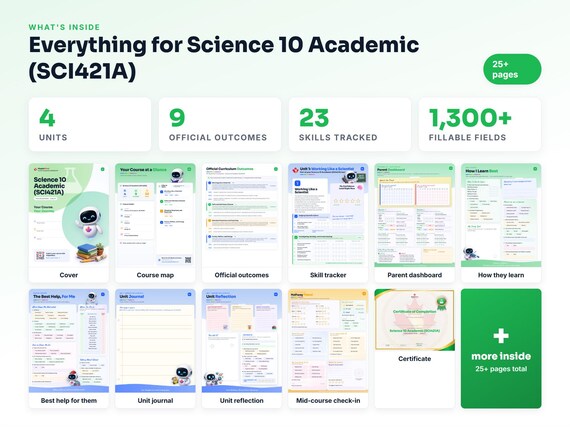
A Science 10 Academic (SCI421A) workbook worth keeping
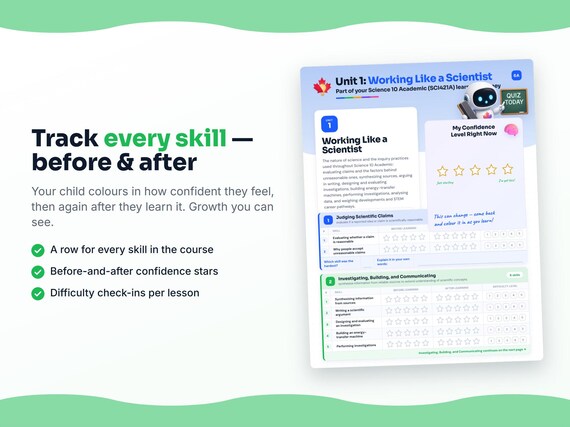
Built from the same official curriculum as this page. Before and after each skill above, your student colours in how sure they feel — so the two of you can see, on one page, what's clicking and what needs another look. It's a quiet way to follow how the year is really going.
By June it's full of their own handwriting: units worked through, confidence grown, a mid-year check-in, notes from parent-teacher night, and a certificate at the end. Less a worksheet, more a record of the year worth keeping on the shelf.
Instant download · see every page, reviews and the full description · five or more workbooks are $2.99 each
What it looks like in the app



Common questions
Can MapleMind help me with Science 10 Academic (SCI421A)?
Yes. MapleMind's AI tutor covers all 23 skills in Prince Edward Island's Science 10 Academic (SCI421A) — you pick the exact skill, and the tutor teaches it step by step: a short lesson, a worked example, solving together, then a skill check to show it stuck.
Is MapleMind aligned to Prince Edward Island's official curriculum?
Yes. Every skill in this course maps to an official outcome code from Prince Edward Island's Grade 10 Science curriculum, and the ministry's own wording is quoted under each unit on this page — with the official government source linked so you can check it yourself.
What does MapleMind cost?
It's free to start — 5 tutoring chats and a practice quiz every day, no credit card. A Pro subscription ($9.99/month or $49.99/year CAD, 7-day free trial) unlocks unlimited tutoring, practice, and exam simulations.
What if I'm stuck on just one topic?
That's the point of skill-level tutoring: open Science 10 Academic (SCI421A) in the app, tap the exact skill from the list on this page, and the tutor teaches just that — no wading through lessons you don't need.
Does MapleMind work in French or other languages?
Yes — 14 languages, including French. Both the app and the tutor's explanations switch to the language you choose.
Where can I see the official Prince Edward Island curriculum for Science 10 Academic (SCI421A)?
The official source is linked on this page — Prince Edward Island's official curriculum. The outline here follows it: every MapleMind skill carries its official outcome code, and the ministry's own wording is quoted under each unit.
Keep exploring
Ready when you are
Pick a skill from this page and see it taught properly — free, in the browser, in under a minute.