Get help with Chemistry, Grade 11 (CHM521A)
Most tutoring makes you sit through material you already know. MapleMind flips that: pick the exact skill that's causing trouble — any of the 28 below — and the tutor teaches just that one, step by step, as many times as it takes. Ask questions in plain words, any time of day, in English, French, or 12 other languages.
The official Prince Edward Island Chemistry, Grade 11 (CHM521A) curriculum
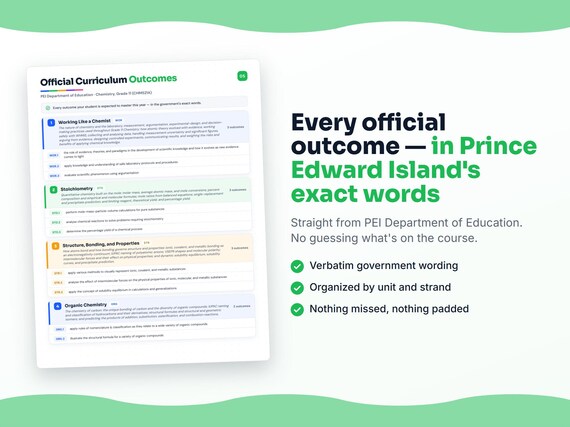
Prince Edward Island defines Chemistry, Grade 11 (CHM521A) by strands and outcomes. MapleMind teaches the same curriculum reorganized for one-skill-at-a-time tutoring — the table shows exactly where every official strand lands, and the ministry's own wording is quoted under each unit below.
Official source Prince Edward Island's official curriculumRead it on the government site — princeedwardisland.ca ↗| Official strand | Outcomes | Where MapleMind teaches it |
|---|---|---|
| Strand PK | 8 | Working Like a Chemist |
| Strand CK | 9 | Stoichiometry · Structure, Bonding, and Properties · Organic Chemistry |
Every skill below, taught one on one.
 Try the first session free
How MapleMind teaches Chemistry, Grade 11 (CHM521A) — every unit, lesson, and skill
Every skill below runs as a short session: a plain-words lesson, a worked example, solving it together, then a five-question skill check that earns up to three stars. Guided Mode keeps it teaching instead of answer-handing — turning it off needs a parent's password.
Unit 1Working Like a ChemistOfficial strand · Strand PK
The nature of chemistry and the laboratory, measurement, argumentation, experimental-design, and decision-making practices used throughout Grade 11 Chemistry: how atomic theory evolved with evidence, working safely with WHMIS, collecting and analysing data, handling measurement uncertainty and significant figures, arguing from evidence, designing controlled experiments, communicating results, and weighing the risks and benefits of applying chemical knowledge.
How Atomic Theory Evolved
- Evidence, theories, and the evolving atomic modelchm11.NoS.1 — Explain, using the history of atomic theory, how evidence, theories, and paradigms drive scientific knowledge and how it evolves as new evidence comes to light.
Working Safely and Measuring Well
- Safe laboratory protocols and WHMISchm11.PK.1 — Apply safe laboratory protocols and procedures, including interpreting WHMIS 2015 pictograms and labels and handling and disposing of materials safely.
- Collecting and analysing datachm11.PK.2 — Apply appropriate techniques, procedures, and technologies - including data loggers and spreadsheets - for collecting and analysing chemistry data to solve problems.
- Measurement uncertainty and significant figureschm11.PK.3 — Use uncertainty in data measurement and processing: distinguish accuracy from precision, identify random and systematic error, and report values with appropriate significant figures.
Argument, Design, and Decisions
- Evaluating phenomena with argumentationchm11.PK.4 — Evaluate scientific phenomena using argumentation: support a claim with evidence and reasoning, and discuss sources of error and limitations.
- Designing a controlled experimentchm11.PK.5 — Design an experiment that identifies and controls the major variables, formulating questions, hypotheses, and predictions.
- Communicating plans, data, and resultschm11.PK.6 — Use appropriate language, visual aids, numeric and symbolic representation, and formatting conventions to communicate plans, procedures, data, results, and conclusions.
- Risks and benefits of applying chemistrychm11.DP.1 — Analyse, from multiple perspectives, the risks and benefits to society and the environment of applying chemical knowledge such as industrial chemicals, pharmaceuticals, and their processes.
The official wording — 8 outcomes in this unit
- chm11.NoS.1
the role of evidence, theories, and paradigms in the development of scientific knowledge and how it evolves as new evidence comes to light
- chm11.PK.1
apply knowledge and understanding of safe laboratory protocols and procedures
- chm11.PK.2
apply appropriate techniques, procedures, and technologies for collecting and analysing data to solve problems
- chm11.PK.3
use uncertainty in data measurement and data processing
- chm11.PK.4
evaluate scientific phenomenon using argumentation
- chm11.PK.5
design an experiment identifying and controlling major variables
- chm11.PK.6
use appropriate language, visual aids, and formatting conventions to effectively communicate plans, procedures, data, results, and conclusions of research and experimentation
- chm11.DP.1
analyse from a variety of perspectives the risks and benefits of applying scientific knowledge of chemistry to society and the environment
Unit 2StoichiometryOfficial strand · Strand CK
Quantitative chemistry built on the mole: molar mass, average atomic mass, and mole conversions; percent composition and empirical and molecular formulas; mole ratios from balanced equations; single-replacement and precipitate prediction; and limiting reagent, theoretical yield, and percentage yield.
The Mole and Mole Conversions
- The mole, molar mass, and conversionschm11.CK.1.1 — Define atomic and molar mass, calculate average atomic mass from isotopic abundance, and convert among mass, moles, particles, and gas volume at STP.
- Percent composition and empirical/molecular formulaschm11.CK.1.1 — Determine percent composition and empirical and molecular formulas for a pure substance, and find the formula and name of a hydrate.
Reaction Stoichiometry
- Mole ratios and stoichiometric calculationschm11.CK.1.2 — Use mole ratios from balanced equations and dimensional analysis to perform stoichiometric calculations relating reactants and products.
- Predicting single-replacement and precipitate reactionschm11.CK.1.2 — Predict whether a single-replacement reaction proceeds using an activity series, and whether a double-displacement reaction proceeds by forming a precipitate, gas, or water.
Limiting Reagent and Percentage Yield
- Limiting reagent and theoretical yieldchm11.CK.1.3 — Determine the limiting reagent of a reaction and calculate the theoretical yield of product by stoichiometry.
- Percentage yieldchm11.CK.1.3 — Calculate percentage yield from actual and theoretical yields and explain how a process's yield can be maximized.
The official wording — 3 outcomes in this unit
- chm11.CK.1.1
perform mole-mass-particle-volume calculations for pure substances
- chm11.CK.1.2
analyse chemical reactions to solve problems requiring stoichiometry
- chm11.CK.1.3
determine the percentage yield of a chemical process
Unit 3Structure, Bonding, and PropertiesOfficial strand · Strand CK
How atoms bond and how bonding governs structure and properties: ionic, covalent, and metallic bonding as an electronegativity continuum; IUPAC naming of polyatomic anions; VSEPR shapes and molecular polarity; intermolecular forces and their effect on physical properties; and dynamic solubility equilibrium, solubility curves, and precipitate prediction.
Bonding, VSEPR, and Polarity
- Ionic, covalent, and metallic bondingchm11.CK.2.1 — Explain ionic, covalent, and metallic bonding as an electronegativity continuum, from valence electrons and electronegativity through the structural model of each substance type.
- IUPAC naming of polyatomic anionschm11.CK.2.1 — Use IUPAC conventions to name the hydrogen and oxygen variations of common polyatomic anions and illustrate their bonding structure.
- VSEPR molecular shapeschm11.CK.2.1 — Use VSEPR theory to predict molecular shapes - linear, bent, trigonal planar, trigonal pyramidal, and tetrahedral - about a central atom.
- Molecular polaritychm11.CK.2.1 — Determine molecular polarity from bond polarity, lone pairs, and geometry, using vector addition of bond dipoles.
Intermolecular Forces and Properties
- Types of intermolecular forceschm11.CK.2.2 — Explain and compare the strength of London dispersion, dipole-dipole, and hydrogen bonding, and recognize which forces break during a phase change.
- Physical properties of ionic, molecular, and metallic substanceschm11.CK.2.2 — Compare the physical properties - melting and boiling point, conductivity, and solubility - of ionic, molecular, and metallic substances and relate them to bonding.
Solubility Equilibrium
- Solubility as a dynamic equilibriumchm11.CK.2.3 — Describe solubility as a dynamic equilibrium of dissolving and crystallizing, and explain variations in solubility and the factors that affect it.
- Solubility curves and precipitate predictionchm11.CK.2.3 — Calculate and graph solubility (g solute per 100 g solvent), read solubility curves, and use solubility generalizations to predict precipitate formation.
The official wording — 3 outcomes in this unit
- chm11.CK.2.1
apply various methods to visually represent ionic, covalent, and metallic substances
- chm11.CK.2.2
analyse the effect of intermolecular forces on the physical properties of ionic, molecular, and metallic substances
- chm11.CK.2.3
apply the concept of solubility equilibrium in calculations and generalizations
Unit 4Organic ChemistryOfficial strand · Strand CK
The chemistry of carbon: the unique bonding of carbon and the diversity of organic compounds; IUPAC naming and classification of hydrocarbons and their derivatives; structural formulas and structural and geometric isomers; and predicting the products of addition, substitution, esterification, and combustion reactions.
Naming and Classifying Organic Compounds
- Carbon and the diversity of organic compoundschm11.CK.3.1 — Explain the large number and diversity of organic compounds from the unique bonding of the carbon atom.
- Naming and classifying hydrocarbonschm11.CK.3.1 — Classify hydrocarbons and their derivatives by family and write the formula and IUPAC name for a variety of organic compounds.
Structural Formulas, Isomers, and Reactions
- Drawing structural formulaschm11.CK.3.2 — Illustrate structural formulas for aliphatic, cyclic, and aromatic hydrocarbons and their derivatives, using structural, condensed, and line forms.
- Structural and geometric isomerschm11.CK.3.2 — Define and draw structural and geometric (cis/trans) isomers and relate an isomer's structure to its properties.
- Addition and substitution reactionschm11.CK.3.3 — Describe the relative reactivity of alkanes, alkenes, and alkynes and predict the products of addition (alkenes/alkynes) and substitution (alkanes/benzene) reactions.
- Esterification and combustion reactionschm11.CK.3.3 — Predict the products of esterification (alcohol + carboxylic acid) and complete and incomplete combustion of hydrocarbons, and write and balance the equations.
The official wording — 3 outcomes in this unit
- chm11.CK.3.1
apply rules of nomenclature & classification as they relate to a wide variety of organic compounds
- chm11.CK.3.2
illustrate the structural formula for a variety of organic compounds
- chm11.CK.3.3
predict the product of a chemical reaction for select organic compounds
Printable workbook · A keepsake of the year
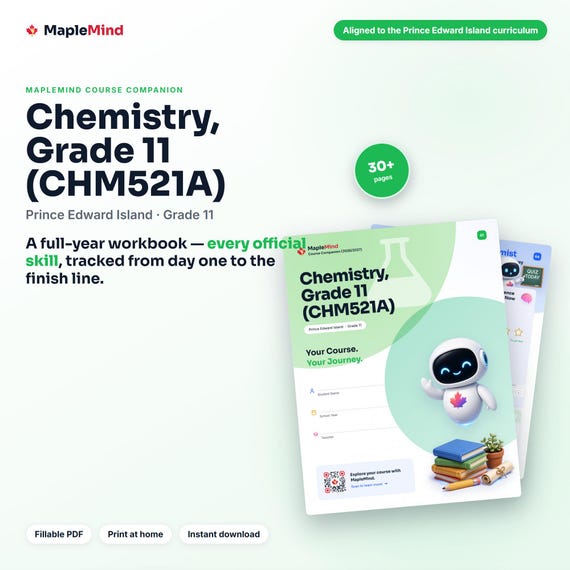
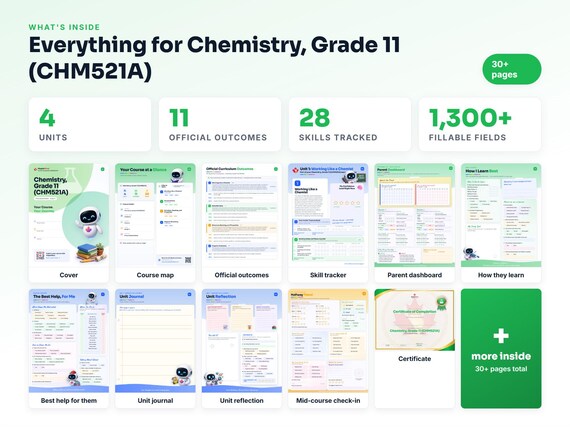
A Chemistry, Grade 11 (CHM521A) workbook worth keeping
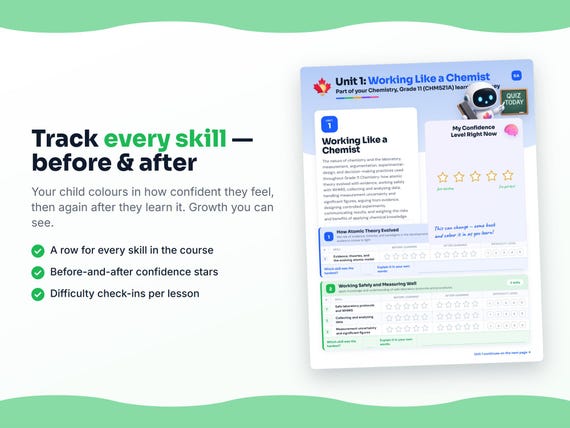
Built from the same official curriculum as this page. Before and after each skill above, your student colours in how sure they feel — so the two of you can see, on one page, what's clicking and what needs another look. It's a quiet way to follow how the year is really going.
By June it's full of their own handwriting: units worked through, confidence grown, a mid-year check-in, notes from parent-teacher night, and a certificate at the end. Less a worksheet, more a record of the year worth keeping on the shelf.
Instant download · see every page, reviews and the full description · five or more workbooks are $2.99 each
What it looks like in the app



Common questions
Can MapleMind help me with Chemistry, Grade 11 (CHM521A)?
Yes. MapleMind's AI tutor covers all 28 skills in Prince Edward Island's Chemistry, Grade 11 (CHM521A) — you pick the exact skill, and the tutor teaches it step by step: a short lesson, a worked example, solving together, then a skill check to show it stuck.
Is MapleMind aligned to Prince Edward Island's official curriculum?
Yes. Every skill in this course maps to an official outcome code from Prince Edward Island's Grade 11 Science curriculum, and the ministry's own wording is quoted under each unit on this page — with the official government source linked so you can check it yourself.
What does MapleMind cost?
It's free to start — 5 tutoring chats and a practice quiz every day, no credit card. A Pro subscription ($9.99/month or $49.99/year CAD, 7-day free trial) unlocks unlimited tutoring, practice, and exam simulations.
What if I'm stuck on just one topic?
That's the point of skill-level tutoring: open Chemistry, Grade 11 (CHM521A) in the app, tap the exact skill from the list on this page, and the tutor teaches just that — no wading through lessons you don't need.
Does MapleMind work in French or other languages?
Yes — 14 languages, including French. Both the app and the tutor's explanations switch to the language you choose.
Where can I see the official Prince Edward Island curriculum for Chemistry, Grade 11 (CHM521A)?
The official source is linked on this page — Prince Edward Island's official curriculum. The outline here follows it: every MapleMind skill carries its official outcome code, and the ministry's own wording is quoted under each unit.
Keep exploring
Ready when you are
Pick a skill from this page and see it taught properly — free, in the browser, in under a minute.