Get help with Science 10 (SCI401A)
Most tutoring makes you sit through material you already know. MapleMind flips that: pick the exact skill that's causing trouble — any of the 23 below — and the tutor teaches just that one, step by step, as many times as it takes. Ask questions in plain words, any time of day, in English, French, or 12 other languages.
The official Prince Edward Island Science 10 (SCI401A) curriculum
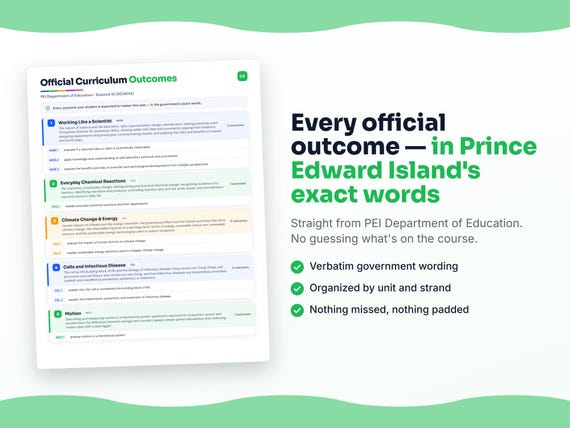
Prince Edward Island defines Science 10 (SCI401A) by strands and outcomes. MapleMind teaches the same curriculum reorganized for one-skill-at-a-time tutoring — the table shows exactly where every official strand lands, and the ministry's own wording is quoted under each unit below.
Official source Prince Edward Island's official curriculumRead it on the government site — princeedwardisland.ca ↗| Official strand | Outcomes | Where MapleMind teaches it |
|---|---|---|
| Strand PK | 9 | Working Like a Scientist |
| Strand CK | 6 | Everyday Chemical Reactions · Climate Change & Energy · Cells and Infectious Disease · Motion |
Every skill below, taught one on one.
 Try the first session free
How MapleMind teaches Science 10 (SCI401A) — every unit, lesson, and skill
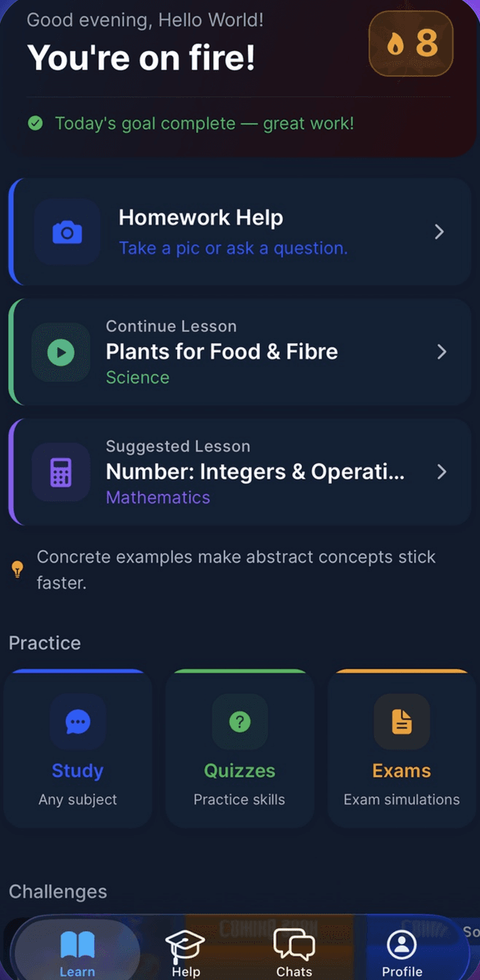
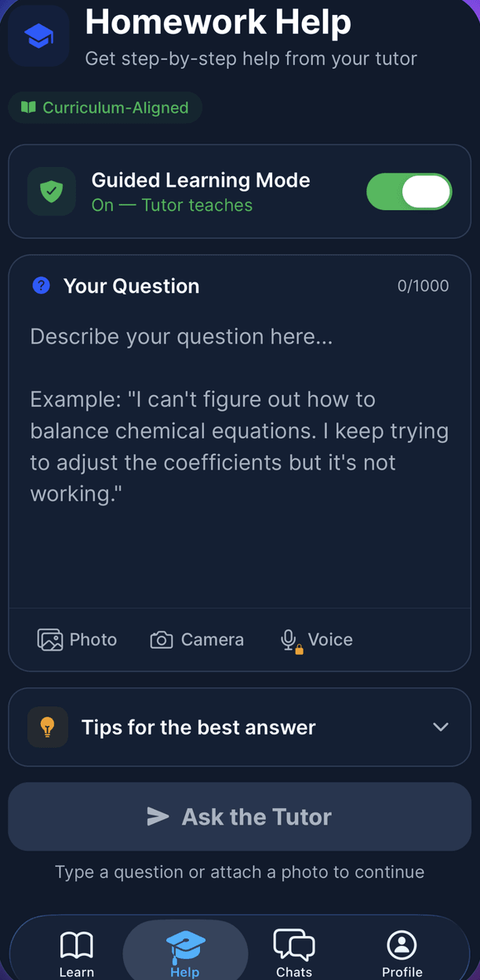
Every skill below runs as a short session: a plain-words lesson, a worked example, solving it together, then a five-question skill check that earns up to three stars. Guided Mode keeps it teaching instead of answer-handing — turning it off needs a parent's password.
Unit 1Working Like a ScientistOfficial strand · Strand PK
The nature of science and the laboratory, data, argumentation, design, and decision-making practices used throughout Science 10: evaluating claims, working safely with data and uncertainty, arguing from evidence, designing experiments and prototypes, communicating results, and weighing the risks and benefits of science and technology.
Judging Scientific Claims
- Evaluating whether a claim is reasonablesci10a.NoS.1 — Evaluate whether a reported idea or claim is scientifically reasonable.
- Why people accept unreasonable claimssci10a.NoS.2 — Analyse the factors that influence decisions to accept scientifically unreasonable claims.
Working with Data, Design, and Communication
- Safe laboratory protocolssci10a.PK1 — Apply knowledge and understanding of safe laboratory protocols and procedures.
- Collecting and analysing datasci10a.PK.2 — Apply appropriate techniques, procedures, and technologies for collecting and analysing data to solve problems.
- Uncertainty in measurementsci10a.PK.3 — Use uncertainty in data measurement and data processing.
- Evaluating phenomena with argumentationsci10a.PK.4 — Evaluate scientific phenomena using argumentation.
- Designing an experiment and a prototypesci10a.PK.5 — Design an experiment and a prototype.
- Communicating and collaboratingsci10a.PK.6 — Use appropriate language and visual elements to effectively collaborate and communicate experimental and design processes.
Weighing Science and Technology
- Benefits and risks from multiple perspectivessci10a.DP.1 — Analyse the benefits and risks of scientific and technological developments from multiple perspectives.
The official wording — 9 outcomes in this unit
- sci10a.NoS.1
evaluate if a reported idea or claim is scientifically reasonable.
- sci10a.NoS.2
analyse factors that influence decisions to accept scientifically unreasonable claims.
- sci10a.PK1
apply knowledge and understanding of safe laboratory protocols and procedures.
- sci10a.PK.2
apply appropriate techniques, procedures, and technologies for collecting and analysing data to solve problems.
- sci10a.PK.3
use uncertainty in data measurement and data processing.
- sci10a.PK.4
evaluate scientific phenomena using argumentation.
- sci10a.PK.5
design an experiment and a prototype.
- sci10a.PK.6
use appropriate language and visual elements to effectively collaborate, and to communicate experimental and design processes.
- sci10a.DP.1
analyse the benefits and risks of scientific and technological developments from multiple perspectives.
Unit 2Everyday Chemical ReactionsOfficial strand · Strand CK
The chemistry of everyday change: distinguishing physical and chemical change, recognizing evidence of a reaction, identifying reactants and products, controlling reaction rate, and the acids, bases, and neutralization reactions found in daily life.
Chemical Change and Reactions
- Physical vs chemical change and its evidencesci10a.CK.1 — Compare physical and chemical changes and explain the evidence that a chemical change has occurred.
- Reactants, products, and reaction ratesci10a.CK.1 — Identify reactants and products in word equations and describe the factors that affect the rate of a reaction.
- Acids, bases, and neutralizationsci10a.CK.1 — Classify substances as acidic, basic, or neutral and describe neutralization reactions and their everyday applications.
- Naming ionic compoundssci10a.CK.1 — Name common binary and tertiary ionic compounds using a table of common monatomic and polyatomic ions and their names.
The official wording — 1 outcome in this unit
- sci10a.CK.1
explain everyday chemical reactions and their applications.
Unit 3Climate Change & EnergyOfficial strand · Strand CK
Human impact on climate and the energy transition: the greenhouse effect and the human activities that drive climate change, the observable impacts of a warming Earth, forms of energy, renewable versus non-renewable sources, and the sustainable energy technologies used to reduce emissions.
Human Activity and Climate Change
- Greenhouse gases and the greenhouse effectsci10a.CK.2.1 — Identify the main greenhouse gas and its human sources and explain how greenhouse gases cause global warming through the greenhouse effect.
- Climate data, Indigenous knowledge, and impactssci10a.CK.2.1 — Compare Indigenous observations of the environment with climate data and describe the observable impacts of climate change on Earth.
Energy and Sustainable Solutions
- Forms of energy and energy sourcessci10a.CK.2.2 — Identify common forms of energy and compare renewable and non-renewable energy sources.
- Sustainable energy technologiessci10a.CK.2.2 — Describe sustainable technologies that generate and use electrical energy from renewable sources and explain ways to reduce energy consumption.
The official wording — 2 outcomes in this unit
- sci10a.CK.2.1
analyse the impact of human activity on climate change.
- sci10a.CK.2.2
explain sustainable energy solutions used to mitigate climate change.
Unit 4Cells and Infectious DiseaseOfficial strand · Strand CK
The cell as the building block of life and the biology of infectious disease: living versus non-living things, cell structures and cell theory, why viruses are non-living, and how infectious diseases are transmitted, prevented, treated, and classified as pandemics, epidemics, or endemics.
The Cell as the Building Block of Life
- Living things and cell structuressci10a.CK.3.1 — Distinguish living from non-living things and explain the function of major structures in plant and animal cells, including DNA.
- Cell theory and why viruses are non-livingsci10a.CK.3.1 — Describe the principles of cell theory and explain why viruses are considered non-living.
Infectious Disease
- Transmission, prevention, and treatment of diseasesci10a.CK.3.2 — Compare bacterial and viral diseases and describe how infectious disease is transmitted, prevented, and treated.
- Pandemics, epidemics, and endemicssci10a.CK.3.2 — Compare pandemics, epidemics, and endemics and use these terms to describe disease spread in different populations.
The official wording — 2 outcomes in this unit
- sci10a.CK.3.1
explain why the cell is considered the building block of life.
- sci10a.CK.3.2
explain the transmission, prevention, and treatment of infectious disease.
Unit 5MotionOfficial strand · Strand CK
Describing and measuring motion in a mechanical system: qualitative descriptions of position, speed, and acceleration; the difference between average and constant speed; simple speed calculations; and collecting motion data with a data logger.
Analysing Motion
- Describing motion and kinds of speedsci10a.CK.4 — Describe an object's motion qualitatively in terms of position, speed, and acceleration, and distinguish average speed from constant speed.
- Calculating speed and collecting motion datasci10a.CK.4 — Calculate speed using provided formulas and collect motion data from a mechanical system using a data logger.
The official wording — 1 outcome in this unit
- sci10a.CK.4
analyse motion in a mechanical system.
Printable workbook · A keepsake of the year
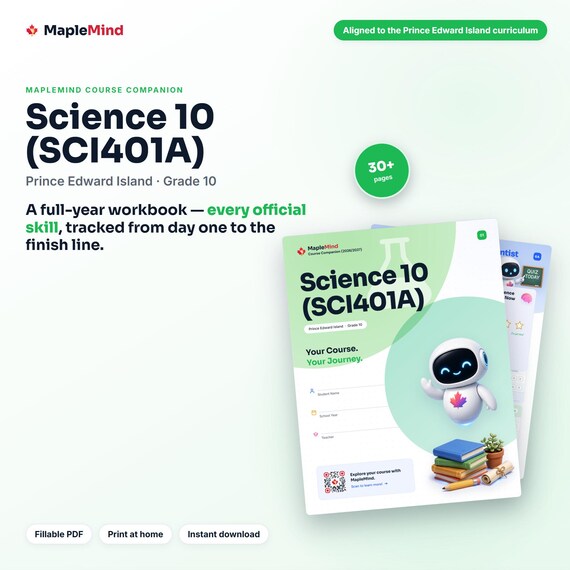
A Science 10 (SCI401A) workbook worth keeping
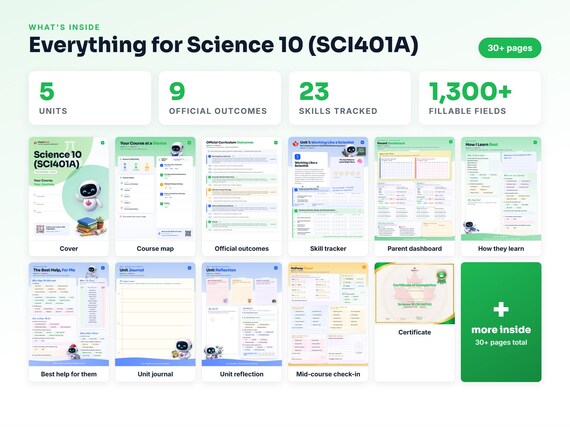
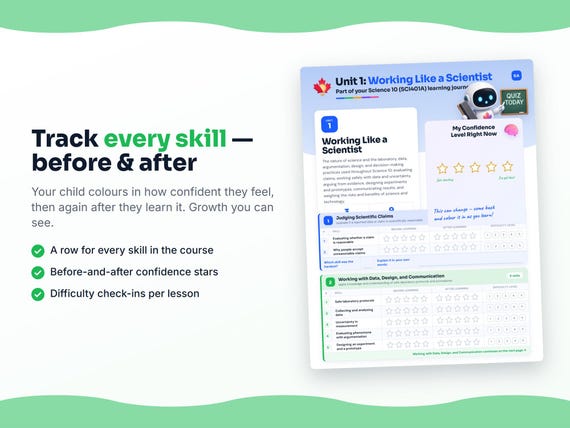
Built from the same official curriculum as this page. Before and after each skill above, your student colours in how sure they feel — so the two of you can see, on one page, what's clicking and what needs another look. It's a quiet way to follow how the year is really going.
By June it's full of their own handwriting: units worked through, confidence grown, a mid-year check-in, notes from parent-teacher night, and a certificate at the end. Less a worksheet, more a record of the year worth keeping on the shelf.
Instant download · see every page, reviews and the full description · five or more workbooks are $2.99 each
What it looks like in the app
Common questions
Can MapleMind help me with Science 10 (SCI401A)?
Yes. MapleMind's AI tutor covers all 23 skills in Prince Edward Island's Science 10 (SCI401A) — you pick the exact skill, and the tutor teaches it step by step: a short lesson, a worked example, solving together, then a skill check to show it stuck.
Is MapleMind aligned to Prince Edward Island's official curriculum?
Yes. Every skill in this course maps to an official outcome code from Prince Edward Island's Grade 10 Science curriculum, and the ministry's own wording is quoted under each unit on this page — with the official government source linked so you can check it yourself.
What does MapleMind cost?
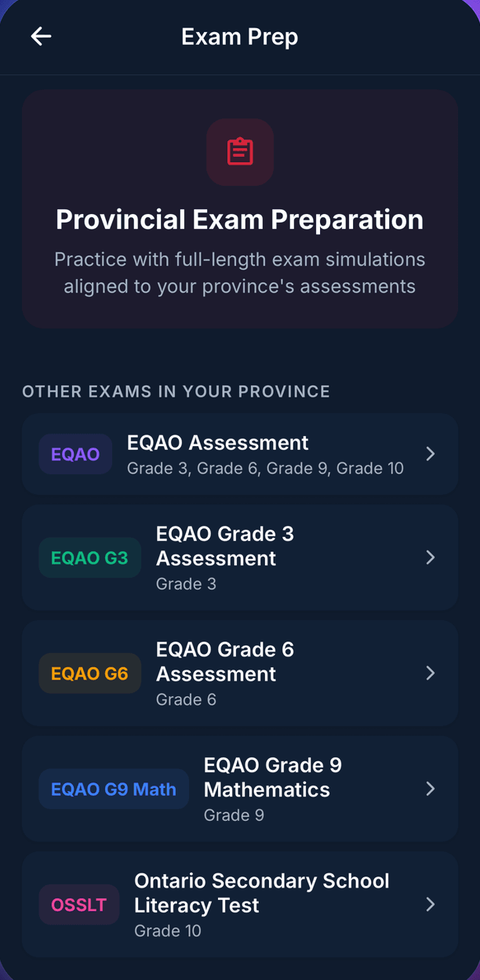
It's free to start — 5 tutoring chats and a practice quiz every day, no credit card. A Pro subscription ($9.99/month or $49.99/year CAD, 7-day free trial) unlocks unlimited tutoring, practice, and exam simulations.
What if I'm stuck on just one topic?
That's the point of skill-level tutoring: open Science 10 (SCI401A) in the app, tap the exact skill from the list on this page, and the tutor teaches just that — no wading through lessons you don't need.
Does MapleMind work in French or other languages?
Yes — 14 languages, including French. Both the app and the tutor's explanations switch to the language you choose.
Where can I see the official Prince Edward Island curriculum for Science 10 (SCI401A)?
The official source is linked on this page — Prince Edward Island's official curriculum. The outline here follows it: every MapleMind skill carries its official outcome code, and the ministry's own wording is quoted under each unit.
Keep exploring
Ready when you are
Pick a skill from this page and see it taught properly — free, in the browser, in under a minute.