Get help with Physics, Grade 11 (PHY521A)
Most tutoring makes you sit through material you already know. MapleMind flips that: pick the exact skill that's causing trouble — any of the 47 below — and the tutor teaches just that one, step by step, as many times as it takes. Ask questions in plain words, any time of day, in English, French, or 12 other languages.
The official Prince Edward Island Physics, Grade 11 (PHY521A) curriculum
Prince Edward Island defines Physics, Grade 11 (PHY521A) by strands and outcomes. MapleMind teaches the same curriculum reorganized for one-skill-at-a-time tutoring — the table shows exactly where every official strand lands, and the ministry's own wording is quoted under each unit below.
Official source Prince Edward Island's official curriculumRead it on the government site — princeedwardisland.ca ↗| Official strand | Outcomes | Where MapleMind teaches it |
|---|---|---|
| SKL | 28 | Working Like a Physicist |
| KIN | 3 | Kinematics |
| DYN | 1 | Dynamics |
| MEN | 9 | Momentum and Energy |
| WAV | 6 | Waves |
Every skill below, taught one on one.
 Try the first session free
How MapleMind teaches Physics, Grade 11 (PHY521A) — every unit, lesson, and skill
Every skill below runs as a short session: a plain-words lesson, a worked example, solving it together, then a five-question skill check that earns up to three stars. Guided Mode keeps it teaching instead of answer-handing — turning it off needs a parent's password.
Unit 1Working Like a PhysicistOfficial strand · SKL
The science, technology, and society context and the inquiry skills used throughout Physics 11: asking investigable questions, designing and carrying out controlled experiments, using instruments and building prototypes, analysing and communicating data, and examining how physics and technology shape each other and society.
Investigating in Physics
- Identifying questions to investigatephy11.1 — Identify questions to investigate that arise from practical problems and issues in physics.
- Carrying out procedures and controlling variablesphy11.2 — Carry out procedures, controlling the major variables and adapting or extending procedures where required.
- Using research tools to gather informationphy11.3 — Use library and electronic research tools to collect information on a given physics topic.
- Interpreting patterns and relationships in dataphy11.4 — Interpret patterns and trends in data, and infer or calculate linear and nonlinear relationships among variables.
- Working co-operatively and troubleshootingphy11.5 — Work co-operatively with team members to develop and carry out a plan, and troubleshoot problems as they arise.
- Designing an experimentphy11.15 — Design an experiment, identifying and controlling the major variables.
- Selecting instruments and processesphy11.16 — Evaluate and select appropriate instruments for collecting evidence and appropriate processes for problem solving, inquiring, and decision making.
- Using instruments accuratelyphy11.17 — Use instruments effectively and accurately for collecting data.
- Building and testing a prototypephy11.18 — Construct and test a prototype of a device, and troubleshoot problems as they arise.
- Displaying evidence in tables and graphsphy11.19 — Compile and display evidence and information, by hand or computer, in a variety of formats including diagrams, flow charts, tables, graphs, and scatter plots.
- Comparing theoretical and empirical valuesphy11.25 — Compare theoretical and empirical values and account for discrepancies.
- Stating a conclusion from evidencephy11.26 — Provide a statement that addresses the problem or answers the question investigated in light of the link between data and the conclusion.
- Stating predictions and hypothesesphy11.37 — State a prediction and a hypothesis based on available evidence and background information.
- Formulating operational definitionsphy11.38 — Formulate operational definitions of the major variables in an investigation.
- Implementing sampling proceduresphy11.39 — Implement appropriate sampling procedures in an investigation.
- Integrating information from sourcesphy11.40 — Select and integrate information from various print and electronic sources or from several parts of the same source.
- Evaluating the reliability of dataphy11.41 — Evaluate the relevance, reliability, and adequacy of data and data-collection methods.
Physics, Technology, and Society
- How a milestone revolutionized thinkingphy11.9 — Explain how a major scientific milestone revolutionized thinking in the scientific communities.
- How technology advances scientific understandingphy11.10 — Analyse and describe examples where scientific understanding was enhanced or revised as a result of the invention of a technology.
- Explaining technologies with physics principlesphy11.11 — Describe the functioning of domestic and industrial technologies using scientific principles.
- Evaluating designs with energy and momentumphy11.12 — Describe and evaluate the design of technological solutions and the way they function, using principles of energy and momentum.
- Analysing natural and technological systemsphy11.13 — Analyse natural and technological systems to interpret and explain their structure and dynamics.
- Society's influence on science and technologyphy11.14 — Analyse society's influence on scientific and technological endeavours.
- Communicating results with conventionsphy11.21 — Explain the importance of communicating the results of a scientific or technological endeavour using appropriate language and conventions.
- How a technology developed over timephy11.22 — Analyse why and how a particular technology was developed and improved over time.
- Technologies developed from scientific understandingphy11.23 — Analyse and describe examples where technologies were developed based on scientific understanding.
- Distinguishing science and technology questionsphy11.24 — Distinguish between questions that can be answered by science and those that cannot, and between problems that can be solved by technology and those that cannot.
- Risks and benefits of applying sciencephy11.36 — Analyse, from a variety of perspectives, the risks and benefits to society and the environment of applying scientific knowledge or introducing a particular technology.
The official wording — 28 outcomes in this unit
- phy11.1
identify questions to investigate that arise from practical problems and issues
- phy11.2
carry out procedures, controlling the major variables and adapting or extending procedures where required
- phy11.3
use library and electronic research tools to collect information on a given topic
- phy11.4
interpret patterns and trends in data, and infer or calculate linear and nonlinear relationships among variables
- phy11.5
work co-operatively with team members to develop and carry out a plan, and troubleshoot problems as they arise
- phy11.15
design an experiment, identifying and controlling major variables
- phy11.16
evaluate and select appropriate instruments for collecting evidence, and appropriate processes for problem solving, inquiring, and decision making
- phy11.17
use instruments effectively and accurately for collecting data
- phy11.18
construct and test a prototype of a device, and troubleshoot problems as they arise
- phy11.19
compile and display evidence and information, by hand or computer, in a variety of formats, including diagrams, flow-charts, tables, graphs, and scatter plots
- phy11.25
compare theoretical and empirical values, and account for discrepancies
- phy11.26
provide a statement that addresses the problem or answers the question investigated in light of the link between data and the conclusion
- phy11.37
state a prediction and a hypothesis based on available evidence and background information
- phy11.38
formulate operational definitions of major variables
- phy11.39
implement appropriate sampling procedures
- phy11.40
select and integrate information from various print and electronic sources or from several parts of the same source
- phy11.41
evaluate the relevance, reliability, and adequacy of data and data collection methods
- phy11.9
explain how a major scientific milestone revolutionized thinking in the scientific communities
- phy11.10
analyse and describe examples where scientific understanding was enhanced or revised as a result of the invention of a technology
- phy11.11
describe the functioning of domestic and industrial technologies, using scientific principles
- phy11.12
describe and evaluate the design of technological solutions and the way they function, using principles of energy and momentum
- phy11.13
analyse natural and technological systems to interpret and explain their structure and dynamics
- phy11.14
analyse society’s influence on scientific and technological endeavours
- phy11.21
explain the importance of communicating the results of a scientific or technological endeavour using appropriate language and conventions
- phy11.22
analyse why and how a particular technology was developed and improved over time
- phy11.23
analyse and describe examples where technologies were developed based on scientific understanding
- phy11.24
distinguish between questions that can be answered by science and those that cannot and between problems that can be solved by technology and those that cannot
- phy11.36
analyse from a variety of perspectives the risks and benefits to society and the environment of applying scientific knowledge or introducing a particular technology
Unit 2KinematicsOfficial strand · KIN
The description of motion: frames of reference; vectors for position, displacement, velocity, acceleration, and force; and the graphical and mathematical analysis of the relationships among displacement, velocity, acceleration, and time for uniformly accelerated motion.
Describing Motion with Vectors
- Frame of reference for motionphy11.6 — Identify the frame of reference for a given motion.
- Vectors for motion and forcephy11.7 — Use vectors to represent position, displacement, velocity, acceleration, and force.
- Displacement, velocity, and timephy11.8 — Analyse graphically and mathematically the relationships among displacement, velocity, and time, including for uniformly accelerated motion.
The official wording — 3 outcomes in this unit
- phy11.6
identify the frame of reference for a given motion
- phy11.7
use vectors to represent position, displacement, velocity, acceleration, and force
- phy11.8
analyse graphically and mathematically the relationships among displacement, velocity, and time
Unit 3DynamicsOfficial strand · DYN
The causes of motion: Newton's laws of motion - inertia, the relationship among force, mass, and acceleration (F = ma), and the interaction of forces between two objects (action and reaction).
Newton's Laws of Motion
- Applying Newton's laws of motionphy11.20 — Apply Newton's laws of motion to explain inertia; the relationship among force, mass, and acceleration; and the interaction of forces between two objects.
The official wording — 1 outcome in this unit
- phy11.20
apply Newton’s laws of motion to explain inertia; the relationship among force, mass, and acceleration; and the interaction of forces between two objects
Unit 4Momentum and EnergyOfficial strand · MEN
Conservation laws for motion: momentum and its conservation in one-dimensional collisions and explosions; work, power, and the forms of mechanical energy; the conservation of mechanical energy and the work-energy theorem; and the percent efficiency of energy transformations.
Momentum and Its Conservation
- Conservation of momentumphy11.27 — Apply quantitatively the law of conservation of momentum to one-dimensional collisions and explosions.
Work, Power, and Energy
- Work, force, and displacementphy11.28 — Analyse quantitatively the relationships among force, displacement, and work.
- Work, time, and powerphy11.29 — Analyse quantitatively the relationships among work, time, and power.
- Conservation of energyphy11.30 — Analyse quantitatively the relationships among mass, height, speed, and heat energy using the law of conservation of energy.
- Mechanical energy as kinetic plus potentialphy11.31 — Describe quantitatively mechanical energy as the sum of kinetic and potential energies.
- Kinematics and dynamics via mechanical energyphy11.32 — Analyse quantitatively problems related to kinematics and dynamics using the mechanical energy concept.
- The work-energy theoremphy11.33 — Analyse common energy-transformation situations using the work-energy theorem.
- Choosing momentum or energy conservationphy11.34 — Determine which laws of conservation - energy or momentum - are best used to solve particular real-life situations involving elastic and inelastic collisions.
- Percent efficiency of energy transformationsphy11.35 — Determine the percent efficiency of energy transformations.
The official wording — 9 outcomes in this unit
- phy11.27
apply quantitatively the laws of conservation of momentum to one-dimensional collisions and explosions
- phy11.28
analyse quantitatively the relationships among force, displacement, and work
- phy11.29
analyse quantitatively the relationships among work, time, and power
- phy11.30
analyse quantitatively the relationships among mass, height, speed, and heat energy using the law of conservation of energy
- phy11.31
describe quantitatively mechanical energy as the sum of kinetic and potential energies
- phy11.32
analyse quantitatively problems related to kinematics and dynamics using the mechanical energy concept
- phy11.33
analyse common energy transformation situations using the work-energy theorem
- phy11.34
determine which laws of conservation of energy or momentum are best used to solve particular real-life situations involving elastic and inelastic collisions
- phy11.35
determine the percent efficiency of energy transformations
Unit 5WavesOfficial strand · WAV
The physics of waves: the characteristics of longitudinal and transverse waves; the wave equation; reflection and refraction; interference, diffraction, and the Doppler effect; and the properties and production of sound and electromagnetic radiation.
Wave Properties and the Wave Equation
- Longitudinal and transverse wavesphy11.42 — Describe the characteristics of longitudinal and transverse waves.
- The wave equationphy11.43 — Apply the wave equation to explain and predict the behaviour of waves.
- Reflection and refractionphy11.44 — Apply the laws of reflection and the laws of refraction to predict wave behaviour.
Wave Phenomena, Sound, and Radiation
- Interference, diffraction, and the Doppler effectphy11.45 — Explain qualitatively and quantitatively the phenomena of wave interference, diffraction, reflection, and refraction, and the Doppler-Fizeau effect.
- Comparing sound and electromagnetic radiationphy11.46 — Compare and describe the properties of electromagnetic radiation and sound.
- How sound and radiation are produced and transmittedphy11.47 — Describe how sound and electromagnetic radiation, as forms of energy, are produced and transmitted.
The official wording — 6 outcomes in this unit
- phy11.42
describe the characteristics of longitudinal and transverse waves
- phy11.43
apply the wave equation to explain and predict the behaviour of waves
- phy11.44
apply the laws of reflection and the laws of refraction to predict wave behaviour
- phy11.45
explain qualitatively and quantitatively the phenomena of wave interference, diffraction, reflection, and refraction, and the Doppler-Fizeau effect
- phy11.46
compare and describe the properties of electromagnetic radiation and sound
- phy11.47
describe how sound and electromagnetic radiation, as forms of energy, are produced and transmitted
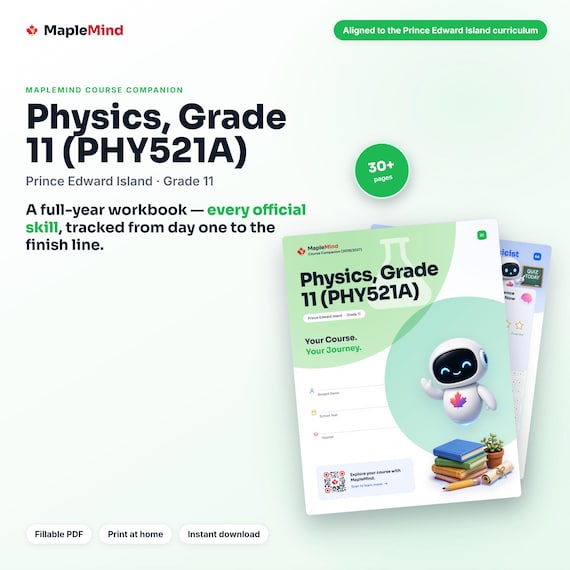
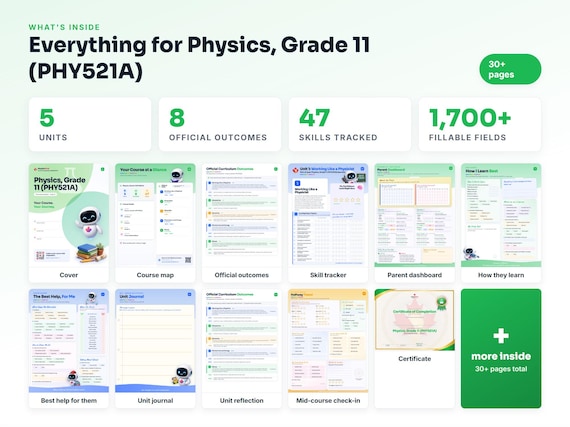


Printable workbook · A keepsake of the year
A Physics, Grade 11 (PHY521A) workbook worth keeping
Built from the same official curriculum as this page. Before and after each skill above, your student colours in how sure they feel — so the two of you can see, on one page, what's clicking and what needs another look. It's a quiet way to follow how the year is really going.
By June it's full of their own handwriting: units worked through, confidence grown, a mid-year check-in, notes from parent-teacher night, and a certificate at the end. Less a worksheet, more a record of the year worth keeping on the shelf.
Instant download · see every page, reviews and the full description · five or more workbooks are $2.99 each
What it looks like in the app



Common questions
Can MapleMind help me with Physics, Grade 11 (PHY521A)?
Yes. MapleMind's AI tutor covers all 47 skills in Prince Edward Island's Physics, Grade 11 (PHY521A) — you pick the exact skill, and the tutor teaches it step by step: a short lesson, a worked example, solving together, then a skill check to show it stuck.
Is MapleMind aligned to Prince Edward Island's official curriculum?
Yes. Every skill in this course maps to an official outcome code from Prince Edward Island's Grade 11 Science curriculum, and the ministry's own wording is quoted under each unit on this page — with the official government source linked so you can check it yourself.
What does MapleMind cost?
It's free to start — 5 tutoring chats and a practice quiz every day, no credit card. A Pro subscription ($9.99/month or $49.99/year CAD, 7-day free trial) unlocks unlimited tutoring, practice, and exam simulations.
What if I'm stuck on just one topic?
That's the point of skill-level tutoring: open Physics, Grade 11 (PHY521A) in the app, tap the exact skill from the list on this page, and the tutor teaches just that — no wading through lessons you don't need.
Does MapleMind work in French or other languages?
Yes — 14 languages, including French. Both the app and the tutor's explanations switch to the language you choose.
Where can I see the official Prince Edward Island curriculum for Physics, Grade 11 (PHY521A)?
The official source is linked on this page — Prince Edward Island's official curriculum. The outline here follows it: every MapleMind skill carries its official outcome code, and the ministry's own wording is quoted under each unit.
Keep exploring
Ready when you are
Pick a skill from this page and see it taught properly — free, in the browser, in under a minute.