Get help with Human Biology 801A
Most tutoring makes you sit through material you already know. MapleMind flips that: pick the exact skill that's causing trouble — any of the 51 below — and the tutor teaches just that one, step by step, as many times as it takes. Ask questions in plain words, any time of day, in English, French, or 12 other languages.
The official Prince Edward Island Human Biology 801A curriculum
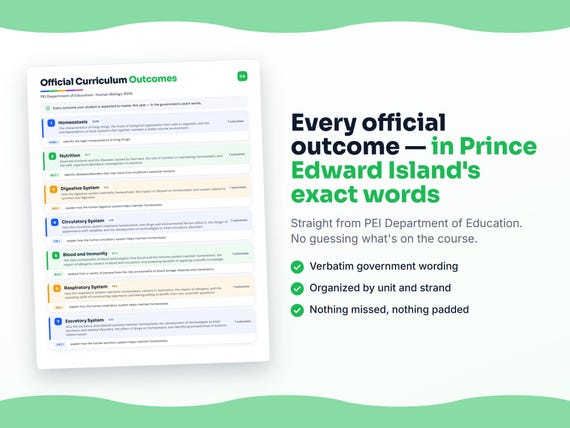
Prince Edward Island defines Human Biology 801A by strands and outcomes. MapleMind teaches the same curriculum reorganized for one-skill-at-a-time tutoring — the table shows exactly where every official strand lands, and the ministry's own wording is quoted under each unit below.
Official source Prince Edward Island's official curriculumRead it on the government site — princeedwardisland.ca ↗| Official strand | Outcomes | Where MapleMind teaches it |
|---|---|---|
| Strand 1 | 3 | Homeostasis |
| Strand 2 | 4 | Nutrition |
| Strand 3 | 3 | Digestive System |
| Strand 4 | 6 | Circulatory System |
| Strand 5 | 6 | Blood and Immunity |
| Strand 6 | 5 | Respiratory System |
| Strand 7 | 6 | Excretory System |
| Strand 8 | 8 | Muscular and Nervous Systems |
| Strand 9 | 2 | Endocrine System |
| Strand 10 | 6 | Reproductive Systems and Embryonic Development |
| Strand 11 | 2 | Genetics |
Every skill below, taught one on one.
 Try the first session free
How MapleMind teaches Human Biology 801A — every unit, lesson, and skill
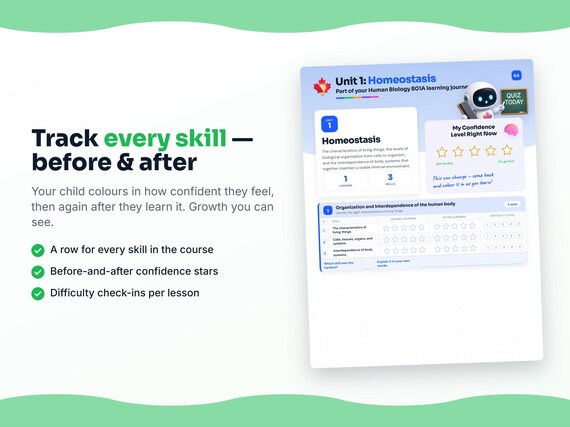
Every skill below runs as a short session: a plain-words lesson, a worked example, solving it together, then a five-question skill check that earns up to three stars. Guided Mode keeps it teaching instead of answer-handing — turning it off needs a parent's password.
Unit 1HomeostasisOfficial strand · Strand 1
The characteristics of living things, the levels of biological organization from cells to organism, and the interdependence of body systems that together maintain a stable internal environment.
Organization and interdependence of the human body
- The characteristics of living thingshumbio.1 — Identify the eight characteristics shared by all living things and use them to distinguish living from non-living.
- Cells, tissues, organs, and systemshumbio.2 — Explain the hierarchy from cells to tissues to organs to organ systems to the whole organism.
- Interdependence of body systemshumbio.3 — Describe examples of how the systems of the human body depend on one another to maintain homeostasis.
The official wording — 3 outcomes in this unit
- humbio.1
identify the eight characteristics of living things
- humbio.2
explain the relationship among cells, tissues, organs, organ systems, and organisms
- humbio.3
describe examples of the interdependence of various systems of the human body
Unit 2NutritionOfficial strand · Strand 2
Essential nutrients and the diseases caused by their lack, the role of nutrition in maintaining homeostasis, and the safe, organized laboratory investigation of nutrients.
Nutrients, deficiency disease, and homeostasis
- Diseases from insufficient nutrientshumbio.4 — Identify diseases and disorders that can result from a lack of essential nutrients.
- Nutrition and the maintenance of homeostasishumbio.5 — Explain why nutrition is important to maintaining homeostasis in the body.
- Using apparatus and materials safelyhumbio.6 — Select and use laboratory apparatus and materials safely when investigating nutrients.
- Compiling and organizing nutrition datahumbio.7 — Compile and organize data using appropriate formats and treatments so nutrition results can be interpreted.
The official wording — 4 outcomes in this unit
- humbio.4
identify diseases/disorders that may result from insufficient essential nutrients
- humbio.5
explain the importance of nutrition to the maintenance of homeostasis
- humbio.6
select and use apparatus and materials safely
- humbio.7
compile and organize data using appropriate formats and data treatments to facilitate interpretation
Unit 3Digestive SystemOfficial strand · Strand 3
How the digestive system maintains homeostasis, the impact of disease on homeostasis, and careers related to nutrition and digestion.
The digestive system and homeostasis
- How digestion maintains homeostasishumbio.8 — Explain how the human digestive system helps maintain homeostasis.
- Impact of disease on homeostasishumbio.9 — Evaluate the impact of viral, bacterial, genetic, and environmental diseases on an organism's homeostasis.
- Careers in nutrition and digestionhumbio.10 — Identify and describe science- and technology-based careers related to nutrition and digestion.
The official wording — 3 outcomes in this unit
- humbio.8
explain how the human digestive system helps maintain homeostasis
- humbio.9
evaluate the impact of viral, bacterial, genetic, and environmental diseases on an organism
- humbio.10
identify and describe science- and technology-based careers related to nutrition/digestion
Unit 4Circulatory SystemOfficial strand · Strand 4
How the circulatory system maintains homeostasis, how drugs and environmental factors affect it, the design of experiments with variables, and the development of technologies to treat circulatory disorders.
The circulatory system and homeostasis
- How circulation maintains homeostasishumbio.11 — Explain how the human circulatory system helps maintain homeostasis.
- Drugs and environmental factors on homeostasishumbio.12 — Describe how prescription and non-prescription drugs and environmental factors can disrupt or help maintain homeostasis.
- Designing an experiment with variableshumbio.13 — Design an experiment and identify the specific variables involved.
- Communicating with multiple representationshumbio.14 — Select and use appropriate numeric, symbolic, graphical, and linguistic modes to communicate ideas, plans, and results.
- Development of circulatory treatment technologyhumbio.15 — Analyse why and how a technology for treating circulatory disorders was developed and improved over time.
- Alternative solutions to lifestyle disordershumbio.16 — Propose alternative solutions to a disorder that may result from lifestyle choices, and select one as the basis for a plan.
The official wording — 6 outcomes in this unit
- humbio.11
explain how the human circulatory system helps maintain homeostasis
- humbio.12
describe how the use of prescription and nonprescription drugs and environmental factors can disrupt or help maintain homeostasis
- humbio.13
design an experiment and identify specific variables
- humbio.14
select and use appropriate numeric, symbolic, graphical, and linguistic modes of representation to communicate ideas, plans, and results
- humbio.15
analyse why and how a particular technology related to the treatment of circulatory disorders was developed and improved over time
- humbio.16
propose alternative solutions to a given practical problem (disease/ disorder) that may result from lifestyle choices, and select one as a basis for a plan
Unit 5Blood and ImmunityOfficial strand · Strand 5
The risks and benefits of blood technologies, how blood and the immune system maintain homeostasis, the impact of allergens, careers in blood and circulation, and analysing benefits of applying scientific knowledge.
Blood, immunity, and homeostasis
- Risks and benefits of blood technologieshumbio.17 — Analyse from a variety of perspectives the risks and benefits of blood storage, disposal, and transfusions.
- How blood maintains homeostasishumbio.18 — Explain how blood in the human circulatory system helps maintain homeostasis.
- Careers in blood and circulationhumbio.19 — Identify and describe science- and technology-based careers related to blood and circulation.
- Allergens and homeostasishumbio.20 — Predict the impact of environmental factors such as allergens on homeostasis within an organism.
- How the immune system maintains homeostasishumbio.21 — Explain how the human immune system helps maintain homeostasis.
- Benefits of applying scientific knowledgehumbio.22 — Analyse from a variety of perspectives the benefits to society and the environment of applying scientific knowledge or introducing a particular technology.
The official wording — 6 outcomes in this unit
- humbio.17
analyse from a variety of perspectives the risks and benefits of blood storage, disposal, and transfusions
- humbio.18
explain how blood in the human circulatory system helps maintain homeostasis
- humbio.19
identify and describe science- and technology-based careers related to blood and circulation
- humbio.20
predict the impact of environmental factors such as allergens on the homeostasis within an organism
- humbio.21
explain how the human immune system helps maintain homeostasis
- humbio.22
analyse from a variety of perspectives the benefits to society and the environment of applying scientific knowledge or introducing a particular technology
Unit 6Respiratory SystemOfficial strand · Strand 6
How the respiratory system maintains homeostasis, careers in respiration, the impact of allergens, and the reasoning skills of constructing arguments and distinguishing scientific from non-scientific questions.
The respiratory system and homeostasis
- How respiration maintains homeostasishumbio.23 — Explain how the human respiratory system helps maintain homeostasis.
- Allergens and respiratory homeostasishumbio.25 — Predict the impact of environmental factors such as allergens on homeostasis within an organism.
- Constructing evidence-based argumentshumbio.26 — Construct arguments to support a decision or judgment using examples, evidence, and multiple perspectives.
- Scientific versus non-scientific questionshumbio.27 — Distinguish questions that can be answered by science from those that cannot, and problems solvable by technology from those that are not.
The official wording — 5 outcomes in this unit
- humbio.23
explain how the human respiratory system helps maintain homeostasis
- humbio.24
identify and describe science- and technology-based careers related to respiration
- humbio.25
predict the impact of environmental factors such as allergens on homeostasis within an organism
- humbio.26
construct arguments to support a decision or judgment, using examples and evidence and recognizing various perspectives
- humbio.27
distinguish between questions that can be answered by science and those that cannot, and between problems that can be solved by technology and those that cannot
Unit 7Excretory SystemOfficial strand · Strand 7
How the excretory and skeletal systems maintain homeostasis, the development of technologies to treat excretory and skeletal disorders, the effect of drugs on homeostasis, and identifying perspectives in science-related issues.
The excretory and skeletal systems and homeostasis
- How excretion maintains homeostasishumbio.28 — Explain how the human excretory system helps maintain homeostasis.
- Development of excretory treatment technologyhumbio.29 — Analyse why and how a technology for treating excretory disorders was developed and improved over time.
- Drugs and excretory homeostasishumbio.30 — Describe how prescription and non-prescription drugs can disrupt or help maintain homeostasis.
- How the skeletal system maintains homeostasishumbio.32 — Explain how the human skeletal system helps maintain homeostasis.
- Development of skeletal treatment technologyhumbio.33 — Analyse why and how a technology for treating skeletal disorders was developed and improved over time.
The official wording — 6 outcomes in this unit
- humbio.28
explain how the human excretory system helps maintain homeostasis
- humbio.29
analyse why and how a particular technology related to the treatment of excretory disorders was developed and improved over time
- humbio.30
describe how the use of prescription and nonprescription drugs can disrupt or help maintain homeostasis
- humbio.31
identify multiple perspectives that influence a science-related decision or issue
- humbio.32
explain how the human skeletal system helps maintain homeostasis
- humbio.33
analyse why and how a particular technology related to the treatment of skeletal disorders was developed and improved over time
Unit 8Muscular and Nervous SystemsOfficial strand · Strand 8
How the muscular and nervous systems maintain homeostasis, the effects of drugs on muscular performance and on homeostasis, the development of nervous-system treatment technologies, careers in movement, and defending a position from findings.
The muscular and nervous systems and homeostasis
- How the muscular system maintains homeostasishumbio.34 — Explain how the human muscular system helps maintain homeostasis.
- Impact of disease on muscular homeostasishumbio.35 — Evaluate the impact of viral, bacterial, genetic, and environmental diseases on the muscular system's homeostasis.
- Drug technology and muscular performancehumbio.36 — Debate the merits of a drug-related technological endeavour and how it affects muscular performance.
- Defending a position from findingshumbio.37 — Develop, present, and defend a position or course of action based on findings.
- How the nervous system maintains homeostasishumbio.39 — Explain how the human nervous system helps maintain homeostasis.
- Drugs and nervous-system homeostasishumbio.40 — Describe how prescription and non-prescription drugs can disrupt or help maintain homeostasis.
- Development of nervous-system treatment technologyhumbio.41 — Analyse why and how technologies for treating nervous-system disorders were developed and improved over time.
The official wording — 8 outcomes in this unit
- humbio.34
explain how the human muscular system helps maintain homeostasis
- humbio.35
evaluate the impact of viral, bacterial, genetic, and environmental diseases on an organisms homeostasis (muscular system)
- humbio.36
debate the merits of a drug related technological endeavour and how it impacts muscular performance
- humbio.37
develop, present, and defend a position or course of action, based on findings
- humbio.38
identify and describe science- and technology-based careers related to movement
- humbio.39
explain how the human nervous system helps maintain homeostasis
- humbio.40
describe how the use of prescription and non- prescription drugs can disrupt or help maintain homeostasis
- humbio.41
analyse why and how technologies related to the treatment of nervous system disorders were developed and improved over time
Unit 9Endocrine SystemOfficial strand · Strand 9
How the endocrine system maintains homeostasis through hormones, and Canadian contributions to science and technology.
The endocrine system and homeostasis
- How the endocrine system maintains homeostasishumbio.42 — Explain how the human endocrine system helps maintain homeostasis.
- Canadian contributions to science and technologyhumbio.43 — Analyse examples of Canadian contributions to science and technology.
The official wording — 2 outcomes in this unit
- humbio.42
explain how human endocrine systems help maintain homeostasis
- humbio.43
analyse examples of Canadian contributions to science and technology
Unit 10Reproductive Systems and Embryonic DevelopmentOfficial strand · Strand 10
The structure and function of the male and female reproductive systems, the reproductive cycle, reproductive technologies, sexually transmitted infections, careers in reproduction, and conditions during pregnancy and delivery.
Reproduction and embryonic development
- Structure and function of the reproductive systemshumbio.44 — Analyse and describe the structure and function of the female and male reproductive systems.
- The human reproductive cyclehumbio.46 — Explain the human reproductive cycle.
- Evaluating reproductive technologieshumbio.47 — Evaluate the use of reproductive technologies for humans.
- Health risks of sexually transmitted infectionshumbio.48 — Research and evaluate the potential health risks associated with exposure to sexually transmitted infections.
- Conditions during pregnancy and deliveryhumbio.49 — Research and evaluate conditions that could arise during pregnancy and delivery.
The official wording — 6 outcomes in this unit
- humbio.44
analyse and describe the structure and function of female and male reproductive systems
- humbio.45
identify and describe science- and technology-based careers related to reproduction
- humbio.46
explain the human reproductive cycle
- humbio.47
evaluate the use of reproductive technologies for humans
- humbio.48
research and evaluate the potential health risks associated with exposure to sexually transmitted infections
- humbio.49
research and evaluate conditions that could arise during pregnancy and delivery
Unit 11GeneticsOfficial strand · Strand 11
The role of chromosomes in inheritance and the circumstances that lead to genetic disease.
Chromosomes, inheritance, and genetic disease
- Chromosomes and the transmission of heredityhumbio.50 — Describe and illustrate the role of chromosomes in transmitting hereditary information from one cell to another.
- Circumstances that lead to genetic diseasehumbio.51 — Explain the circumstances that lead to genetic diseases.
The official wording — 2 outcomes in this unit
- humbio.50
describe and illustrate the role of chromosomes in the transmission of hereditary information from one cell to another
- humbio.51
explain circumstances that lead to genetic diseases
Printable workbook · A keepsake of the year
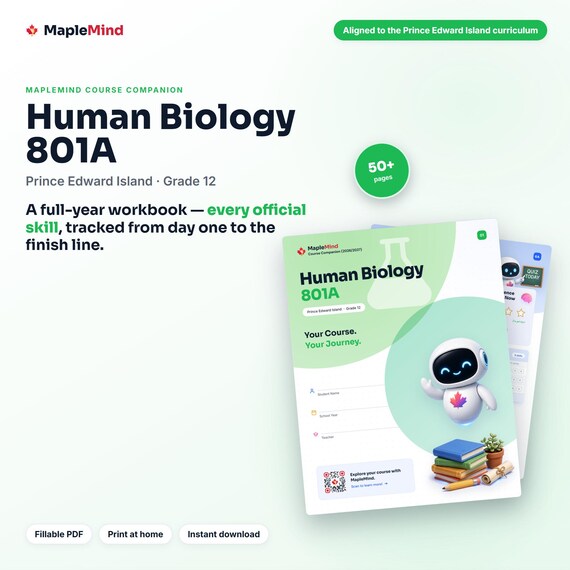
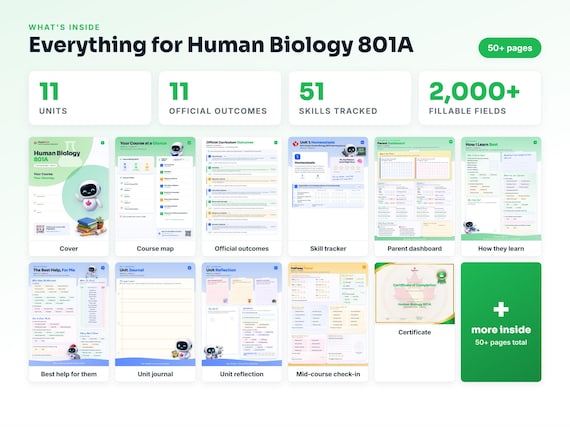
A Human Biology 801A workbook worth keeping
Built from the same official curriculum as this page. Before and after each skill above, your student colours in how sure they feel — so the two of you can see, on one page, what's clicking and what needs another look. It's a quiet way to follow how the year is really going.
By June it's full of their own handwriting: units worked through, confidence grown, a mid-year check-in, notes from parent-teacher night, and a certificate at the end. Less a worksheet, more a record of the year worth keeping on the shelf.
Instant download · see every page, reviews and the full description · five or more workbooks are $2.99 each
What it looks like in the app



Common questions
Can MapleMind help me with Human Biology 801A?
Yes. MapleMind's AI tutor covers all 51 skills in Prince Edward Island's Human Biology 801A — you pick the exact skill, and the tutor teaches it step by step: a short lesson, a worked example, solving together, then a skill check to show it stuck.
Is MapleMind aligned to Prince Edward Island's official curriculum?
Yes. Every skill in this course maps to an official outcome code from Prince Edward Island's Grade 12 Science curriculum, and the ministry's own wording is quoted under each unit on this page — with the official government source linked so you can check it yourself.
What does MapleMind cost?
It's free to start — 5 tutoring chats and a practice quiz every day, no credit card. A Pro subscription ($9.99/month or $49.99/year CAD, 7-day free trial) unlocks unlimited tutoring, practice, and exam simulations.
What if I'm stuck on just one topic?
That's the point of skill-level tutoring: open Human Biology 801A in the app, tap the exact skill from the list on this page, and the tutor teaches just that — no wading through lessons you don't need.
Does MapleMind work in French or other languages?
Yes — 14 languages, including French. Both the app and the tutor's explanations switch to the language you choose.
Where can I see the official Prince Edward Island curriculum for Human Biology 801A?
The official source is linked on this page — Prince Edward Island's official curriculum. The outline here follows it: every MapleMind skill carries its official outcome code, and the ministry's own wording is quoted under each unit.
Keep exploring
Ready when you are
Pick a skill from this page and see it taught properly — free, in the browser, in under a minute.