Get help with Environmental Science 621A
Most tutoring makes you sit through material you already know. MapleMind flips that: pick the exact skill that's causing trouble — any of the 62 below — and the tutor teaches just that one, step by step, as many times as it takes. Ask questions in plain words, any time of day, in English, French, or 12 other languages.
The official Prince Edward Island Environmental Science 621A curriculum
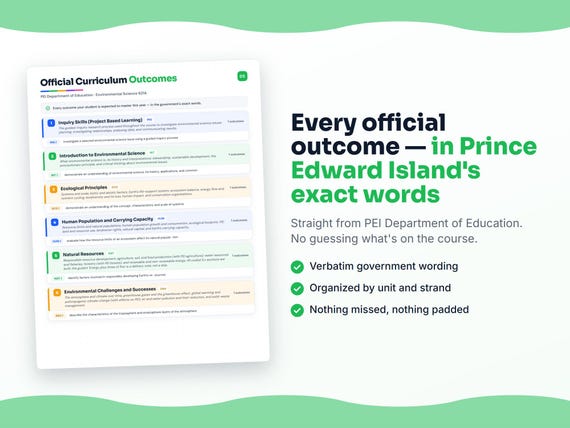
Prince Edward Island defines Environmental Science 621A by strands and outcomes. MapleMind teaches the same curriculum reorganized for one-skill-at-a-time tutoring — the table shows exactly where every official strand lands, and the ministry's own wording is quoted under each unit below.
Official source Prince Edward Island's official curriculumRead it on the government site — princeedwardisland.ca ↗| Official strand | Outcomes | Where MapleMind teaches it |
|---|---|---|
| Strand 1 | 5 | Inquiry Skills (Project Based Learning) |
| Strand 2 | 6 | Introduction to Environmental Science |
| Strand 3 | 10 | Ecological Principles |
| Strand 4 | 7 | Human Population and Carrying Capacity |
| Strand 5 | 19 | Natural Resources |
| Strand 6 | 15 | Environmental Challenges and Successes |
Every skill below, taught one on one.
 Try the first session free
How MapleMind teaches Environmental Science 621A — every unit, lesson, and skill
Every skill below runs as a short session: a plain-words lesson, a worked example, solving it together, then a five-question skill check that earns up to three stars. Guided Mode keeps it teaching instead of answer-handing — turning it off needs a parent's password.
Unit 1Inquiry Skills (Project Based Learning)Official strand · Strand 1
The guided-inquiry research process used throughout the course to investigate environmental science issues: planning, investigating relationships, analysing data, and communicating results.
Investigating an environmental issue through guided inquiry
- Investigating an issue with guided inquiryenv.1.1 — Investigate a selected environmental science issue using a guided inquiry process.
- Planning an investigationenv.1.1.1 — Develop a plan to investigate questions, ideas, problems, and issues.
- Conducting investigations of relationshipsenv.1.1.2 — Conduct investigations into relationships between and among variables using a range of tools and techniques.
- Analysing data and explanationsenv.1.1.3 — Analyse data to develop and assess possible explanations.
- Communicating information and resultsenv.1.1.4 — Communicate information, ideas, and results.
The official wording — 5 outcomes in this unit
- env.1.1
investigate a selected environmental science issue using a guided inquiry process
- env.1.1.1
develop a plan to investigate questions, ideas, problems, and issues
- env.1.1.2
conduct investigations into relationships between and among vari- ables, using a broad range of tools and techniques
- env.1.1.3
analyse data to develop and assess possible explanations
- env.1.1.4
communicate information, ideas, and results
Unit 2Introduction to Environmental ScienceOfficial strand · Strand 2
What environmental science is, its history and interpretations; stewardship, sustainable development, the precautionary principle, and critical thinking about environmental issues.
Environmental science, stewardship, and sustainability
- Understanding environmental scienceenv.2.1 — Demonstrate an understanding of environmental science, its history, applications, and common misconceptions.
- Factors of sustainable developmentenv.2.2 — Explain the environmental, social, and economic factors of sustainable development.
- Stewardship and sustainabilityenv.2.3 — Define stewardship in relation to sustainability.
- Interpretations of environmental scienceenv.2.4 — Demonstrate an understanding of the many different interpretations of environmental science.
- The precautionary principleenv.2.5 — Define the precautionary principle.
- Critical thinking about environmental issuesenv.2.6 — Demonstrate critical thinking through research and analysis of environmental science issues.
The official wording — 6 outcomes in this unit
- env.2.1
demonstrate an understanding of environmental science, its history, applications, and common
- env.2.2
explain the environmental, social, and economic factors of sustainable development
- env.2.3
stewardship in relation to sustainability
- env.2.4
demonstrate an understanding of the many different interpretations of environmental science
- env.2.5
the precautionary
- env.2.6
demonstrate critical thinking skills through research and analysis of envi- ronmental science issues
Unit 3Ecological PrinciplesOfficial strand · Strand 3
Systems and scale, biotic and abiotic factors, Earth's life-support system, ecosystem balance, energy flow and nutrient cycling, biodiversity and its loss, human impact, and conservation organizations.
Systems, cycles, and biodiversity
- The concept and scale of systemsenv.3.1 — Demonstrate an understanding of the concept, characteristics, and scale of systems.
- Abiotic and biotic factorsenv.3.2 — Explain the relationship between abiotic and biotic factors of an ecosystem.
- Earth's life-support systemenv.3.3 — Define the components of Earth's life-support system.
- How balance is maintained in ecosystemsenv.3.4 — Explain how balance is maintained in ecosystems.
- Cycling of matter and biogeochemical cyclesenv.3.5 — Illustrate the cycling of matter through biotic and abiotic components of an ecosystem.
- Measuring abiotic factorsenv.3.6 — Conduct an experiment to measure abiotic factors of an ecosystem.
- Human impact on living and nonliving systemsenv.3.7 — Demonstrate an understanding that humans can have a great impact on systems of living and non-living things.
- Types of biodiversityenv.3.8 — Define the different types of biodiversity: genetic, species, ecological, functional, and structural.
- Loss of diversity and sustainabilityenv.3.9 — Explain how factors that lead to loss of diversity affect the sustainability of an ecosystem.
- Organizations preserving ecosystemsenv.3.10 — Analyse the role of intergovernmental and non-governmental organizations in preserving and restoring ecosystems and biodiversity.
The official wording — 10 outcomes in this unit
- env.3.1
demonstrate an understanding of the concept, characteristics, and scale of systems
- env.3.2
explain the relationship between abiotic factors and biotic factors of an ecosystem
- env.3.3
the components of the Earth
- env.3.4
explain how balance is maintained in ecosystems
- env.3.5
illustrate the cycling of matter through biotic and abiotic components of an ecosystem
- env.3.6
conduct an experiment to measure abiotic factors of an ecosystem
- env.3.7
demonstrate an understanding that humans can have a great impact on systems of living and nonliving things
- env.3.8
the different types of biodiversity: genetic diversity, species diversity, ecological diversity, functional diversity, and structural diversity
- env.3.9
explain how factors that lead to loss of diversity affect the sustain- ability of an ecosystem
- env.3.10
analyse the role and activities of intergovernmental and non-govern- mental organizations in preserving and restoring ecosystems and biodiversity
Unit 4Human Population and Carrying CapacityOfficial strand · Strand 4
Resource limits and natural populations, human population growth and consumerism, ecological footprint, PEI land and resource use, landowner rights, natural capital, and Earth's carrying capacity.
Carrying capacity, footprint, and PEI land use
- Resource limits and natural populationsenv.4.1 — Evaluate how the resource limits of an ecosystem affect its natural population.
- Population growth, resource demand, and consumerismenv.4.2 — Identify the relationship between human population growth, demand for resources, and increased consumerism.
- Ecological footprintenv.4.3 — Identify individual impacts on the environment using the concept of ecological footprint.
- PEI resource and land use over timeenv.4.4 — Analyse resource and land use on Prince Edward Island over time.
- Landowner rights and responsibilitiesenv.4.5 — Identify local landowners' responsibilities and rights regarding land use.
- From natural resources to natural capitalenv.4.6 — Explain how the term natural resources has evolved into the term natural capital.
- Earth's carrying capacityenv.4.7 — Demonstrate an understanding of Earth's carrying capacity, considering human population growth and its demands on natural capital.
The official wording — 7 outcomes in this unit
- env.4.1
evaluate how the resource limits of an ecosystem affect its natural popula- tion
- env.4.2
identify the relationship between human population growth, demand for resources, and increased consum- erism
- env.4.3
identify individual impacts on the environment using the concept of ecological footprint
- env.4.4
analyse resource and land use on Prince Edward Island over time
- env.4.5
identify local land owners responsi- bilities and rights regarding land use
- env.4.6
explain how the term natural resources has evolved into the term natural capital
- env.4.7
demonstrate an understanding of Earth’s carrying capacity, consider- ing human population growth and its demands on natural capital
Unit 5Natural ResourcesOfficial strand · Strand 5
Responsible resource development; agriculture, soil, and food production (with PEI agriculture); water resources and fisheries; forestry (with PEI forests); and renewable and non-renewable energy. All coded 5.x sections are built; the guide's 'Energy plus three of five' is a delivery note, not a skip.
Responsible development, agriculture, and soil
- Responsibly developing Earth's resourcesenv.5.1 — Identify factors involved in responsibly developing Earth's resources.
- Types of agricultureenv.5.2 — Describe the processes used for the four major types of agriculture.
- Strategies affecting global food productionenv.5.3 — Demonstrate an understanding of strategies that affect the state of global food production.
- Agriculture in Prince Edward Islandenv.5.4 — Describe the present level of agriculture in Prince Edward Island.
- Organic and traditional farmingenv.5.5 — Distinguish between organic and traditional farming practices.
- Soil conservation, erosion, and degradationenv.5.6 — Demonstrate an understanding of soil conservation, erosion, and degradation.
- Environmental impacts from agricultureenv.5.7 — Describe the environmental impacts from agriculture.
- Sustainable water useenv.5.8 — Demonstrate an understanding of sustainable water use at local, national, and global levels.
- Water resources and international relationsenv.5.9 — Evaluate the significance of water resources for international relations.
- Global fishery managementenv.5.10 — Evaluate global fishery management from a sustainability viewpoint.
- Environmental impacts of fishing techniquesenv.5.11 — Describe the environmental impacts of various fishing techniques.
- Ocean resources and Prince Edward Islandenv.5.12 — Identify the importance of ocean resources to Prince Edward Island over time.
- Major forest regions of Canadaenv.5.13 — Identify the major forest regions of Canada.
- Forests as natural capitalenv.5.14 — Identify the role forests play as natural capital and their economic, ecological, and social value.
- Forest history on Prince Edward Islandenv.5.15 — Examine the history of old-growth forests, second-growth forests, and tree farms on Prince Edward Island.
- Managing forests sustainablyenv.5.16 — Explain how to manage forests more sustainably.
- Renewable and non-renewable energyenv.5.17 — Evaluate the advantages and disadvantages of renewable and non-renewable energy sources from a variety of perspectives.
- Future energy use on Prince Edward Islandenv.5.18 — Describe factors that might affect future energy use on Prince Edward Island.
- Improving home energy efficiencyenv.5.19 — Create a plan to improve energy efficiency in the home.
The official wording — 19 outcomes in this unit
- env.5.1
identify factors involved in responsibly developing Earth’s re- sources
- env.5.2
describe the processes used for the four major types of agriculture
- env.5.3
demonstrate an understanding of strategies that affect the state of global food production
- env.5.4
describe the present level of agricul- ture in Prince Edward Island
- env.5.5
distinguish between organic and traditional farming practices
- env.5.6
demonstrate an understanding of soil conservation, erosion, and degrada- tion
- env.5.7
describe the environmental impacts from agriculture
- env.5.8
demonstrate an understanding of sustainable water use at local, national, and global levels
- env.5.9
evaluate the of water resources for international relations
- env.5.10
evaluate global manage- ment from a sustainability viewpoint
- env.5.11
describe the environmental im- pacts of various techniques
- env.5.12
identify the importance of ocean resources to Prince Edward Island over time
- env.5.13
identify the major forest regions of Canada
- env.5.14
identify the role forests have as natural capital, as well as their eco- nomic, ecological, and social value
- env.5.15
examine the history of old growth forests, second-growth forests, and tree farms on Prince Edward Island
- env.5.16
explain how to manage forests more sustainably
- env.5.17
evaluate the advantages and disad- vantages of renewable and nonrenew- able energy sources from a variety of perspectives
- env.5.18
describe factors that might affect future energy use on Prince Edward Island
- env.5.19
create a plan to improve energy efficiency in the home
Unit 6Environmental Challenges and SuccessesOfficial strand · Strand 6
The atmosphere and climate over time, greenhouse gases and the greenhouse effect, global warming and anthropogenic climate change (with effects on PEI), air and water pollution and their reduction, and solid-waste management.
Atmosphere, greenhouse effect, and climate change
- The troposphere and stratosphereenv.6.1 — Describe the characteristics of the troposphere and stratosphere layers of the atmosphere.
- How Earth's climate has changed over timeenv.6.2 — Demonstrate an understanding of how Earth's climate has changed over time.
- Greenhouse gases in the atmosphereenv.6.3 — Demonstrate an understanding of the greenhouse gases found in the troposphere and stratosphere.
- Greenhouse effect versus global warmingenv.6.4 — Distinguish between the greenhouse effect and global warming.
- Catastrophic effects of climate changeenv.6.5 — Identify that climate change can have a catastrophic effect on Earth.
- Climate change effects on Prince Edward Islandenv.6.6 — Identify the effects that climate change can have on Prince Edward Island.
- Anthropogenic carbon dioxide and climate changeenv.6.7 — Explain how scientific evidence indicates that anthropogenic carbon dioxide is the major cause of climate change.
- Challenges and successes addressing climate changeenv.6.8 — Demonstrate an understanding of challenges and successes made to address climate change.
- Types, sources, and effects of air pollutionenv.6.9 — Summarize the main types, sources, and effects of air pollution.
- Types, sources, and effects of water pollutionenv.6.10 — Summarize the main types, sources, and effects of water pollution.
- Reducing air and water pollutionenv.6.11 — Explain strategies that reduce air and water pollution.
- Testing for water pollutantsenv.6.12 — Conduct an experiment to determine water pollutants.
- Types of solid domestic wasteenv.6.13 — Identify the types of solid domestic waste.
- Managing solid waste on Prince Edward Islandenv.6.14 — Evaluate pollution-management strategies for solid domestic (municipal) waste on Prince Edward Island.
- A course of action on waste managementenv.6.15 — Propose a course of action on a social issue related to waste management, considering human, economic, and environmental needs.
The official wording — 15 outcomes in this unit
- env.6.1
describe the characteristics of the troposphere and stratosphere layers of the atmosphere
- env.6.2
demonstrate an understanding of how Earth’s climate has changed over time
- env.6.3
demonstrate an understanding of the greenhouse gases found in the troposphere and stratosphere
- env.6.4
distinguish between the greenhouse effect and global warming
- env.6.5
identify that climate change can have a catastrophic effect on Earth
- env.6.6
identify the effects that climate change can have on Prince Edward Island
- env.6.7
explain how scientific evidence indicates that anthropogenic carbon dioxide is the major cause of climate change
- env.6.8
demonstrate an understanding of challenges and successes made to ad- dress climate change
- env.6.9
summarize the main types, sources, and effects of air pollution
- env.6.10
summarize the main types, sources, and effects of water pollu- tion
- env.6.11
explain strategies that reduce air and water pollution
- env.6.12
conduct an experiment to deter- mine water pollutants
- env.6.13
identify the types of solid do- mestic waste
- env.6.14
evaluate pollution management strategies for solid domestic (municipal) waste on Prince Edward Island
- env.6.15
propose a course of action on a so- cial issue related to waste management, taking into account human, economic, and environmental needs
Printable workbook · A keepsake of the year
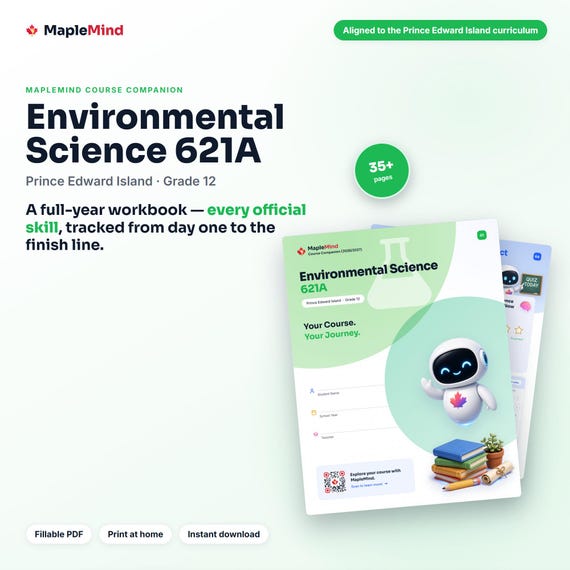
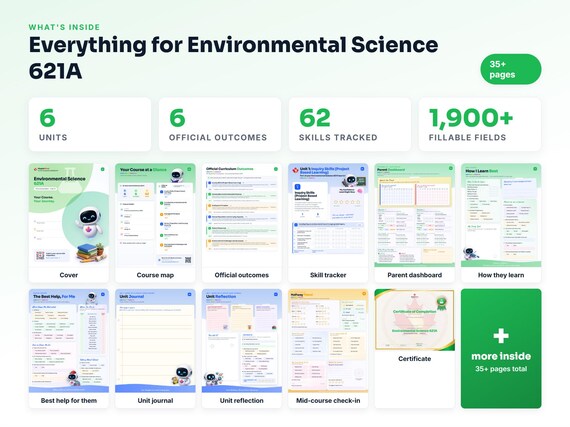
A Environmental Science 621A workbook worth keeping
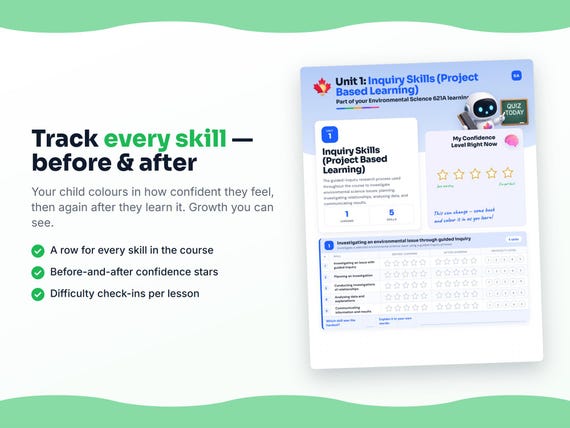
Built from the same official curriculum as this page. Before and after each skill above, your student colours in how sure they feel — so the two of you can see, on one page, what's clicking and what needs another look. It's a quiet way to follow how the year is really going.
By June it's full of their own handwriting: units worked through, confidence grown, a mid-year check-in, notes from parent-teacher night, and a certificate at the end. Less a worksheet, more a record of the year worth keeping on the shelf.
Instant download · see every page, reviews and the full description · five or more workbooks are $2.99 each
What it looks like in the app



Common questions
Can MapleMind help me with Environmental Science 621A?
Yes. MapleMind's AI tutor covers all 62 skills in Prince Edward Island's Environmental Science 621A — you pick the exact skill, and the tutor teaches it step by step: a short lesson, a worked example, solving together, then a skill check to show it stuck.
Is MapleMind aligned to Prince Edward Island's official curriculum?
Yes. Every skill in this course maps to an official outcome code from Prince Edward Island's Grade 12 Science curriculum, and the ministry's own wording is quoted under each unit on this page — with the official government source linked so you can check it yourself.
What does MapleMind cost?
It's free to start — 5 tutoring chats and a practice quiz every day, no credit card. A Pro subscription ($9.99/month or $49.99/year CAD, 7-day free trial) unlocks unlimited tutoring, practice, and exam simulations.
What if I'm stuck on just one topic?
That's the point of skill-level tutoring: open Environmental Science 621A in the app, tap the exact skill from the list on this page, and the tutor teaches just that — no wading through lessons you don't need.
Does MapleMind work in French or other languages?
Yes — 14 languages, including French. Both the app and the tutor's explanations switch to the language you choose.
Where can I see the official Prince Edward Island curriculum for Environmental Science 621A?
The official source is linked on this page — Prince Edward Island's official curriculum. The outline here follows it: every MapleMind skill carries its official outcome code, and the ministry's own wording is quoted under each unit.
Keep exploring
Ready when you are
Pick a skill from this page and see it taught properly — free, in the browser, in under a minute.