Get help with Chemistry, Grade 12 (CHM621A)
Most tutoring makes you sit through material you already know. MapleMind flips that: pick the exact skill that's causing trouble — any of the 33 below — and the tutor teaches just that one, step by step, as many times as it takes. Ask questions in plain words, any time of day, in English, French, or 12 other languages.
The official Prince Edward Island Chemistry, Grade 12 (CHM621A) curriculum
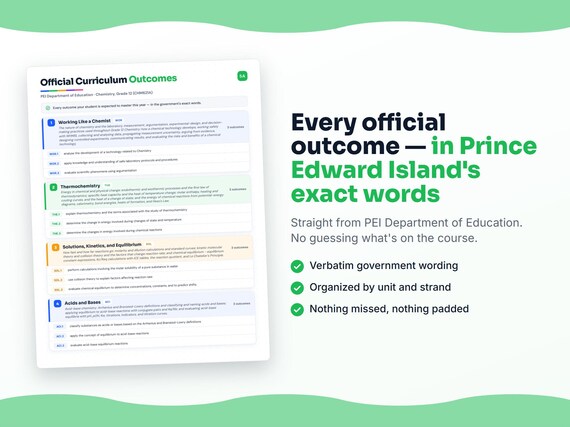
Prince Edward Island defines Chemistry, Grade 12 (CHM621A) by strands and outcomes. MapleMind teaches the same curriculum reorganized for one-skill-at-a-time tutoring — the table shows exactly where every official strand lands, and the ministry's own wording is quoted under each unit below.
Official source Prince Edward Island's official curriculumRead it on the government site — princeedwardisland.ca ↗| Official strand | Outcomes | Where MapleMind teaches it |
|---|---|---|
| Strand PK | 8 | Working Like a Chemist |
| Strand CK | 12 | Thermochemistry · Solutions, Kinetics, and Equilibrium · Acids and Bases · Redox and Electrochemistry |
Every skill below, taught one on one.
 Try the first session free
How MapleMind teaches Chemistry, Grade 12 (CHM621A) — every unit, lesson, and skill
Every skill below runs as a short session: a plain-words lesson, a worked example, solving it together, then a five-question skill check that earns up to three stars. Guided Mode keeps it teaching instead of answer-handing — turning it off needs a parent's password.
Unit 1Working Like a ChemistOfficial strand · Strand PK
The nature of chemistry and the laboratory, measurement, argumentation, experimental-design, and decision-making practices used throughout Grade 12 Chemistry: how a chemical technology develops, working safely with WHMIS, collecting and analysing data, propagating measurement uncertainty, arguing from evidence, designing controlled experiments, communicating results, and evaluating the risks and benefits of a chemical technology.
How a Chemical Technology Develops
- Analysing the development of a chemical technologychm12.NoS.1 — Analyse the design and development of a technology related to chemistry, including how it improved over time and how society influenced it.
Working Safely and Measuring Well
- Safe laboratory protocols and WHMISchm12.PK.1 — Apply safe laboratory protocols and procedures, including interpreting WHMIS 2015 pictograms and labels and safely acquiring, using, and disposing of materials.
- Collecting and analysing datachm12.PK.2 — Apply appropriate techniques, procedures, and technologies - including data loggers and graphing software - for collecting and analysing chemistry data to solve problems.
- Measurement uncertainty and error propagationchm12.PK.3 — Use uncertainty in data measurement and processing: distinguish accuracy and precision, identify random and systematic error, and propagate uncertainty through calculations.
Argument, Design, and Decisions
- Evaluating phenomena with argumentationchm12.PK.4 — Evaluate scientific phenomena using argumentation: support a claim with evidence and reasoning and discuss sources of error and limitations.
- Designing a controlled experimentchm12.PK.5 — Design an experiment that identifies and controls the major variables, formulating questions, hypotheses, and predictions.
- Communicating plans, data, and resultschm12.PK.6 — Use appropriate language, visual aids, numeric and symbolic representation, and formatting conventions to communicate plans, procedures, data, results, and conclusions.
- Evaluating the risks and benefits of a technologychm12.DP.1 — Evaluate, from multiple perspectives, the risks and benefits of a chemistry-related technology to society and the environment, including its sustainability.
The official wording — 8 outcomes in this unit
- chm12.NoS.1
analyse the development of a technology related to Chemistry
- chm12.PK.1
apply knowledge and understanding of safe laboratory protocols and procedures
- chm12.PK.2
apply appropriate techniques, procedures, and technologies for collecting and analysing data to solve problems
- chm12.PK.3
use uncertainty in data measurement and data processing
- chm12.PK.4
evaluate scientific phenomena using argumentation
- chm12.PK.5
design an experiment identifying and controlling major variables
- chm12.PK.6
use appropriate language, visual aids, and formatting conventions to effectively communicate plans, procedures, data, results, and conclusions of research and experimentation
- chm12.DP.1
evaluate, from multiple perspectives, the risks and benefits of a technology related to Chemistry to society and the environment
Unit 2ThermochemistryOfficial strand · Strand CK
Energy in chemical and physical change: endothermic and exothermic processes and the first law of thermodynamics; specific heat capacity and the heat of temperature change; molar enthalpy, heating and cooling curves, and the heat of a change of state; and the energy of chemical reactions from potential-energy diagrams, calorimetry, bond energies, heats of formation, and Hess's Law.
Energy and the First Law
- Thermochemistry terms and the first lawchm12.CK.1.1 — Explain thermochemistry and its terms: distinguish endothermic and exothermic change, identify system, surroundings, and energy-flow direction, and state the first law of thermodynamics.
Heat in State and Temperature Change
- Specific heat capacity and temperature changechm12.CK.1.2 — Determine specific heat capacity and calculate the heat gained or lost during a temperature change using q = mcΔt.
- Molar enthalpy, heating curves, and change of statechm12.CK.1.2 — Determine molar enthalpy and use q = nΔH for changes of state, drawing and interpreting heating and cooling curves.
Energy of Chemical Reactions
- Potential-energy diagrams and thermochemical equationschm12.CK.1.3 — Represent the energy of chemical reactions using potential-energy diagrams and thermochemical equations, and interpret the sign of ΔH.
- Calorimetry, bond energies, and Hess's Lawchm12.CK.1.3 — Determine reaction energy from calorimetry data and from bond energies, heats of formation, and Hess's Law.
The official wording — 3 outcomes in this unit
- chm12.CK.1.1
explain thermochemistry and the terms associated with the study of thermochemistry
- chm12.CK.1.2
determine the change in energy involved during changes of state and temperature
- chm12.CK.1.3
determine the changes in energy involved during chemical reactions
Unit 3Solutions, Kinetics, and EquilibriumOfficial strand · Strand CK
How fast and how far reactions go: molarity and dilution calculations and standard curves; kinetic molecular theory and collision theory and the factors that change reaction rate; and chemical equilibrium - equilibrium constant expressions, Kc/Keq calculations with ICE tables, the reaction quotient, and Le Chatelier's Principle.
Molarity and Dilutions
- Molarity of solutionschm12.CK.2.1 — Calculate molarity from mass or moles of solute and volume of solution, and prepare stock solutions of a specified concentration.
- Dilutions and standard curveschm12.CK.2.1 — Perform dilution calculations and construct and interpret a standard curve to find an unknown concentration.
Reaction Rate and Collision Theory
- Collision theory and factors affecting reaction ratechm12.CK.2.2 — Use kinetic molecular theory and collision theory to explain how nature of reactants, surface area, temperature, concentration, and catalysts affect reaction rate.
- Reaction mechanisms and catalystschm12.CK.2.2 — Describe reaction mechanisms - including the rate-determining step and intermediates - and how a catalyst provides an alternative pathway.
Chemical Equilibrium
- Equilibrium and the equilibrium constant expressionchm12.CK.2.3 — Explain chemical equilibrium, write equilibrium constant expressions, and predict whether reactants or products are favoured from the size of Keq.
- Kc calculations with ICE tableschm12.CK.2.3 — Calculate Kc/Keq from equilibrium concentrations and use an ICE table to find equilibrium concentrations from initial data.
- Le Chatelier's Principle and predicting shiftschm12.CK.2.3 — Predict the direction of an equilibrium shift using Le Chatelier's Principle and by comparing the reaction quotient Q to Keq.
The official wording — 3 outcomes in this unit
- chm12.CK.2.1
perform calculations involving the molar solubility of a pure substance in water
- chm12.CK.2.2
use collision theory to explain factors affecting reaction rate
- chm12.CK.2.3
evaluate chemical equilibrium to determine concentrations, constants, and to predict shifts
Unit 4Acids and BasesOfficial strand · Strand CK
Acid-base chemistry: Arrhenius and Bronsted-Lowry definitions and classifying and naming acids and bases; applying equilibrium to acid-base reactions with conjugate pairs and Ka/Kb; and evaluating acid-base equilibria with pH, pOH, Kw, titrations, indicators, and titration curves.
Defining Acids and Bases
- Arrhenius and Bronsted-Lowry definitionschm12.CK.3.1 — Describe the Arrhenius and Bronsted-Lowry definitions of acids and bases, including writing ionization and dissociation equations, and why the theory was extended.
- Classifying and naming acids and baseschm12.CK.3.1 — Classify substances as acids, bases, or salts by their characteristics, and write the formula and IUPAC name for a variety of acids and bases.
Acid-Base Equilibrium
- Proton transfer and conjugate acid-base pairschm12.CK.3.2 — Complete Bronsted-Lowry proton-transfer equations and identify the acid, base, and conjugate acid-base pairs.
- Strong and weak acids and Ka/Kbchm12.CK.3.2 — Distinguish strong from weak acids and bases using equilibrium, and write Ka and Kb expressions for weak acids and bases.
pH, pOH, and Titration
- pH, pOH, and Kw calculationschm12.CK.3.3 — Calculate pH and pOH from concentration (and the reverse), using Kw to relate hydronium and hydroxide concentrations.
- Evaluating weak acid-base equilibriachm12.CK.3.3 — Evaluate weak acid-base equilibria with ICE tables to find equilibrium concentrations, pH, pOH, and percent dissociation from initial concentration and Ka or Kb.
- Titrations, indicators, and titration curveschm12.CK.3.3 — Perform titration calculations, select and explain indicators, distinguish endpoint from equivalence point, and sketch and interpret titration curves.
The official wording — 3 outcomes in this unit
- chm12.CK.3.1
classify substances as acids or bases based on the Arrhenius and Brønsted-Lowry definitions
- chm12.CK.3.2
apply the concept of equilibrium to acid-base reactions
- chm12.CK.3.3
evaluate acid-base equilibrium reactions
Unit 5Redox and ElectrochemistryOfficial strand · Strand CK
Electron-transfer chemistry: describing redox reactions with oxidation numbers, oxidizing and reducing agents; balancing redox equations by the half-reaction method in acidic, basic, and neutral solutions; and analysing electrochemical cells with cell notation, standard reduction potentials, and cell potential.
Redox Reactions
- Redox definitions and oxidation numberschm12.CK.4.1 — Define oxidation, reduction, oxidizing and reducing agents, and oxidation number, and assign oxidation numbers using the rules.
- Identifying oxidizing and reducing agentschm12.CK.4.1 — Identify the species oxidized and reduced and the oxidizing and reducing agents, and distinguish redox reactions from other reactions.
Balancing Redox and Electrochemical Cells
- Balancing redox in neutral solutionchm12.CK.4.2 — Write and balance oxidation and reduction half-reactions and the net redox equation in neutral solution using the half-reaction method.
- Balancing redox in acidic and basic solutionchm12.CK.4.2 — Balance more complex redox reactions in acidic and basic solutions using H+, OH-, and water in the half-reaction method.
- Structure and function of an electrochemical cellchm12.CK.4.3 — Describe the components and functioning of an electrochemical cell - electrodes, electron flow, ion migration - and represent it with cell notation.
- Cell potential and spontaneitychm12.CK.4.3 — Calculate cell potential from standard reduction potentials and identify whether a redox reaction is spontaneous.
The official wording — 3 outcomes in this unit
- chm12.CK.4.1
describe the chemical changes that occur during redox reactions
- chm12.CK.4.2
balance redox reactions in acidic, basic, and neutral solutions using the half reaction method
- chm12.CK.4.3
analyse the functioning of electrochemical cells

Printable workbook · A keepsake of the year
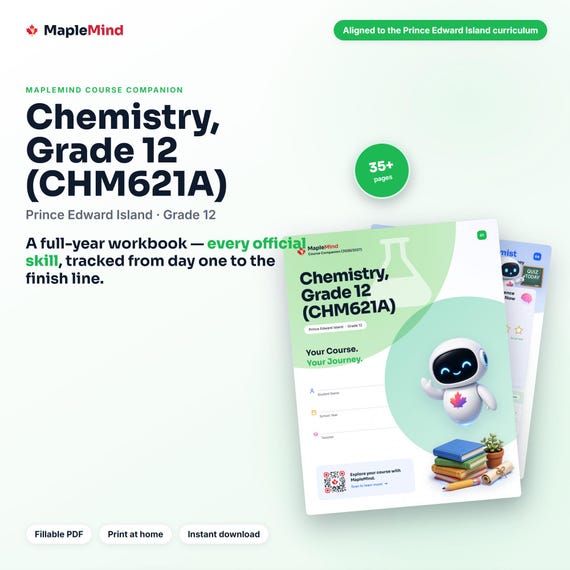
A Chemistry, Grade 12 (CHM621A) workbook worth keeping
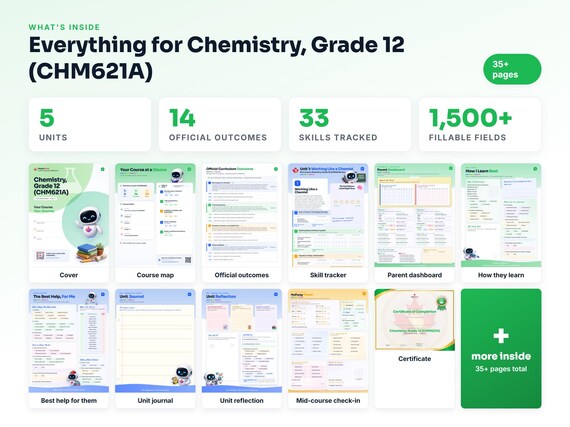
Built from the same official curriculum as this page. Before and after each skill above, your student colours in how sure they feel — so the two of you can see, on one page, what's clicking and what needs another look. It's a quiet way to follow how the year is really going.
By June it's full of their own handwriting: units worked through, confidence grown, a mid-year check-in, notes from parent-teacher night, and a certificate at the end. Less a worksheet, more a record of the year worth keeping on the shelf.
Instant download · see every page, reviews and the full description · five or more workbooks are $2.99 each
What it looks like in the app



Common questions
Can MapleMind help me with Chemistry, Grade 12 (CHM621A)?
Yes. MapleMind's AI tutor covers all 33 skills in Prince Edward Island's Chemistry, Grade 12 (CHM621A) — you pick the exact skill, and the tutor teaches it step by step: a short lesson, a worked example, solving together, then a skill check to show it stuck.
Is MapleMind aligned to Prince Edward Island's official curriculum?
Yes. Every skill in this course maps to an official outcome code from Prince Edward Island's Grade 12 Science curriculum, and the ministry's own wording is quoted under each unit on this page — with the official government source linked so you can check it yourself.
What does MapleMind cost?
It's free to start — 5 tutoring chats and a practice quiz every day, no credit card. A Pro subscription ($9.99/month or $49.99/year CAD, 7-day free trial) unlocks unlimited tutoring, practice, and exam simulations.
What if I'm stuck on just one topic?
That's the point of skill-level tutoring: open Chemistry, Grade 12 (CHM621A) in the app, tap the exact skill from the list on this page, and the tutor teaches just that — no wading through lessons you don't need.
Does MapleMind work in French or other languages?
Yes — 14 languages, including French. Both the app and the tutor's explanations switch to the language you choose.
Where can I see the official Prince Edward Island curriculum for Chemistry, Grade 12 (CHM621A)?
The official source is linked on this page — Prince Edward Island's official curriculum. The outline here follows it: every MapleMind skill carries its official outcome code, and the ministry's own wording is quoted under each unit.
Keep exploring
Ready when you are
Pick a skill from this page and see it taught properly — free, in the browser, in under a minute.