Get help with Science, Grade 9
Most tutoring makes you sit through material you already know. MapleMind flips that: pick the exact skill that's causing trouble — any of the 30 below — and the tutor teaches just that one, step by step, as many times as it takes. Ask questions in plain words, any time of day, in English, French, or 12 other languages.
The official Prince Edward Island Science, Grade 9 curriculum
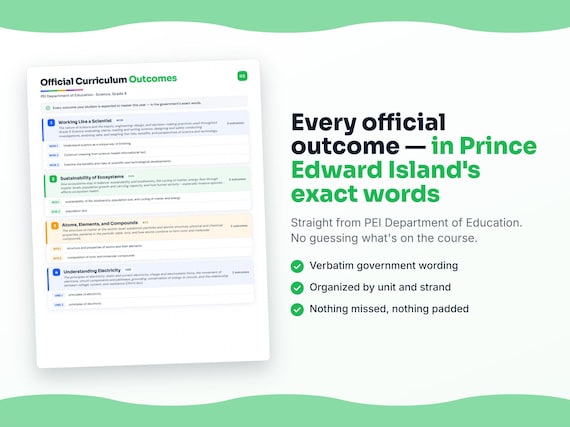
Prince Edward Island defines Science, Grade 9 by strands and outcomes. MapleMind teaches the same curriculum reorganized for one-skill-at-a-time tutoring — the table shows exactly where every official strand lands, and the ministry's own wording is quoted under each unit below.
Official source Prince Edward Island's official curriculumRead it on the government site — princeedwardisland.ca ↗| Official strand | Outcomes | Where MapleMind teaches it |
|---|---|---|
| Strand PK | 12 | Working Like a Scientist |
| Strand CK | 4 | Sustainability of Ecosystems · Atoms, Elements, and Compounds · Understanding Electricity |
Every skill below, taught one on one.
 Try the first session free
How MapleMind teaches Science, Grade 9 — every unit, lesson, and skill
Every skill below runs as a short session: a plain-words lesson, a worked example, solving it together, then a five-question skill check that earns up to three stars. Guided Mode keeps it teaching instead of answer-handing — turning it off needs a parent's password.
Unit 1Working Like a ScientistOfficial strand · Strand PK
The nature of science and the inquiry, engineering-design, and decision-making practices used throughout Grade 9 Science: evaluating claims, reading and writing science, designing and safely conducting investigations, analysing data, and weighing the risks, benefits, and perspectives of science and technology.
Science as a Way of Knowing
- Science as a unique way of knowingsci9.NoS.1 — Understand science as a distinct way of knowing about the natural world, based on evidence and reasoning.
- Evaluating whether a claim is reasonablesci9.NoS.2 — Evaluate, with support, whether a reported idea or claim is scientifically reasonable.
Reading, Investigating, and Communicating Science
- Making meaning from science textsci9.PK.1 — Construct meaning from science-based informational text.
- Communicating scientific thinking in writingsci9.PK.2 — Compose written reports and arguments that clearly communicate scientific thinking.
- Designing an investigationsci9.PK.3 — Design an investigation to examine a relationship between variables.
- The engineering design processsci9.PK.4 — Apply the engineering design process to develop a technical solution that addresses a need.
- Investigating safely to collect datasci9.PK.5 — Conduct investigations safely to collect data that can answer questions or build scientific understanding.
- Analysing data for patternssci9.PK.6 — Analyse data to determine patterns, trends, and causal relationships.
- Evaluating the strength of evidencesci9.PK.7 — Evaluate, with support, the strength of the evidence resulting from a scientific investigation.
Science, Society, and Choices
- Benefits and risks of developmentssci9.DP.1 — Examine the benefits and risks of scientific and technological developments.
- Defending a decision from multiple perspectivessci9.DP.2 — Defend decisions or judgments about scientific or technological issues, considering multiple perspectives.
- Connecting to science careerssci9.DP.3 — Reflect on personal characteristics, skills, and opportunities that connect to a career in science.
The official wording — 12 outcomes in this unit
- sci9.NoS.1
Understand science as a unique way of knowing.
- sci9.NoS.2
Evaluate, with support, if a reported idea or claim is scientifically reasonable.
- sci9.PK.1
Construct meaning from science-based informational text.
- sci9.PK.2
Compose written reports and arguments to effectively communicate scientific thinking.
- sci9.PK.3
Design an investigation to examine a relationship between variables.
- sci9.PK.4
Apply the engineering design process to develop a technical solution that addresses a need.
- sci9.PK.5
Conduct investigations safely to collect data that can be used to answer questions or learn scientific concepts.
- sci9.PK.6
Analyze data to determine patterns, trends, and causal relationships.
- sci9.PK.7
Evaluate, with support, the strength of evidence resulting from a scientific investigation.
- sci9.DP.1
Examine the benefits and risks of scientific and technological developments.
- sci9.DP.2
Defend decisions or judgments regarding scientific or technological issues, with consideration of multiple perspectives.
- sci9.DP.3
Reflect on personal characteristics, skills, and opportunities that connect to a career in science.
Unit 2Sustainability of EcosystemsOfficial strand · Strand CK
How ecosystems stay in balance: sustainability and biodiversity, the cycling of matter, energy flow through trophic levels, population growth and carrying capacity, and how human activity - especially invasive species - affects ecosystem health.
Sustainable Ecosystems: Matter and Energy
- Vocabulary of sustainable ecosystemssci9.CK.1 — Build and use the key vocabulary of sustainable ecosystems, including biotic and abiotic factors, biodiversity, carrying capacity, and trophic levels.
- Photosynthesis and respiration as opposite reactionssci9.CK.1 — Explain why photosynthesis and respiration are opposite chemical reactions and why both are essential to the sustainability of life.
- Matter cycles and why they mattersci9.CK.1 — Explain how matter cycles (such as carbon and nitrogen) recycle a limited amount of matter through an ecosystem, and predict effects of a change to one part of a cycle.
- Energy flow through trophic levelssci9.CK.1 — Explain how energy flows one way through trophic levels, decreasing at each level, and why this flow is essential to sustaining life.
Populations, Carrying Capacity, and Biodiversity
- Population changes and carrying capacitysci9.CK.1 — Analyse how births, deaths, and limiting factors change population size and determine an environment's carrying capacity.
- Human activity and invasive speciessci9.CK.1 — Describe how human activities - habitat change, overexploitation, pollution, invasive species, and climate change - reduce biodiversity, with emphasis on invasive species in PEI.
- Biodiversity and ecosystem healthsci9.CK.1 — Explain how changes in biodiversity affect the health, resilience, and sustainability of ecosystems.
The official wording — 1 outcome in this unit
- sci9.CK.1
sustainability of life, biodiversity, population size, and cycling of matter and energy
Unit 3Atoms, Elements, and CompoundsOfficial strand · Strand CK
The structure of matter at the atomic level: subatomic particles and atomic structure, physical and chemical properties, patterns in the periodic table, ions, and how atoms combine to form ionic and molecular compounds.
Atomic Structure and the Periodic Table
- Atomic vocabulary and subatomic particlessci9.CK.2.1 — Use atomic vocabulary and contrast the three subatomic particles by their location, charge, and relative size.
- Physical and chemical propertiessci9.CK.2.1 — Distinguish physical properties from chemical properties and give examples of each.
- Patterns in the periodic tablesci9.CK.2.1 — Use Bohr and Lewis diagrams and the periodic table to find patterns in atomic structure and deduce an element's group and properties from its position.
Ions and Compounds
- Atoms, ions, and chemical changesci9.CK.2.2 — Explain how atoms become ions by losing or gaining valence electrons, and how chemical change forms new substances by rearranging atoms.
- Ionic and molecular compoundssci9.CK.2.2 — Distinguish ionic compounds (formed by transferring electrons between metals and non-metals) from molecular compounds (formed by non-metals sharing electrons).
- Chemical formulas and ratiossci9.CK.2.2 — Read chemical formulas to determine the type and ratio of atoms in a compound, deduce simple binary ionic formulas, and distinguish pure substances from mixtures.
The official wording — 2 outcomes in this unit
- sci9.CK.2.1
structure and properties of atoms and their elements
- sci9.CK.2.2
composition of ionic and molecular compounds
Unit 4Understanding ElectricityOfficial strand · Strand CK
The principles of electricity: static and current electricity, charge and electrostatic force, the movement of electrons, circuit components and pathways, grounding, conservation of energy in circuits, and the relationship between voltage, current, and resistance (Ohm's law).
Charge and Static Electricity
- Electricity vocabulary and chargesci9.CK.3 — Use electricity vocabulary and relate electric charge to the attractive and repulsive forces between charged particles in atoms.
- Static electricity and electron movementsci9.CK.3 — Apply the rule that like charges repel and opposites attract, explain that electrons (not protons) move, and describe how charge imbalance, discharge, and grounding occur.
Current Electricity, Circuits, and Ohm's Law
- Circuit components and currentsci9.CK.3 — Identify the components of an electrical circuit and their functions, and trace the pathway of current through series and parallel circuits.
- Energy conservation and electrical safetysci9.CK.3 — Apply the law of conservation of energy to electrical energy and assess the risk of shock or fire from voltage, current, and resistance.
- Ohm's law: voltage, current, and resistancesci9.CK.3 — Examine and use the mathematical relationship between voltage, current, and resistance described by Ohm's law, V = IR.
The official wording — 1 outcome in this unit
- sci9.CK.3
principles of electricity
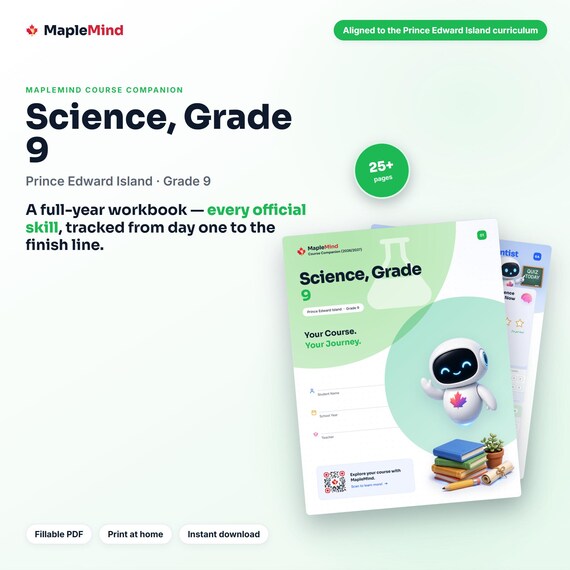
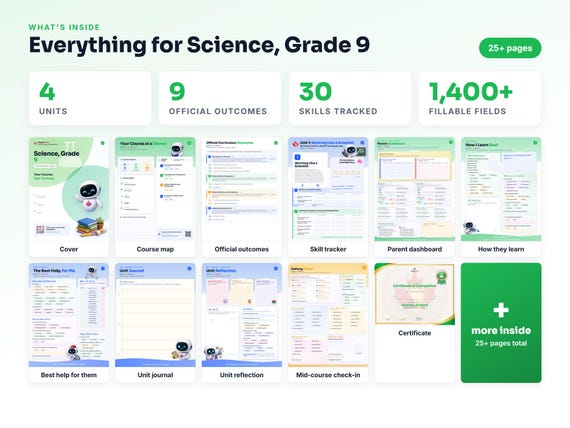
Printable workbook · A keepsake of the year
A Science, Grade 9 workbook worth keeping
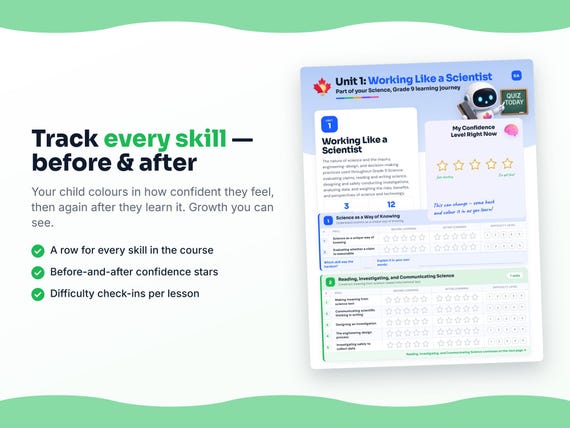
Built from the same official curriculum as this page. Before and after each skill above, your student colours in how sure they feel — so the two of you can see, on one page, what's clicking and what needs another look. It's a quiet way to follow how the year is really going.
By June it's full of their own handwriting: units worked through, confidence grown, a mid-year check-in, notes from parent-teacher night, and a certificate at the end. Less a worksheet, more a record of the year worth keeping on the shelf.
Instant download · see every page, reviews and the full description · five or more workbooks are $2.99 each
What it looks like in the app



Common questions
Can MapleMind help me with Science, Grade 9?
Yes. MapleMind's AI tutor covers all 30 skills in Prince Edward Island's Science, Grade 9 — you pick the exact skill, and the tutor teaches it step by step: a short lesson, a worked example, solving together, then a skill check to show it stuck.
Is MapleMind aligned to Prince Edward Island's official curriculum?
Yes. Every skill in this course maps to an official outcome code from Prince Edward Island's Grade 9 Science curriculum, and the ministry's own wording is quoted under each unit on this page — with the official government source linked so you can check it yourself.
What does MapleMind cost?
It's free to start — 5 tutoring chats and a practice quiz every day, no credit card. A Pro subscription ($9.99/month or $49.99/year CAD, 7-day free trial) unlocks unlimited tutoring, practice, and exam simulations.
What if I'm stuck on just one topic?
That's the point of skill-level tutoring: open Science, Grade 9 in the app, tap the exact skill from the list on this page, and the tutor teaches just that — no wading through lessons you don't need.
Does MapleMind work in French or other languages?
Yes — 14 languages, including French. Both the app and the tutor's explanations switch to the language you choose.
Where can I see the official Prince Edward Island curriculum for Science, Grade 9?
The official source is linked on this page — Prince Edward Island's official curriculum. The outline here follows it: every MapleMind skill carries its official outcome code, and the ministry's own wording is quoted under each unit.
Keep exploring
Ready when you are
Pick a skill from this page and see it taught properly — free, in the browser, in under a minute.