Get help with English Language Arts 11 (ENG521A)
Most tutoring makes you sit through material you already know. MapleMind flips that: pick the exact skill that's causing trouble — any of the 29 below — and the tutor teaches just that one, step by step, as many times as it takes. Ask questions in plain words, any time of day, in English, French, or 12 other languages.
The official Prince Edward Island English Language Arts 11 (ENG521A) curriculum
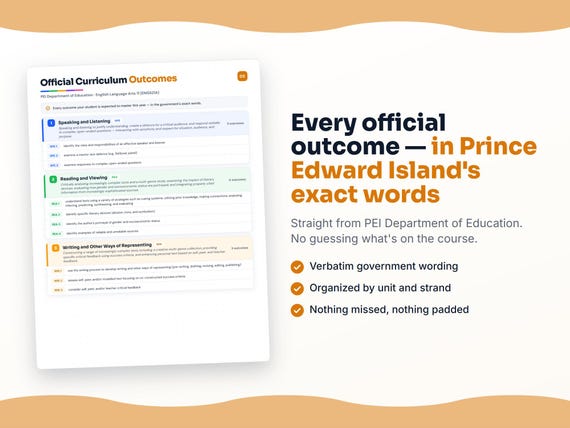
Prince Edward Island defines English Language Arts 11 (ENG521A) by strands and outcomes. MapleMind teaches the same curriculum reorganized for one-skill-at-a-time tutoring — the table shows exactly where every official strand lands, and the ministry's own wording is quoted under each unit below.
Official source Prince Edward Island's official curriculumRead it on the government site — princeedwardisland.ca ↗| Official strand | Outcomes | Where MapleMind teaches it |
|---|---|---|
| Strand SL | 9 | Speaking and Listening |
| Strand RV | 12 | Reading and Viewing |
| Strand W | 8 | Writing and Other Ways of Representing |
Every skill below, taught one on one.
 Try the first session free
How MapleMind teaches English Language Arts 11 (ENG521A) — every unit, lesson, and skill
Every skill below runs as a short session: a plain-words lesson, a worked example, solving it together, then a five-question skill check that earns up to three stars. Guided Mode keeps it teaching instead of answer-handing — turning it off needs a parent's password.
Unit 1Speaking and ListeningOfficial strand · Strand SL
Speaking and listening to justify understanding, create a defence for a critical audience, and respond verbally to complex, open-ended questions — interacting with sensitivity and respect for situation, audience, and purpose.
Justifying Understanding Through Communication (SCO1)
- Roles and responsibilities of an effective speaker and listenerPEI-ELA-11.SCO1.a — Identify the roles and responsibilities of an effective speaker and listener, recognizing communication as an exchange of ideas carried by physical qualities and language choices.
- Analysing others' viewpoints through active listeningPEI-ELA-11.SCO1.e — Analyse the viewpoints of others — such as an author, character, or peer — using active listening and examining their motivation.
- Asking complex, open-ended questions to analyse ideasPEI-ELA-11.SCO1.i — Ask complex, open-ended, discriminating questions to acquire, interpret, and analyse ideas and information, using examples to justify understanding.
Creating a Defence for a Critical Audience (SCO2)
- Examining a mentor text defencePEI-ELA-11.SCO2.a — Examine a mentor text defence, such as a fishbowl or panel, applying co-constructed success criteria.
- Presenting a viewpoint to a critical audiencePEI-ELA-11.SCO2.c — Present a personal viewpoint to a critical audience, using supportive details to persuade them.
- Critiquing opposing viewpoints with supportPEI-ELA-11.SCO2.i — Critique opposing viewpoints using examples for support, responding to challenging questions from the critical audience.
Responding Verbally to Complex, Open-Ended Questions (SCO3)
- Examining responses to complex, open-ended questionsPEI-ELA-11.SCO3.b — Examine responses to complex, open-ended questions, using co-constructed success criteria to judge them.
- Assessing the situation in which questions are askedPEI-ELA-11.SCO3.d — Assess the situation in which questions are being asked, analysing and considering the viewpoints of others while constructing a response.
- Responding with precise information and examplesPEI-ELA-11.SCO3.g — Use precise information and examples to support verbal responses to complex, open-ended questions.
The official wording — 9 outcomes in this unit
- PEI-ELA-11.SCO1.a
identify the roles and responsibilities of an effective speaker and listener
- PEI-ELA-11.SCO1.e
analyse the viewpoints of others (e.g., author, character, peer)
- PEI-ELA-11.SCO1.i
ask complex, open-ended, discriminating questions to acquire, interpret, and analyse ideas and information
- PEI-ELA-11.SCO2.a
examine a mentor text defence (e.g., fishbowl, panel)
- PEI-ELA-11.SCO2.c
present a personal viewpoint to a critical audience
- PEI-ELA-11.SCO2.i
critique opposing viewpoints using examples for support
- PEI-ELA-11.SCO3.b
examine responses to complex, open-ended questions
- PEI-ELA-11.SCO3.d
assess the situation in which questions are being asked
- PEI-ELA-11.SCO3.g
use precise information and examples to support responses
Unit 2Reading and ViewingOfficial strand · Strand RV
Critically analysing increasingly complex texts and a multi-genre study; examining the impact of literary devices; evaluating how gender and socioeconomic status are portrayed; and integrating properly cited information from increasingly sophisticated sources.
Critically Analysing Increasingly Complex Texts (SCO4)
- Comprehending increasingly complex texts using strategiesPEI-ELA-11.SCO4.b — Understand increasingly complex texts using strategies such as cueing systems, prior knowledge, connections, analysing, inferring, predicting, synthesizing, and evaluating.
- Identifying a text's purpose, structure, and characteristicsPEI-ELA-11.SCO4.e — Identify the characteristics of a text (fiction, non-fiction, poetry, visual/multimedia), together with its purpose and structure.
- Analysing how texts manipulate and shape belief and powerPEI-ELA-11.SCO4.f — Examine how texts manipulate, persuade, or control; how beliefs, values, and power are shaped by the text; and the relationships among topic, genre, purpose, context, and audience.
- Reading an issue across a multi-genre studyPEI-ELA-11.SCO4.l — Carry out a multi-genre study: examine multi-genre mentor texts and assess how an issue, theme, or question is represented and how personal connections are made across genres.
Examining the Impact of Literary Devices (SCO5)
- Identifying allusion, irony, and symbolism and their meaningPEI-ELA-11.SCO5.b — Identify specific literary devices — allusion, irony, and symbolism — and understand their meaning in text.
- Analysing a literary device in contextPEI-ELA-11.SCO5.d — Analyse the context of literary devices — for example, what is being compared — supporting the analysis with examples from the text.
Evaluating How Gender and Socioeconomic Status Are Portrayed (SCO6)
- Analysing gender and socioeconomic status across textsPEI-ELA-11.SCO6.c — Analyse gender and socioeconomic status in a variety of texts, considering own and others' interpretations and making connections among texts.
- Assessing the reliability of informationPEI-ELA-11.SCO6.g — Assess the reliability of information, seeking further information to clarify understanding and posing questions where needed.
Integrating Properly Cited Information (SCO7)
- Identifying reliable and unreliable sourcesPEI-ELA-11.SCO7.b — Identify examples of reliable and unreliable sources, reading texts in relation to an idea.
- Selecting increasingly sophisticated, reliable sourcesPEI-ELA-11.SCO7.c — Evaluate and select a variety of increasingly sophisticated and reliable sources to support an idea.
- Synthesizing sources with quotations and citing properlyPEI-ELA-11.SCO7.e — Cite information properly and synthesize it in support of an idea using direct and indirect quotations.
The official wording — 12 outcomes in this unit
- PEI-ELA-11.SCO4.b
understand texts using a variety of strategies such as cueing systems, utilizing prior knowledge, making connections, analysing, inferring, predicting, synthesizing, and evaluating
- PEI-ELA-11.SCO4.e
identify characteristics of text: fiction/narrative nonfiction: setting, conflict, plot, characterization, and point of view nonfiction: thesis, argument/explanation, supporting details, and point of view poetry: tone, mood, point of view, and context visual/multimedia: tone, mood, point of view, and context
- PEI-ELA-11.SCO4.f
examine how texts manipulate, persuade, or control
- PEI-ELA-11.SCO4.l
multi-genre study: examine multi-genre mentor texts, assessing how issues, themes, and questions are represented through a variety of genres; assess how personal connections were made to each text
- PEI-ELA-11.SCO5.b
identify specific literary devices (allusion, irony, and symbolism)
- PEI-ELA-11.SCO5.d
analyse the context of the literary devices (e.g., what is being compared)
- PEI-ELA-11.SCO6.b
identify the author’s portrayal of gender and socioeconomic status
- PEI-ELA-11.SCO6.c
analyse gender and socioeconomic status in a variety of texts
- PEI-ELA-11.SCO6.g
assess reliability of information
- PEI-ELA-11.SCO7.b
identify examples of reliable and unreliable sources
- PEI-ELA-11.SCO7.c
evaluate and select a variety of increasingly sophisticated and reliable sources to support an idea
- PEI-ELA-11.SCO7.e
cite information properly
Unit 3Writing and Other Ways of RepresentingOfficial strand · Strand W
Constructing a range of increasingly complex texts including a creative multi-genre collection, providing specific critical feedback using success criteria, and enhancing personal text based on self, peer, and teacher feedback.
Constructing Increasingly Complex Texts (SCO8)
- Using the writing process to develop a textPEI-ELA-11.SCO8.b — Use the writing process — pre-writing, drafting, revising, editing, publishing — to develop writing and other ways of representing, studying mentor texts to mimic writing styles.
- Selecting form, style, and content for audience and purposePEI-ELA-11.SCO8.c — Select appropriate form, style, and content for specific audiences and purposes across expressive, expository, expository research, visual/multimedia, and creative multi-genre texts.
- Making informed language and technique choicesPEI-ELA-11.SCO8.f — Make informed choices of language and techniques to refine imaginative writing and other ways of representing, using the six writing traits.
- Developing a creative multi-genre collectionPEI-ELA-11.SCO8.j — Create a creative multi-genre collection: identify an issue, theme, or question and develop it through a variety of genres with attention to each genre's qualities.
Providing Specific Critical Feedback (SCO9)
- Assessing a text against success criteriaPEI-ELA-11.SCO9.b — Assess self, peer, and/or modelled text focusing on co-constructed success criteria, considering the purpose and audience of the text.
- Giving specific, respectful suggestions for improvementPEI-ELA-11.SCO9.e — Provide specific suggestions for improvement in the text, identifying strengths and communicating effectively while respecting the rights of others.
Enhancing Personal Text Based on Feedback (SCO10)
- Considering critical feedback and its advantagesPEI-ELA-11.SCO10.d — Consider self, peer, and/or teacher critical feedback, demonstrating openness to it and stating the advantages of receiving it.
- Revising a text in response to feedbackPEI-ELA-11.SCO10.f — Revise text based on self, peer, and/or teacher feedback and justify the action taken in response.
The official wording — 8 outcomes in this unit
- PEI-ELA-11.SCO8.b
use the writing process to develop writing and other ways of representing (pre-writing, drafting, revising, editing, publishing)
- PEI-ELA-11.SCO8.c
select appropriate form, style, and content for specific audiences and purposes (expressive, expository, expository research, visual/multimedia, and creative multi-genre collection)
- PEI-ELA-11.SCO8.f
make informed choices of language and techniques to refine imaginative writing and other ways of representing
- PEI-ELA-11.SCO8.j
Creative multi-genre collection: identify an issue, theme, or question to develop through a variety of genres select appropriate genres to represent chosen issue, theme, or question develop the issue, theme, or question in multiple genres
- PEI-ELA-11.SCO9.b
assess self, peer, and/or modelled text focusing on co-constructed success criteria
- PEI-ELA-11.SCO9.e
provide specific suggestions for improvement in the text
- PEI-ELA-11.SCO10.d
consider self, peer, and/or teacher critical feedback
- PEI-ELA-11.SCO10.f
revise text based on self, peer, and/or teacher feedback
Printable workbook · A keepsake of the year
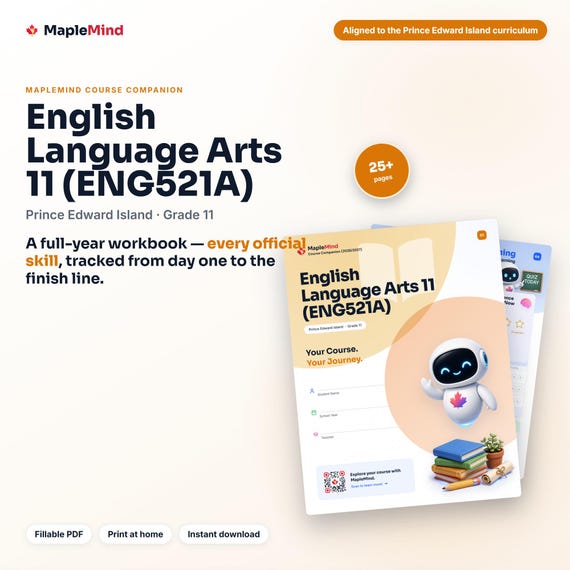
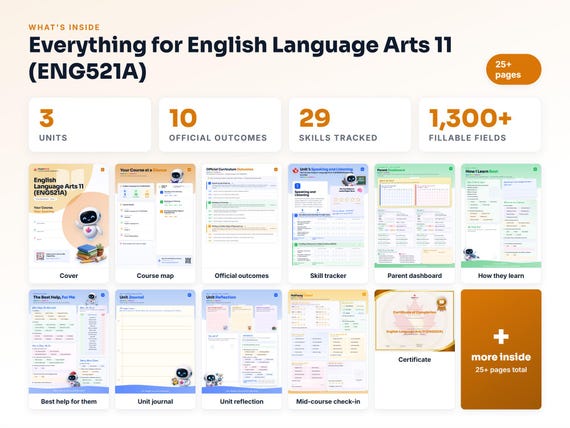
A English Language Arts 11 (ENG521A) workbook worth keeping
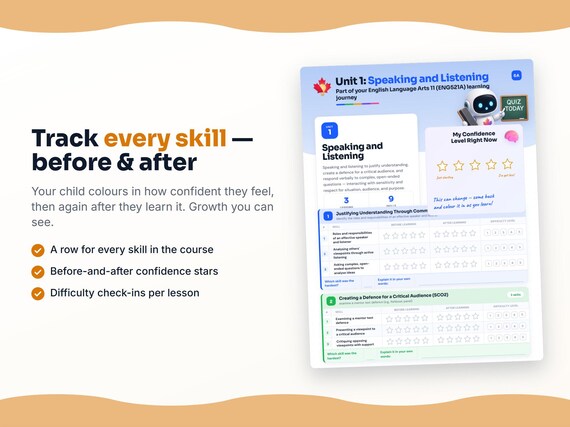
Built from the same official curriculum as this page. Before and after each skill above, your student colours in how sure they feel — so the two of you can see, on one page, what's clicking and what needs another look. It's a quiet way to follow how the year is really going.
By June it's full of their own handwriting: units worked through, confidence grown, a mid-year check-in, notes from parent-teacher night, and a certificate at the end. Less a worksheet, more a record of the year worth keeping on the shelf.
Instant download · see every page, reviews and the full description · five or more workbooks are $2.99 each
What it looks like in the app



Common questions
Can MapleMind help me with English Language Arts 11 (ENG521A)?
Yes. MapleMind's AI tutor covers all 29 skills in Prince Edward Island's English Language Arts 11 (ENG521A) — you pick the exact skill, and the tutor teaches it step by step: a short lesson, a worked example, solving together, then a skill check to show it stuck.
Is MapleMind aligned to Prince Edward Island's official curriculum?
Yes. Every skill in this course maps to an official outcome code from Prince Edward Island's Grade 11 English Language Arts curriculum, and the ministry's own wording is quoted under each unit on this page — with the official government source linked so you can check it yourself.
What does MapleMind cost?
It's free to start — 5 tutoring chats and a practice quiz every day, no credit card. A Pro subscription ($9.99/month or $49.99/year CAD, 7-day free trial) unlocks unlimited tutoring, practice, and exam simulations.
What if I'm stuck on just one topic?
That's the point of skill-level tutoring: open English Language Arts 11 (ENG521A) in the app, tap the exact skill from the list on this page, and the tutor teaches just that — no wading through lessons you don't need.
Does MapleMind work in French or other languages?
Yes — 14 languages, including French. Both the app and the tutor's explanations switch to the language you choose.
Where can I see the official Prince Edward Island curriculum for English Language Arts 11 (ENG521A)?
The official source is linked on this page — Prince Edward Island's official curriculum. The outline here follows it: every MapleMind skill carries its official outcome code, and the ministry's own wording is quoted under each unit.
Keep exploring
Ready when you are
Pick a skill from this page and see it taught properly — free, in the browser, in under a minute.