Get help with Introductory Law 521A
Most tutoring makes you sit through material you already know. MapleMind flips that: pick the exact skill that's causing trouble — any of the 46 below — and the tutor teaches just that one, step by step, as many times as it takes. Ask questions in plain words, any time of day, in English, French, or 12 other languages.
The official Prince Edward Island Introductory Law 521A curriculum
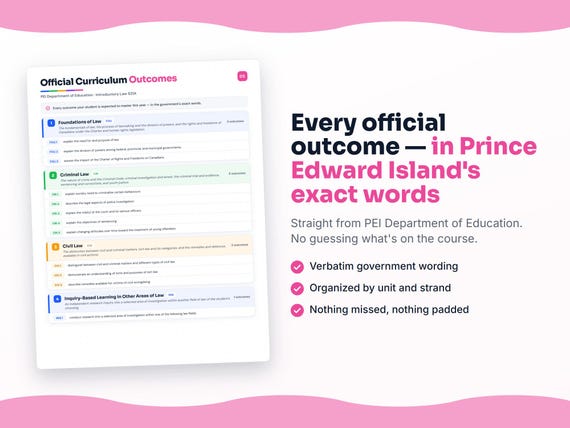
Prince Edward Island defines Introductory Law 521A by strands and outcomes. MapleMind teaches the same curriculum reorganized for one-skill-at-a-time tutoring — the table shows exactly where every official strand lands, and the ministry's own wording is quoted under each unit below.
Official source Prince Edward Island's official curriculumRead it on the government site — princeedwardisland.ca ↗| Official strand | Outcomes | Where MapleMind teaches it |
|---|---|---|
| Strand 1 | 13 | Foundations of Law |
| Strand 2 | 22 | Criminal Law |
| Strand 3 | 9 | Civil Law |
| Strand 4 | 1 | Inquiry-Based Learning in Other Areas of Law |
Every skill below, taught one on one.
 Try the first session free
How MapleMind teaches Introductory Law 521A — every unit, lesson, and skill
Every skill below runs as a short session: a plain-words lesson, a worked example, solving it together, then a five-question skill check that earns up to three stars. Guided Mode keeps it teaching instead of answer-handing — turning it off needs a parent's password.
Unit 1Foundations of LawOfficial strand · Strand 1
The fundamentals of law, the process of lawmaking and the division of powers, and the rights and freedoms of Canadians under the Charter and human rights legislation.
The Fundamentals of Law
- The need for and purpose of law1.1.1 — Explain why societies need law and the purposes a legal system serves.
- Historical roots and influences on Canadian law1.1.2 — Describe the historical roots and influences that shaped Canadian law.
- Sources that create the basis of Canadian law1.1.3 — Identify and describe the sources that create the basis of Canadian law.
- Primary categories of Canadian law1.1.4 — Differentiate among the primary categories of Canadian law, such as public and private, substantive and procedural.
- Factors that influence change in law1.1.5 — Analyse the social, technological, and moral factors that drive changes in law over time.
- How law reform happens: pressure groups and reform bodies1.1.5 — Analyse the mechanisms through which law is revised or created, including lobby groups, pressure groups, and Royal Commissions.
The Process of Lawmaking
- Division of powers among governments1.2.1 — Explain how lawmaking power is divided among federal, provincial, and municipal governments in Canada.
- The lawmaking process at various levels of government1.2.3 — Explain how a bill becomes law at various levels of government in Canada.
- Structure and powers of federal and provincial courts1.2.4 — Describe the structure and powers of the federal and provincial court systems in Canada.
The Rights and Freedoms of Canadians
- Impact of the Charter of Rights and Freedoms1.3.1 — Assess how the Charter of Rights and Freedoms has affected the rights and daily lives of Canadians.
- Impact of legislation concerning Aboriginal peoples1.3.2 — Analyse the impact of past and present legislation concerning Indigenous peoples, including the Indian Act, treaties, and the Royal Commission on Aboriginal Peoples.
- The Supreme Court's role in Charter decisions1.3.3 — Explain the Supreme Court of Canada's role in interpreting and applying the Charter of Rights and Freedoms.
- Comparing the Canadian and PEI Human Rights Acts1.3.4 — Compare the Canadian Human Rights Act and the Prince Edward Island Human Rights Act in scope and application.
The official wording — 13 outcomes in this unit
- 1.1.1
explain the need for and purpose of law
- 1.1.2
describe the historical roots and influences on Canadian law
- 1.1.3
identify and describe the sources that create the basis of Canadian law
- 1.1.4
differentiate among primary categories of Canadian law
- 1.1.5
analyse factors that influence change in law
- 1.2.1
explain the division of powers among federal, provincial, and municipal governments
- 1.2.2
demonstrate an understanding of issues related to Aboriginal self-government within Canada
- 1.2.3
explain the lawmaking process at various levels of government in Canada
- 1.2.4
describe the structure and powers of the federal and provincial courts
- 1.3.1
assess the impact of the Charter of Rights and Freedoms on Canadians
- 1.3.2
analyse the impact of past and present legislation concerning Aboriginal peoples
- 1.3.3
explain the role of the Supreme Court in decisions related to the Charter of Rights and Freedoms
- 1.3.4
compare the Canadian Human Rights Act and the PEI Human Rights Act
Unit 2Criminal LawOfficial strand · Strand 2
The nature of crime and the Criminal Code, criminal investigation and arrest, the criminal trial and evidence, sentencing and corrections, and youth justice.
The Nature of Crime
- Society's need to criminalize certain behaviours2.1.1 — Explain why a society chooses to criminalize certain behaviours.
- Crime, criminal law, and the Criminal Code2.1.2 — Define crime and criminal law, and describe the Criminal Code of Canada.
- Elements of a criminal offence2.1.3 — Explain the elements of a criminal offence, including actus reus and mens rea, for selected specific offences.
- Parties to an offence2.1.4 — Identify the parties to an offence, including those who commit, aid, abet, or counsel a crime.
- Indictable, summary, and hybrid offences2.1.5 — Distinguish among indictable, summary conviction, and hybrid offences.
- Analysing cases under the Criminal Code2.1.6 — Analyse fact situations and cases according to the provisions of the Criminal Code of Canada.
Criminal Investigation
- Legal aspects of police investigation2.2.1 — Describe the legal aspects of police investigation, including search, seizure, and gathering evidence.
- Rights of citizens and responsibilities of police on arrest2.2.2 — Compare the rights of citizens with the responsibilities of police upon arrest or detention.
- Release and pre-trial procedures2.2.3 — Identify release and pre-trial procedures, including bail and judicial interim release.
The Criminal Trial
- Roles of the court and its officers2.3.1 — Explain the roles of the court and its various officers, including judge, Crown, defence, and jury.
- Criminal trial procedures2.3.2 — Describe the procedures followed during a criminal trial.
- Types of evidence and rules of evidence2.3.3 — Demonstrate an understanding of the types of evidence and the rules of evidence in a criminal trial.
- The jury system: selection and duties2.3.4 — Analyse elements of the jury system, including jury selection and the duties of jurors.
- Standard defences to criminal charges2.3.5 — Describe standard defences to criminal charges, such as self-defence, automatism, and mistake.
Sentencing and Corrections
- Objectives of sentencing2.4.1 — Explain the objectives of sentencing, such as deterrence, denunciation, rehabilitation, and protection of the public.
- Traditional sentencing and alternative justice2.4.2 — Demonstrate an understanding of traditional types of sentencing and of alternative and restorative justice.
- Release procedures after sentencing2.4.3 — Demonstrate an understanding of release procedures, such as parole and conditional release.
- Canada's correctional system2.4.4 — Demonstrate an understanding of Canada's correctional system and its purposes.
Youth Justice
- Changing attitudes toward young offenders2.5.1 — Explain how attitudes toward the treatment of young offenders have changed over time.
- Youth justice legislation over time2.5.2 — Compare the provisions of the Juvenile Delinquents Act, the Young Offenders Act, and the Youth Criminal Justice Act.
- Rights and protections for young offenders2.5.3 — Identify the special rights and protections provided to young offenders on arrest, detention, and at trial under the Youth Criminal Justice Act.
- Treating young offenders differently from adults2.5.4 — Assess the validity of treating young offenders differently from adult offenders.
The official wording — 22 outcomes in this unit
- 2.1.1
explain society need to criminalize certain behaviours
- 2.1.2
define crime, criminal law, and the Criminal Code of Canada
- 2.1.3
explain the elements of a criminal offence and of selected specific offences
- 2.1.4
identify parties to an offence
- 2.1.5
distinguish among indictable, summary, and hybrid conviction offences
- 2.1.6
analyse cases according to the Criminal Code of Canada
- 2.2.1
describe the legal aspects of police investigation
- 2.2.2
compare the rights of citizens and the responsibilities of police upon arrest or detention
- 2.2.3
identify release and pre-trial procedures
- 2.3.1
explain the role(s) of the court and its various officers
- 2.3.2
describe trial procedures
- 2.3.3
demonstrate an understanding of the types of evidence and rules of evidence in a criminal trial
- 2.3.4
analyse elements of the jury system, including jury selection and duties
- 2.3.5
describe standard defences to criminal charges
- 2.4.1
explain the objectives of sentencing
- 2.4.2
demonstrate an understanding of traditional types of sentencing as well as alternative justice
- 2.4.3
demonstrate an understanding of release procedures
- 2.4.4
demonstrate an understanding of Canada correctional system
- 2.5.1
explain changing attitudes over time toward the treatment of young offenders
- 2.5.2
compare the provisions of the Juvenile Delinquents Act, the Young Offenders Act, and the Youth Criminal Justice Act
- 2.5.3
identify special rights and protections currently provided to young offenders upon arrest and detention, during trial
- 2.5.4
assess the validity of treating young offenders differently from adults
Unit 3Civil LawOfficial strand · Strand 3
The distinction between civil and criminal matters, tort law and its categories, and the remedies and defences available in civil actions.
Civil and Criminal Matters
- Civil versus criminal matters3.1.1 — Distinguish between civil and criminal matters and among different types of civil law.
- Civil versus criminal court procedures3.1.2 — Contrast the procedures of a civil court action with those of a criminal prosecution.
Tort Law
- Torts and the purposes of tort law3.2.1 — Demonstrate an understanding of what a tort is and the purposes of tort law.
- Intentional versus unintentional torts3.2.2 — Distinguish between intentional and unintentional torts.
- Three categories of torts3.2.3 — Demonstrate an understanding of the three categories of torts: negligence, intentional torts, and strict liability.
- Types of special liability3.2.4 — Explain various types of special liability, such as vicarious liability and occupiers' liability.
Remedies and Defences
- Remedies for victims of civil wrongdoing3.3.1 — Describe the remedies available to victims of civil wrongdoing, such as damages and injunctions.
- Defences to torts3.3.2 — Identify specific defences to various torts, such as consent and contributory negligence.
- Applying tort law to cases3.3.3 — Apply an understanding of tort law to analyse specific cases.
The official wording — 9 outcomes in this unit
- 3.1.1
distinguish between civil and criminal matters and different types of civil law
- 3.1.2
contrast civil court procedures with criminal court procedures
- 3.2.1
demonstrate an understanding of torts and purposes of tort law
- 3.2.2
distinguish between intentional and unintentional torts
- 3.2.3
demonstrate an understanding of the three categories of torts negligence, intentional, and strict liability
- 3.2.4
explain various types of special liability
- 3.3.1
describe remedies available for victims of civil wrongdoing
- 3.3.2
identify specific defences to various torts
- 3.3.3
apply their understanding of tort law to specific cases
Unit 4Inquiry-Based Learning in Other Areas of LawOfficial strand · Strand 4
An independent research inquiry into a selected area of investigation within another field of law of the student's choosing.
Inquiry into Another Field of Law
- Inquiry into another area of law4.INQ — Conduct research into a selected area of investigation within a chosen field of law (for example, family, employment, environmental, or human rights law).
The official wording — 1 outcome in this unit
- 4.INQ
conduct research into a selected area of investigation within one of the following law fields
Printable workbook · A keepsake of the year
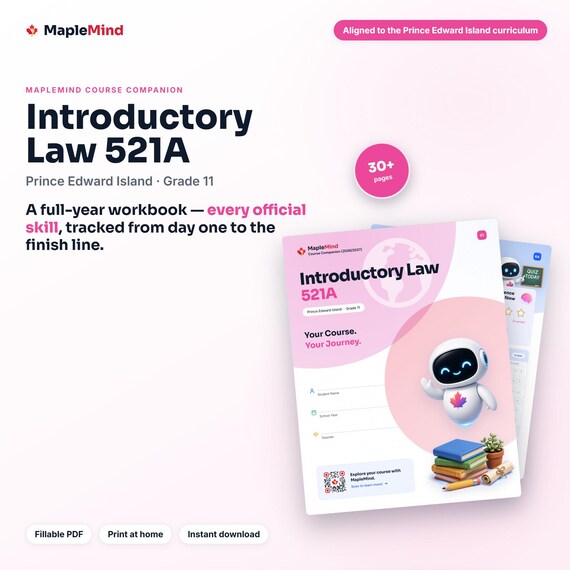
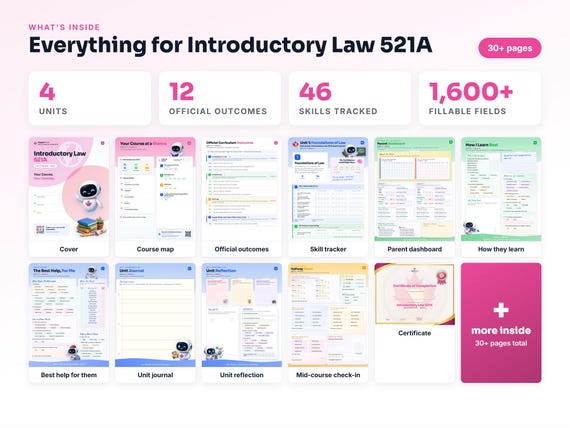
A Introductory Law 521A workbook worth keeping
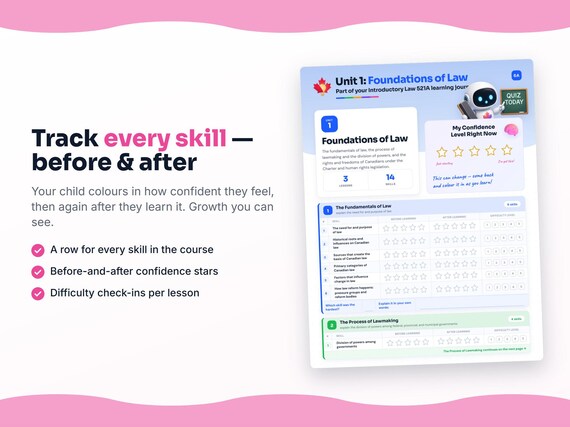
Built from the same official curriculum as this page. Before and after each skill above, your student colours in how sure they feel — so the two of you can see, on one page, what's clicking and what needs another look. It's a quiet way to follow how the year is really going.
By June it's full of their own handwriting: units worked through, confidence grown, a mid-year check-in, notes from parent-teacher night, and a certificate at the end. Less a worksheet, more a record of the year worth keeping on the shelf.
Instant download · see every page, reviews and the full description · five or more workbooks are $2.99 each
What it looks like in the app
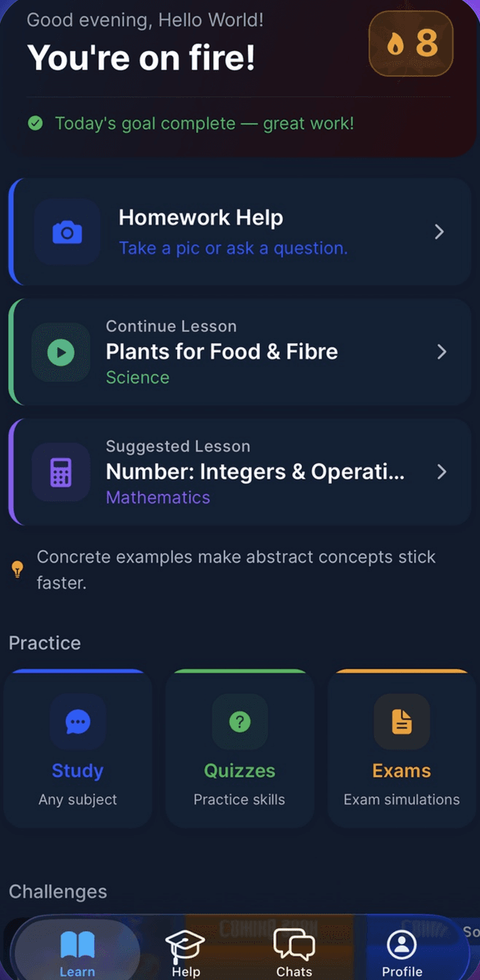
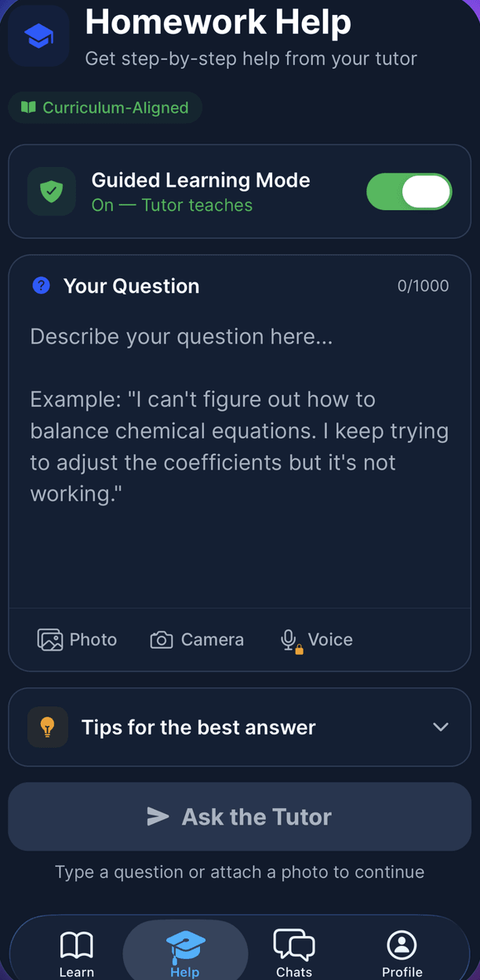
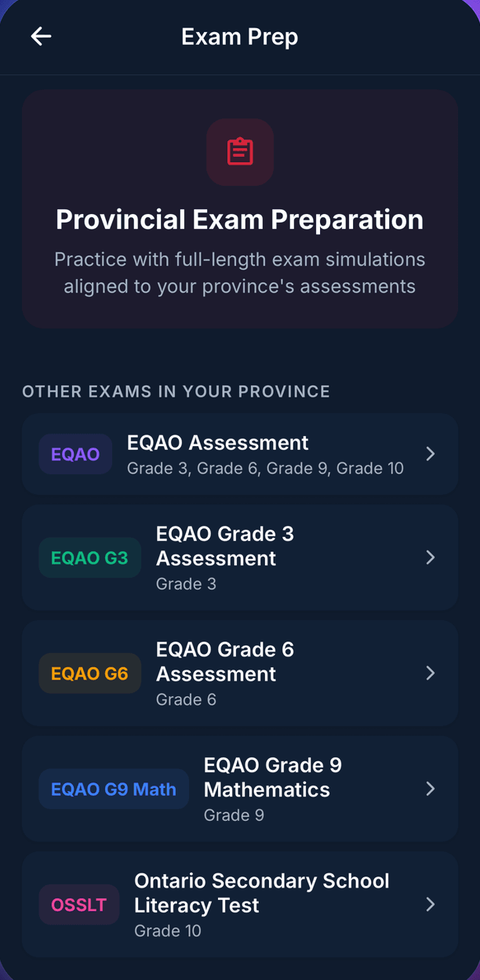
Common questions
Can MapleMind help me with Introductory Law 521A?
Yes. MapleMind's AI tutor covers all 46 skills in Prince Edward Island's Introductory Law 521A — you pick the exact skill, and the tutor teaches it step by step: a short lesson, a worked example, solving together, then a skill check to show it stuck.
Is MapleMind aligned to Prince Edward Island's official curriculum?
Yes. Every skill in this course maps to an official outcome code from Prince Edward Island's Grade 11 Social Studies curriculum, and the ministry's own wording is quoted under each unit on this page — with the official government source linked so you can check it yourself.
What does MapleMind cost?
It's free to start — 5 tutoring chats and a practice quiz every day, no credit card. A Pro subscription ($9.99/month or $49.99/year CAD, 7-day free trial) unlocks unlimited tutoring, practice, and exam simulations.
What if I'm stuck on just one topic?
That's the point of skill-level tutoring: open Introductory Law 521A in the app, tap the exact skill from the list on this page, and the tutor teaches just that — no wading through lessons you don't need.
Does MapleMind work in French or other languages?
Yes — 14 languages, including French. Both the app and the tutor's explanations switch to the language you choose.
Where can I see the official Prince Edward Island curriculum for Introductory Law 521A?
The official source is linked on this page — Prince Edward Island's official curriculum. The outline here follows it: every MapleMind skill carries its official outcome code, and the ministry's own wording is quoted under each unit.
Keep exploring
Ready when you are
Pick a skill from this page and see it taught properly — free, in the browser, in under a minute.