Prince Edward Island · For parents

What your child learns in Grade 10 in Prince Edward Island

Every subject, unit by unit, from Prince Edward Island’s curriculum: 170 skills in plain words.

Subjects
5
Skills
170
Provincial exams
1
Official curriculum
princeedwardisland.ca

Math in Grade 10

2 courses. Choose the one your child takes.

Apprenticeship and Workplace Mathematics 10

MAT421K · 3 units · 30 skills

  1. Unit 1

    Geometry

    Spatial reasoning means picturing, rotating, and fitting shapes mentally.

    • Analysing spatial puzzles and games
    • Recognizing and verifying the Pythagorean theorem
    • Applying the Pythagorean formula
    13 more skills
    • Solving job problems with the Pythagorean theorem
    • Recognizing similar polygons
    • Solving problems with similar polygons
    • Similar right triangles and constant ratios
    • Generalizing the ratio patterns
    • Applying the primary trigonometric ratios
    • Solving job problems with trigonometry
    • Parallel, perpendicular and transversal lines
    • Angle pairs between lines
    • Drawing angles of every type
    • Replicating and constructing angles
    • Bisecting angles
    • Solving problems with angles
  2. Unit 2

    Measurement

    SI prefixes (kilo, centi, milli) scale a base unit by powers of ten.

    • SI units and their relationships
    • Converting SI units to Imperial
    • Imperial units and their relationships
    7 more skills
    • American and British capacity units
    • Converting Imperial units to SI
    • Solving linear measurement problems
    • Verifying linear measurement solutions
    • Area of regular and composite 2-D shapes
    • Area of irregular 2-D shapes
    • Surface area of 3-D objects
  3. Unit 3

    Number

    Unit price is total price divided by the number of units.

    • Unit pricing and currency exchange
    • Wages, salary and contracts
    • Commission and piecework
    1 more skill
    • Gross and net pay

Foundations of Mathematics and Pre-Calculus 10

MAT421A · 3 units · 32 skills

  1. Unit 1

    Algebra and Number

    Every whole number greater than 1 has a unique prime factorization.

    • Prime factors of whole numbers
    • Greatest common factor and least common multiple
    • Square roots and cube roots
    5 more skills
    • Representing and simplifying irrational numbers
    • Ordering irrational numbers
    • Powers with integral and rational exponents
    • Multiplying polynomial expressions
    • Common factors and trinomial factoring
  2. Unit 2

    Measurement

    A personal referent (a thumb width ≈ 1 inch, a doorknob height ≈ 1 m) helps estimate a measure.

    • Estimating in SI and Imperial units
    • Measuring in SI and Imperial units
    • Converting units with proportional reasoning
    4 more skills
    • Surface area and volume of prisms and cylinders
    • Surface area and volume of cones and pyramids
    • Surface area and volume of spheres
    • Sine, cosine and tangent in right triangles
  3. Unit 3

    Relations and Functions

    The shape of a graph (rising, falling, flat) describes how one quantity changes with another.

    • Interpreting graphs and situations
    • Distinguishing relations and functions
    • Slope as rise over run for segments and lines
    14 more skills
    • Slope as a rate of change
    • Slopes of parallel and perpendicular lines
    • Linear relations from words, ordered pairs and tables
    • Linear relations as graphs
    • Linear relations as equations
    • Intercepts, slope, domain and range of a line
    • Slope-intercept form and its graph
    • General form and its graph
    • Slope-point form and its graph
    • Equation from a graph, or a point and slope
    • Equation from two points
    • Equation from a parallel or perpendicular line
    • Representing a linear function with function notation
    • Solving systems of linear equations

Science in Grade 10

2 courses. Choose the one your child takes.

Science 10 (SCI401A)

5 units · 23 skills

  1. Unit 1

    Working Like a Scientist

    A reasonable claim is backed by checkable evidence, not just assertion.

    • Evaluating whether a claim is reasonable
    • Why people accept unreasonable claims
    • Safe laboratory protocols
    6 more skills
    • Collecting and analysing data
    • Uncertainty in measurement
    • Evaluating phenomena with argumentation
    • Designing an experiment and a prototype
    • Communicating and collaborating
    • Benefits and risks from multiple perspectives
  2. Unit 2

    Everyday Chemical Reactions

    In a physical change the substance's identity stays the same (e.g., melting).

    • Physical vs chemical change and its evidence
    • Reactants, products, and reaction rate
    • Acids, bases, and neutralization
    1 more skill
    • Naming ionic compounds
  3. Unit 3

    Climate Change & Energy

    Carbon dioxide (CO2) is the main greenhouse gas driving climate change.

    • Greenhouse gases and the greenhouse effect
    • Climate data, Indigenous knowledge, and impacts
    • Forms of energy and energy sources
    1 more skill
    • Sustainable energy technologies
  4. Unit 4

    Cells and Infectious Disease

    Living things grow, reproduce, and respond to their environment.

    • Living things and cell structures
    • Cell theory and why viruses are non-living
    • Transmission, prevention, and treatment of disease
    1 more skill
    • Pandemics, epidemics, and endemics
  5. Unit 5

    Motion

    Motion can be described by position, speed, and acceleration.

    • Describing motion and kinds of speed
    • Calculating speed and collecting motion data

Science 10 Academic (SCI421A)

4 units · 23 skills

  1. Unit 1

    Working Like a Scientist

    A reasonable claim rests on checkable evidence and sound reasoning.

    • Evaluating whether a claim is reasonable
    • Why people accept unreasonable claims
    • Synthesizing information from sources
    7 more skills
    • Writing a scientific argument
    • Designing and evaluating an investigation
    • Building an energy-transfer machine
    • Performing investigations
    • Analysing data for patterns
    • Arguing for or against a development
    • Skills for STEM career pathways
  2. Unit 2

    Cells and Infectious Disease

    Living things grow, reproduce, and respond to their environment.

    • Cell vocabulary and living vs non-living
    • Cell types and why viruses are non-living
    • Germ theory, antibiotics, and vaccines
    2 more skills
    • Transmission, prevention, and herd immunity
    • Pandemics, epidemics, endemics, and society
  3. Unit 3

    Chemical Reactions and Reactivity

    Reactants are on the left; products are on the right of an equation.

    • Balanced equations and conservation of mass
    • Recognizing reactions from evidence
    • Classifying reactions by type
    1 more skill
    • Analysing real-world reactions
  4. Unit 4

    Forces, Motion, and Energy

    Contact forces act by touching; non-contact forces (like gravity) act at a distance.

    • Forces, mass, weight, and inertia
    • Net force and Newton's second law
    • Kinetic, potential energy, and transformations
    1 more skill
    • Calculating energy: KE and PE

English in Grade 10

English Language Arts 10 (ENG421A/B)

3 units · 27 skills

  1. Unit 1

    Speaking and Listening

    Effective communication is a shared job: the speaker and the listener each carry responsibilities.

    • Roles and responsibilities of an effective speaker and listener
    • Active listening and analysing others' viewpoints
    • Reflecting on learning and justifying understanding with examples
    5 more skills
    • Examining a mentor text that advocates for a cause
    • Presenting a personal viewpoint with supporting detail
    • How spoken language influences and reveals values
    • Examining a mentor text that explains an idea or process
    • Presenting an idea or process with effective language
  2. Unit 2

    Reading and Viewing

    Skilled senior readers switch among strategies — inferring, predicting, synthesizing, evaluating — to make meaning.

    • Reading and comprehending texts using strategies
    • Identifying a text's purpose, structure, and characteristics
    • Analysing how texts manipulate and shape belief and power
    8 more skills
    • Making and supporting critical judgments about a text
    • Identifying literary devices and their meaning
    • Analysing a literary device in context
    • Identifying an author's portrayal of identity and culture
    • Analysing identity and culture across texts
    • Assessing the reliability of information
    • Evaluating and selecting reliable sources
    • Synthesizing sources with quotations and citing properly
  3. Unit 3

    Writing and Other Ways of Representing

    The writing process — pre-writing, drafting, revising, editing, publishing — is a set of stages, not a single sitting.

    • Using the writing process to develop a text
    • Selecting form, style, and content for audience and purpose
    • Creating an organized structure and using the six traits
    5 more skills
    • Integrating cited sources into writing
    • Assessing a text against success criteria
    • Giving specific, respectful suggestions for improvement
    • Considering and being open to critical feedback
    • Revising a text in response to feedback

French in Grade 10

Core French, Grade 10

FRE421A · 3 units · 13 skills

  1. Unit 1

    La production orale et l'ecoute

    Predict the topic and likely vocabulary before you listen (a plan, an opinion, an event).

    • Active listening to build meaning (senior entry)
    • Understanding a more complex spoken text
    • Inferring meaning and viewpoint in speech
    4 more skills
    • Speaking strategies for coherent structured speech
    • Speaking fluently and repairing (guided)
    • Speech acts to interact and justify
    • Presenting on a familiar topic
  2. Unit 2

    La lecture et le visionnement

    Choose the strategy that fits the text type and your purpose.

    • Reading strategies for varied short texts
    • Overall comprehension of everyday French
    • Reading a cultural text and connecting
  3. Unit 3

    L'ecriture et la representation

    Plan before you write: purpose, audience, main points.

    • Strategies to orient your writing (guided)
    • Writing an articulated informative text
    • Writing a coherent opinion text (guided)

Social studies in Grade 10

Geography of Canada 421A

GEO421A · 7 units · 22 skills

  1. Unit 1

    Unit 1: Canadian Connections

    Everyone begins with some knowledge of Canada's geography.

    • Articulating your understanding of Canadian geography
  2. Unit 2

    Unit 2: Methods of Geographic Inquiry

    Geographic inquiry follows a process: locate, gather, evaluate, organize.

    • Locating and gathering geographic information
    • Analysing and interpreting geographic data
  3. Unit 3

    Unit 3: Physical Connections: Canada's Ecozones

    Internal forces come from within the Earth.

    • Internal forces shaping the landscape
    • External forces shaping the landscape
    • The components of an ecozone
    2 more skills
    • Assessing diversity by comparing ecozones
    • Ecozones as a tool for interconnectedness
  4. Unit 4

    Unit 4: Cultural Connections

    Population change comes from births, deaths, immigration, and emigration.

    • Calculating population change
    • Factors in current Aboriginal demographics
    • Patterns and trends in Canadian migration
    4 more skills
    • Patterns and trends in rural/urban settlement
    • Land-use changes from demographic change
    • Assessing land-use sustainability
    • Recommending an urban development model
  5. Unit 5

    Unit 5: Economic Connections

    The primary sector extracts raw materials.

    • Canada's economic sectors
    • The importance of each sector
    • A geographic inquiry into an economic sector
  6. Unit 6

    Unit 6: Canada's Global Connections

    Trade and investment link Canada's economy to the world.

    • Economic and societal connections
    • Environmental connections
    • Assessing Canada's involvement in a global issue
  7. Unit 7

    Unit 7: Future Connections

    Active citizenship turns understanding into action.

    • An active citizenship project from geographic inquiry

Provincial exams in Grade 10

MapleMind

See Grade 10 in MapleMind

Real screens from the app your child would use.

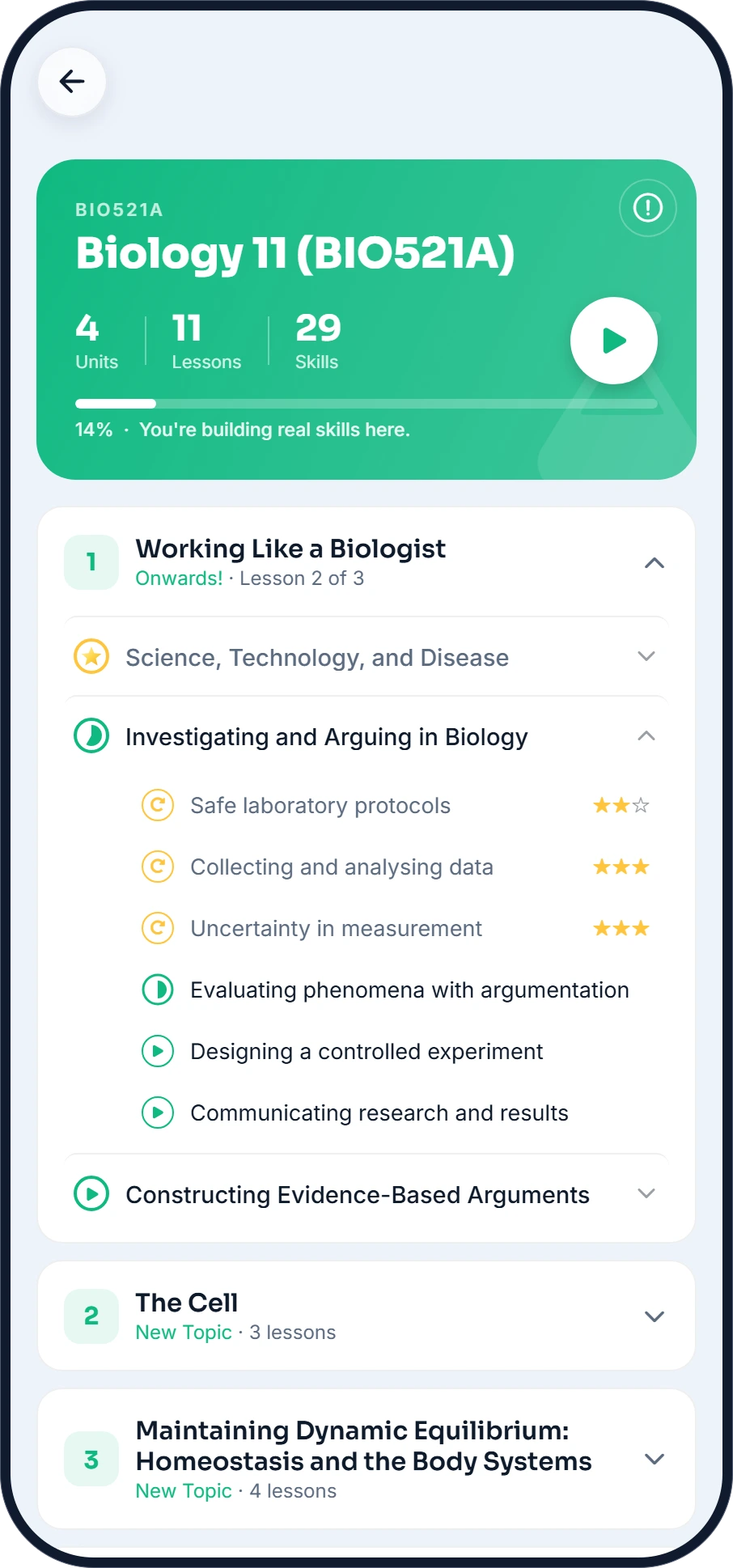
Biology 11 (BIO521A) in MapleMind on a tablet: its units and lessons in order, a student partway through.Biology 11 (BIO521A) in MapleMind on a phone: its units and lessons in order, a student partway through.
Their course, unit by unit, the way Prince Edward Island teaches it.Shown: Biology 11 (BIO521A)
Homework Help on a tablet: a photo of a worksheet, the tutor’s worked example of a two-step equation, and a question back to the student.Homework Help on a phone: a photo of a worksheet, the tutor’s worked example of a two-step equation, and a question back to the student.
Homework Help: they take a photo of the question, and the tutor works through it with them.
The Parent Dashboard on a tablet: a student’s days studied, streak, lessons, quiz average and recent activity.The Parent Dashboard on a phone: a student’s days studied, streak, lessons, quiz average and recent activity.
The Parent Dashboard: how each child’s week went, in lessons, quizzes and days studied.
A Grade 9 provincial mathematics exam on a tablet: a readiness score, the exam’s time and its next sitting.A Grade 9 provincial mathematics exam on a phone: a readiness score, the exam’s time and its next sitting.
A provincial exam: a practice sitting under the real time, and how ready they are.
The Learn tab on a tablet: a four-day streak, the week’s days, Homework Help, the next lesson and a review.The Learn tab on a phone: a four-day streak, the week’s days, Homework Help, the next lesson and a review.
The Learn tab: their week so far, and the next thing to do.

Help at home

Questions parents ask

What will my child learn in Grade 10 in Prince Edward Island?

Math: Apprenticeship and Workplace Mathematics 10 and Foundations of Mathematics and Pre-Calculus 10. Science: Science 10 (SCI401A) and Science 10 Academic (SCI421A). English: English Language Arts 10 (ENG421A/B). French: Core French, Grade 10. Social studies: Geography of Canada 421A. That’s 170 skills in all, from Prince Edward Island’s curriculum.

Does my child write a provincial exam in Grade 10?

No. Prince Edward Island has no provincial exam in Grade 10.

Where does this list come from?

From Prince Edward Island’s official curriculum, the documents its education ministry publishes for each course. Each skill here is one of their expectations, written in plain words.

Can MapleMind help my child in Grade 10?

Yes. Every course on this page is in MapleMind, with lessons, practice and a tutor that works through each step with them. A free account gets 30 messages and 4 activities a day.

Help with Grade 10, one skill at a time.

Every course on this page is in MapleMind, free with daily limits.