Get help with Applied Science and Technology, Secondary Cycle Two
Most tutoring makes you sit through material you already know. MapleMind flips that: pick the exact skill that's causing trouble — any of the 46 below — and the tutor teaches just that one, step by step, as many times as it takes. Ask questions in plain words, any time of day, in English, French, or 12 other languages.
The official Quebec Applied Science and Technology, Secondary Cycle Two curriculum
Quebec defines Applied Science and Technology, Secondary Cycle Two by strands and outcomes. MapleMind teaches the same curriculum reorganized for one-skill-at-a-time tutoring — the table shows exactly where every official strand lands, and the ministry's own wording is quoted under each unit below.
Official source Québec's official education programRead it on the government site — quebec.ca ↗| Official strand | Outcomes | Where MapleMind teaches it |
|---|---|---|
| Strand MW | 17 | The Material World |
| Strand LW | 11 | The Living World |
| Strand ES | 5 | The Earth and Space |
| Strand TW | 13 | The Technological World |
Every skill below, taught one on one.
 Try the first session free
How MapleMind teaches Applied Science and Technology, Secondary Cycle Two — every unit, lesson, and skill
Every skill below runs as a short session: a plain-words lesson, a worked example, solving it together, then a five-question skill check that earns up to three stars. Guided Mode keeps it teaching instead of answer-handing — turning it off needs a parent's password.
Unit 1The Material WorldOfficial strand · Strand MW
Density and solutions, the particle model and physical/chemical changes, energy forms and efficiency, pure substances and mixtures, fluid pressure and buoyancy, waves and optics, and electricity, magnetism and forces - approached through devices and the human body.
Density, solutions and concentration
- Density and identifying substancesMW.A.18 — Explains and determines density and uses it, with melting and boiling points, to identify substances from reference tables.
- Solutions and concentrationMW.A.23 — Recognizes solute and solvent, describes how their amounts affect concentration, determines concentration in g/L or percentage, and identifies substances by characteristic chemical properties.
The particle model and changes in matter
- The particle modelMW.B.7 — Defines the particle model and describes its qualities and limitations as a scientific model.
- Physical changes and the particle modelMW.B.11 — Describes physical changes and illustrates them using the particle model.
- Chemical changes, oxidation and combustionMW.B.19 — Names chemical changes in the body, represents oxidation with the particle model, associates reactions with oxidation, and explains combustion with the fire triangle.
Forms of energy and efficiency
- Forms of energy and transformationsMW.B.45 — Describes forms of energy and identifies the forms involved in a transformation.
- Conservation of energy and efficiencyMW.B.47 — Applies conservation of energy, defines and computes energy efficiency, explains how to improve it, and relates heat and temperature.
Pure substances and mixtures
- Pure substances, elements and compoundsMW.C.7 — Defines a pure substance and distinguishes elements from compounds, and describes mixtures in the body.
Fluids, pressure and buoyancy
- Fluid pressure and the gas relationshipMW.D.1 — Defines pressure, describes the factors affecting it, distinguishes compressible from incompressible fluids, and relates gas pressure and volume.
- Buoyancy, Archimedes, Pascal and BernoulliMW.D.7 — Relates displaced-water weight to buoyant force, explains buoyancy by Archimedes' principle, recognizes Pascal-based systems, and explains lift by Bernoulli's principle.
Waves and geometric optics
- Waves, frequency, wavelength and the spectrumMW.E.1 — Defines frequency, wavelength and amplitude, relates them to pitch, loudness and energy, and locates waves on the decibel scale and electromagnetic spectrum with health applications.
- Reflection, refraction and lensesMW.E.9 — Describes reflection and refraction, determines the angle of reflection and the focal point of lenses, and relates focal point to ray deviation in corrective lenses.
Electricity, magnetism and forces
- Electric charges and static electricityMW.F.1 — Associates particles with charge and describes charge interactions and static electricity.
- Ohm's law and circuit elementsMW.F.4 — Describes and applies the voltage-resistance-current relationship, describes circuit elements, connection types and current type, and draws a circuit diagram.
- Electrical power and energy consumedMW.F.10 — Applies the power relationship P = VI and the energy relationship E = PDeltat.
- Magnetism, solenoids and inductionMW.F.13 — Describes the magnetic field of a current-carrying wire and solenoid, ways to modify it, and induction of current.
- Forces, equilibrium, speed and weightMW.F.19 — Describes force effects and types, equilibrium under two forces, and applies the speed and mass-weight relationships.
The official wording — 17 outcomes in this unit
- MW.A.18
Explains the concept of density
- MW.A.23
Recognizes the solute and the solvent in a homogeneous mixture
- MW.B.7
Defines the particle model as a means of representing the behaviour of matter
- MW.B.11
Describes a few physical changes
- MW.B.19
Names chemical changes that occur in the human body
- MW.B.45
Describes different forms of energy
- MW.B.47
Applies the law of conservation of energy in different contexts
- MW.C.7
Defines a pure substance as a substance made up of a single type of atom or molecule
- MW.D.1
Defines pressure as the force exerted by particles when they collide with a constricting surface
- MW.D.7
Describes the relationship between the weight of the water displaced by an immersed body and the upward acting force
- MW.E.1
Defines the frequency of a wave as the number of cycles per second (Hz)
- MW.E.9
Describes how light rays are deviated by a plane reflective surface
- MW.F.1
Associates elementary particles with their electrical charge
- MW.F.4
Qualitatively describes the relationship between voltage, resistance and current intensity in an electrical circuit
- MW.F.10
Applies the mathematical relationship between power, voltage and current intensity in an electrical circuit
- MW.F.13
Describes the magnetic field produced by a current-carrying wire
- MW.F.19
Describes the effects produced by a force
Unit 2The Living WorldOfficial strand · Strand LW
Primary productivity and the human body's systems - digestion and nutrition, respiration and blood, circulation and immunity, excretion and metabolic balance, the nervous system and senses, and cell division, reproduction and the menstrual cycle.
Digestion and nutrition
- The digestive tract and its organsLW.C.1 — Names the parts of the digestive tract, explains its role, and describes the functions of its main organs.
- Digestive glands and food transformationLW.C.4 — Names and describes digestive glands, the biological functions of food constituents and their sources, and the mechanical vs chemical transformation of food.
Respiration and blood
- The respiratory systemLW.C.11 — Names the parts of the respiratory system, explains its role, and describes the function of the nasal cavity and lungs.
- Blood: plasma and formed elementsLW.C.14 — Describes the function of plasma and names and describes the function of the formed elements of the blood.
Circulation and immunity
- The circulatory systemLW.C.18 — Names the parts of the circulatory system, explains its role, and describes the function of its main parts.
- The lymphatic system and immunityLW.C.21 — Names the parts of the lymphatic system, explains its role, and describes two ways of acquiring active immunity.
Excretion and the nervous system
- The urinary and excretory systemLW.C.24 — Names the parts of the urinary system, explains the excretory role, describes kidney and bladder function, urine components, and the role of kidneys, lungs and sweat glands in balance.
- The nervous system and the eyeLW.C.29 — Identifies the central nervous system parts and roles, names neuron parts, explains the peripheral nervous system, and describes the eye's function.
Cell division and reproduction
- Mitosis, meiosis and genetic diversityLW.D.17 — Describes the functions of mitosis and meiosis and associates genetic diversity with sexual reproduction.
- Puberty and reproductive hormonesLW.D.20 — Describes the changes at puberty, names the hormones for gamete formation, and describes the physiology of erection and the role of ejaculation.
- The menstrual cycleLW.D.24 — Names the hormones for ovarian follicle maturation and describes the hormone changes and main stages of the menstrual cycle.
The official wording — 11 outcomes in this unit
- LW.C.1
Names the main parts of the digestive tract
- LW.C.4
Names the main digestive glands
- LW.C.11
Names the main parts of the respiratory system
- LW.C.14
Describes the main function of plasma
- LW.C.18
Names the main parts of the circulatory system
- LW.C.21
Names the main parts of the lymphatic system
- LW.C.24
Names the main parts of the urinary system
- LW.C.29
Identifies the parts of the central nervous system
- LW.D.17
Describes the functions of mitosis
- LW.D.20
Describes physical and psychological changes that occur at puberty
- LW.D.24
Names the hormones responsible for the maturation of the ovarian follicle
Unit 3The Earth and SpaceOfficial strand · Strand ES
Minerals and mining, catchment areas and human impact, air masses and weather, energy resources and technologies, and tides and solar energy - through the technologies that use them.
Minerals, mining and catchment areas
- Minerals, ore and mining impactsES.A.10 — Distinguishes minerals from ore and describes environmental impacts of mining and mineral transformation.
- Catchment areas and human impactES.A.20 — Defines a catchment area and describes human impacts on its waterways.
Atmosphere, energy technologies and tides
- Air masses, clouds and cyclonesES.A.30 — Describes air-mass properties and explains cloud formation and the formation of cyclones and anticyclones.
- Energy technologies and their impactES.B.11 — Describes technologies producing electricity from lithosphere/hydrosphere/atmosphere resources and their impact.
- Tides and solar energy inputES.C.2 — Describes tides from the Earth-Moon gravitational effect and the factors affecting solar energy reaching Earth.
The official wording — 5 outcomes in this unit
- ES.A.10
Distinguishes between minerals and ore
- ES.A.20
Defines a catchment area as a territory surrounding a waterway
- ES.A.30
Describes the properties of an air mass
- ES.B.11
Describes technologies used to produce electricity using the energy resources in the lithosphere, hydrosphere and atmosphere
- ES.C.2
Describes the tides in terms of the gravitational effect of the Earth-Moon system
Unit 4The Technological WorldOfficial strand · Strand TW
Graphic communication and technical drawing, links and guiding, motion transmission and transformation systems, electrical power supply and control, materials and manufacturing, and biotechnology - the applied core of the program.
Technical drawing and graphic communication
- Diagram types and motion symbolsTW.A.11 — Chooses the appropriate diagram type, represents motions with symbols, and associates drawings with geometric lines.
- Basic lines and projectionsTW.A.14 — Names and applies basic drawing lines and interprets and represents shapes in multiview and isometric projection.
- Scales, developments and freehand sketchingTW.A.21 — Associates and chooses scales, applies them in interpretation, defines perspective forms, sketches freehand, and draws developments of solids.
Links, guiding and typical functions
- Link types and characteristicsTW.B.15 — Describes link advantages/disadvantages, names link types, and describes and determines link characteristics.
- Guiding, limiting motion and typical functionsTW.B.20 — Explains limiting motion, defines and associates typical functions, and explains the choice of link and guiding control.
Motion transmission and transformation
- Motion transmission systemsTW.B.27 — Names motion transmission systems, describes their components and speed changes, and explains their choice.
- Motion transformation systems and speed changeTW.B.32 — Names motion transformation systems, describes their components and reversibility, explains their choice, distinguishes cams from eccentrics, and uses speed-change systems with torque concepts.
Electrical power supply and control
- Power supply and conductionTW.C.1 — Defines power supply, identifies current sources, defines conduction, distinguishes conductors from insulators, and analyzes conductivity factors.
- Control, switches and protectionTW.C.5 — Describes protective devices, defines control, describes and distinguishes switch types.
- Energy transformation and electronic componentsTW.C.13 — Associates energy transformation with circuit components, describes transformations in appliances, and describes electronic component functions.
Materials and manufacturing
- Constraints, properties and material choiceTW.D.5 — Describes constraints on objects, describes mechanical properties, explains material choice by properties, and describes degradation and heat treatments.
- Shaping techniques and measurement controlTW.E.5 — Associates shaping processes with materials, determines shaping techniques, defines roughing and layout, describes tool characteristics, and explains direct and indirect measurement control.
Biotechnology
- Biotechnology processesTW.F.1 — Describes pasteurization and its purpose, vaccine manufacture, assisted-reproduction processes and their purpose, and cell-culture parameters.
The official wording — 13 outcomes in this unit
- TW.A.11
Chooses the appropriate type of diagram for a given representation
- TW.A.14
Names basic lines in a drawing
- TW.A.21
Associates scales with their use
- TW.B.15
Describes the advantages and disadvantages of different types of links
- TW.B.20
Explains the purpose of limiting motion (degree of freedom) in a technical object
- TW.B.27
Names motion transmission systems in technical objects
- TW.B.32
Names motion transformation systems in technical objects
- TW.C.1
Defines power supply as the ability to generate electrical current
- TW.C.5
Describes the role of a protective device in a circuit
- TW.C.13
Associates the transformation of energy with different components of a circuit
- TW.D.5
Describes the constraints to which different technical objects are subject: tension, compression, torsion
- TW.E.5
Associates shaping processes with the types of materials used
- TW.F.1
Describes the pasteurization process



Printable workbook · A keepsake of the year
A Applied Science and Technology, Secondary Cycle Two workbook worth keeping
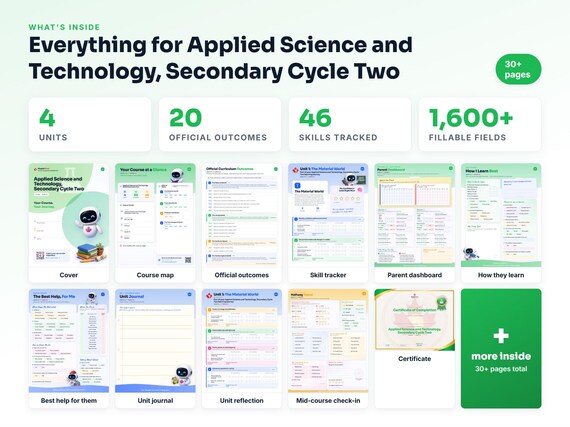
Built from the same official curriculum as this page. Before and after each skill above, your student colours in how sure they feel — so the two of you can see, on one page, what's clicking and what needs another look. It's a quiet way to follow how the year is really going.
By June it's full of their own handwriting: units worked through, confidence grown, a mid-year check-in, notes from parent-teacher night, and a certificate at the end. Less a worksheet, more a record of the year worth keeping on the shelf.
Instant download · see every page, reviews and the full description · five or more workbooks are $2.99 each
What it looks like in the app



Common questions
Can MapleMind help me with Applied Science and Technology, Secondary Cycle Two?
Yes. MapleMind's AI tutor covers all 46 skills in Quebec's Applied Science and Technology, Secondary Cycle Two — you pick the exact skill, and the tutor teaches it step by step: a short lesson, a worked example, solving together, then a skill check to show it stuck.
Is MapleMind aligned to Quebec's official curriculum?
Yes. Every skill in this course maps to an official outcome code from Quebec's Grade 10 Science curriculum, and the ministry's own wording is quoted under each unit on this page — with the official government source linked so you can check it yourself.
What does MapleMind cost?
It's free to start — 5 tutoring chats and a practice quiz every day, no credit card. A Pro subscription ($9.99/month or $49.99/year CAD, 7-day free trial) unlocks unlimited tutoring, practice, and exam simulations.
What if I'm stuck on just one topic?
That's the point of skill-level tutoring: open Applied Science and Technology, Secondary Cycle Two in the app, tap the exact skill from the list on this page, and the tutor teaches just that — no wading through lessons you don't need.
Does MapleMind work in French or other languages?
Yes — 14 languages, including French. Both the app and the tutor's explanations switch to the language you choose.
Where can I see the official Quebec curriculum for Applied Science and Technology, Secondary Cycle Two?
The official source is linked on this page — Québec's official education program. The outline here follows it: every MapleMind skill carries its official outcome code, and the ministry's own wording is quoted under each unit.
Keep exploring
Ready when you are
Pick a skill from this page and see it taught properly — free, in the browser, in under a minute.