Get help with Physics, Secondary 5
Most tutoring makes you sit through material you already know. MapleMind flips that: pick the exact skill that's causing trouble — any of the 42 below — and the tutor teaches just that one, step by step, as many times as it takes. Ask questions in plain words, any time of day, in English, French, or 12 other languages.
The official Quebec Physics, Secondary 5 curriculum
Quebec defines Physics, Secondary 5 by strands and outcomes. MapleMind teaches the same curriculum reorganized for one-skill-at-a-time tutoring — the table shows exactly where every official strand lands, and the ministry's own wording is quoted under each unit below.
Official source Québec's official education programRead it on the government site — quebec.ca ↗| Official strand | Outcomes | Where MapleMind teaches it |
|---|---|---|
| Strand K | 9 | Kinematics |
| Strand D | 14 | Dynamics |
| Strand T | 10 | Transformation of energy |
| Strand O | 9 | Geometric optics |
Every skill below, taught one on one.
 Try the first session free
How MapleMind teaches Physics, Secondary 5 — every unit, lesson, and skill
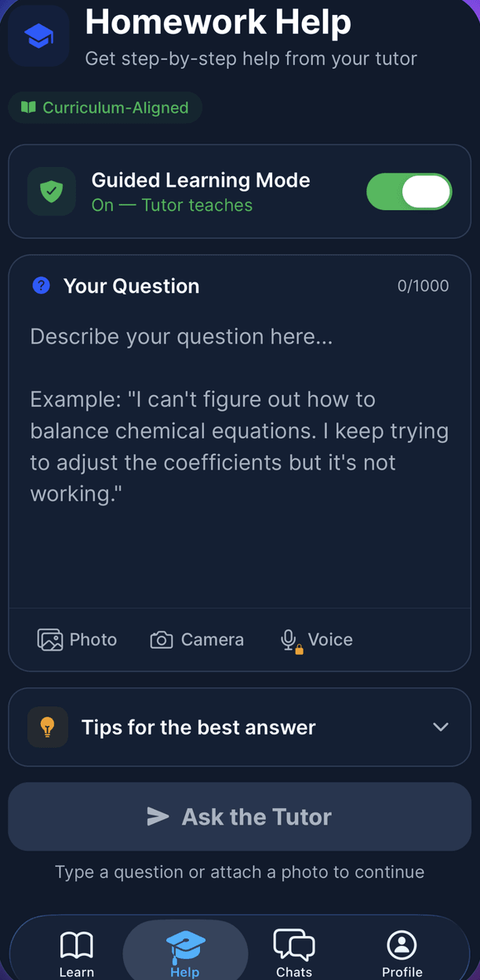
Every skill below runs as a short session: a plain-words lesson, a worked example, solving it together, then a five-question skill check that earns up to three stars. Guided Mode keeps it teaching instead of answer-handing — turning it off needs a parent's password.
Unit 1KinematicsOfficial strand · Strand K
Describing motion: speed, velocity, acceleration, the uniformly-accelerated equations, free fall, inclined planes, and projectiles.
Speed, velocity and reference frames
- Constant speed, distance and timeK.4 — Senior physics — constant speed, distance and time.
- Displacement, velocity and timeK.7 — Senior physics — displacement, velocity and time.
Acceleration
- Acceleration and change in velocityK.11 — Senior physics — acceleration and change in velocity.
- The uniformly-accelerated motion equationK.13 — Senior physics — the uniformly-accelerated motion equation.
- Average velocityK.14 — Senior physics — average velocity.
- Instantaneous velocityK.15 — Senior physics — instantaneous velocity.
Free fall, inclined planes and projectiles
- Motion of a free-falling bodyK.18 — Senior physics — motion of a free-falling body.
- Motion on an inclined planeK.20 — Senior physics — motion on an inclined plane.
- Projectile motionK.21 — Senior physics — projectile motion.
The official wording — 9 outcomes in this unit
- K.4
Applies the mathematical relationship between constant speed, distance and time (v = d/
- K.7
Applies the mathematical relationship between position with respect to the point of origin (displacement), velocity and time
- K.11
Applies the mathematical relationship between acceleration, change in velocity and time (a =
- K.13
Applies the mathematical relationship between acceleration, the distance travelled and the time
- K.14
Determines the average velocity of an object
- K.15
Determines the instantaneous velocity of an object
- K.18
Determines the position, displacement, average velocity, instantaneous velocity or acceleration of a free-falling body
- K.20
Determines the position, displacement, average velocity, instantaneous velocity or acceleration of a body on an inclined plane
- K.21
Explains the motion of a projectile (combination of uniform rectilinear motion and uniformly accelerated rectilinear motion)
Unit 2DynamicsOfficial strand · Strand D
The causes of motion: work, mass and weight, gravitational force, Newton's laws, friction, structural constraints, and force vectors.
Work, mass and weight
- Work, force and distanceD.6 — Senior physics — work, force and distance.
- Mass versus weight (qualitative)D.7 — Senior physics — mass versus weight (qualitative).
- Calculating weight (Fg = mg)D.8 — Senior physics — calculating weight (fg = mg).
Gravitational and effective force
- Effective forceD.9 — Senior physics — effective force.
- Gravitational force on a slopeD.14 — Senior physics — gravitational force on a slope.
Newton's laws of motion
- The law of inertia (Newton's First Law)D.15 — Senior physics — the law of inertia (newton's first law).
- Newton's Second Law (F = ma)D.17 — Senior physics — newton's second law (f = ma).
- Newton's Third Law (action-reaction)D.18 — Senior physics — newton's third law (action-reaction).
- Explaining phenomena with Newton's lawsD.19 — Senior physics — explaining phenomena with newton's laws.
Friction, constraints and force vectors
- Effects of frictionD.22 — Senior physics — effects of friction.
- Factors affecting frictionD.23 — Senior physics — factors affecting friction.
- Calculating the force of frictionD.24 — Senior physics — calculating the force of friction.
- Structural constraints on technical objectsD.26 — Senior physics — structural constraints on technical objects.
- Resultant of a system of forcesD.29 — Senior physics — resultant of a system of forces.
The official wording — 14 outcomes in this unit
- D.6
Applies the mathematical relationship between work, effective force and distance travelled (W = F
- D.7
Describes qualitatively the relationship between mass and weight
- D.8
Applies the mathematical relationship between mass and weight (Fg = mg)
- D.9
Defines effective force as the component of the applied force parallel to the direction of travel
- D.14
Determines the component of gravitational force parallel to the displacement of a body
- D.15
Describes qualitatively the law of inertia (Newton
- D.17
Applies the mathematical relationship between the force acting on a body, mass and acceleration (F = ma)
- D.18
Describes qualitatively the law of action-reaction (Newton
- D.19
Explains a phenomenon or how a technical object works, using Newton
- D.22
Explains the possible effects of a frictional force (slows down, stops or impedes the motion of a body)
- D.23
Names the factors that can affect the force of friction in a given situation
- D.24
Determines the value of the force of friction in a given situation (force of friction = applied force - net force)
- D.26
Describes the constraints to which different technical objects are subject: tension, compression, torsion, deflection, shearing
- D.29
Determines the magnitude and direction of the vector associated with the resultant force of a system of forces
Unit 3Transformation of energyOfficial strand · Strand T
Conservation of energy, work-energy relationships, potential and kinetic energy, elastic energy, power, and efficiency.
Conservation of energy and efficiency
- Conservation of energy (qualitative)TOE.7 — Senior physics — conservation of energy (qualitative).
- Applying conservation of energyTOE.8 — Senior physics — applying conservation of energy.
- Energy efficiencyTOE.9 — Senior physics — energy efficiency.
Potential and kinetic energy
- Gravitational potential energy (Ep = mgh)TOE.13 — Senior physics — gravitational potential energy (ep = mgh).
- Kinetic energy (Ek = one-half mv squared)TOE.15 — Senior physics — kinetic energy (ek = one-half mv squared).
- The work-energy relationship (W = delta-E)TOE.17 — Senior physics — the work-energy relationship (w = delta-e).
- Analysing mechanical energy transformationsTOE.20 — Senior physics — analysing mechanical energy transformations.
- Elastic potential energyTOE.22 — Senior physics — elastic potential energy.
Power
- Electrical energy and powerTOE.24 — Senior physics — electrical energy and power.
- Power, work and time (P = W/delta-t)TOE.26 — Senior physics — power, work and time (p = w/delta-t).
The official wording — 10 outcomes in this unit
- TOE.7
Explains qualitatively the law of conservation of energy
- TOE.8
Applies the law of conservation of energy in different contexts
- TOE.9
Defines the energy efficiency of a device or system as the proportion of energy consumed that is transformed into effective work
- TOE.13
Applies the mathematical relationship between potential energy, mass, gravitational acceleration and the distance travelled (Ep = mgh)
- TOE.15
Applies the mathematical relationship between kinetic energy, mass and speed (Ek =
- TOE.17
Applies the mathematical relationship between work and energy (W =
- TOE.20
Analyzes quantitatively a transformation of mechanical energy in a given situation
- TOE.22
Applies the mathematical relationship between elastic potential energy, the force constant and the change in length in a given situation
- TOE.24
Applies the mathematical relationship between electrical energy consumed, the power of an electrical appliance and the amount of time it is in operation (E = P
- TOE.26
Applies the mathematical relationship between power, work and time (P = W/
Unit 4Geometric opticsOfficial strand · Strand O
The behaviour of light: reflection, refraction, lenses and mirrors, the eye, and the image relations.
Reflection of light
- The law of reflectionGO.4 — Senior physics — the law of reflection.
- Diffuse and specular reflectionGO.8 — Senior physics — diffuse and specular reflection.
- Applying the law of reflectionGO.10 — Senior physics — applying the law of reflection.
Refraction of light
- Index of refractionGO.17 — Senior physics — index of refraction.
- The law of refraction (Snell's law)GO.18 — Senior physics — the law of refraction (snell's law).
- Total internal reflectionGO.19 — Senior physics — total internal reflection.
Lenses, mirrors and the eye
- Focal point of lensesGO.11 — Senior physics — focal point of lenses.
- Real and virtual imagesGO.20 — Senior physics — real and virtual images.
- The mirror and lens equationsGO.22 — Senior physics — the mirror and lens equations.
The official wording — 9 outcomes in this unit
- GO.4
Determines the angle of reflection of a light ray on the surface of a plane mirror
- GO.8
Distinguishes diffuse reflection from specular reflection in various situations
- GO.10
Explains qualitatively and quantitatively a phenomenon using the Law of Reflection
- GO.17
Defines the index of refraction of a medium as the ratio of the speed of light in a vacuum to the speed of light in that medium (n = c/v)
- GO.18
Explains qualitatively and quantitatively a phenomenon using the Law of Refraction
- GO.19
Explains the phenomenon of total internal reflection (e.g. mirage, fibre optics)
- GO.11
Determines the focal point of concave and convex lenses
- GO.20
Explains the distinction between a real image and a virtual image
- GO.22
Applies the mathematical relationships that make it possible to determine the position, orientation and height of an object or its image in the case of mirrors or lenses
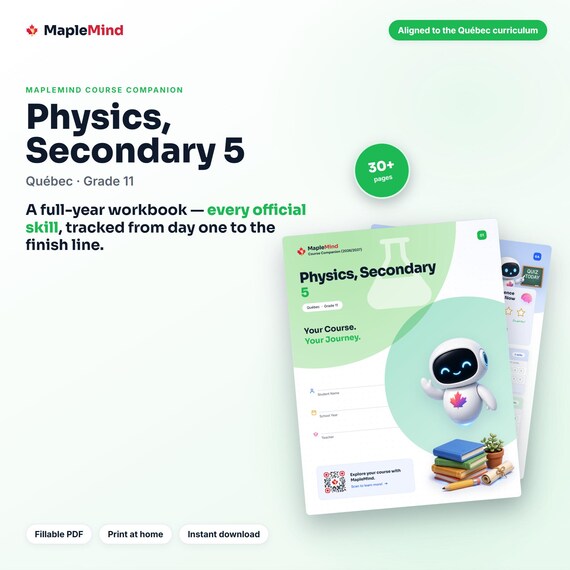
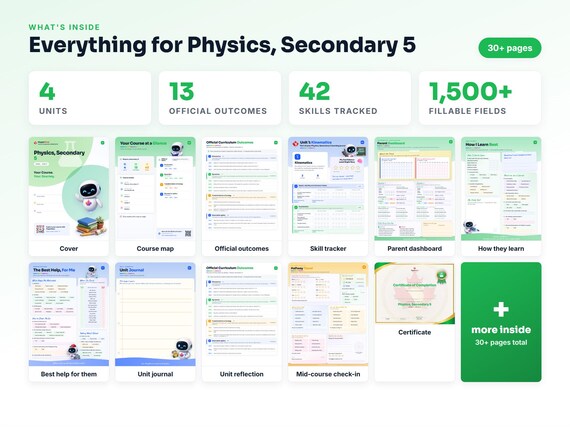


Printable workbook · A keepsake of the year
A Physics, Secondary 5 workbook worth keeping
Built from the same official curriculum as this page. Before and after each skill above, your student colours in how sure they feel — so the two of you can see, on one page, what's clicking and what needs another look. It's a quiet way to follow how the year is really going.
By June it's full of their own handwriting: units worked through, confidence grown, a mid-year check-in, notes from parent-teacher night, and a certificate at the end. Less a worksheet, more a record of the year worth keeping on the shelf.
Instant download · see every page, reviews and the full description · five or more workbooks are $2.99 each
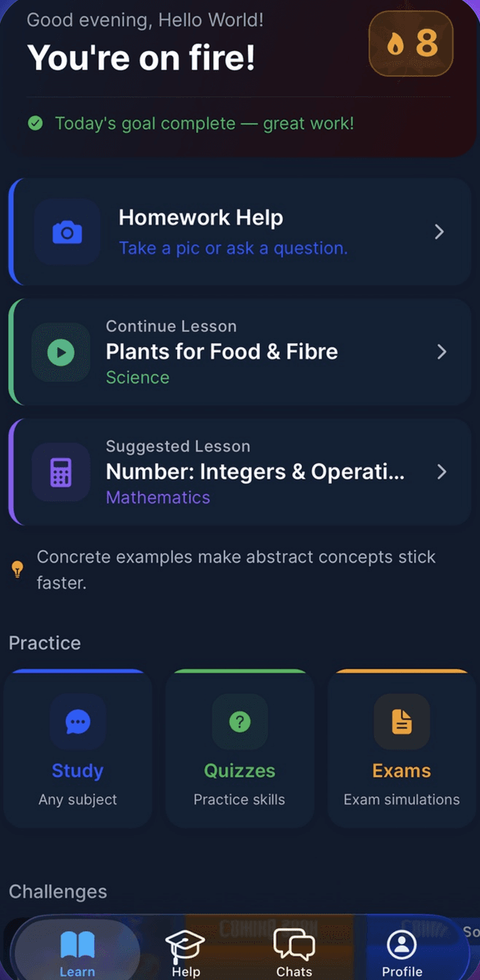
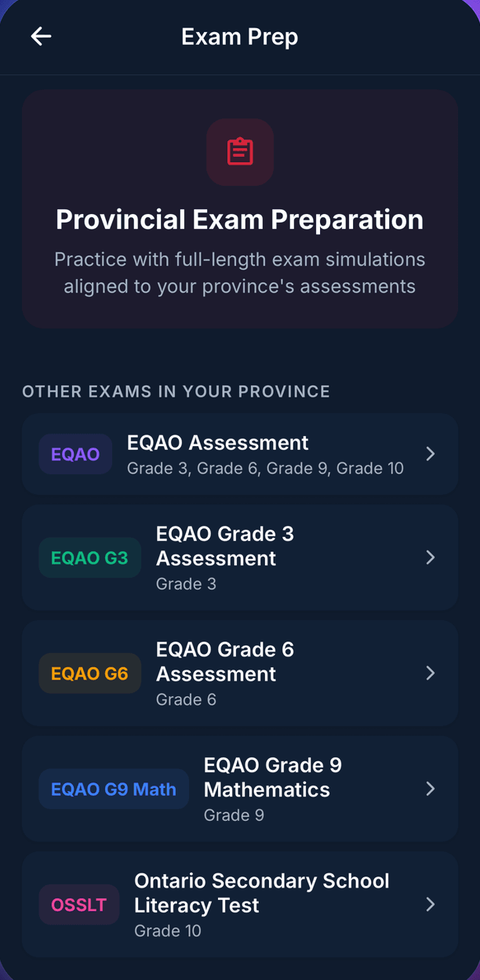
What it looks like in the app
Common questions
Can MapleMind help me with Physics, Secondary 5?
Yes. MapleMind's AI tutor covers all 42 skills in Quebec's Physics, Secondary 5 — you pick the exact skill, and the tutor teaches it step by step: a short lesson, a worked example, solving together, then a skill check to show it stuck.
Is MapleMind aligned to Quebec's official curriculum?
Yes. Every skill in this course maps to an official outcome code from Quebec's Grade 11 Science curriculum, and the ministry's own wording is quoted under each unit on this page — with the official government source linked so you can check it yourself.
What does MapleMind cost?
It's free to start — 5 tutoring chats and a practice quiz every day, no credit card. A Pro subscription ($9.99/month or $49.99/year CAD, 7-day free trial) unlocks unlimited tutoring, practice, and exam simulations.
What if I'm stuck on just one topic?
That's the point of skill-level tutoring: open Physics, Secondary 5 in the app, tap the exact skill from the list on this page, and the tutor teaches just that — no wading through lessons you don't need.
Does MapleMind work in French or other languages?
Yes — 14 languages, including French. Both the app and the tutor's explanations switch to the language you choose.
Where can I see the official Quebec curriculum for Physics, Secondary 5?
The official source is linked on this page — Québec's official education program. The outline here follows it: every MapleMind skill carries its official outcome code, and the ministry's own wording is quoted under each unit.
Keep exploring
Ready when you are
Pick a skill from this page and see it taught properly — free, in the browser, in under a minute.