Get help with Science and the Environment, Secondary 4
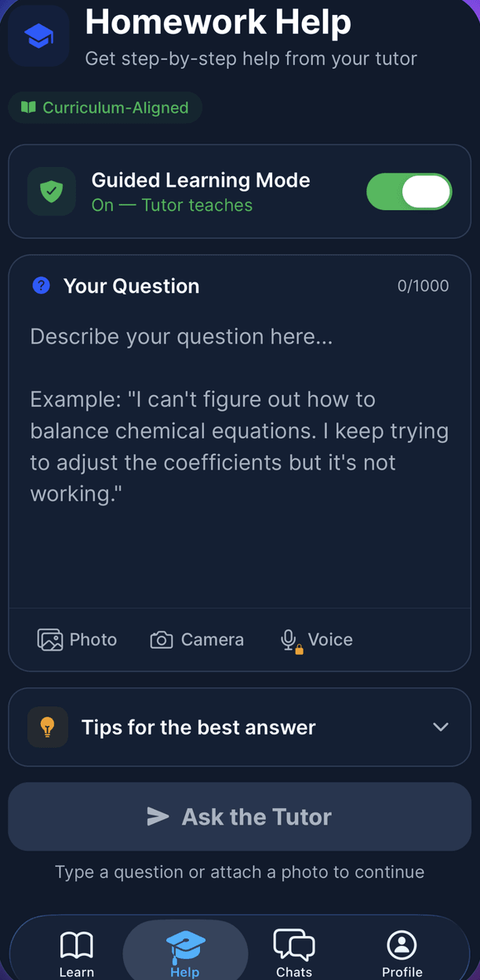
Most tutoring makes you sit through material you already know. MapleMind flips that: pick the exact skill that's causing trouble — any of the 20 below — and the tutor teaches just that one, step by step, as many times as it takes. Ask questions in plain words, any time of day, in English, French, or 12 other languages.
The official Quebec Science and the Environment, Secondary 4 curriculum
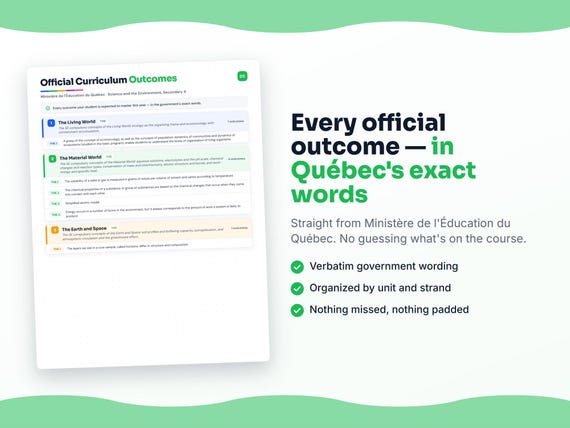
Quebec defines Science and the Environment, Secondary 4 by strands and outcomes. MapleMind teaches the same curriculum reorganized for one-skill-at-a-time tutoring — the table shows exactly where every official strand lands, and the ministry's own wording is quoted under each unit below.
Official source Québec's official education programRead it on the government site — quebec.ca ↗| Official strand | Outcomes | Where MapleMind teaches it |
|---|---|---|
| Strand LW | 3 | The Living World |
| Strand MW | 13 | The Material World |
| Strand ES | 4 | The Earth and Space |
Every skill below, taught one on one.
 Try the first session free
How MapleMind teaches Science and the Environment, Secondary 4 — every unit, lesson, and skill
Every skill below runs as a short session: a plain-words lesson, a worked example, solving it together, then a five-question skill check that earns up to three stars. Guided Mode keeps it teaching instead of answer-handing — turning it off needs a parent's password.
Unit 1The Living WorldOfficial strand · Strand LW
The SE compulsory concepts of the Living World: ecology as the organizing frame and ecotoxicology with contaminant accumulation.
Ecology and ecotoxicology
- Ecology and the organization of living organismsLW.2 — Frames environmental study through ecology and the levels of organization of organisms.
- EcotoxicologyLW.3 — Defines ecotoxicology as the study of long-term effects of chronic pollutants.
- Contaminants, bioaccumulation and the toxicity levelLW.4 — Distinguishes degrading from accumulating contaminants and explains bioconcentration, bioaccumulation and the toxicity level.
The official wording — 3 outcomes in this unit
- LW.2
A grasp of the concept of ecotoxicology, as well as the concepts of population, dynamics of communities and dynamics of ecosystems (studied in the basic program), enable students to understand the levels of organization of living organisms
- LW.3
Ecotoxicology is the study of the long-term effects of certain chronic pollutants on ecosystems
- LW.4
While some contaminants may degrade naturally, others (e.g. phosphates and mercury) accumulate in ecosystems, living organisms, waterways, lakes and ponds
Unit 2The Material WorldOfficial strand · Strand MW
The SE compulsory concepts of the Material World: aqueous solutions, electrolytes and the pH scale, chemical changes and reaction types, conservation of mass and stoichiometry, atomic structure and bonds, and work-energy and specific heat.
Solutions, electrolytes and pH
- Solubility of solids and gasesMW.8 — Explains solubility as mass of solute per volume of solvent and its variation with temperature.
- Concentration, dissolution and dilutionMW.9 — Expresses concentration in several units and describes dissolution, dilution and evaporation in the water cycle.
- Electrolytes, conductivity and the pH scaleMW.11 — Explains why some dissolved substances conduct electricity and describes the pH scale for acidic, basic and salt solutions.
Chemical changes, conservation and stoichiometry
- Chemical changes: precipitation, decomposition and synthesisMW.23 — Explains chemical change and links products' different properties to their differences from reagents, and the precipitation, decomposition and synthesis reaction types.
- Photosynthesis, respiration and neutralizationMW.34 — Explains the environmental reactions of photosynthesis and respiration and acid-base neutralization forming salts.
- Conservation of mass and balancing equationsMW.25 — Explains conservation of mass and balances chemical equations.
- Stoichiometry and the moleMW.26 — Calculates quantities of matter in moles and grams and relates them to energy produced or absorbed.
Atomic structure and bonds
- Elementary particles and the atomic modelMW.53 — Names the elementary particles and describes the simplified atomic model and Lewis notation.
- Isotopes and relative atomic massMW.47 — Explains isotopes and relative atomic mass and why isotopes share chemical properties.
- Bonding tendency and types of bondsMW.30 — Explains why atoms bond to reach an inert-gas structure and distinguishes covalent from ionic bonds.
- Nomenclature, polyatomic ions and the moleMW.46 — Applies nomenclature and notation rules including polyatomic ions and uses the mole for quantitative relationships.
Work, energy and heat
- Work, energy transformation and conservationMW.58 — Explains work as force and motion, energy transformation and conservation in isolated and open systems.
- Heat, temperature and specific heatMW.66 — Distinguishes heat from temperature and applies the heat-energy relationship with specific heat capacity.
The official wording — 13 outcomes in this unit
- MW.8
The solubility of a solid or gas is measured in grams of solute per volume of solvent and varies according to temperature
- MW.9
Concentration is expressed in parts per million (ppm), as a percentage, in grams or in moles of solute per litre of solution
- MW.11
Some substances dissolved in water conduct electricity
- MW.23
The chemical properties of a substance or group of substances are based on the chemical changes that occur when they come into contact with each other
- MW.34
Photosynthesis and respiration
- MW.25
The number of atoms of each element and their mass, however, remain the same
- MW.26
This makes it possible to balance chemical equations.The quantities of matter that are involved in a chemical reaction are calculated (in moles and grams)
- MW.53
Simplified atomic model
- MW.47
Some atoms in a given element, called isotopes, differ from the others in the number of neutrons they have and, therefore, in their atomic mass
- MW.30
The tendency of atoms to acquire the peripheral electronic structure of the neighbouring inert gas, through the loss, gain or sharing of electrons, is determined by the number and arrangement of the electrons in the atoms
- MW.46
The nomenclature and notation of the formulas of various compounds, including those made up of the most common polyatomic ions, are based on accepted rules
- MW.58
Energy occurs in a number of forms in the environment, but it always corresponds to the amount of work a system is likely to produce
- MW.66
A warm body exhibits a characteristic behaviour: as it cools, it warms cooler bodies with which it is in contact
Unit 3The Earth and SpaceOfficial strand · Strand ES
The SE compulsory concepts of the Earth and Space: soil profiles and buffering capacity, eutrophication, and atmospheric circulation and the greenhouse effect.
Soil, water and atmosphere
- Soil horizons and profilesES.3 — Explains soil horizons and profiles and the regulators of biological activity.
- Soil buffering capacity and contaminationES.6 — Explains soil buffering capacity as fertility indicator and how contamination and acid rain degrade it.
- Aquatic pollution and eutrophicationES.14 — Explains aquatic ecosystem pollution, the pollutant factors, and eutrophication from excess nutrients.
- Atmospheric circulation and the greenhouse effectES.28 — Explains atmospheric circulation, prevailing winds and the greenhouse effect in the spread of contaminants and climate.
The official wording — 4 outcomes in this unit
- ES.3
The layers we see in a core sample, called horizons, differ in structure and composition
- ES.6
The buffering capacity of the soil is its ability to limit pH variations, which enables it to postpone the consequences of contamination
- ES.14
Lakes, waterways and wetlands are dynamic systems home to a variety of species
- ES.28
Atmospheric circulation

Printable workbook · A keepsake of the year
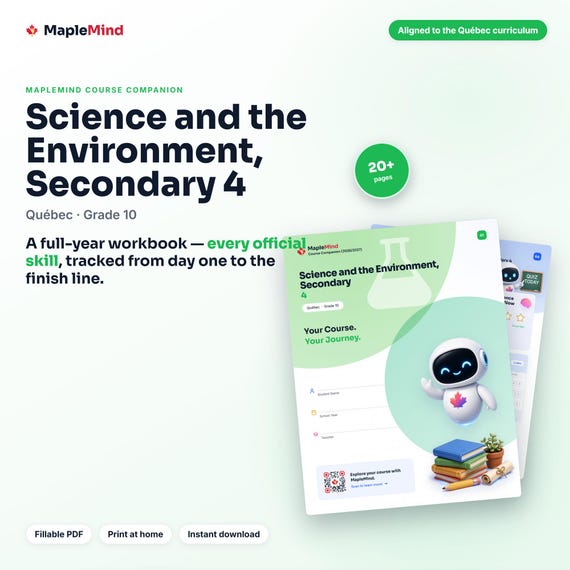
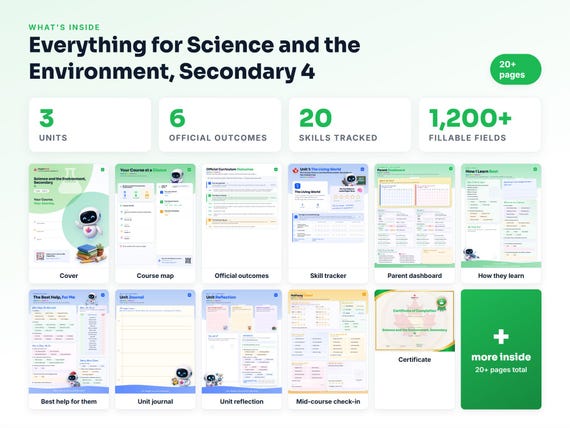
A Science and the Environment, Secondary 4 workbook worth keeping
Built from the same official curriculum as this page. Before and after each skill above, your student colours in how sure they feel — so the two of you can see, on one page, what's clicking and what needs another look. It's a quiet way to follow how the year is really going.
By June it's full of their own handwriting: units worked through, confidence grown, a mid-year check-in, notes from parent-teacher night, and a certificate at the end. Less a worksheet, more a record of the year worth keeping on the shelf.
Instant download · see every page, reviews and the full description · five or more workbooks are $2.99 each
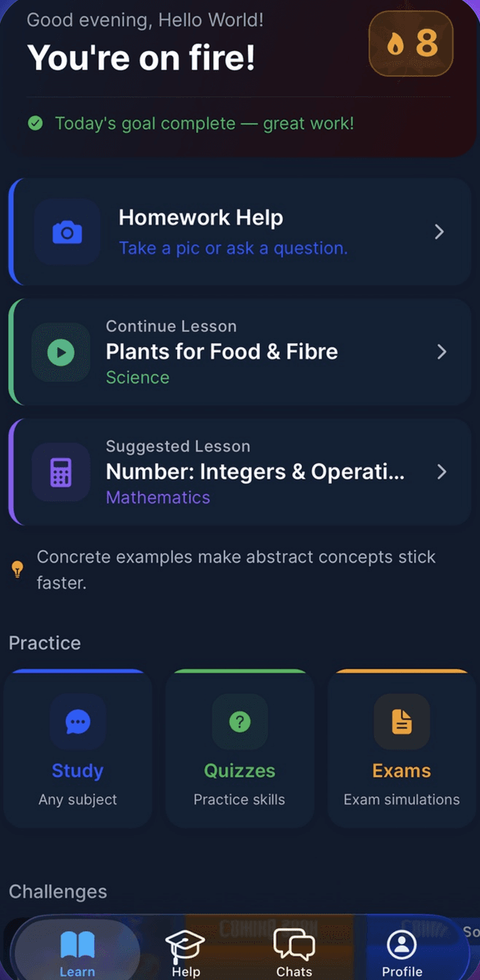
What it looks like in the app
Common questions
Can MapleMind help me with Science and the Environment, Secondary 4?
Yes. MapleMind's AI tutor covers all 20 skills in Quebec's Science and the Environment, Secondary 4 — you pick the exact skill, and the tutor teaches it step by step: a short lesson, a worked example, solving together, then a skill check to show it stuck.
Is MapleMind aligned to Quebec's official curriculum?
Yes. Every skill in this course maps to an official outcome code from Quebec's Grade 10 Science curriculum, and the ministry's own wording is quoted under each unit on this page — with the official government source linked so you can check it yourself.
What does MapleMind cost?
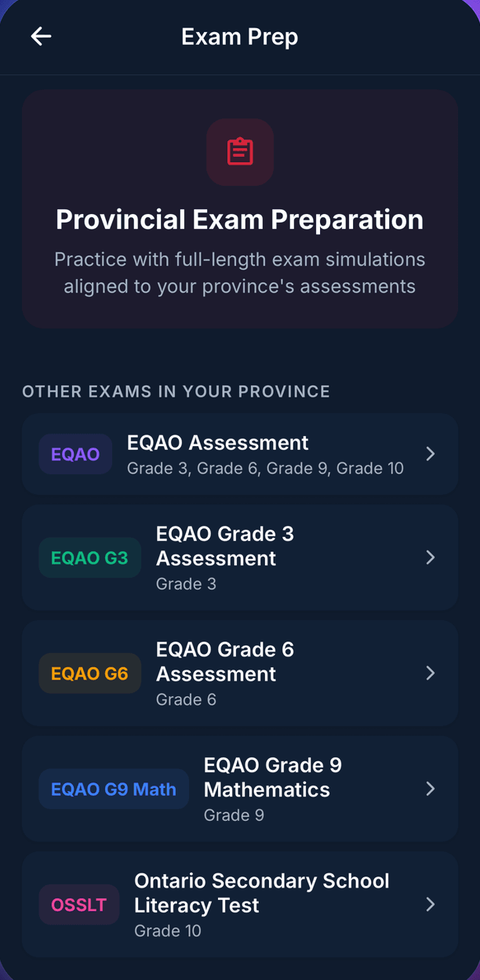
It's free to start — 5 tutoring chats and a practice quiz every day, no credit card. A Pro subscription ($9.99/month or $49.99/year CAD, 7-day free trial) unlocks unlimited tutoring, practice, and exam simulations.
What if I'm stuck on just one topic?
That's the point of skill-level tutoring: open Science and the Environment, Secondary 4 in the app, tap the exact skill from the list on this page, and the tutor teaches just that — no wading through lessons you don't need.
Does MapleMind work in French or other languages?
Yes — 14 languages, including French. Both the app and the tutor's explanations switch to the language you choose.
Where can I see the official Quebec curriculum for Science and the Environment, Secondary 4?
The official source is linked on this page — Québec's official education program. The outline here follows it: every MapleMind skill carries its official outcome code, and the ministry's own wording is quoted under each unit.
Keep exploring
Ready when you are
Pick a skill from this page and see it taught properly — free, in the browser, in under a minute.