Get help with Environmental Science and Technology, Secondary 4
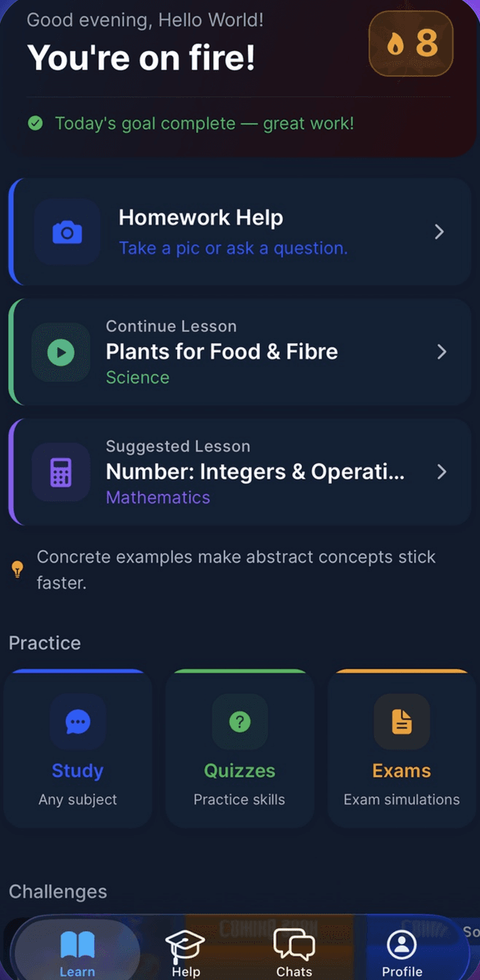
Most tutoring makes you sit through material you already know. MapleMind flips that: pick the exact skill that's causing trouble — any of the 29 below — and the tutor teaches just that one, step by step, as many times as it takes. Ask questions in plain words, any time of day, in English, French, or 12 other languages.
The official Quebec Environmental Science and Technology, Secondary 4 curriculum
Quebec defines Environmental Science and Technology, Secondary 4 by strands and outcomes. MapleMind teaches the same curriculum reorganized for one-skill-at-a-time tutoring — the table shows exactly where every official strand lands, and the ministry's own wording is quoted under each unit below.
Official source Québec's official education programRead it on the government site — quebec.ca ↗| Official strand | Outcomes | Where MapleMind teaches it |
|---|---|---|
| Strand LW | 6 | The Living World |
| Strand MW | 13 | The Material World |
| Strand ES | 3 | The Earth and Space |
| Strand TW | 7 | The Technological World |
Every skill below, taught one on one.
 Try the first session free
How MapleMind teaches Environmental Science and Technology, Secondary 4 — every unit, lesson, and skill
Every skill below runs as a short session: a plain-words lesson, a worked example, solving it together, then a five-question skill check that earns up to three stars. Guided Mode keeps it teaching instead of answer-handing — turning it off needs a parent's password.
Unit 1The Living WorldOfficial strand · Strand LW
The EST-specific overlay on the Living World: the ecological footprint, ecotoxicology and contaminant accumulation, and the Mendelian genetics of heredity.
Ecological footprint and ecotoxicology
- Ecological footprintLW.11 — Defines the ecological footprint as a measure of human impact on ecosystems.
- Ecotoxicology and contaminantsLW.12 — Defines ecotoxicology and distinguishes contaminants that degrade from those that accumulate.
- Bioconcentration, bioaccumulation and the toxicity thresholdLW.9 — Explains why pollutants concentrate up a food web and defines the toxicity threshold.
Mendelian genetics and heredity
- Heredity, genes, alleles and cross-breedingLW.16 — Explains how cross-breeding and genetic engineering change traits and introduces genes and alleles as units of heredity.
- Genotype, phenotype, dominance and recessivityLW.24 — Explains homozygous/heterozygous alleles, dominance and recessivity, and genotype versus phenotype.
- Protein synthesis and DNALW.30 — Explains protein synthesis from DNA and how environmental substances can deregulate it.
The official wording — 6 outcomes in this unit
- LW.11
The ecological footprint is a tool for evaluating the actual impact of human activity on ecosystems
- LW.12
Ecotoxicology is the study of the long-term effects of certain chronic pollutants on ecosystems
- LW.9
Bioaccumulation
- LW.16
Plant and animal cross-breeding can foster the emergence of a useful trait in the majority of individuals in a species
- LW.24
two identical alleles of a given gene, the offspring is homozygotic for this gene and the trait borne by the alleles
- LW.30
modify its observable anatomical, morphological and physiological characteristics, or its phenotype
Unit 2The Material WorldOfficial strand · Strand MW
The EST-specific overlay on the Material World: electrolyte strength and reaction energy, stoichiometry and the mole, atomic structure and periodicity, nomenclature and bonds, nuclear transformations, electrostatics and circuit laws, and work-energy and specific heat.
Electrolytes, reactions and stoichiometry
- Strength of electrolytesMW.2 — Distinguishes the strength of electrolytes by how fully they dissociate.
- Oxidation reactionsMW.4 — Identifies oxidation as a chemical reaction class and relates it to environmental processes.
- Endothermic and exothermic reactionsMW.15 — Distinguishes endothermic from exothermic reactions and relates them to energy produced or absorbed.
- Stoichiometry, the mole and Avogadro's numberMW.5 — Calculates quantities of matter in moles and grams using the mole and Avogadro's number.
Atomic structure, periodicity and bonds
- The simplified atomic model and isotopesMW.19 — Describes the simplified atomic model with the neutron and explains isotopes and atomic number.
- Periodicity of propertiesMW.7 — Explains why atoms bond to reach an inert-gas structure and the periodicity of properties in the periodic table.
- Nomenclature, notation and polyatomic ionsMW.25 — Applies nomenclature and notation rules for compounds, including common polyatomic ions, and the mole.
- Types of bonds: covalent and ionicMW.10 — Distinguishes covalent from ionic bonds based on atomic structure, excluding transition elements.
Nuclear transformations and electricity
- Nuclear stability, radioactivity, fission and fusionMW.35 — Explains nuclear transformations, fission and fusion, and the energy and environmental impact of radioactivity.
- Coulomb's law and the electrical fieldMW.38 — Applies Coulomb's law for the force between charges and describes the electrical field.
- Kirchhoff's laws and the solenoid fieldMW.44 — Uses Kirchhoff's and Ohm's laws to find current, voltage and equivalent resistance, and describes the solenoid's magnetic field.
- Work, force and mechanical energyMW.50 — Applies the relationships between work, force and travel, work and energy, and kinetic and potential energy.
- Heat energy and specific heat capacityMW.58 — Applies the relationship between heat energy, specific heat capacity, mass and temperature variation.
The official wording — 13 outcomes in this unit
- MW.2
Strength of electrolytes
- MW.4
Oxidation
- MW.15
Endothermic and exothermic reactions
- MW.5
The quantities of matter that are involved in a chemical reaction are
- MW.19
around the nucleus in electron shells that correspond to different energy levels
- MW.7
The tendency
- MW.25
Matter is also organized at a molecular and ionic level
- MW.10
Types of bonds
- MW.35
Transformations of matter are considered “nuclear” when they occur in the nucleus of the atom
- MW.38
The force of attraction or repulsion is directly
- MW.44
Kirchhoff’s and Ohm’s laws enable us to determine the intensity and
- MW.50
Relationship between work, force and travel
- MW.58
Relationship between heat energy, specific heat
Unit 3The Earth and SpaceOfficial strand · Strand ES
The EST-specific overlay on the Earth and Space: the phosphorus cycle and soil buffering capacity, eutrophication, and atmospheric contamination.
Soil, water and air contamination
- The phosphorus cycle and soil depletionES.8 — Explains soil depletion, buffering capacity and contamination, and the phosphorus cycle.
- Aquatic pollution and eutrophicationES.10 — Explains aquatic ecosystem pollution, the pollutant factors, and eutrophication from excess nutrients.
- Combustion emissions and atmospheric spreadES.14 — Explains the effects of fossil-fuel combustion products and how prevailing winds spread contaminants.
The official wording — 3 outcomes in this unit
- ES.8
Some agricultural and forestry practices reduce the soil’s ability to accommodate healthy vegetation
- ES.10
Lakes, waterways and wetlands are dynamic systems home to a variety of species
- ES.14
The different substances emitted during the combustion of fossil fuels have harmful effects at the local, regional and planetary levels
Unit 4The Technological WorldOfficial strand · Strand TW
The EST-specific overlay on the Technological World: drawings with dimensional tolerances, degrees of freedom, heat treatments, precision manufacturing and measurement, and the biotechnology of cloning and wastewater biodegradation.
Drawings, heat treatments and manufacturing
- Exploded and assembly drawings with tolerancesTW.8 — Explains exploded and assembly drawings and dimensional tolerances for interchangeable parts.
- Adhesion, friction and degrees of freedomTW.11 — Explains adhesion and friction between parts and the degrees of freedom of a linked part.
- Heat treatments of steelTW.24 — Explains heat treatments (quenching, tempering, annealing) and their effect on steel's properties.
- Manufacturing, machining and shapingTW.28 — Explains manufacturing prerequisites, shaping, laying out, drilling and threading.
- Precision measurementTW.36 — Explains precision measurement with instruments such as vernier calipers in machining.
Cloning and wastewater biodegradation
- Cloning and its applicationsTW.40 — Explains plant and animal cloning and its applications and ethical questions.
- Wastewater treatment and biodegradationTW.42 — Explains the physical, chemical and biological treatment of wastewater and phytoremediation of soil.
The official wording — 7 outcomes in this unit
- TW.8
Representing objects in exploded view enables us to easily visualize each component
- TW.11
Adhesion and friction between the parts
- TW.24
Heat treatments, such as quenching and tempering, make it possible to improve the mechanical properties of steel
- TW.28
The concepts associated with manufacturing are important prerequisites
- TW.36
diameter before tapping. Measurement requires the use of instruments such as vernier calipers and fosters greater precision during machining operations
- TW.40
Cloning generally refers to the reproduction of an individual, a cell tissue, a cell or even a gene
- TW.42
The depollution of wastewater requires a series of steps involving physical, physico-chemical and biological treatments
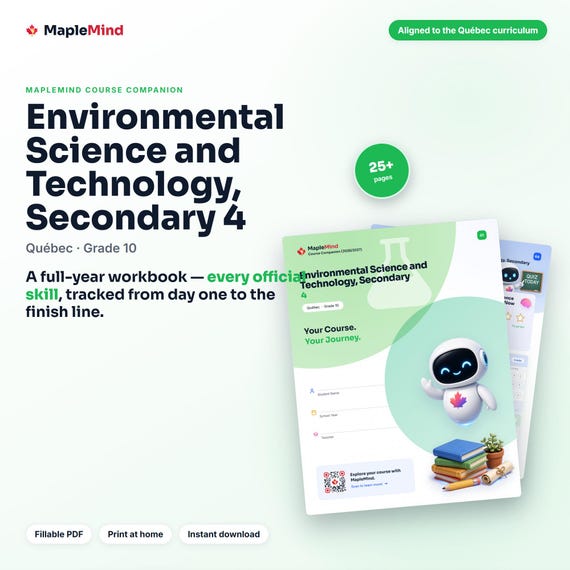
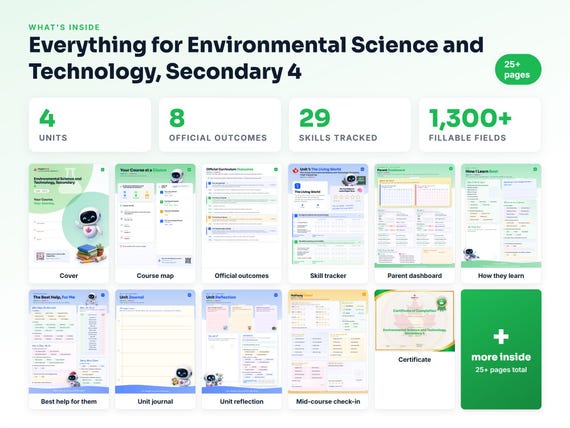


Printable workbook · A keepsake of the year
A Environmental Science and Technology, Secondary 4 workbook worth keeping
Built from the same official curriculum as this page. Before and after each skill above, your student colours in how sure they feel — so the two of you can see, on one page, what's clicking and what needs another look. It's a quiet way to follow how the year is really going.
By June it's full of their own handwriting: units worked through, confidence grown, a mid-year check-in, notes from parent-teacher night, and a certificate at the end. Less a worksheet, more a record of the year worth keeping on the shelf.
Instant download · see every page, reviews and the full description · five or more workbooks are $2.99 each
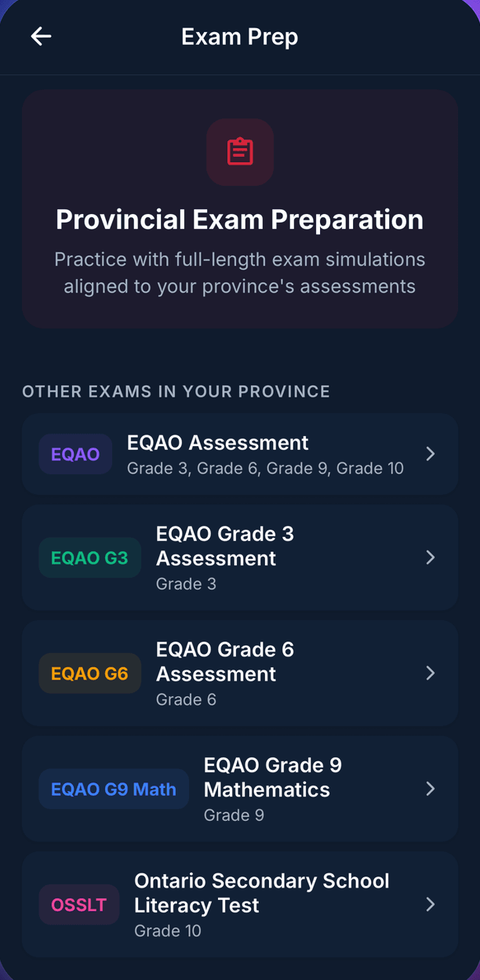
What it looks like in the app

Common questions
Can MapleMind help me with Environmental Science and Technology, Secondary 4?
Yes. MapleMind's AI tutor covers all 29 skills in Quebec's Environmental Science and Technology, Secondary 4 — you pick the exact skill, and the tutor teaches it step by step: a short lesson, a worked example, solving together, then a skill check to show it stuck.
Is MapleMind aligned to Quebec's official curriculum?
Yes. Every skill in this course maps to an official outcome code from Quebec's Grade 10 Science curriculum, and the ministry's own wording is quoted under each unit on this page — with the official government source linked so you can check it yourself.
What does MapleMind cost?
It's free to start — 5 tutoring chats and a practice quiz every day, no credit card. A Pro subscription ($9.99/month or $49.99/year CAD, 7-day free trial) unlocks unlimited tutoring, practice, and exam simulations.
What if I'm stuck on just one topic?
That's the point of skill-level tutoring: open Environmental Science and Technology, Secondary 4 in the app, tap the exact skill from the list on this page, and the tutor teaches just that — no wading through lessons you don't need.
Does MapleMind work in French or other languages?
Yes — 14 languages, including French. Both the app and the tutor's explanations switch to the language you choose.
Where can I see the official Quebec curriculum for Environmental Science and Technology, Secondary 4?
The official source is linked on this page — Québec's official education program. The outline here follows it: every MapleMind skill carries its official outcome code, and the ministry's own wording is quoted under each unit.
Keep exploring
Ready when you are
Pick a skill from this page and see it taught properly — free, in the browser, in under a minute.