Get help with Science and Technology, Secondary 4
Most tutoring makes you sit through material you already know. MapleMind flips that: pick the exact skill that's causing trouble — any of the 31 below — and the tutor teaches just that one, step by step, as many times as it takes. Ask questions in plain words, any time of day, in English, French, or 12 other languages.
The official Quebec Science and Technology, Secondary 4 curriculum
Quebec defines Science and Technology, Secondary 4 by strands and outcomes. MapleMind teaches the same curriculum reorganized for one-skill-at-a-time tutoring — the table shows exactly where every official strand lands, and the ministry's own wording is quoted under each unit below.
Official source Québec's official education programRead it on the government site — quebec.ca ↗| Official strand | Outcomes | Where MapleMind teaches it |
|---|---|---|
| Strand MW | 14 | The Material World |
| Strand LW | 3 | The Living World |
| Strand ES | 9 | The Earth and Space |
| Strand TW | 5 | The Technological World |
Every skill below, taught one on one.
 Try the first session free
How MapleMind teaches Science and Technology, Secondary 4 — every unit, lesson, and skill
Every skill below runs as a short session: a plain-words lesson, a worked example, solving it together, then a five-question skill check that earns up to three stars. Guided Mode keeps it teaching instead of answer-handing — turning it off needs a parent's password.
Unit 1The Material WorldOfficial strand · Strand MW
Concentration and ions, acids/bases and the pH scale, combustion and neutralization, chemical bonding, energy and its conservation, the periodic table and atomic models, and electricity and magnetism.
Concentration, electrolytes and ions
- Molar concentrationMW.A.29 — Determines the concentration of an aqueous solution including in mol/L.
- Electrolytes, ions and conductionMW.A.31 — Defines electrolyte and ion, electrolytic dissociation, and the mechanism of conduction in solution.
Acids, bases and the pH scale
- The pH scaleMW.A.33 — Describes the pH scale and determines the pH of common substances.
Combustion and neutralization
- Combustion reactionsMW.B.26 — Describes rapid combustion and explains it with the fire triangle.
- Acid-base neutralizationMW.B.28 — Gives examples of and names the products of acid-base neutralization and recognizes it from an equation.
Chemical bonding
- Covalent bondsMW.B.32 — Defines, represents, and identifies molecules with a covalent bond.
- Ionic bondsMW.B.35 — Defines, represents, and identifies molecules with an ionic bond and associates it with electrolytes.
Energy, its conservation and efficiency
- Conservation of energy and efficiencyMW.B.52 — Explains and applies conservation of energy, defines and improves energy efficiency, and relates heat and temperature.
- Kinetic energyMW.B.69 — Applies the mathematical relationship between kinetic energy, mass and speed.
Atomic models and the periodic table
- Reading the periodic tableMW.C.10 — Locates groups and periods and links them to valence electrons and shells.
- Atomic models, Lewis notation and polyatomic ionsMW.C.13 — Applies the Rutherford-Bohr and Lewis models and recognizes common polyatomic ions.
Electricity and circuits
- Electric charges and static electricityMW.F.1 — Associates particles with charge and describes charge interactions and static electricity.
- Voltage, resistance and current (Ohm's law)MW.F.5 — Describes and applies the relationship between voltage, resistance, and current; describes circuit elements and connection types.
- Electrical power and energyMW.F.10 — Applies the power relationship P = VI and the energy relationship E = PDeltat; magnetism of a current.
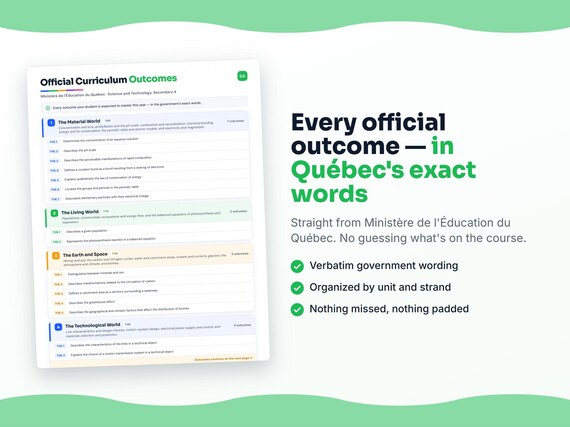
The official wording — 14 outcomes in this unit
- MW.A.29
Determines the concentration of an aqueous solution
- MW.A.31
Defines the concept of electrolyte
- MW.A.33
Describes the pH scale
- MW.B.26
Describes the perceivable manifestations of rapid combustion
- MW.B.28
Gives examples of acid-base neutralization reactions
- MW.B.32
Defines a covalent bond as a bond resulting from a sharing of electrons
- MW.B.35
Defines an ionic bond as a bond resulting from the gain or loss of electrons
- MW.B.52
Explains qualitatively the law of conservation of energy
- MW.B.69
Applies the mathematical relationship between kinetic energy
- MW.C.10
Locates the groups and periods in the periodic table
- MW.C.13
Describes the Rutherford-Bohr atomic model
- MW.F.1
Associates elementary particles with their electrical charge
- MW.F.5
Applies the mathematical relationship between voltage, resistance and current intensity in an electrical circuit
- MW.F.10
Applies the mathematical relationship between power, voltage and current intensity in an electrical circuit
Unit 2The Living WorldOfficial strand · Strand LW
Populations, communities, ecosystems and energy flow, and the balanced equations of photosynthesis and respiration.
Populations, communities and ecosystems
- Populations and their factorsLW.A.8 — Describes a population and the biotic/abiotic factors and resources that affect it.
- Communities, ecosystems and energy flowLW.A.11 — Defines community and ecosystem and describes material and energy flow and chemical recycling.
Photosynthesis and respiration equations
- Balanced equations of photosynthesis and respirationLW.B.11 — Represents the photosynthesis and respiration reactions in balanced equations.
The official wording — 3 outcomes in this unit
- LW.A.8
Describes a given population
- LW.A.11
Defines a community as a group of populations that interact
- LW.B.11
Represents the photosynthesis reaction in a balanced equation
Unit 3The Earth and SpaceOfficial strand · Strand ES
Mining and soil, the carbon and nitrogen cycles, water and catchment areas, oceans and currents, glaciers, the atmosphere and climate, and biomes.
Mining, minerals and soil
- Minerals, ore and mining impactsES.A.17 — Distinguishes minerals from ore and describes environmental impacts of mining.
- Soil structure, reactivity and permafrostES.A.20 — Describes soil structure and chemical/biological reactivity, and permafrost and its warming.
The carbon and nitrogen cycles
- Carbon and nitrogen cyclesES.A.28 — Describes transformations related to the circulation of carbon and of nitrogen.
Water, catchment areas and oceans
- Catchment areas and human impactES.A.33 — Defines a catchment area and describes human impacts on its waterways.
- Salinity, currents and glaciersES.A.35 — Defines salinity and describes its effect on density, ocean currents, thermohaline circulation, and glaciers.
The atmosphere, weather and climate
- The greenhouse effect and climate changeES.A.47 — Describes the greenhouse effect and the consequences of higher greenhouse-gas concentrations.
- Air masses, clouds and atmospheric circulationES.A.49 — Describes air masses, cloud and cyclone formation, and atmospheric circulation.
Biomes
- Terrestrial and marine biomesES.A.55 — Describes the factors affecting biome distribution and the main terrestrial and marine biomes; solar energy factors and tides.
- Energy resources and their impactES.B.11 — Describes technologies producing electricity from lithosphere/hydrosphere/atmosphere resources and their impact.
The official wording — 9 outcomes in this unit
- ES.A.17
Distinguishes between minerals and ore
- ES.A.20
Describes the structure of a soil
- ES.A.28
Describes transformations related to the circulation of carbon
- ES.A.33
Defines a catchment area as a territory surrounding a waterway
- ES.A.35
Defines salinity as a measure of the quantity of salt in a solution
- ES.A.47
Describes the greenhouse effect
- ES.A.49
Describes the properties of an air mass
- ES.A.55
Describes the geographical and climatic factors that affect the distribution of biomes
- ES.B.11
Describes technologies used to produce electricity using the energy resources in the lithosphere, hydrosphere and atmosphere
Unit 4The Technological WorldOfficial strand · Strand TW
Link characteristics and design choices, motion-system design, electrical power supply and control, and materials selection and protection.
Link characteristics and design choices
- Link characteristics and assembly choicesTW.B.17 — Describes link characteristics and determines/judges design choices for links, guiding, and assembly.
Designing motion systems
- Choosing motion systemsTW.B.30 — Explains the choice of motion transmission and transformation systems and using speed changes in design.
Electrical power supply and control
- Power supply and conductionTW.C.1 — Defines power supply, identifies current sources, and describes conduction, conductors/insulators, and factors affecting conductivity.
- Control, protection and energy transformationTW.C.5 — Describes protective devices, control switches, and energy transformations in circuits and appliances.
Materials selection and protection
- Material selection and protectionTW.D.8 — Describes advanced constraints, explains material choice by properties, and describes degradation treatments.
The official wording — 5 outcomes in this unit
- TW.B.17
Describes the characteristics of the links in a technical object
- TW.B.30
Explains the choice of a motion transmission system in a technical object
- TW.C.1
Defines power supply as the ability to generate electrical current
- TW.C.5
Describes the role of a protective device in a circuit
- TW.D.8
Explains the choice of a material based on its properties

Printable workbook · A keepsake of the year
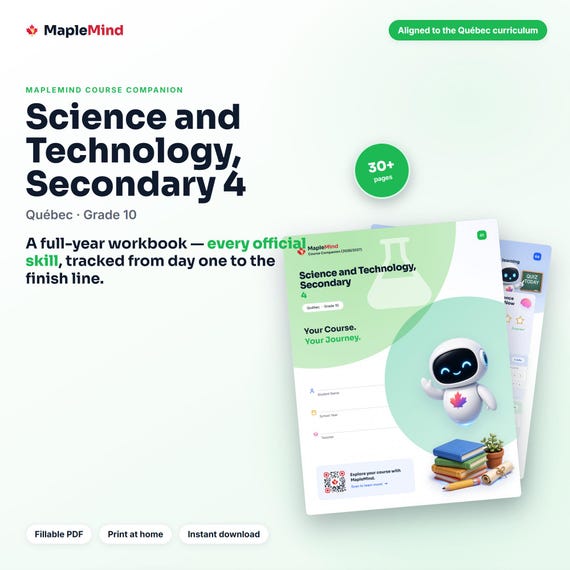
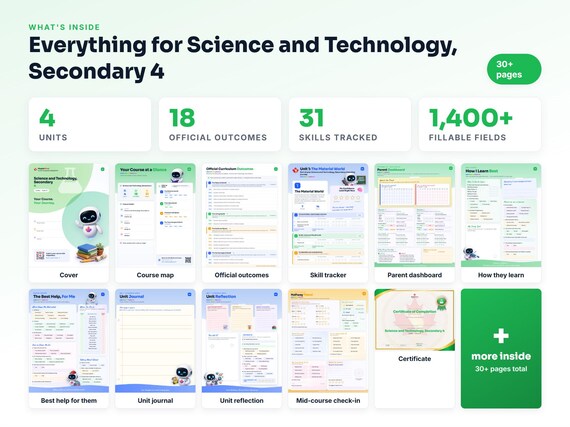
A Science and Technology, Secondary 4 workbook worth keeping
Built from the same official curriculum as this page. Before and after each skill above, your student colours in how sure they feel — so the two of you can see, on one page, what's clicking and what needs another look. It's a quiet way to follow how the year is really going.
By June it's full of their own handwriting: units worked through, confidence grown, a mid-year check-in, notes from parent-teacher night, and a certificate at the end. Less a worksheet, more a record of the year worth keeping on the shelf.
Instant download · see every page, reviews and the full description · five or more workbooks are $2.99 each
What it looks like in the app



Common questions
Can MapleMind help me with Science and Technology, Secondary 4?
Yes. MapleMind's AI tutor covers all 31 skills in Quebec's Science and Technology, Secondary 4 — you pick the exact skill, and the tutor teaches it step by step: a short lesson, a worked example, solving together, then a skill check to show it stuck.
Is MapleMind aligned to Quebec's official curriculum?
Yes. Every skill in this course maps to an official outcome code from Quebec's Grade 10 Science curriculum, and the ministry's own wording is quoted under each unit on this page — with the official government source linked so you can check it yourself.
What does MapleMind cost?
It's free to start — 5 tutoring chats and a practice quiz every day, no credit card. A Pro subscription ($9.99/month or $49.99/year CAD, 7-day free trial) unlocks unlimited tutoring, practice, and exam simulations.
What if I'm stuck on just one topic?
That's the point of skill-level tutoring: open Science and Technology, Secondary 4 in the app, tap the exact skill from the list on this page, and the tutor teaches just that — no wading through lessons you don't need.
Does MapleMind work in French or other languages?
Yes — 14 languages, including French. Both the app and the tutor's explanations switch to the language you choose.
Where can I see the official Quebec curriculum for Science and Technology, Secondary 4?
The official source is linked on this page — Québec's official education program. The outline here follows it: every MapleMind skill carries its official outcome code, and the ministry's own wording is quoted under each unit.
Keep exploring
Ready when you are
Pick a skill from this page and see it taught properly — free, in the browser, in under a minute.