Get help with Chemistry, Secondary 5
Most tutoring makes you sit through material you already know. MapleMind flips that: pick the exact skill that's causing trouble — any of the 46 below — and the tutor teaches just that one, step by step, as many times as it takes. Ask questions in plain words, any time of day, in English, French, or 12 other languages.
The official Quebec Chemistry, Secondary 5 curriculum
Quebec defines Chemistry, Secondary 5 by strands and outcomes. MapleMind teaches the same curriculum reorganized for one-skill-at-a-time tutoring — the table shows exactly where every official strand lands, and the ministry's own wording is quoted under each unit below.
Official source Québec's official education programRead it on the government site — quebec.ca ↗| Official strand | Outcomes | Where MapleMind teaches it |
|---|---|---|
| Strand G | 11 | Gases |
| Strand E | 14 | Energy changes in reactions |
| Strand R | 10 | Reaction rate |
| Strand C | 11 | Chemical equilibrium |
Every skill below, taught one on one.
 Try the first session free
How MapleMind teaches Chemistry, Secondary 5 — every unit, lesson, and skill
Every skill below runs as a short session: a plain-words lesson, a worked example, solving it together, then a five-question skill check that earns up to three stars. Guided Mode keeps it teaching instead of answer-handing — turning it off needs a parent's password.
Unit 1GasesOfficial strand · Strand G
The behaviour of gases: kinetic theory, the gas laws, and the ideal-gas relationship.
Particle behaviour and pressure of gases
- Reactivity and uses of common gasesG.9 — Senior chemistry — reactivity and uses of common gases.
- Kinetic theory and the behaviour of gasesG.11 — Senior chemistry — kinetic theory and the behaviour of gases.
- Pressure and the factors that affect itG.12 — Senior chemistry — pressure and the factors that affect it.
- The pressure-volume relationship (qualitative)G.14 — Senior chemistry — the pressure-volume relationship (qualitative).
- The mole and Avogadro's numberG.15 — Senior chemistry — the mole and avogadro's number.
- The individual gas laws (Boyle, Charles, Gay-Lussac)G.18 — Senior chemistry — the individual gas laws (boyle, charles, gay-lussac).
- The combined gas lawG.23 — Senior chemistry — the combined gas law.
- The ideal gas law PV = nRTG.25 — Senior chemistry — the ideal gas law pv = nrt.
- Dalton's law of partial pressuresG.27 — Senior chemistry — dalton's law of partial pressures.
- Molar volume of a gasG.29 — Senior chemistry — molar volume of a gas.
- Finding moles of a gas from its conditionsG.31 — Senior chemistry — finding moles of a gas from its conditions.
The official wording — 11 outcomes in this unit
- G.9
Associates the use of certain gases in various applications with their chemical reactivity
- G.11
Explains the macroscopic behaviour of a gas (e.g. compressibility, expansion, diffusion) using kinetic theory
- G.12
Defines pressure as the force exerted by particles when they collide with a constricting surface
- G.14
Describes qualitatively the relationship between the pressure and volume of a gas
- G.15
Expresses a quantity of particles using Avogadro
- G.18
Determines the relationship between the pressure of a gas and its volume when the temperature and number of moles of gas are kept constant
- G.23
Applies the mathematical relationship between the pressure, volume, number of moles and temperature of a gas
- G.25
Applies the mathematical relationship between the pressure, volume and number of moles of a gas, the ideal gas constant and the temperature of a gas (pV = nRT)
- G.27
Applies the mathematical relationship between the total pressure of a mixture of gases and the partial pressures of the component gases
- G.29
Calculates the molar volume of a gas at standard temperature and pressure
- G.31
Determines the number of moles of a gas at a given temperature and pressure
Unit 2Energy changes in reactionsOfficial strand · Strand E
Endothermic and exothermic reactions, energy diagrams, enthalpy, reaction types, and thermochemistry.
Endothermic and exothermic reactions
- Distinguishing endothermic from exothermic reactionsECIR.6 — Senior chemistry — distinguishing endothermic from exothermic reactions.
- Reading the energy term in a chemical equationECIR.7 — Senior chemistry — reading the energy term in a chemical equation.
- Heat and temperatureECIR.9 — Senior chemistry — heat and temperature.
Energy diagrams and enthalpy
- Producing and interpreting energy diagramsECIR.12 — Senior chemistry — producing and interpreting energy diagrams.
- Activation energyECIR.14 — Senior chemistry — activation energy.
- Enthalpy change (qualitative)ECIR.15 — Senior chemistry — enthalpy change (qualitative).
- Determining enthalpy change from a diagramECIR.16 — Senior chemistry — determining enthalpy change from a diagram.
Types of chemical reactions
- Decomposition and synthesis reactionsECIR.17 — Senior chemistry — decomposition and synthesis reactions.
- Oxidation reactionsECIR.19 — Senior chemistry — oxidation reactions.
- Precipitation reactionsECIR.22 — Senior chemistry — precipitation reactions.
- Acid-base neutralizationECIR.25 — Senior chemistry — acid-base neutralization.
Thermochemistry and molar heat
- Heat, mass and specific heat capacityECIR.29 — Senior chemistry — heat, mass and specific heat capacity.
- Molar heat of a reaction by calorimetryECIR.30 — Senior chemistry — molar heat of a reaction by calorimetry.
- Molar heat by Hess's LawECIR.31 — Senior chemistry — molar heat by hess's law.
The official wording — 14 outcomes in this unit
- ECIR.6
Distinguishes an endothermic reaction from an exothermic reaction according to perceptible signs
- ECIR.7
Distinguishes an endothermic reaction from an exothermic reaction according to the position of the energy term in the chemical equation
- ECIR.9
Describes the relationship between heat and temperature
- ECIR.12
Produces an energy diagram representing the energy balance for a chemical reaction
- ECIR.14
Determines the activation energy for a reaction using its energy diagram
- ECIR.15
Explains qualitatively the enthalpy change of substances during a chemical reaction
- ECIR.16
Determines the enthalpy change of a reaction, using its energy diagram
- ECIR.17
Represents a decomposition or synthesis reaction using the particle model
- ECIR.19
Represents an oxidation reaction using the particle model
- ECIR.22
Describes the visible manifestation of precipitation (formation of a solid deposit after two aqueous solutions are mixed)
- ECIR.25
Gives examples of acid-base neutralization reactions
- ECIR.29
Applies the mathematical relationship between thermal energy, mass, specific heat capacity and temperature variation
- ECIR.30
Determines the molar heat of a reaction using a calorimeter
- ECIR.31
Determines the molar heat of a reaction using Hess
Unit 3Reaction rateOfficial strand · Strand R
Concentration of solutions, stoichiometry, and the factors and rate laws that govern how fast reactions proceed.
Concentration and stoichiometry
- Concentration of aqueous solutionsRR.4 — Senior chemistry — concentration of aqueous solutions.
- Stoichiometric calculationsRR.5 — Senior chemistry — stoichiometric calculations.
Factors that affect reaction rate
- Investigating rate factors experimentallyRR.6 — Senior chemistry — investigating rate factors experimentally.
- Effect of the nature of the reactantsRR.7 — Senior chemistry — effect of the nature of the reactants.
- Effect of concentrationRR.8 — Senior chemistry — effect of concentration.
- Effect of surface areaRR.9 — Senior chemistry — effect of surface area.
- Effect of temperatureRR.10 — Senior chemistry — effect of temperature.
- Effect of a catalystRR.11 — Senior chemistry — effect of a catalyst.
Rate laws
- Writing the rate lawRR.12 — Senior chemistry — writing the rate law.
- Applying the rate law to a concentration changeRR.13 — Senior chemistry — applying the rate law to a concentration change.
The official wording — 10 outcomes in this unit
- RR.4
Determines the concentration of an aqueous solution (g/L, percentage, ppm, mol/L)
- RR.5
Determines the quantities of reactants or products using stoichiometric calculations (gram or mole)
- RR.6
Determines experimentally the factors that influence the reaction rate
- RR.7
Explains the effect of the nature of the reactants on the reaction rate
- RR.8
Explains the effect of the concentration of the reactants on the reaction rate
- RR.9
Explains the effect of the surface area of reactants on the reaction rate
- RR.10
Explains the effect of the temperature of the reactants on the reaction rate
- RR.11
Explains the effect of a catalyst on the reaction rate
- RR.12
Describes the relationship between the concentration of the reactants and the reaction rate using algebraic expressions
- RR.13
Determines the effect of a variation in the concentration of a reactant on the reaction rate, using the related algebraic expression
Unit 4Chemical equilibriumOfficial strand · Strand C
Dynamic equilibrium, Le Chatelier's principle, ionic bonding and electrolytes, and the equilibrium constants for acids, bases, solubility and water.
Dynamic equilibrium and Le Chatelier's principle
- Dynamic equilibriumCE.10 — Senior chemistry — dynamic equilibrium.
- Effect of temperature on equilibriumCE.11 — Senior chemistry — effect of temperature on equilibrium.
- Le Chatelier's principle and predicting the shiftCE.14 — Senior chemistry — le chatelier's principle and predicting the shift.
Ionic bonds and electrolytes
- Ionic bondsCE.16 — Senior chemistry — ionic bonds.
- Electrolytes and conductivityCE.19 — Senior chemistry — electrolytes and conductivity.
Acids, bases and equilibrium constants
- Salts from neutralizationCE.25 — Senior chemistry — salts from neutralization.
- The pH scaleCE.26 — Senior chemistry — the ph scale.
- Equilibrium constant for dissociation (Ka, Kb)CE.27 — Senior chemistry — equilibrium constant for dissociation (ka, kb).
- Solubility product constant (Ksp)CE.30 — Senior chemistry — solubility product constant (ksp).
- The ionization constant of water (Kw)CE.32 — Senior chemistry — the ionization constant of water (kw).
- Calculating pH from hydronium concentrationCE.35 — Senior chemistry — calculating ph from hydronium concentration.
The official wording — 11 outcomes in this unit
- CE.10
Explains qualitatively the state of dynamic equilibrium
- CE.11
Explains the effect of a temperature change on a system
- CE.14
Predicts the direction of the shift in equilibrium of a system following a change in concentration, temperature or pressure
- CE.16
Defines an ionic bond as a bond resulting from the gain or loss of electrons
- CE.19
Associates an ionic bond with an electrolytic substance
- CE.25
Determines the molecular formula of the salt produced by the neutralization of a given acid and a given base
- CE.26
Describes the pH scale (acidity, alkalinity, neutrality, increasing and decreasing values)
- CE.27
Writes as an algebraic expression the equilibrium constant for the dissociation of an acid or a base
- CE.30
Calculates the solubility product constant of a substance
- CE.32
Writes the water ionization constant as an algebraic expression
- CE.35
Applies the relationship between the pH and the molar concentration of hydronium ions



Printable workbook · A keepsake of the year
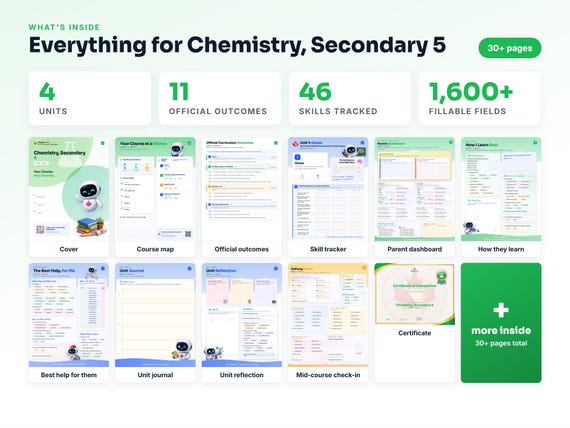
A Chemistry, Secondary 5 workbook worth keeping
Built from the same official curriculum as this page. Before and after each skill above, your student colours in how sure they feel — so the two of you can see, on one page, what's clicking and what needs another look. It's a quiet way to follow how the year is really going.
By June it's full of their own handwriting: units worked through, confidence grown, a mid-year check-in, notes from parent-teacher night, and a certificate at the end. Less a worksheet, more a record of the year worth keeping on the shelf.
Instant download · see every page, reviews and the full description · five or more workbooks are $2.99 each
What it looks like in the app



Common questions
Can MapleMind help me with Chemistry, Secondary 5?
Yes. MapleMind's AI tutor covers all 46 skills in Quebec's Chemistry, Secondary 5 — you pick the exact skill, and the tutor teaches it step by step: a short lesson, a worked example, solving together, then a skill check to show it stuck.
Is MapleMind aligned to Quebec's official curriculum?
Yes. Every skill in this course maps to an official outcome code from Quebec's Grade 11 Science curriculum, and the ministry's own wording is quoted under each unit on this page — with the official government source linked so you can check it yourself.
What does MapleMind cost?
It's free to start — 5 tutoring chats and a practice quiz every day, no credit card. A Pro subscription ($9.99/month or $49.99/year CAD, 7-day free trial) unlocks unlimited tutoring, practice, and exam simulations.
What if I'm stuck on just one topic?
That's the point of skill-level tutoring: open Chemistry, Secondary 5 in the app, tap the exact skill from the list on this page, and the tutor teaches just that — no wading through lessons you don't need.
Does MapleMind work in French or other languages?
Yes — 14 languages, including French. Both the app and the tutor's explanations switch to the language you choose.
Where can I see the official Quebec curriculum for Chemistry, Secondary 5?
The official source is linked on this page — Québec's official education program. The outline here follows it: every MapleMind skill carries its official outcome code, and the ministry's own wording is quoted under each unit.
Keep exploring
Ready when you are
Pick a skill from this page and see it taught properly — free, in the browser, in under a minute.