Get help with Science and Technology, Secondary 3
Most tutoring makes you sit through material you already know. MapleMind flips that: pick the exact skill that's causing trouble — any of the 34 below — and the tutor teaches just that one, step by step, as many times as it takes. Ask questions in plain words, any time of day, in English, French, or 12 other languages.
The official Quebec Science and Technology, Secondary 3 curriculum
Quebec defines Science and Technology, Secondary 3 by strands and outcomes. MapleMind teaches the same curriculum reorganized for one-skill-at-a-time tutoring — the table shows exactly where every official strand lands, and the ministry's own wording is quoted under each unit below.
Official source Québec's official education programRead it on the government site — quebec.ca ↗| Official strand | Outcomes | Where MapleMind teaches it |
|---|---|---|
| Strand MW | 13 | The Material World |
| Strand LW | 12 | The Living World |
| Strand ES | 3 | The Earth and Space |
| Strand TW | 6 | The Technological World |
Every skill below, taught one on one.
 Try the first session free
How MapleMind teaches Science and Technology, Secondary 3 — every unit, lesson, and skill
Every skill below runs as a short session: a plain-words lesson, a worked example, solving it together, then a five-question skill check that earns up to three stars. Guided Mode keeps it teaching instead of answer-handing — turning it off needs a parent's password.
Unit 1The Material WorldOfficial strand · Strand MW
Properties of solutions, the particle model, chemical reactions, forms of energy, pure substances, fluids and pressure, and waves and optics.
Solutions, solubility and concentration
- Solubility and its limitsMW.A.21 — Defines solubility, its temperature dependence, and identifying substances by physical constants.
- Concentration of a solutionMW.A.26 — Defines concentration, the effect of changing solute/solvent, and calculating concentration in g/L or percent; solute/solvent identification.
- DensityMW.A.18 — Defines and determines density and uses it to identify substances.
The particle model
- The particle model and its limitsMW.B.6 — Defines the particle model as a scientific model with qualities and limitations.
- Dissolution and dilutionMW.B.10 — Explains dissolution and dilution using the particle model and calculates a dilution.
- Phase changes with the particle modelMW.B.14 — Explains phase changes using the particle model.
Chemical reactions
- Decomposition, synthesis and oxidationMW.B.18 — Names body chemical changes and represents/associates decomposition, synthesis, and oxidation reactions.
- Precipitation reactionsMW.B.24 — Describes and represents precipitation reactions.
Forms of energy
- Forms of energy and transformationsMW.B.49 — Describes forms of energy, identifies transformations, and defines the joule.
Pure substances and mixtures in the body
- Pure substances, elements and compoundsMW.C.7 — Defines a pure substance and distinguishes elements from compounds; body mixtures.
Fluids and pressure
- Pressure in fluidsMW.D.1 — Defines pressure, its factors, compressible vs incompressible fluids, body fluids, and the qualitative pressure-volume relationship.
Waves and optics
- Waves, sound and the spectrumMW.E.1 — Defines frequency, wavelength, amplitude, and links to sound, energy, the decibel scale, and the electromagnetic spectrum.
- Reflection, refraction and lensesMW.E.9 — Describes reflection, refraction, and lens behaviour including the focal point.
The official wording — 13 outcomes in this unit
- MW.A.21
Defines the concept of solubility
- MW.A.26
Defines the concept of the concentration of a solution
- MW.A.18
Explains the concept of density
- MW.B.6
Defines the particle model as a means of representing the behaviour of matter
- MW.B.10
Explains dissolution using the particle model
- MW.B.14
Explains phase changes using the particle model
- MW.B.18
Names chemical changes that occur in the human body
- MW.B.24
Describes the visible manifestation of precipitation
- MW.B.49
Describes different forms of energy
- MW.C.7
Defines a pure substance as a substance made up of a single type of atom or molecule
- MW.D.1
Defines pressure as the force exerted by particles when they collide with a constricting surface
- MW.E.1
Defines the frequency of a wave as the number of cycles per second (Hz)
- MW.E.9
Describes how light rays are deviated by a plane reflective surface
Unit 2The Living WorldOfficial strand · Strand LW
Organization of life and the human body: digestion, respiration, circulation, excretion, the nervous system and senses, the musculoskeletal system, and cell division.
Organization of the living body
- Cells, tissues, organs and systemsLW.C.1 — Defines tissue, organ, and biological system and the body's main functions.
The digestive system
- The digestive tract and glandsLW.D.1 — Names the digestive tract and glands and describes their functions.
- Food constituents and their transformationLW.D.6 — Describes food constituents, their sources and value, and the two types of food transformation.
Respiration and the blood
- The respiratory systemLW.D.11 — Names the respiratory system parts and describes their function.
- Blood: plasma and formed elementsLW.D.14 — Describes plasma, the formed elements, their functions, and blood-type compatibility.
Circulation, immunity and excretion
- The circulatory and lymphatic systemsLW.D.18 — Names and describes the circulatory system and the lymphatic system and immunity.
- The urinary and excretory systemLW.D.24 — Names the urinary system, its role, kidney and bladder function, urine components, and balance.
The nervous system and the senses
- Central and peripheral nervous systemsLW.D.29 — Identifies the central nervous system, its role, the neuron, and the peripheral system and nerve impulses.
- The sense organsLW.D.36 — Names and describes the parts and functions of the eye, ear, tongue, nose, and skin receptors.
The musculoskeletal system
- The skeleton, muscles and jointsLW.D.45 — Names the skeleton parts and functions, the musculoskeletal system, antagonistic muscles, joints, and muscle types.
Cell division and DNA
- DNA, mitosis and meiosisLW.E.17 — Describes DNA shape and role, mitosis and meiosis functions, and the link to genetic diversity.
- Puberty and reproductive physiologyLW.E.24 — Describes puberty changes and the hormonal physiology of reproduction and the menstrual cycle (factual, health-focused).
The official wording — 12 outcomes in this unit
- LW.C.1
Defines a tissue as a set of identical or different cells that work together
- LW.D.1
Names the main parts of the digestive tract
- LW.D.6
Describes the main biological functions of the different food constituents
- LW.D.11
Names the main parts of the respiratory system
- LW.D.14
Describes the main function of plasma
- LW.D.18
Names the main parts of the circulatory system
- LW.D.24
Names the main parts of the urinary system
- LW.D.29
Identifies the parts of the central nervous system
- LW.D.36
Names the parts of the eye involved in vision
- LW.D.45
Names the main parts of the skeleton
- LW.E.17
Describes the shape of DNA
- LW.E.24
Describes physical and psychological changes that occur at puberty
Unit 3The Earth and SpaceOfficial strand · Strand ES
Geological time and fossils, and distances and conditions for life in space.
Geological time and fossils
- Rock strata and geological timeES.A.6 — Explains strata formation, orders the geological time scale, and locates life and extinctions on it.
- Fossils and datingES.A.11 — Defines fossils and explains their use in dating stratigraphic layers.
Distances and life in space
- Astronomical distances and conditions for lifeES.C.16 — Defines the astronomical unit and light year, compares celestial distances, and describes conditions for life.
The official wording — 3 outcomes in this unit
- ES.A.6
Explains the formation of strata in terms of the layering of sediment
- ES.A.11
Defines fossils as traces of organisms preserved for the most part in sedimentary rock
- ES.C.16
Defines an astronomical unit as the unit of length corresponding to the average distance between the Earth and the Sun
Unit 4The Technological WorldOfficial strand · Strand TW
Technical drawing and projection, links and mechanical systems, materials, and biotechnology processes.
Technical drawing and projection
- Choosing diagrams and reading linesTW.A.11 — Chooses diagram types, represents motion, and reads the basic lines of a technical drawing.
- Projection and scaleTW.A.16 — Associates projection types, interprets and represents multiview and isometric projections, and applies scale and cross-sections.
Links and mechanical systems
- Links and typical functionsTW.B.15 — Describes links, their types, and the typical functions of parts.
- Motion transmission and transformationTW.B.27 — Names and describes motion transmission and transformation systems and their speed/reversibility behaviour.
Materials and biotechnology
- Material constraints and propertiesTW.D.5 — Describes constraints on objects and the mechanical properties of materials and their use.
- Biotechnology processesTW.F.1 — Describes pasteurization, vaccine manufacture, assisted reproduction, cell culture, and genetic transformation.
The official wording — 6 outcomes in this unit
- TW.A.11
Chooses the appropriate type of diagram for a given representation
- TW.A.16
Associates the types of projection with their use
- TW.B.15
Describes the advantages and disadvantages of different types of links
- TW.B.27
Names motion transmission systems in technical objects
- TW.D.5
Describes the constraints to which different technical objects are subject: tension, compression, torsion
- TW.F.1
Describes the pasteurization process


Printable workbook · A keepsake of the year
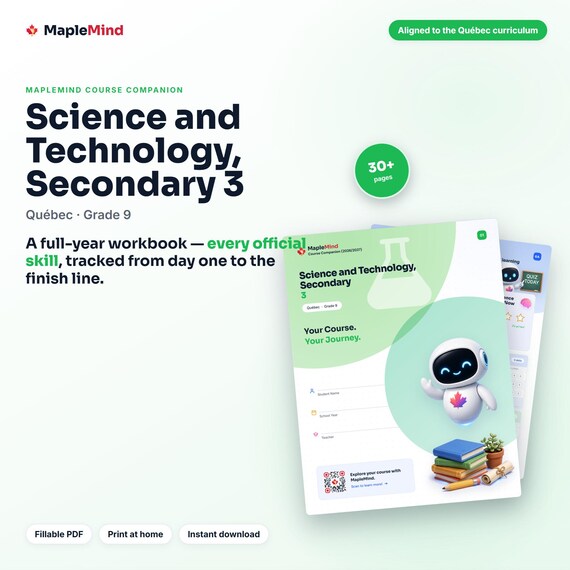
A Science and Technology, Secondary 3 workbook worth keeping
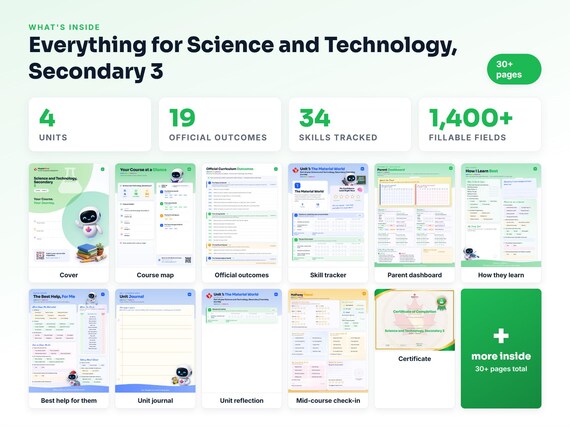
Built from the same official curriculum as this page. Before and after each skill above, your student colours in how sure they feel — so the two of you can see, on one page, what's clicking and what needs another look. It's a quiet way to follow how the year is really going.
By June it's full of their own handwriting: units worked through, confidence grown, a mid-year check-in, notes from parent-teacher night, and a certificate at the end. Less a worksheet, more a record of the year worth keeping on the shelf.
Instant download · see every page, reviews and the full description · five or more workbooks are $2.99 each
What it looks like in the app



Common questions
Can MapleMind help me with Science and Technology, Secondary 3?
Yes. MapleMind's AI tutor covers all 34 skills in Quebec's Science and Technology, Secondary 3 — you pick the exact skill, and the tutor teaches it step by step: a short lesson, a worked example, solving together, then a skill check to show it stuck.
Is MapleMind aligned to Quebec's official curriculum?
Yes. Every skill in this course maps to an official outcome code from Quebec's Grade 9 Science curriculum, and the ministry's own wording is quoted under each unit on this page — with the official government source linked so you can check it yourself.
What does MapleMind cost?
It's free to start — 5 tutoring chats and a practice quiz every day, no credit card. A Pro subscription ($9.99/month or $49.99/year CAD, 7-day free trial) unlocks unlimited tutoring, practice, and exam simulations.
What if I'm stuck on just one topic?
That's the point of skill-level tutoring: open Science and Technology, Secondary 3 in the app, tap the exact skill from the list on this page, and the tutor teaches just that — no wading through lessons you don't need.
Does MapleMind work in French or other languages?
Yes — 14 languages, including French. Both the app and the tutor's explanations switch to the language you choose.
Where can I see the official Quebec curriculum for Science and Technology, Secondary 3?
The official source is linked on this page — Québec's official education program. The outline here follows it: every MapleMind skill carries its official outcome code, and the ministry's own wording is quoted under each unit.
Keep exploring
Ready when you are
Pick a skill from this page and see it taught properly — free, in the browser, in under a minute.