Ministerial exam · Quebec
Applied Science and Technology, Secondary IV, theory component
Ministerial Examination — Applied Science and Technology, Secondary IV, theory component (057‑410; 557‑410 in English)
- Grade 10
- 557-306 / 557-406
Dates and details can change. We do our best to keep this page up to date, but check the official sources before relying on it.
- Total time
- 3 h
- Marked questions
- 25
- Parts
- 3
- Counts for
- 50% of the final mark
- Calculator
- Approved models
- Format
- On paper
Secondary 4 ATS Ministry Exam practice test
The whole exam or the parts you choose, in its own format, on the clock.
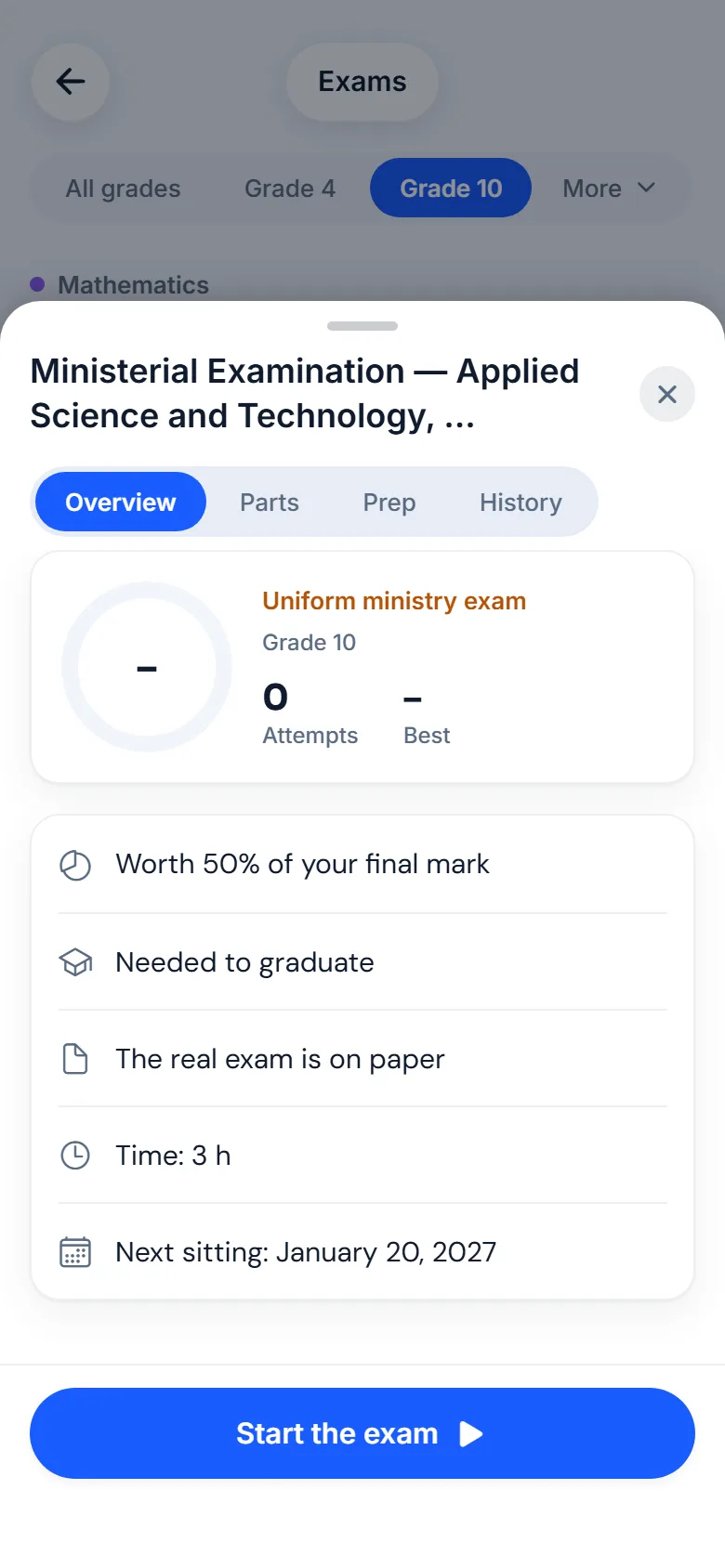 The exam in the app
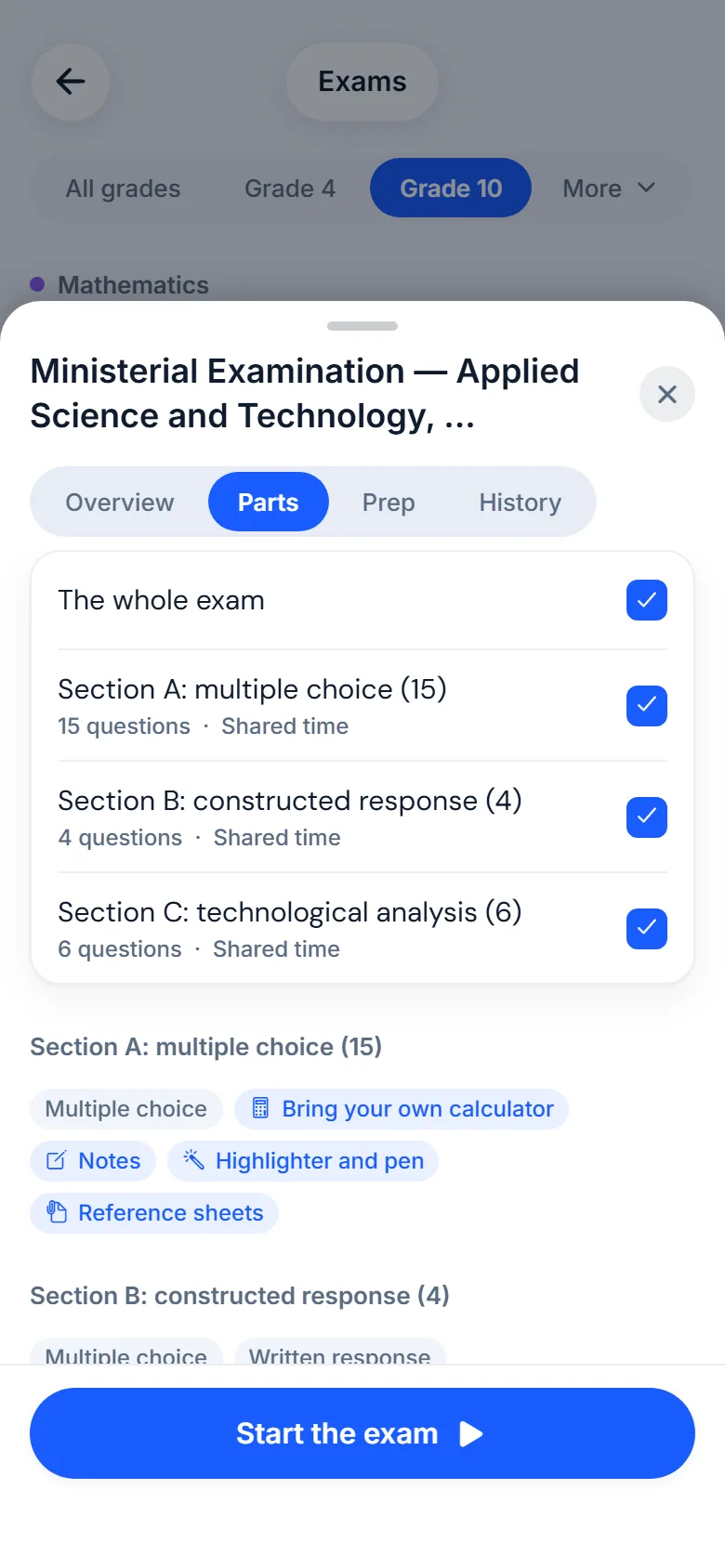 Its parts, and what you can use in each
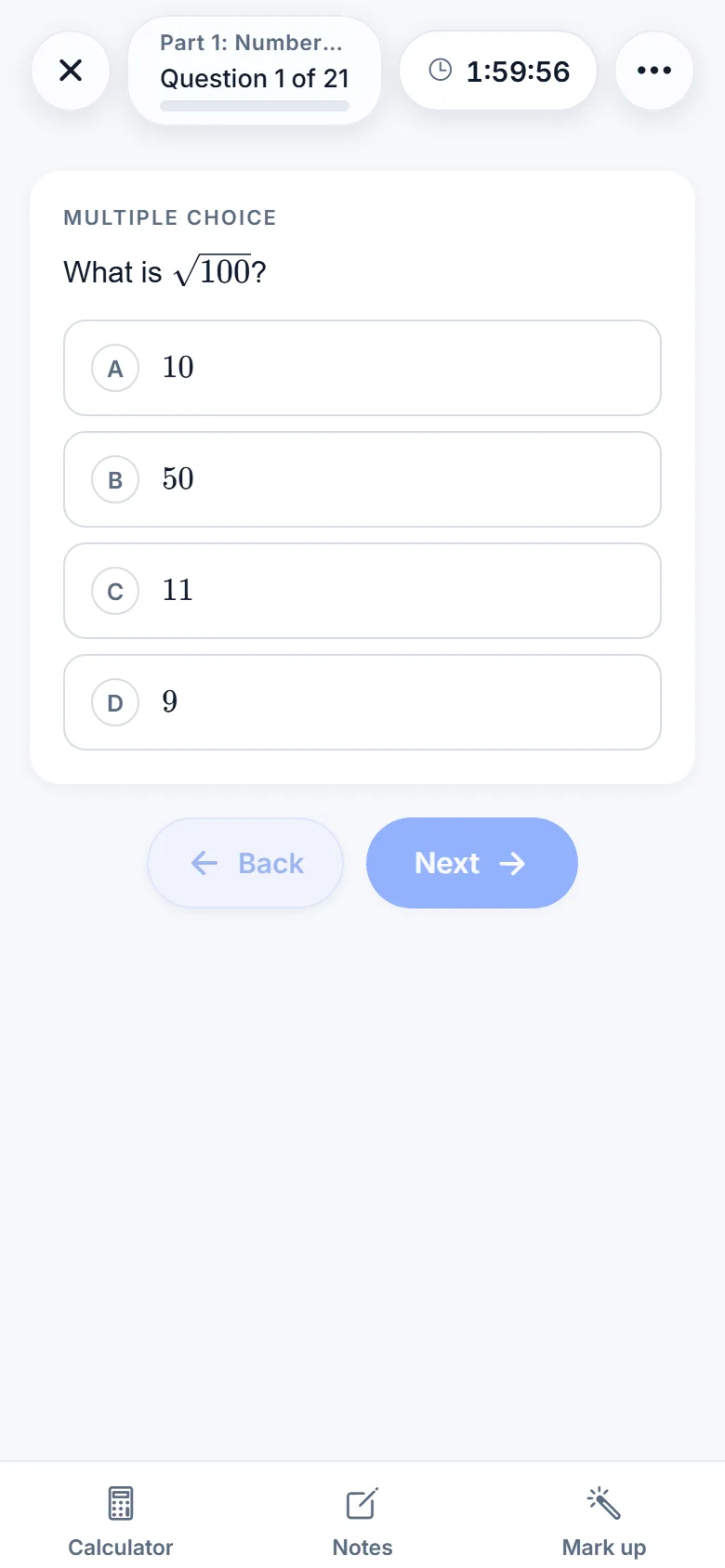 A question, timed, with the exam’s tools
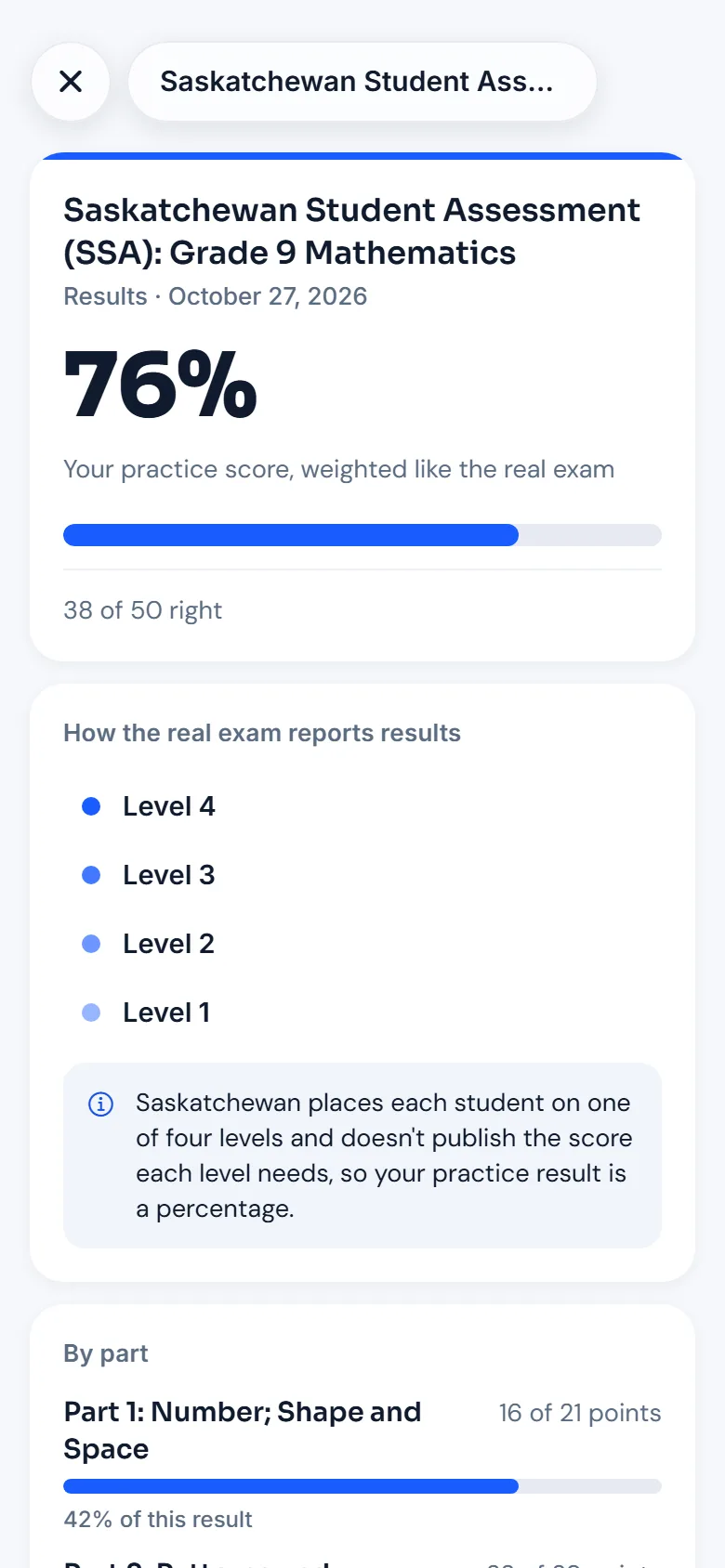 The marked result, part by part
A practice run of Saskatchewan’s Grade 9 math assessment.
Free with a MapleMind account
When
3 sessions this school year: January, June and August.
January 2027 session
- Wednesday, January 20, 20279:00 a.m.-12:00 p.m.
June 2027 session
- Wednesday, June 16, 20279:00 a.m.-12:00 p.m.
August 2027 session
- Wednesday, August 4, 20279:00 a.m.-12:00 p.m.
The dates are Quebec’s own, read on September 28, 2026. See the official schedule (quebec.ca)
What’s on it
3 topics. Univers technologique counts most, at 48%.
- Terre et espace8%
- Univers matériel44%
- Univers technologique48%
The skills it tests · 26 skills
- Air masses, clouds and cyclones
- Basic lines and projections
- Buoyancy, Archimedes, Pascal and Bernoulli
- Catchment areas and human impact
- Chemical changes, oxidation and combustion
- Conservation of energy and efficiency
- Constraints, properties and material choice
- Control, switches and protection
- Diagram types and motion symbols
- Electric charges and static electricity
- Electrical power and energy consumed
- Energy technologies and their impact
- Energy transformation and electronic components
- Fluid pressure and the gas relationship
- Forces, equilibrium, speed and weight
- Forms of energy and transformations
- Guiding, limiting motion and typical functions
- Link types and characteristics
- Magnetism, solenoids and induction
- Motion transformation systems and speed change
- Motion transmission systems
- Ohm's law and circuit elements
- Power supply and conduction
- Scales, developments and freehand sketching
- Shaping techniques and measurement control
- Tides and solar energy input
How it’s built
Multiple-choice questions, written answers and questions in sets.
- Section A: multiple choice (15)
- Questions
- 15
- Marks
- 60
- Of the marks
- 60%
- Multiple choice
Fifteen multiple-choice questions, 4 points each, on Earth and space, the material world and the technological world.
- Section B: constructed response (4)
- Questions
- 4
- Marks
- 16
- Of the marks
- 16%
- Multiple choice
- Written answers
Four questions where you write your answer, 4 points each, showing your work in the booklet.
- Section C: technological analysis (6)
- Questions
- 6
- Marks
- 24
- Of the marks
- 24%
- Written answers
- Questions in sets
Six written questions, 4 points each, analysing one technical object from its drawings and the video.
How it’s marked
In June, the ministry marks Section A by machine and your school marks Sections B and C. It's out of 100 and counts for 50% of your final result; you need 60% to pass the course.
On the day
- Calculator
- Bring a calculator, graphing or not. One with symbolic algebra (CAS) is allowed only with those functions turned off. Clear its memory before the exam, and don't lend or borrow one.
- Provided
- Document de référence: formulas and quantities, drawings of the technical object
One paper sitting. A video of a technical object plays on a loop the whole time, and you can't talk or ask questions while it plays. Bring only a ruler and your calculator. A reference document with formulas and drawings of the object is provided. A phone or other device gets you 0%. Up to 15 more minutes if needed.
Getting ready
3 official documents to practise with, and 4 tips.
Official practice
Tips from the people who write it
- Section A's 15 multiple-choice questions are 60% of the mark.
- Section C analyses one technical object from drawings and a looping video: practise reading technical drawings.
- The living world isn't on this exam; Earth and space, the material world and the technological world are.
- The ministry's companion document says what each concept covers on the exam.
The mark you need
Your class mark counts for 50% of the final mark, the exam for 50%. Quebec may moderate your class mark before it’s blended.
You need
65% on the exam
With 75% in class, your final mark lands between 37.5% (0 on the exam) and 87.5% (100% on it).
After the exam
- Results
After marking, the Ministry mails you your achievement record, and the results are on your Online Academic Record. Your school mark may be moderated: moved up or down by comparing your group’s school marks with its exam results. If your exam mark is higher than your moderated school mark, only the exam mark counts.
- Re-marking
You can ask for a review within six months of receiving your achievement record, through the person in charge of exams at your school, for a fee. A lower result never replaces your original mark.
- Writing it again
If you fail, or want a better mark, your school may let you retake it at the January, June or August session; you show you’ve worked on it first. Your final mark uses your best result.
- If you miss it
Without a valid reason, ABS goes on your record and you can write at another session. Valid reasons: a serious illness or accident with a medical note, the death of a close relative, a court summons, or an important event approved in advance. Then you write at a later date, or, if that’s impossible, your moderated school mark can stand in (only if it’s a pass and you attended at least 120 class days; never for the August session).
From Final results in Secondary IV and V (Quebec) (quebec.ca) and Administrative Guide for the Certification of Studies and Management of Ministerial Examinations (the edition Quebec links today) (cdn-contenu.quebec.ca), read on October 27, 2026.
More for you
Students
Start with the topics worth the most marks, then write full practice exams under the real time limit.
Practise itParents
Put the dates on the family calendar. The Parent Dashboard shows each practice exam’s result and the skills that need another look.
See the Parent DashboardEducators
The topic weights and the official practice above make a review plan. Students can practise each skill on its own in MapleMind, free with daily limits.
For schools
Questions about this exam
When is the Applied Science and Technology, Secondary IV, theory component in 2026–27?
The next sitting is January 20, 2027, 9:00 a.m.-12:00 p.m.. This school year it’s written in January 2027 session, June 2027 session and August 2027 session.
How long is the Applied Science and Technology, Secondary IV, theory component?
It takes 3 hours in all, over 3 parts.
How many questions are on the Applied Science and Technology, Secondary IV, theory component?
It has 25 marked questions: 15 in Section A: multiple choice (15), 4 in Section B: constructed response (4) and 6 in Section C: technological analysis (6).
Can you use a calculator on the Applied Science and Technology, Secondary IV, theory component?
Yes, a calculator from the approved list.
How much does the Applied Science and Technology, Secondary IV, theory component count?
It’s worth 50% of the final mark in Applied Science and Technology, Secondary Cycle Two.
Where can I find practice tests for the Applied Science and Technology, Secondary IV, theory component?
MapleMind builds a full practice exam in its format. Start it from this page, free with an account.

Practise for the Applied Science and Technology, Secondary IV, theory component
Every skill on the Applied Science and Technology, Secondary IV, theory component, taught one at a time, then practised on questions written like the real ones.


