Ministerial exam · Quebec
Mathematics, Secondary IV, Science option
Ministerial Examination — Mathematics, Secondary IV, Science option (065‑420; 565‑420 in English)
- Grade 10
- 565-406
Dates and details can change. We do our best to keep this page up to date, but check the official sources before relying on it.
- Total time
- 3 h
- Marked questions
- 16
- Parts
- 3
- Counts for
- 50% of the final mark
- Calculator
- Approved models
- Format
- On paper
Secondary 4 Math SN Ministry Exam practice test
The whole exam or the parts you choose, in its own format, on the clock.
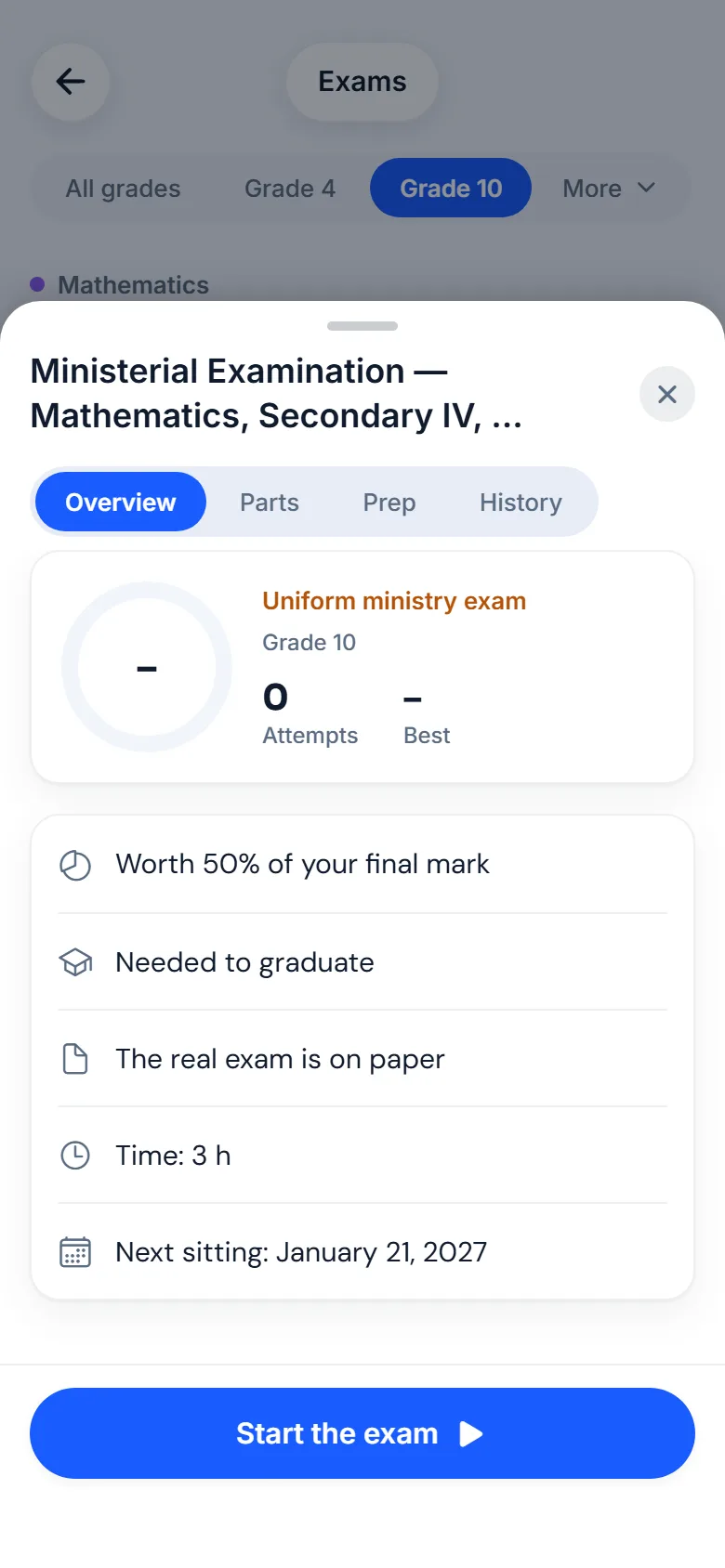 The exam in the app
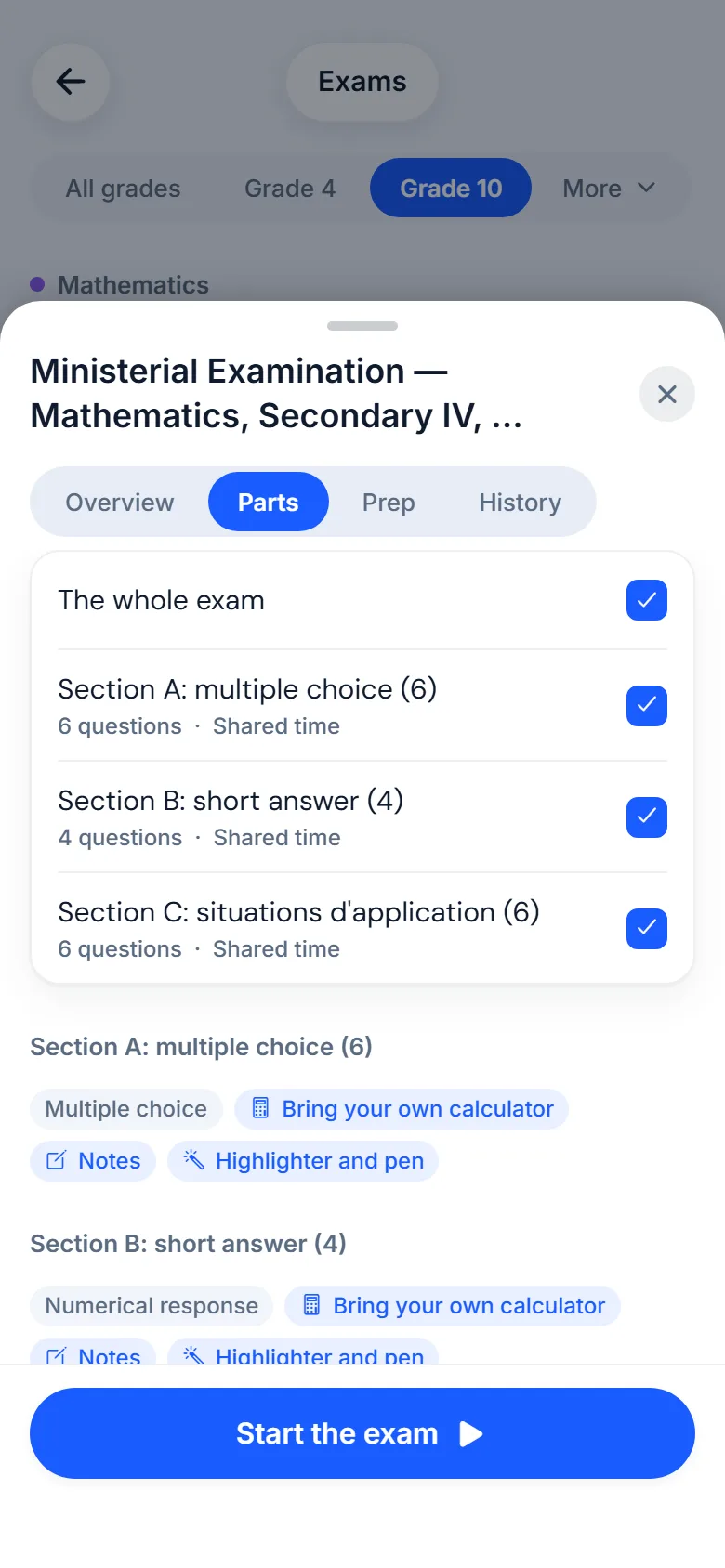 Its parts, and what you can use in each
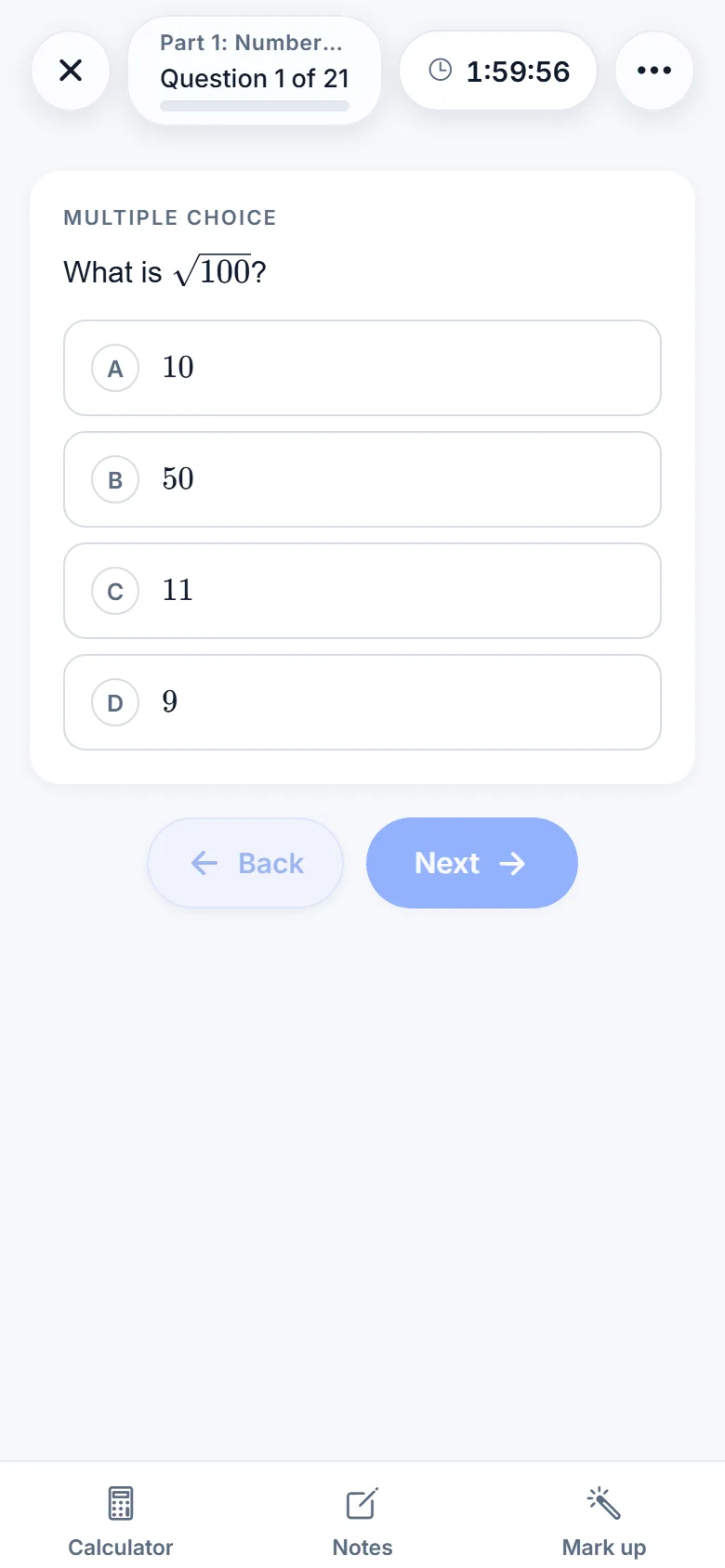 A question, timed, with the exam’s tools
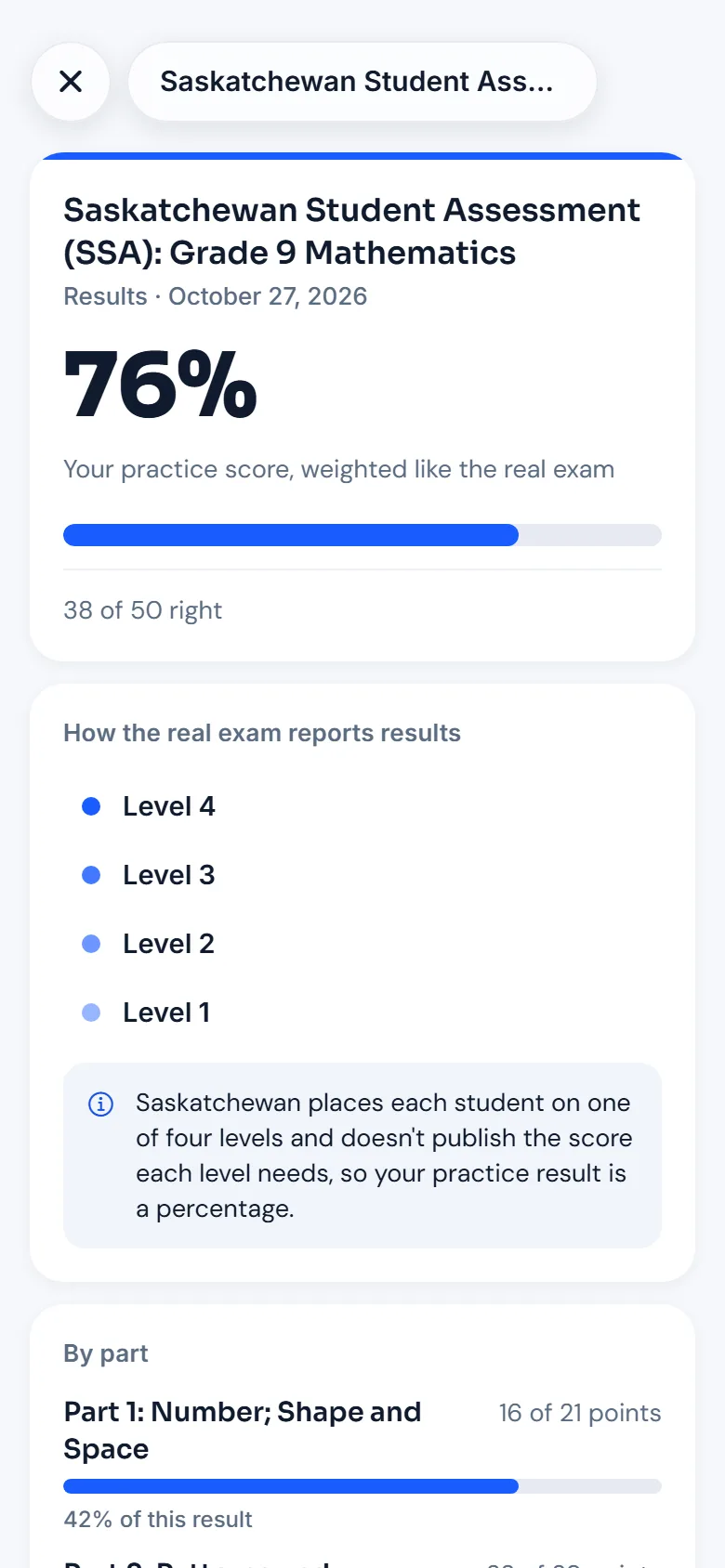 The marked result, part by part
A practice run of Saskatchewan’s Grade 9 math assessment.
Free with a MapleMind account
When
3 sessions this school year: January, June and August.
January 2027 session
- Thursday, January 21, 20279:00 a.m.-12:00 p.m.
June 2027 session
- Friday, June 11, 20279:00 a.m.-12:00 p.m.
August 2027 session
- Tuesday, August 3, 20279:00 a.m.-12:00 p.m.
The dates are Quebec’s own, read on September 28, 2026. See the official schedule (quebec.ca)
What’s on it
3 topics. Algèbre counts most, at 48–54%.
- Algèbre48–54%
- Probabilités et statistique4–10%
- Géométrie38–44%
The skills it tests · 57 skills
- Analyzes a second-degree inequality in two variables
- Analyzes a situation to be optimized using a system of first-degree inequalities
- Analyzes greatest-integer functions of the form f(x) = a[b(x – h)] + k
- Analyzes second-degree polynomial functions of the form f(x) = ax² + bx + c, f(x) = a(b(x – h))² + k or f(x) = a(x – x₁)(x – x₂)
- Analyzes step functions
- Approximates and interprets the linear correlation coefficient
- Calculates and interprets a slope
- Calculates the area of a triangle given the measure of an angle and the lengths of two sides or given the measures of two angles and the length of one side
- Calculates the distance between two points
- Compares two-variable distributions
- Constructs an algebraic expression using a register (type) of representation
- Defines the concept absolute value in context (e.g. difference between two numbers, distance between two points)
- Demonstrates the congruence or similarity between triangles or finds unknown measurements using minimum conditions
- Describes and interprets the relationship between two variables, if any
- Describes the role of additive parameters in the functions under study
- Describes the role of multiplicative parameters in the functions under study
- Determines measures of segments or perimeters in equivalent figures
- Determines the area of equivalent figures
- Determines the equation of a line parallel or perpendicular to another
- Determines the equation of a line using the slope and a point or using two points
- Determines the minimum conditions required to conclude that triangles are congruent or similar
- Determines the relative position of two straight lines using their respective slope (intersecting at one point, perpendicular, non-intersecting parallel or coincident)
- Determines the volume of equivalent solids
- Determines values or data by solving equations and inequalities
- Determines, through exploration or deduction, different metric relations associated with plane figures
- Divides a polynomial by another polynomial (with or without a remainder)
- Factors by completing the square (switching from one type of notation to another)
- Factors by substituting second-degree algebraic identities (perfect square trinomial and difference of two squares)
- Factors polynomials by grouping (including decomposable second-degree trinomials)
- Factors trinomials of the form ax² + bx + c using formulas
- Finds unknown measurements using metric or trigonometric relations
- Finds unknown measurements using the cosine law
- Finds unknown measurements using the trigonometric ratios sine, cosine and tangent
- Gives a qualitative assessment of a linear correlation
- Identifies the coefficient, degree, terms, constant term and like terms of an algebraic expression
- Interpolates and extrapolates data, if applicable
- Interpolates or extrapolates values using a regression line
- Interprets parameters (multiplicative or additive) and describes the effect of changing their values
- Interprets solutions or makes decisions, if necessary, depending on the context
- Interprets the solution or makes decisions if necessary, depending on the context
- Models a situation verbally, algebraically, graphically, using a table of values or a scatter plot
- Models two-variable data using a first-degree polynomial function
- Multiplies algebraic expressions
- Recognizes equivalent figures (plane figures or solids)
- Recognizes or constructs equivalent algebraic expressions
- Represents a half-plane graphically and algebraically
- Represents a regression line algebraically or graphically
- Represents and interprets the inverse of a function
- Represents data using a scatter plot or a double-entry (two-variable) distribution table
- Represents parallel lines and perpendicular lines
- Represents straight lines graphically and algebraically
- Solves a second-degree equation in two variables
- Solves exponential, logarithmic and square root equations and inequalities using the properties of exponents, logarithms and radicals
- Solves systems of first-degree equations in two variables
- Solves systems of second-degree equations in relation to conics, changing variables if applicable
- Validates a solution, with or without technological tools, by substitution
- Validates the solution, with or without technological tools
How it’s built
Multiple-choice questions, numerical-response questions and written answers.
- Section A: multiple choice (6)
- Questions
- 6
- Marks
- 24
- Of the marks
- 24%
- Multiple choice
Six multiple-choice questions, 4 points each, on using math concepts and processes.
- Section B: short answer (4)
- Questions
- 4
- Marks
- 16
- Of the marks
- 16%
- Numerical response
Four short-answer questions, 4 points each, with your answers written in the booklet.
- Section C: situations d'application (6)
- Questions
- 6
- Marks
- 60
- Of the marks
- 60%
- Written answers
Six situations where you show your math reasoning clearly: apply concepts, justify, prove, compare, deduce or generalize.
How it’s marked
In June, the ministry marks Section A by machine and your school marks Sections B and C. It's out of 100 and counts for 50% of your final result; you need 60% to pass the course.
On the day
- Calculator
- Bring a calculator, graphing or not. One with symbolic algebra (CAS) is allowed only with those functions turned off. Clear its memory before the exam, and don't lend or borrow one.
One paper sitting. A week before, you make a memory aid: one handwritten letter-size sheet, both sides. A student found with a phone or other device gets 0%, and no one may help you, even by clarifying a question. Up to 15 more minutes if you need them.
Getting ready
3 official documents to practise with, and 3 tips.
Official practice
Tips from the people who write it
- Section C is 60% of the mark and rewards clear reasoning: write your justification, not just the answer.
- Make your memory aid a week before: one handwritten letter-size sheet, both sides.
- Check your calculator: graphing is fine, but symbolic algebra (CAS) must be off and the memory cleared.
The mark you need
Your class mark counts for 50% of the final mark, the exam for 50%. Quebec may moderate your class mark before it’s blended.
You need
65% on the exam
With 75% in class, your final mark lands between 37.5% (0 on the exam) and 87.5% (100% on it).
After the exam
- Results
After marking, the Ministry mails you your achievement record, and the results are on your Online Academic Record. Your school mark may be moderated: moved up or down by comparing your group’s school marks with its exam results. If your exam mark is higher than your moderated school mark, only the exam mark counts.
- Re-marking
You can ask for a review within six months of receiving your achievement record, through the person in charge of exams at your school, for a fee. A lower result never replaces your original mark.
- Writing it again
If you fail, or want a better mark, your school may let you retake it at the January, June or August session; you show you’ve worked on it first. Your final mark uses your best result.
- If you miss it
Without a valid reason, ABS goes on your record and you can write at another session. Valid reasons: a serious illness or accident with a medical note, the death of a close relative, a court summons, or an important event approved in advance. Then you write at a later date, or, if that’s impossible, your moderated school mark can stand in (only if it’s a pass and you attended at least 120 class days; never for the August session).
From Final results in Secondary IV and V (Quebec) (quebec.ca) and Administrative Guide for the Certification of Studies and Management of Ministerial Examinations (the edition Quebec links today) (cdn-contenu.quebec.ca), read on October 27, 2026.
More for you
Students
Start with the topics worth the most marks, then write full practice exams under the real time limit.
Practise itParents
Put the dates on the family calendar. The Parent Dashboard shows each practice exam’s result and the skills that need another look.
See the Parent DashboardEducators
The topic weights and the official practice above make a review plan. Students can practise each skill on its own in MapleMind, free with daily limits.
For schools
Questions about this exam
When is the Mathematics, Secondary IV, Science option in 2026–27?
The next sitting is January 21, 2027, 9:00 a.m.-12:00 p.m.. This school year it’s written in January 2027 session, June 2027 session and August 2027 session.
How long is the Mathematics, Secondary IV, Science option?
It takes 3 hours in all, over 3 parts.
How many questions are on the Mathematics, Secondary IV, Science option?
It has 16 marked questions: 6 in Section A: multiple choice (6), 4 in Section B: short answer (4) and 6 in Section C: situations d'application (6).
Can you use a calculator on the Mathematics, Secondary IV, Science option?
Yes, a calculator from the approved list.
How much does the Mathematics, Secondary IV, Science option count?
It’s worth 50% of the final mark in Mathematics, Secondary 4 (Science).
Where can I find practice tests for the Mathematics, Secondary IV, Science option?
MapleMind builds a full practice exam in its format. Start it from this page, free with an account.

Practise for the Mathematics, Secondary IV, Science option
Every skill on the Mathematics, Secondary IV, Science option, taught one at a time, then practised on questions written like the real ones.