Get help with Mathematics, Secondary 4 (Science)
Most tutoring makes you sit through material you already know. MapleMind flips that: pick the exact skill that's causing trouble — any of the 57 below — and the tutor teaches just that one, step by step, as many times as it takes. Ask questions in plain words, any time of day, in English, French, or 12 other languages.
The official Quebec Mathematics, Secondary 4 (Science) curriculum
Quebec defines Mathematics, Secondary 4 (Science) by strands and outcomes. MapleMind teaches the same curriculum reorganized for one-skill-at-a-time tutoring — the table shows exactly where every official strand lands, and the ministry's own wording is quoted under each unit below.
Official source Québec's official education programRead it on the government site — quebec.ca ↗| Official strand | Outcomes | Where MapleMind teaches it |
|---|---|---|
| Strand A | 1 | Arithmetic |
| Strand B | 29 | Algebra |
| Strand D | 8 | Statistics |
| Strand E | 11 | Geometry |
| Strand F | 8 | Analytic Geometry |
Every skill below, taught one on one.
 Try the first session free
How MapleMind teaches Mathematics, Secondary 4 (Science) — every unit, lesson, and skill
Every skill below runs as a short session: a plain-words lesson, a worked example, solving it together, then a five-question skill check that earns up to three stars. Guided Mode keeps it teaching instead of answer-handing — turning it off needs a parent's password.
Unit 1ArithmeticOfficial strand · Strand A
The PDA Arithmetic branch, taught in the Science (Natural Science) sequence register (formal mathematics as the object of study (Quebec Science program: "develop formal proofs... to confirm a truth", properties of mathematical objects, abstract thinking)).
Defines the concept of absolute value in context
- Defines the concept absolute value in context (e.g. difference between two numbers, distance between two points)ARITH.N10 — The student carries out: Defines the concept absolute value in context (e.g. difference between two numbers, distance between two points) — in Science (Natural Science) contexts (state the general result and prove/justify it formally, not just compute a case).
The official wording — 1 outcome in this unit
- ARITH.N10
Defines the concept absolute value in context (e.g. difference between two numbers, distance between two points)
Unit 2AlgebraOfficial strand · Strand B
The PDA Algebra branch, taught in the Science (Natural Science) sequence register (formal mathematics as the object of study (Quebec Science program: "develop formal proofs... to confirm a truth", properties of mathematical objects, abstract thinking)).
Identifies the components and parameters of algebraic expressions
- Identifies the coefficient, degree, terms, constant term and like terms of an algebraic expressionALG.N4.d — The student carries out: coefficient, degree, term, constant term, like terms — in Science (Natural Science) contexts (state the general result and prove/justify it formally, not just compute a case).
- Interprets parameters (multiplicative or additive) and describes the effect of changing their valuesALG.N4.2 — The student carries out: Interprets parameters (multiplicative or additive) and describes the effect of changing — in Science (Natural Science) contexts (state the general result and prove/justify it formally, not just compute a case).
Analyzes second-degree polynomial functions
- Manipulates algebraic expressions of the functions under studyALG.b — The student carries out: algebraic expressions — in Science (Natural Science) contexts (state the general result and prove/justify it formally, not just compute a case).
- Analyzes second-degree polynomial functions of the form f(x) = ax² + bx + c, f(x) = a(b(x – h))² + k or f(x) = a(x – x₁)(x – x₂)ALG.b.iii — The student carries out: f(x) = ax2+ bx + c, f(x) = a(b(x – h))2 + k, f(x) = a(x – x1)(x – x2) — in Science (Natural Science) contexts (state the general result and prove/justify it formally, not just compute a case).
Divides polynomials and constructs algebraic expressions
- Divides a polynomial by another polynomial (with or without a remainder)ALG.N5.c — The student carries out: a polynomial by another polynomial (with or without a remainder) — in Science (Natural Science) contexts (state the general result and prove/justify it formally, not just compute a case).
- Validates the solution, with or without technological toolsALG.N5.2 — The student carries out: Validates the solution, with or without technological tools — in Science (Natural Science) contexts (state the general result and prove/justify it formally, not just compute a case).
- Constructs an algebraic expression using a register (type) of representationALG.N5.4 — The student carries out: Constructs an algebraic expression using a register (type) of representation — in Science (Natural Science) contexts (state the general result and prove/justify it formally, not just compute a case).
Factors and manipulates second-degree algebraic expressions
- Factors polynomials by grouping (including decomposable second-degree trinomials)ALG.N6.b — The student carries out: factoring by grouping (polynomials including decomposable second-degree trinomials) — in Science (Natural Science) contexts (state the general result and prove/justify it formally, not just compute a case).
- Factors by completing the square (switching from one type of notation to another)ALG.N6.c — The student carries out: completing the square (factoring and switching from one type of notation to another) — in Science (Natural Science) contexts (state the general result and prove/justify it formally, not just compute a case).
- Factors trinomials of the form ax² + bx + c using formulasALG.N6.d — The student carries out: using formulas for trinomials of the form ax2 + bx + c : — in Science (Natural Science) contexts (state the general result and prove/justify it formally, not just compute a case).
- Factors by substituting second-degree algebraic identities (perfect square trinomial and difference of two squares)ALG.N6.e — The student carries out: substituting second-degree algebraic identities (perfect square trinomial and difference of two squares) — in Science (Natural Science) contexts (state the general result and prove/justify it formally, not just compute a case).
- Interprets the solution or makes decisions if necessary, depending on the contextALG.N6.3 — The student carries out: Interprets the solution or makes decisions if necessary, depending on the context — in Science (Natural Science) contexts (state the general result and prove/justify it formally, not just compute a case).
- Manipulates expressions involving multiplicative parametersALG.N6.a.2 — The student carries out: multiplicative parameters — in Science (Natural Science) contexts (state the general result and prove/justify it formally, not just compute a case).
- Manipulates expressions involving additive parametersALG.N6.b.2 — The student carries out: additive parameters — in Science (Natural Science) contexts (state the general result and prove/justify it formally, not just compute a case).
- Determines values or data by solving equations and inequalitiesALG.N6.4 — The student carries out: Determines values or data by solving equations and inequalities — in Science (Natural Science) contexts (state the general result and prove/justify it formally, not just compute a case).
Recognizes or constructs equivalent algebraic expressions
- Recognizes or constructs equivalent algebraic expressionsALG.N7.2 — The student carries out: Recognizes or constructs equivalent algebraic expressions — in Science (Natural Science) contexts (state the general result and prove/justify it formally, not just compute a case).
- Interpolates and extrapolates data, if applicableALG.N7.5 — The student carries out: Interpolates and extrapolates data, if applicable — in Science (Natural Science) contexts (state the general result and prove/justify it formally, not just compute a case).
Solves exponential, logarithmic and square root equations and inequalities
- Solves exponential, logarithmic and square root equations and inequalities using the properties of exponents, logarithms and radicalsALG.N11.b — The student carries out: exponential, logarithmic or square root, using the properties of exponents, logarithms and radicals — in Science (Natural Science) contexts (state the general result and prove/justify it formally, not just compute a case).
Solves a second-degree equation in two variables
- Solves a second-degree equation in two variablesALG.N12 — The student carries out: Solves a second-degree equation in two variables — in Science (Natural Science) contexts (state the general result and prove/justify it formally, not just compute a case).
Validates a solution by substitution, with or without technological tools
- Validates a solution, with or without technological tools, by substitutionALG.N13 — The student carries out: Validates a solution, with or without technological tools, by substitution — in Science (Natural Science) contexts (state the general result and prove/justify it formally, not just compute a case).
Analyzes a second-degree inequality in two variables
- Analyzes a second-degree inequality in two variablesALG.N14.b — The student carries out: second-degree inequality in two variables — in Science (Natural Science) contexts (state the general result and prove/justify it formally, not just compute a case).
Interprets solutions or makes decisions, depending on the context
- Interprets solutions or makes decisions, if necessary, depending on the contextALG.N15 — The student carries out: Interprets solutions or makes decisions, if necessary, depending on the context — in Science (Natural Science) contexts (state the general result and prove/justify it formally, not just compute a case).
Solves systems of equations in two variables
- Solves systems of first-degree equations in two variablesALG.N3.b — The student carries out: of first-degree equations in two variables — in Science (Natural Science) contexts (state the general result and prove/justify it formally, not just compute a case).
- Solves systems of second-degree equations in relation to conics, changing variables if applicableALG.N3.d — The student carries out: of second-degree equations in relation to conics using changing variables, if applicable — in Science (Natural Science) contexts (state the general result and prove/justify it formally, not just compute a case).
- Represents and interprets the inverse of a functionALG.N3.5 — The student carries out: Represents and interprets the inverse — in Science (Natural Science) contexts (state the general result and prove/justify it formally, not just compute a case).
Analyzes a situation to be optimized using a system of inequalities
- Analyzes a situation to be optimized mathematizing the situation using a system of first-degree inequalities in two variables drawing a bounded or unbounded polygon of constraints to represent the situation determining the coordinates of the vertices of the bounded polygon (feasible region)ALG.N1.3 — The student carries out: Analyzes a situation to be optimized mathematizing the situation using a system of first-degree inequalities in two variables drawing a bounded or unbounded polygon of constraints to represent the situation determining the coordinates of the vertices of the bounded polygon (feasible region) — in Science (Natural Science) contexts (state the general result and prove/justify it formally, not just compute a case).
- Models a situation verbally, algebraically, graphically, using a table of values or a scatter plotALG.N1.5 — The student carries out: Models a situation verbally, algebraically, graphically, using a table of values or a scatter — in Science (Natural Science) contexts (state the general result and prove/justify it formally, not just compute a case).
Analyzes step functions
- Analyzes step functionsALG.i — The student carries out: Step functions — in Science (Natural Science) contexts (state the general result and prove/justify it formally, not just compute a case).
Analyzes greatest-integer functions of the form f(x) = a[b(x – h)] + k
- Analyzes greatest-integer functions of the form f(x) = a[b(x – h)] + kALG.j.ii — The student carries out: f(x) = a[b(x – h)] + k — in Science (Natural Science) contexts (state the general result and prove/justify it formally, not just compute a case).
The official wording — 29 outcomes in this unit
- ALG.N4.d
coefficient, degree, term, constant term, like terms
- ALG.N4.2
Interprets parameters (multiplicative or additive) and describes the effect of changing
- ALG.b
algebraic expressions
- ALG.b.iii
f(x) = ax2+ bx + c, f(x) = a(b(x – h))2 + k, f(x) = a(x – x1)(x – x2)
- ALG.N5.c
a polynomial by another polynomial (with or without a remainder)
- ALG.N5.2
Validates the solution, with or without technological tools
- ALG.N5.4
Constructs an algebraic expression using a register (type) of representation
- ALG.N6.b
factoring by grouping (polynomials including decomposable second-degree trinomials)
- ALG.N6.c
completing the square (factoring and switching from one type of notation to another)
- ALG.N6.d
using formulas for trinomials of the form ax2 + bx + c :
- ALG.N6.e
substituting second-degree algebraic identities (perfect square trinomial and difference of two squares)
- ALG.N6.3
Interprets the solution or makes decisions if necessary, depending on the context
- ALG.N6.a.2
multiplicative parameters
- ALG.N6.b.2
additive parameters
- ALG.N6.4
Determines values or data by solving equations and inequalities
- ALG.N7.2
Recognizes or constructs equivalent algebraic expressions
- ALG.N7.5
Interpolates and extrapolates data, if applicable
- ALG.N11.b
exponential, logarithmic or square root, using the properties of exponents, logarithms and radicals
- ALG.N12
Solves a second-degree equation in two variables
- ALG.N13
Validates a solution, with or without technological tools, by substitution
- ALG.N14.b
second-degree inequality in two variables
- ALG.N15
Interprets solutions or makes decisions, if necessary, depending on the context
- ALG.N3.b
of first-degree equations in two variables
- ALG.N3.d
of second-degree equations in relation to conics using changing variables, if applicable
- ALG.N3.5
Represents and interprets the inverse
- ALG.N1.3
Analyzes a situation to be optimized mathematizing the situation using a system of first-degree inequalities in two variables drawing a bounded or unbounded polygon of constraints to represent the situation determining the coordinates of the vertices of the bounded polygon (feasible region)
- ALG.N1.5
Models a situation verbally, algebraically, graphically, using a table of values or a scatter
- ALG.i
Step functions
- ALG.j.ii
f(x) = a[b(x – h)] + k
Unit 3StatisticsOfficial strand · Strand D
The PDA Statistics branch, taught in the Science (Natural Science) sequence register (formal mathematics as the object of study (Quebec Science program: "develop formal proofs... to confirm a truth", properties of mathematical objects, abstract thinking)).
Represents data using a scatter plot or a two-variable distribution table
- Represents data using a scatter plot or a double-entry (two-variable) distribution tableSTAT.N2.2 — The student carries out: Represents data using a scatter plot or a double-entry (two-variable) distribution table — in Science (Natural Science) contexts (state the general result and prove/justify it formally, not just compute a case).
Models two-variable data using a first-degree polynomial function
- Models two-variable data using a first-degree polynomial functionSTAT.N3.a — The student carries out: first-degree polynomial function — in Science (Natural Science) contexts (state the general result and prove/justify it formally, not just compute a case).
Describes and interprets the relationship between two variables
- Describes and interprets the relationship between two variables, if anySTAT.N4.2 — The student carries out: Describes and interprets the relationship between two variables, if any — in Science (Natural Science) contexts (state the general result and prove/justify it formally, not just compute a case).
Gives a qualitative assessment of a linear correlation
- Gives a qualitative assessment of a linear correlationSTAT.N5.2 — The student carries out: Gives a qualitative assessment of a linear correlation — in Science (Natural Science) contexts (state the general result and prove/justify it formally, not just compute a case).
Approximates and interprets the linear correlation coefficient
- Approximates and interprets the linear correlation coefficientSTAT.N6 — The student carries out: Approximates and interprets the linear correlation coefficient — in Science (Natural Science) contexts (state the general result and prove/justify it formally, not just compute a case).
Represents a regression line algebraically or graphically
- Represents a regression line algebraically or graphicallySTAT.N8.2 — The student carries out: Represents a regression line algebraically or graphically — in Science (Natural Science) contexts (state the general result and prove/justify it formally, not just compute a case).
Interpolates or extrapolates values using a regression line
- Interpolates or extrapolates values using a regression lineSTAT.N9.a — The student carries out: a regression line — in Science (Natural Science) contexts (state the general result and prove/justify it formally, not just compute a case).
Compares two-variable distributions
- Compares two-variable distributionsSTAT.N10.2 — The student carries out: Compares two-variable distributions — in Science (Natural Science) contexts (state the general result and prove/justify it formally, not just compute a case).
The official wording — 8 outcomes in this unit
- STAT.N2.2
Represents data using a scatter plot or a double-entry (two-variable) distribution table
- STAT.N3.a
first-degree polynomial function
- STAT.N4.2
Describes and interprets the relationship between two variables, if any
- STAT.N5.2
Gives a qualitative assessment of a linear correlation
- STAT.N6
Approximates and interprets the linear correlation coefficient
- STAT.N8.2
Represents a regression line algebraically or graphically
- STAT.N9.a
a regression line
- STAT.N10.2
Compares two-variable distributions
Unit 4GeometryOfficial strand · Strand E
The PDA Geometry branch, taught in the Science (Natural Science) sequence register (formal mathematics as the object of study (Quebec Science program: "develop formal proofs... to confirm a truth", properties of mathematical objects, abstract thinking)).
Determines the minimum conditions for congruent or similar triangles
- Determines the minimum conditions required to conclude that triangles are congruent or similarGEOM.N5.4 — The student carries out: Determines the minimum conditions required to conclude that triangles are congruent or similar — in Science (Natural Science) contexts (state the general result and prove/justify it formally, not just compute a case).
- Determines measures of segments or perimeters in equivalent figuresGEOM.N5.d — The student carries out: segments or perimeters resulting from equivalent figures — in Science (Natural Science) contexts (state the general result and prove/justify it formally, not just compute a case).
- Finds unknown measurements using metric or trigonometric relationsGEOM.N5.b.3 — The student carries out: metric or trigonometric relations — in Science (Natural Science) contexts (state the general result and prove/justify it formally, not just compute a case).
Demonstrates congruence or similarity between triangles
- Demonstrates the congruence or similarity between triangles or finds unknown measurements using minimum conditionsGEOM.N6.3 — The student carries out: Demonstrates the congruence or similarity between triangles or finds unknown measurements using minimum conditions — in Science (Natural Science) contexts (state the general result and prove/justify it formally, not just compute a case).
- Determines the area of equivalent figuresGEOM.N6.h — The student carries out: area of equivalent figures — in Science (Natural Science) contexts (state the general result and prove/justify it formally, not just compute a case).
- Determines the volume of equivalent solidsGEOM.N6.d.2 — The student carries out: volume of equivalent solids — in Science (Natural Science) contexts (state the general result and prove/justify it formally, not just compute a case).
Recognizes equivalent figures (plane figures or solids)
- Recognizes equivalent figures (plane figures or solids)GEOM.N7.3 — The student carries out: Recognizes equivalent figures (plane figures or solids) — in Science (Natural Science) contexts (state the general result and prove/justify it formally, not just compute a case).
Determines metric relations associated with plane figures
- Determines, through exploration or deduction, different metric relations associated with plane figuresGEOM.N1.11 — The student carries out: Determines, through exploration or deduction, different metric relations associated with plane figures — in Science (Natural Science) contexts (state the general result and prove/justify it formally, not just compute a case).
Finds measurements using trigonometric ratios and the cosine law
- Finds unknown measurements using the trigonometric ratios sine, cosine and tangentGEOM.N2.a.iii — The student carries out: trigonometric ratios: sine, cosine, tangent — in Science (Natural Science) contexts (state the general result and prove/justify it formally, not just compute a case).
- Finds unknown measurements using the cosine lawGEOM.N2.b.ii — The student carries out: cosine law — in Science (Natural Science) contexts (state the general result and prove/justify it formally, not just compute a case).
Calculates the area of a triangle from angle and side measurements
- Calculates the area of a triangle given the measure of an angle and the lengths of two sides or given the measures of two angles and the length of one sideGEOM.N3.10 — The student carries out: Calculates the area of a triangle given the measure of an angle and the lengths of two sides or given the measures of two angles and the length of one side — in Science (Natural Science) contexts (state the general result and prove/justify it formally, not just compute a case).
The official wording — 11 outcomes in this unit
- GEOM.N5.4
Determines the minimum conditions required to conclude that triangles are congruent or similar
- GEOM.N5.d
segments or perimeters resulting from equivalent figures
- GEOM.N5.b.3
metric or trigonometric relations
- GEOM.N6.3
Demonstrates the congruence or similarity between triangles or finds unknown measurements using minimum conditions
- GEOM.N6.h
area of equivalent figures
- GEOM.N6.d.2
volume of equivalent solids
- GEOM.N7.3
Recognizes equivalent figures (plane figures or solids)
- GEOM.N1.11
Determines, through exploration or deduction, different metric relations associated with plane figures
- GEOM.N2.a.iii
trigonometric ratios: sine, cosine, tangent
- GEOM.N2.b.ii
cosine law
- GEOM.N3.10
Calculates the area of a triangle given the measure of an angle and the lengths of two sides or given the measures of two angles and the length of one side
Unit 5Analytic GeometryOfficial strand · Strand F
The PDA Analytic Geometry branch, taught in the Science (Natural Science) sequence register (formal mathematics as the object of study (Quebec Science program: "develop formal proofs... to confirm a truth", properties of mathematical objects, abstract thinking)).
Calculates distances and slopes in the Cartesian plane
- Calculates the distance between two pointsANGEO.N1.a — The student carries out: calculate the distance between two points — in Science (Natural Science) contexts (state the general result and prove/justify it formally, not just compute a case).
- Calculates and interprets a slopeANGEO.N1.c — The student carries out: calculate and interpret a slope — in Science (Natural Science) contexts (state the general result and prove/justify it formally, not just compute a case).
Determines the relative position of two straight lines using their slopes
- Determines the relative position of two straight lines using their respective slope (intersecting at one point, perpendicular, non-intersecting parallel or coincident)ANGEO.N2.2 — The student carries out: Determines the relative position of two straight lines using their respective slope (intersecting at one point, perpendicular, non-intersecting parallel or coincident) — in Science (Natural Science) contexts (state the general result and prove/justify it formally, not just compute a case).
Represents lines and half-planes graphically and algebraically
- Represents straight lines graphically and algebraicallyANGEO.N3.a — The student carries out: straight lines: graphically and algebraically — in Science (Natural Science) contexts (state the general result and prove/justify it formally, not just compute a case).
- Represents a half-plane graphically and algebraicallyANGEO.N3.b — The student carries out: a half-plane: graphically and algebraically — in Science (Natural Science) contexts (state the general result and prove/justify it formally, not just compute a case).
- Represents parallel lines and perpendicular linesANGEO.N3.c — The student carries out: parallel lines and perpendicular lines — in Science (Natural Science) contexts (state the general result and prove/justify it formally, not just compute a case).
Determines the equation of a line using the slope and a point or two points
- Determines the equation of a line using the slope and a point or using two pointsANGEO.N4 — The student carries out: Determines the equation of a line using the slope and a point or using two points — in Science (Natural Science) contexts (state the general result and prove/justify it formally, not just compute a case).
Determines the equation of a line parallel or perpendicular to another
- Determines the equation of a line parallel or perpendicular to anotherANGEO.N5 — The student carries out: Determines the equation of a line parallel or perpendicular to another — in Science (Natural Science) contexts (state the general result and prove/justify it formally, not just compute a case).
The official wording — 8 outcomes in this unit
- ANGEO.N1.a
calculate the distance between two points
- ANGEO.N1.c
calculate and interpret a slope
- ANGEO.N2.2
Determines the relative position of two straight lines using their respective slope (intersecting at one point, perpendicular, non-intersecting parallel or coincident)
- ANGEO.N3.a
straight lines: graphically and algebraically
- ANGEO.N3.b
a half-plane: graphically and algebraically
- ANGEO.N3.c
parallel lines and perpendicular lines
- ANGEO.N4
Determines the equation of a line using the slope and a point or using two points
- ANGEO.N5
Determines the equation of a line parallel or perpendicular to another
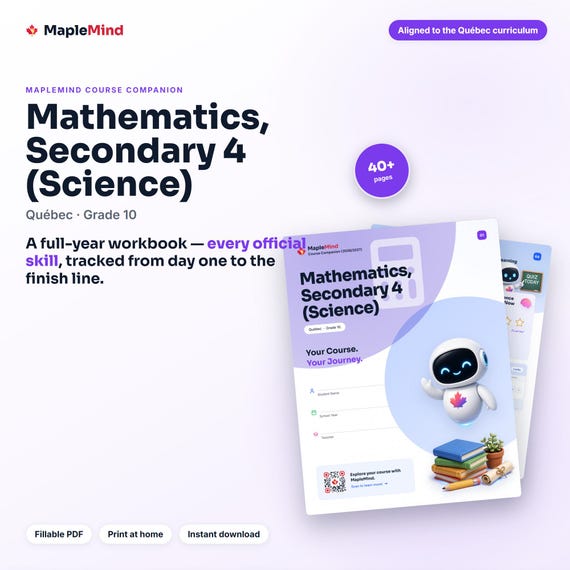


Printable workbook · A keepsake of the year
A Mathematics, Secondary 4 (Science) workbook worth keeping
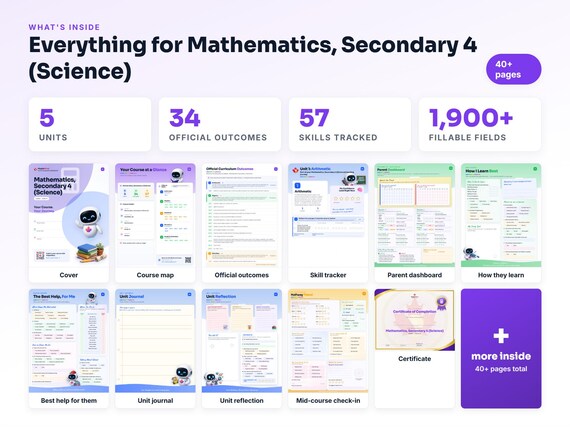
Built from the same official curriculum as this page. Before and after each skill above, your student colours in how sure they feel — so the two of you can see, on one page, what's clicking and what needs another look. It's a quiet way to follow how the year is really going.
By June it's full of their own handwriting: units worked through, confidence grown, a mid-year check-in, notes from parent-teacher night, and a certificate at the end. Less a worksheet, more a record of the year worth keeping on the shelf.
Instant download · see every page, reviews and the full description · five or more workbooks are $2.99 each
What it looks like in the app



Common questions
Can MapleMind help me with Mathematics, Secondary 4 (Science)?
Yes. MapleMind's AI tutor covers all 57 skills in Quebec's Mathematics, Secondary 4 (Science) — you pick the exact skill, and the tutor teaches it step by step: a short lesson, a worked example, solving together, then a skill check to show it stuck.
Is MapleMind aligned to Quebec's official curriculum?
Yes. Every skill in this course maps to an official outcome code from Quebec's Grade 10 Mathematics curriculum, and the ministry's own wording is quoted under each unit on this page — with the official government source linked so you can check it yourself.
What does MapleMind cost?
It's free to start — 5 tutoring chats and a practice quiz every day, no credit card. A Pro subscription ($9.99/month or $49.99/year CAD, 7-day free trial) unlocks unlimited tutoring, practice, and exam simulations.
What if I'm stuck on just one topic?
That's the point of skill-level tutoring: open Mathematics, Secondary 4 (Science) in the app, tap the exact skill from the list on this page, and the tutor teaches just that — no wading through lessons you don't need.
Does MapleMind work in French or other languages?
Yes — 14 languages, including French. Both the app and the tutor's explanations switch to the language you choose.
Where can I see the official Quebec curriculum for Mathematics, Secondary 4 (Science)?
The official source is linked on this page — Québec's official education program. The outline here follows it: every MapleMind skill carries its official outcome code, and the ministry's own wording is quoted under each unit.
Keep exploring
Ready when you are
Pick a skill from this page and see it taught properly — free, in the browser, in under a minute.