Ministerial exam · Quebec
History of Québec and Canada, Secondary IV
Ministerial Examination — History of Québec and Canada, Secondary IV (085‑404; 585‑404 in English)
- Grade 10
- 585-404
Dates and details can change. We do our best to keep this page up to date, but check the official sources before relying on it.
- Total time
- 3 h
- Marked questions
- 23
- Parts
- 3
- Counts for
- 50% of the final mark
- Calculator
- Not allowed
- Format
- On paper
Secondary 4 History Ministry Exam practice test
The whole exam or the parts you choose, in its own format, on the clock.
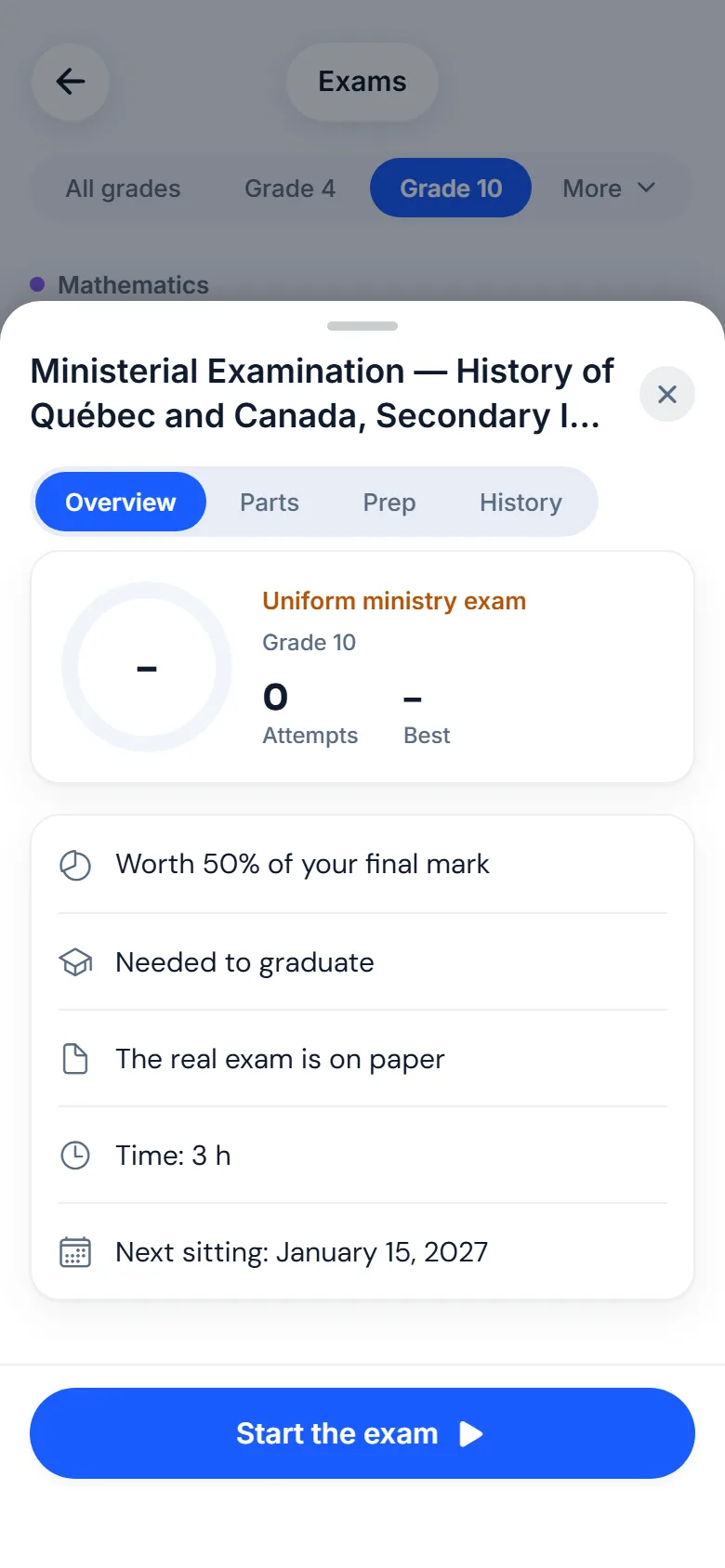 The exam in the app
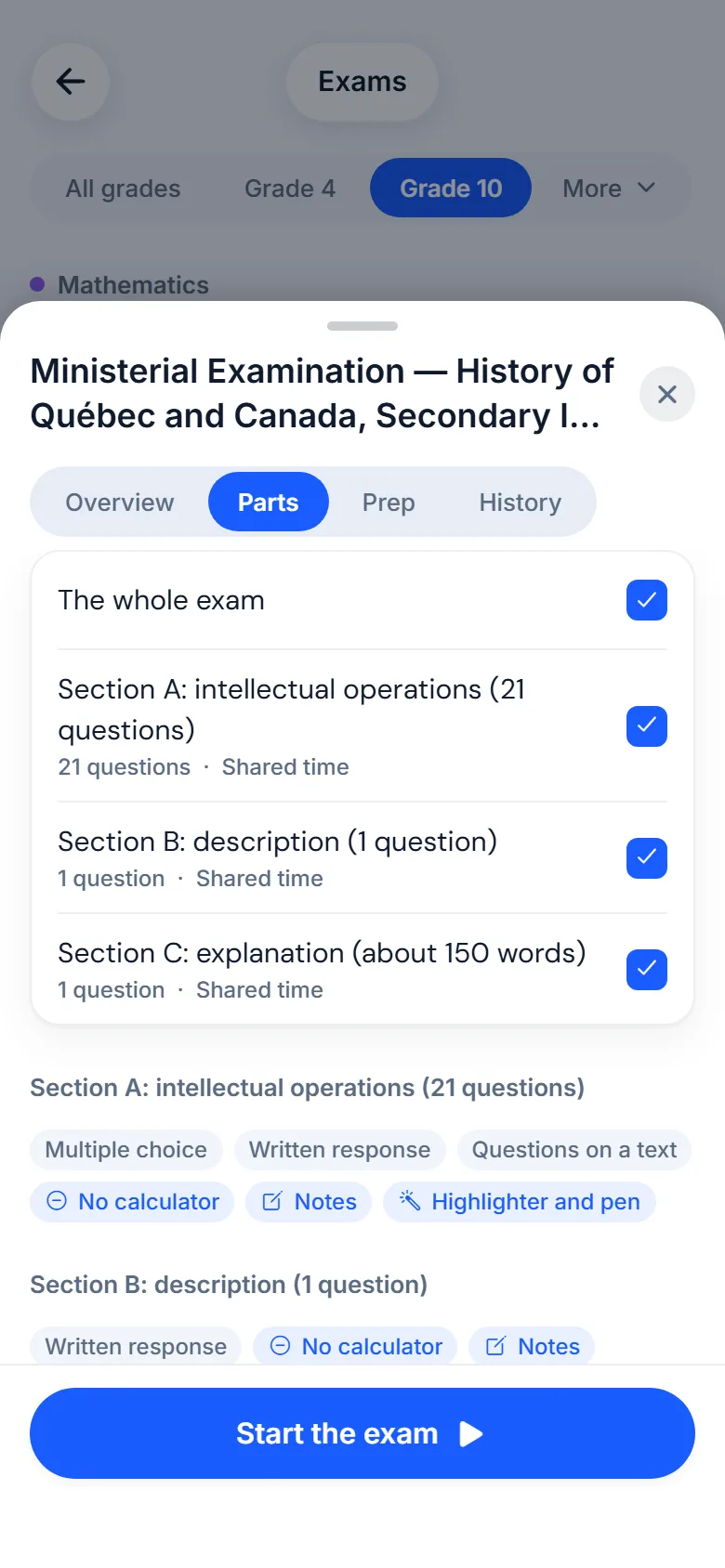 Its parts, and what you can use in each
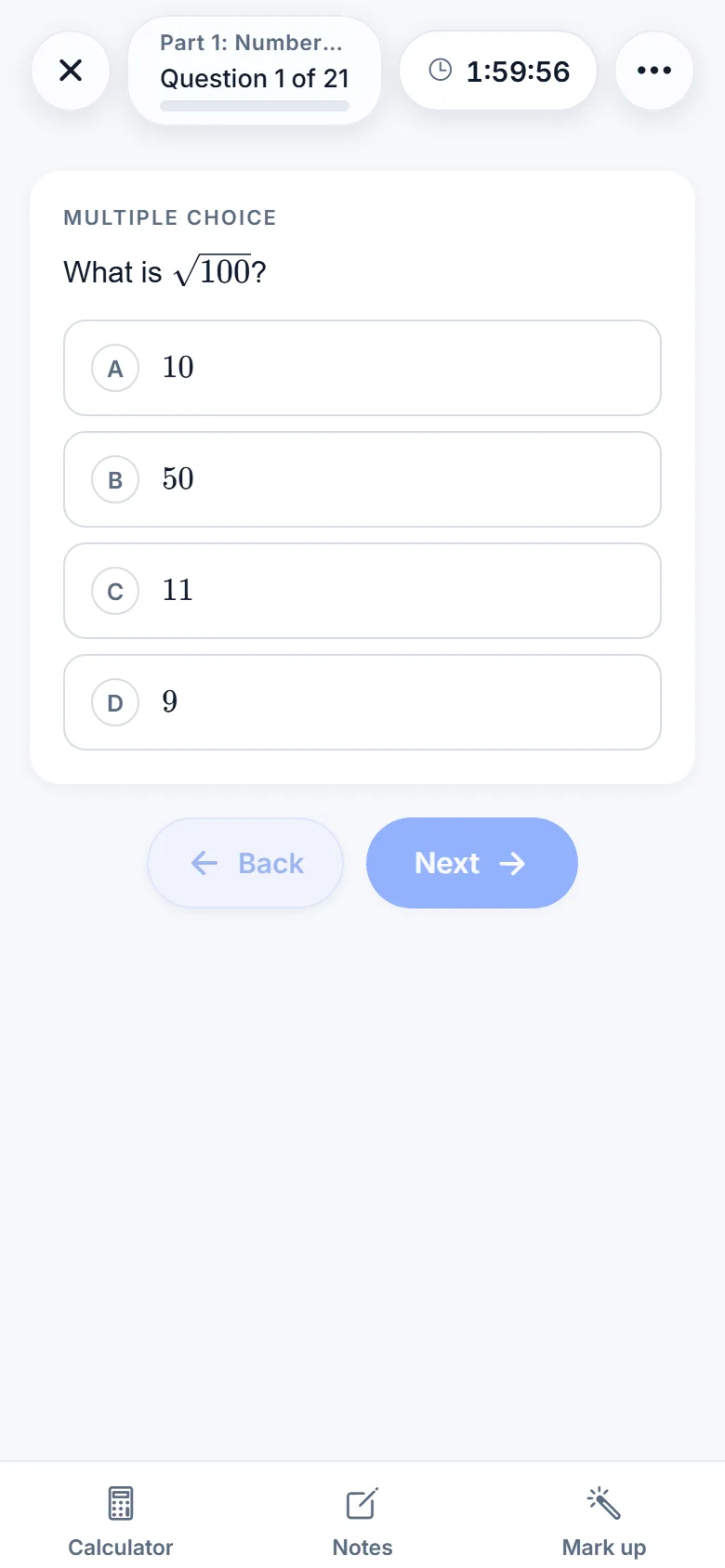 A question, timed, with the exam’s tools
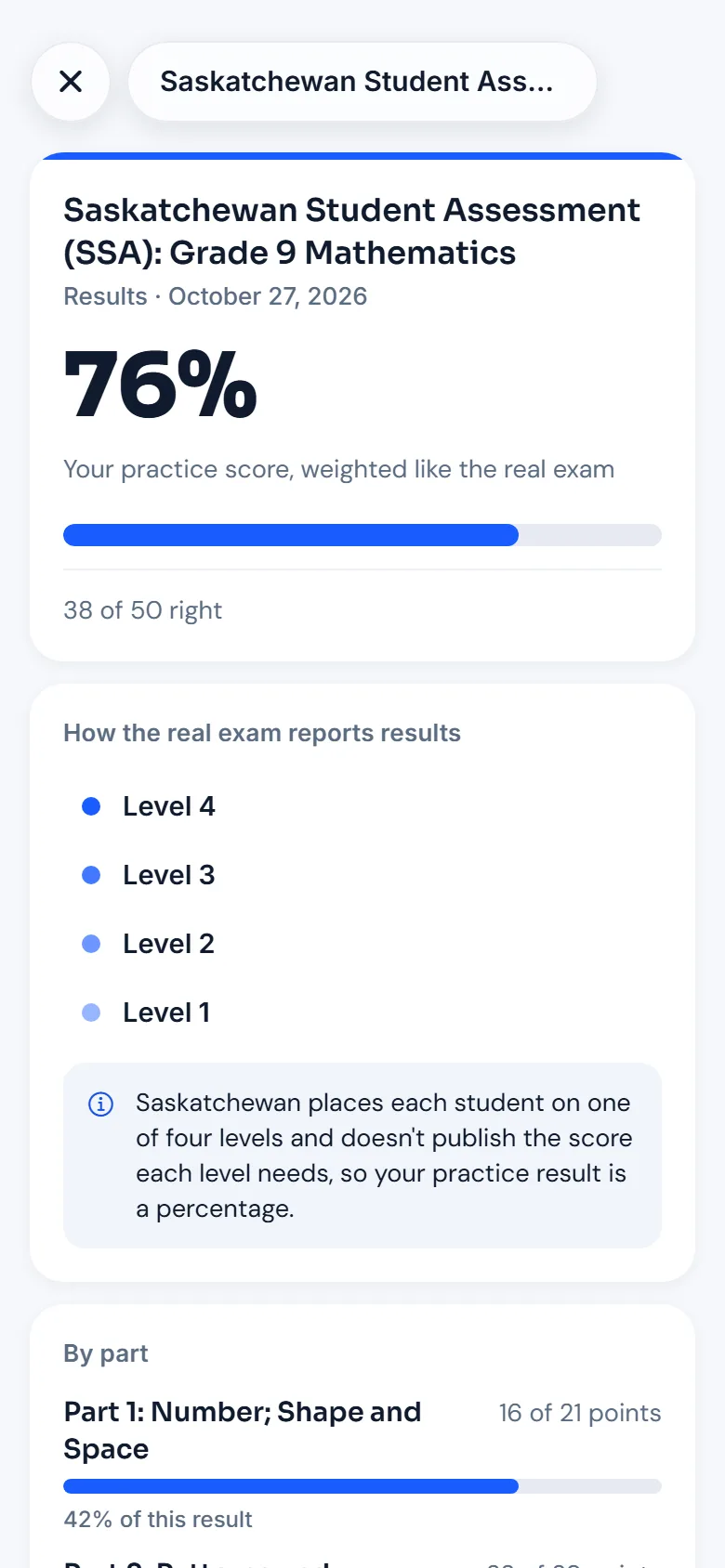 The marked result, part by part
A practice run of Saskatchewan’s Grade 9 math assessment.
Free with a MapleMind account
When
3 sessions this school year: January, June and August.
January 2027 session
- Friday, January 15, 20279:00 a.m.-12:00 p.m.
June 2027 session
- Monday, June 14, 20279:00 a.m.-12:00 p.m.
August 2027 session
- Monday, August 2, 20279:00 a.m.-12:00 p.m.
The dates are Quebec’s own, read on September 28, 2026. See the official schedule (quebec.ca)
What’s on it
- 1840‑1896: La formation du régime fédéral canadienSection A: 5 or 6 questions, 9 to 14 of its 44 points; it may also be the subject of section B or C (8 points each, never both)
- 1896‑1945: Les nationalismes et l'autonomie du CanadaSection A: 5 or 6 questions, 9 to 14 of its 44 points; it may also be the subject of section B or C (8 points each, never both)
- 1945‑1980: La modernisation du Québec et la Révolution tranquilleSection A: 5 or 6 questions, 9 to 14 of its 44 points; it may also be the subject of section B or C (8 points each, never both)
- De 1980 à nos jours: Les choix de société dans le Québec contemporainSection A: 4 or 5 questions, 7 to 12 of its 44 points; it may also be the subject of section B or C (8 points each, never both)
The skills it tests · 56 skills
- Agriculture and dairy farming
- Canada's domestic policy and the governance of First Peoples
- Canada's status in the British Empire
- Challenging capitalism
- Clerico-nationalism
- Confederation and the British North America Act
- Education and technical training
- Employer-union relations
- Environmental concerns
- Federal-provincial relations and the Metis uprisings
- Feminism
- Gender equality
- Indian Affairs and the Indian Act
- Indian residential schools
- Indigenous rights
- Migration and the rural exodus
- Migration flows and immigration policy
- Natural growth and the baby boom
- Neo-nationalism
- New arrivals and immigration
- Power relations in the West
- Quebec's international relations
- Quebec's political status and the sovereignty referendums
- Redefining the role of the state
- Regional development
- Self-determination of Indigenous nations
- Socio-cultural expression
- Socio-cultural vitality
- Sociodemographic change
- The Act of Union of 1840
- The Canadian federation and Quebec
- The Catholic Church and cooperatives
- The Catholic Church and ultramontanism
- The colonial economy and free trade
- The consumer society
- The cultural industry
- The devitalization of communities
- The Duplessis era
- The first phase of industrialization
- The First World War and conscription
- The forestry industry
- The globalization of the economy
- The Great Depression
- The information era
- The language issue
- The National Policy
- The Quiet Revolution
- The rise of mass culture
- The role and status of women
- The second phase of industrialization
- The Second World War
- The union movement
- The winning of responsible government
- Urban agglomeration
- Urban areas and public health
- Women's struggles and the vote
How it’s built
Multiple-choice questions, written answers and questions in sets.
- Section A: intellectual operations (21 questions)
- Questions
- 21
- Marks
- 44
- Of the marks
- 73.3%
- Multiple choice
- Written answers
- Questions in sets
Twenty-one multiple-choice or short-answer questions, grouped by period in time order. Each asks you to do something with the documents, such as putting events in order or finding causes; sometimes the answer is a document number.
- Section B: description (1 question)
- Question
- 1
- Marks
- 8
- Of the marks
- 13.3%
- Written answers
Fill in a diagram describing the cultural, economic, political, social and territorial sides of one period, using only the documents about that period.
- Section C: explanation (about 150 words)
- Question
- 1
- Marks
- 8
- Of the marks
- 13.3%
- Written answers
Write about 150 words explaining how a part of society changed: give causes and consequences, or changes and continuities, each backed by facts.
How it’s marked
Your school marks it out of 60, with the ministry's guide. It counts for 50% of your final result, and you need 60% to pass the course.
On the day
One paper sitting. No atlas, dictionary, textbook, notes or digital tools: everything you need is in the documents booklet. A student found with a phone or other device gets 0%. Up to 15 more minutes if you need them.
Getting ready
3 official documents to practise with, and 4 tips.
Official practice
Tips from the people who write it
- Everything rests on the documents booklet: practise reading historical documents, maps, tables and timelines quickly.
- Some answers in Section A are just document numbers.
- Sections B and C cover different periods, so prepare all four.
- Make your answers complete, clear and accurate.
The mark you need
Your class mark counts for 50% of the final mark, the exam for 50%. Quebec may moderate your class mark before it’s blended.
You need
65% on the exam
With 75% in class, your final mark lands between 37.5% (0 on the exam) and 87.5% (100% on it).
After the exam
- Results
After marking, the Ministry mails you your achievement record, and the results are on your Online Academic Record. Your school mark may be moderated: moved up or down by comparing your group’s school marks with its exam results. If your exam mark is higher than your moderated school mark, only the exam mark counts.
- Re-marking
You can ask for a review within six months of receiving your achievement record, through the person in charge of exams at your school, for a fee. A lower result never replaces your original mark.
- Writing it again
If you fail, or want a better mark, your school may let you retake it at the January, June or August session; you show you’ve worked on it first. Your final mark uses your best result.
- If you miss it
Without a valid reason, ABS goes on your record and you can write at another session. Valid reasons: a serious illness or accident with a medical note, the death of a close relative, a court summons, or an important event approved in advance. Then you write at a later date, or, if that’s impossible, your moderated school mark can stand in (only if it’s a pass and you attended at least 120 class days; never for the August session).
From Final results in Secondary IV and V (Quebec) (quebec.ca) and Administrative Guide for the Certification of Studies and Management of Ministerial Examinations (the edition Quebec links today) (cdn-contenu.quebec.ca), read on October 27, 2026.
More for you
Students
Read what’s on it, then write full practice exams under the real time limit.
Practise itParents
Put the dates on the family calendar. The Parent Dashboard shows each practice exam’s result and the skills that need another look.
See the Parent DashboardEducators
The official practice above makes a review plan. Students can practise each skill on its own in MapleMind, free with daily limits.
For schools
Questions about this exam
When is the History of Québec and Canada, Secondary IV in 2026–27?
The next sitting is January 15, 2027, 9:00 a.m.-12:00 p.m.. This school year it’s written in January 2027 session, June 2027 session and August 2027 session.
How long is the History of Québec and Canada, Secondary IV?
It takes 3 hours in all, over 3 parts.
How many questions are on the History of Québec and Canada, Secondary IV?
It has 23 marked questions: 21 in Section A: intellectual operations (21 questions), 1 in Section B: description (1 question) and 1 in Section C: explanation (about 150 words).
Can you use a calculator on the History of Québec and Canada, Secondary IV?
No. Calculators aren’t allowed.
How much does the History of Québec and Canada, Secondary IV count?
It’s worth 50% of the final mark in History of Quebec and Canada, Secondary IV.
Where can I find practice tests for the History of Québec and Canada, Secondary IV?
MapleMind builds a full practice exam in its format. Start it from this page, free with an account.

Practise for the History of Québec and Canada, Secondary IV
Every skill on the History of Québec and Canada, Secondary IV, taught one at a time, then practised on questions written like the real ones.