Get help with History of Quebec and Canada, Secondary IV
Most tutoring makes you sit through material you already know. MapleMind flips that: pick the exact skill that's causing trouble — any of the 56 below — and the tutor teaches just that one, step by step, as many times as it takes. Ask questions in plain words, any time of day, in English, French, or 12 other languages.
The official Quebec History of Quebec and Canada, Secondary IV curriculum
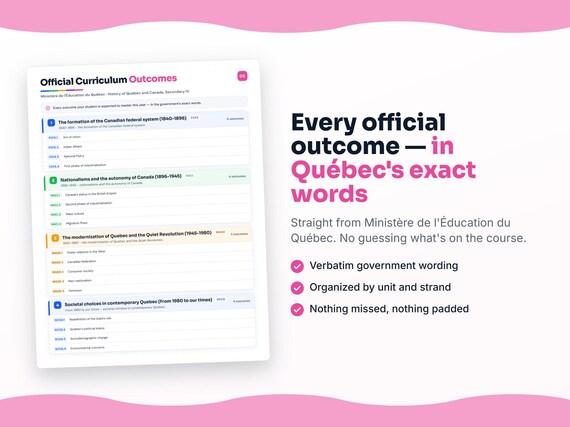
Quebec defines History of Quebec and Canada, Secondary IV by strands and outcomes. MapleMind teaches the same curriculum reorganized for one-skill-at-a-time tutoring — the table shows exactly where every official strand lands, and the ministry's own wording is quoted under each unit below.
Official source Québec's official education programRead it on the government site — quebec.ca ↗| Official strand | Outcomes | Where MapleMind teaches it |
|---|---|---|
| Course outcomes | 56 | The formation of the Canadian federal system (1840-1896) · Nationalisms and the autonomy of Canada (1896-1945) · The modernization of Quebec and the Quiet Revolution (1945-1980) · Societal choices in contemporary Quebec (From 1980 to our times) |
Every skill below, taught one on one.
 Try the first session free
How MapleMind teaches History of Quebec and Canada, Secondary IV — every unit, lesson, and skill
Every skill below runs as a short session: a plain-words lesson, a worked example, solving it together, then a five-question skill check that earns up to three stars. Guided Mode keeps it teaching instead of answer-handing — turning it off needs a parent's password.
Unit 1The formation of the Canadian federal system (1840-1896)
1840-1896 - the formation of the Canadian federal system.
The Act of Union and Responsible Government
- The Act of Union of 1840HQC.259 — Explain the Act of Union of 1840 - the socio-political and economic context after the Rebellions, its political structure, its administrative provisions, and the territory of the united Province of Canada.
- The colonial economy and free tradeHQC.264 — Explain the shift in the colonial economy - the United Kingdom's adoption of free trade and the Reciprocity Treaty with the United States.
- The winning of responsible governmentHQC.267 — Explain the achievement of responsible government - the alliance of Reformers, how responsible government worked, and the ministerial instability that followed.
First Nations Policy and Confederation
- Indian Affairs and the Indian ActHQC.271 — Explain government policy toward First Nations in this period - the creation of Indian reserves in Lower Canada, Catholic and Protestant missions, and the Indian Act - as real legal-historical content with lasting consequences.
- Confederation and the British North America ActHQC.275 — Explain the making of Confederation - the Great Coalition, the conferences, the structure of Canadian federalism set out in the British North America Act, and the territory of the new Dominion of Canada.
- Federal-provincial relations and the Metis uprisingsHQC.280 — Explain the early tensions of the new federation - areas of jurisdiction, revenue sharing, interprovincial conferences, the Metis uprisings led by Louis Riel, and Catholic schools outside Quebec.
National Policy, Migration and Society
- The National PolicyHQC.286 — Explain the National Policy - the economic crisis of 1873, its tariff policy, the Canadian Pacific transcontinental railway, and the settling of the West.
- Migration and the rural exodusHQC.291 — Explain the migrations of this period - the rural exodus, emigration to the United States, the opening of regions for colonization, and transatlantic immigration.
- The role and status of womenHQC.296 — Describe the situation of women in this period - their legal and political status, their sectors of activity, women's religious communities, and English-speaking women's organizations.
- The Catholic Church and ultramontanismHQC.301 — Explain the dominant role of the Catholic Church in this period - ultramontanism, anticlericalism, the nationalism of survival, and the denominational dualism of social institutions.
- Socio-cultural expressionHQC.306 — Describe the cultural life of the period - patriotic works, the emergence of women's literature, and higher education.
The First Phase of Industrialization
- The first phase of industrializationHQC.310 — Explain the first phase of industrialization - industrial capitalism, the eastern transportation network, the production sectors, the division of labour, the harsh living and working conditions of men, women and children, the workers' movement, and urbanization.
- The forestry industryHQC.318 — Describe the forestry industry of the period - the forestry regions and the lumber industry.
- Agriculture and dairy farmingHQC.321 — Describe agriculture in this period - the shift to dairy production, mechanization, and the ending of seigneurial rights.
The official wording — 14 outcomes in this unit
- HQC.259
Act of Union
- HQC.264
Colonial economy
- HQC.267
Responsible government
- HQC.271
Indian Affairs
- HQC.275
British North America Act
- HQC.280
Federal-provincial relations
- HQC.286
National Policy
- HQC.291
Migrations
- HQC.296
Role of women
- HQC.301
Presence of the Catholic Church
- HQC.306
Socio-cultural expression
- HQC.310
First phase of industrialization
- HQC.318
Forestry industry
- HQC.321
Farms
Unit 2Nationalisms and the autonomy of Canada (1896-1945)
1896-1945 - nationalisms and the autonomy of Canada.
Canada's Autonomy and French-Canadian Nationalism
- Canada's status in the British EmpireHQC.325 — Explain Canada's evolving status within the British Empire - imperialism, French-Canadian nationalism, Canadian military support in imperial wars, and the Statute of Westminster.
- Clerico-nationalismHQC.330 — Explain clerico-nationalism in this period - L'Action francaise, the Programme de restauration sociale, and the role of the French-speaking population in the economy.
- Canada's domestic policy and the governance of First PeoplesHQC.334 — Explain Canada's domestic policy in this period - the Liberal era, taxation powers, the French-Catholic minority outside Quebec, the governance of First Nations and Inuit populations, and Canada's territory.
The Second Phase of Industrialization
- The second phase of industrializationHQC.340 — Explain the second phase of industrialization - the exploitation of natural resources, manufacturing and domestic production, war industry, monopoly capitalism, foreign investment, the role of the state, and trade.
- Urban areas and public healthHQC.348 — Describe the growth of urban areas in this period - public health, infrastructure, and services.
Society, Culture and Labour
- The rise of mass cultureHQC.352 — Describe the rise of mass culture in this period - radio, cinema, the romans du terroir, professional sports, and cabarets.
- Women's struggles and the voteHQC.358 — Explain women's struggles in this period - access to education, the labour market, legal recognition, and the right to vote and to stand for election.
- The union movementHQC.363 — Describe the union movement of this period - American and Catholic unions, strikes, and labour legislation.
- The Catholic Church and cooperativesHQC.367 — Describe the Catholic Church in this period - the numerical strength of the clergy, its moral and cultural influence, and cooperatives.
- Education and technical trainingHQC.371 — Describe education in this period - the school attendance of francophones and anglophones, legislation, the education of boys and girls, and the improvement of agricultural practices.
The World Wars and the Depression
- Migration flows and immigration policyHQC.376 — Explain migration in this period - the ethnic origins of immigrants, support measures for new immigrants, immigration controls, and the rise of xenophobia.
- The First World War and conscriptionHQC.381 — Explain the First World War as it touched Quebec and Canada - European national interests, wartime government, the conscription crisis, the war effort of men and women, soldiers' civil re-establishment, and the League of Nations.
- The Great DepressionHQC.388 — Explain the Great Depression - the stock market crash of 1929, its socio-economic problems, colonization as a response, and federal and provincial government measures.
- Challenging capitalismHQC.393 — Explain the challenges to capitalism raised by the Depression - Keynesianism and new socio-political ideologies.
- The Second World WarHQC.396 — Explain the Second World War as it touched Quebec and Canada - the European political and economic climate, wartime government, the conscription plebiscite, the war effort of men and women, and demobilization.
The official wording — 15 outcomes in this unit
- HQC.325
Canada's status in the British Empire
- HQC.330
Clerico-nationalism
- HQC.334
Canada's domestic policy
- HQC.340
Second phase of industrialization
- HQC.348
Urban areas
- HQC.352
Mass culture
- HQC.358
Women's struggles
- HQC.363
Union movement
- HQC.367
Catholic Church
- HQC.371
Education and technical training
- HQC.376
Migration flows
- HQC.381
First World War
- HQC.388
Great Depression
- HQC.393
Challenging capitalism
- HQC.396
Second World War
Unit 3The modernization of Quebec and the Quiet Revolution (1945-1980)
1945-1980 - the modernization of Quebec and the Quiet Revolution.
The Postwar World and a Changing Population
- Power relations in the WestHQC.402 — Explain the postwar international context - the Cold War, Canadian sovereignty in the Arctic, and social struggles in the United States and France.
- Urban agglomerationHQC.406 — Describe postwar urban growth - the spread of suburbs and the building of infrastructure.
- Natural growth and the baby boomHQC.409 — Explain postwar demographic change - natural growth, the baby boom, the later falling birth rate, and the birth rate of the Indigenous population.
- New arrivals and immigrationHQC.413 — Explain postwar immigration - the arrival of new cultural communities, the creation of Quebec's Immigration Department, and the welcoming of refugees.
- Regional developmentHQC.418 — Describe postwar regional development - the modernization of agriculture, the protection of agricultural land, and the exploitation of natural resources.
The Duplessis Era and the Quiet Revolution
- The Canadian federation and QuebecHQC.422 — Explain Quebec's place in the postwar federation - federal social programs, the continentalization of the economy, the Laurendeau-Dunton Commission, and constitutional negotiations.
- Indian residential schoolsHQC.427 — Explain, truthfully and with dignity, the Indian residential schools in Quebec and the Indian residential school system in Canada - their assimilationist purpose, their socio-institutional organization, and their activities and consequences. Remembrance-framed.
Consumer Society and the Duplessis Era
- The consumer societyHQC.431 — Describe the postwar consumer society - the influence of American culture, advertising, and increased purchasing power.
- The Duplessis eraHQC.435 — Explain the Duplessis era - its economic liberalism, social conservatism, defence of provincial autonomy, clericalism, its funding of education and health, and the opposition that grew against it.
Neo-Nationalism and the Quiet Revolution
- Neo-nationalismHQC.442 — Explain the new nationalism of this period - the decolonization movement, territorial identity, the independantiste movement, and the creation of the Parti Quebecois.
- The Quiet RevolutionHQC.447 — Explain the Quiet Revolution - its progressive economic and social measures, the creation of government departments and state-owned corporations, the reform of democratic institutions, the protection of the French language, human rights and freedoms, Quebec delegations abroad, and secularization.
Feminism, Culture and Indigenous Self-Determination
- FeminismHQC.456 — Explain the feminism of this period - legal gains, economic independence, sexual and reproductive rights, and access to non-traditional occupations and professions.
- Socio-cultural vitalityHQC.461 — Describe the cultural flowering of this period - French-language songs, the emergence of Quebec theatre, cultural venues, and the diversity of cultural events and expression.
- Self-determination of Indigenous nationsHQC.466 — Explain the movement for the self-determination of Indigenous nations in this period - land claims and political demands, the recognition of ancestral rights, the Government of Canada's 1969 statement on Indian policy, and Indigenous governance. Autonym-led, honest present-day relevance.
- Employer-union relationsHQC.471 — Describe labour relations in this period - the unionization of state employees, conflicts, common fronts, and social and political action by the unions.
The official wording — 15 outcomes in this unit
- HQC.402
Power relations in the West
- HQC.406
Urban agglomeration
- HQC.409
Natural growth
- HQC.413
New arrivals
- HQC.418
Regional development
- HQC.422
Canadian federation
- HQC.427
Indian residential schools in Québec
- HQC.431
Consumer society
- HQC.435
Duplessis era
- HQC.442
Neo-nationalism
- HQC.447
Quiet Revolution
- HQC.456
Feminism
- HQC.461
Socio-cultural vitality
- HQC.466
Self-determination of Indigenous nations
- HQC.471
Employer-union relations
Unit 4Societal choices in contemporary Quebec (From 1980 to our times)
From 1980 to our times - societal choices in contemporary Quebec.
The State and the Global Economy
- Redefining the role of the stateHQC.476 — Explain the redefinition of the state's role since 1980 - neo-liberal policies, the funding of social programs, the social economy, civil society, public consultations, and state neutrality.
- Indigenous rightsHQC.483 — Explain Indigenous rights in contemporary Quebec and Canada - the Constitution Act of 1982, the Oka crisis, modern agreements and conventions, and the Truth and Reconciliation Commission of Canada. Truthful, dignified, present-day relevance.
- The globalization of the economyHQC.488 — Explain the globalization of the economy since 1980 - Quebec Inc., free trade agreements, and export sectors.
Quebec's Political Status and the Referendums
- Quebec's political status and the sovereignty referendumsHQC.492 — Explain the great constitutional debate since 1980 - the 1980 referendum on sovereignty-association, the patriation of the Constitution, the Meech Lake Accord, the Belanger-Campeau Commission, the Allaire Report, the Charlottetown Accord, the 1995 referendum on sovereignty, and post-referendum action. Multiple perspectives, no editorializing.
Contemporary Society and Identity
- Sociodemographic changeHQC.501 — Explain contemporary sociodemographic change - the aging of the population, family policy, ethnocultural identity, public health, and the living conditions of Indigenous peoples throughout Quebec.
- Gender equalityHQC.507 — Explain contemporary struggles for gender equality - pay equity, parity, and work-family balance.
- The cultural industryHQC.511 — Describe the contemporary cultural industry - the funding of culture, the dissemination of culture, and cultural policy.
- The language issueHQC.515 — Explain the contemporary language issue - the language of signage, the language of instruction, and Indigenous languages.
Contemporary Challenges
- Environmental concernsHQC.519 — Explain contemporary environmental concerns - the monitoring of environmental standards and the exploitation of resources.
- The devitalization of communitiesHQC.522 — Explain the devitalization of communities - single-industry towns, local services, migratory movements, the next generation of farmers, and their political weight.
- Quebec's international relationsHQC.528 — Describe Quebec's international relations - its representation in international organizations and conferences, economic missions, and Canadian army missions abroad.
- The information eraHQC.532 — Explain the information era - internet use, the 24-hour news cycle, and the integration and concentration of mass media.
The official wording — 12 outcomes in this unit
- HQC.476
Redefinition of the state's role
- HQC.483
Indigenous rights
- HQC.488
Globalization of the economy
- HQC.492
Québec’s political status
- HQC.501
Sociodemographic change
- HQC.507
Gender equality
- HQC.511
Cultural industry
- HQC.515
Language issue
- HQC.519
Environmental concerns
- HQC.522
Devitalization of communities
- HQC.528
International relations
- HQC.532
Information era
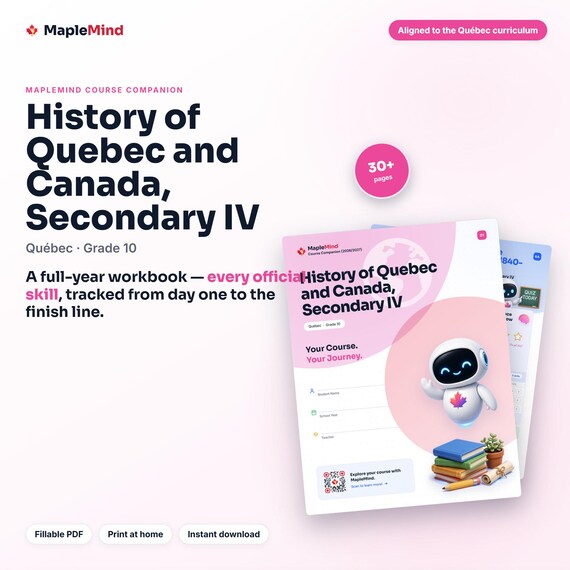
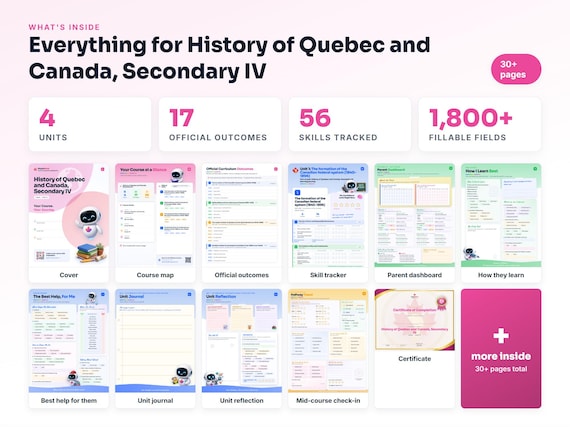
Printable workbook · A keepsake of the year
A History of Quebec and Canada, Secondary IV workbook worth keeping
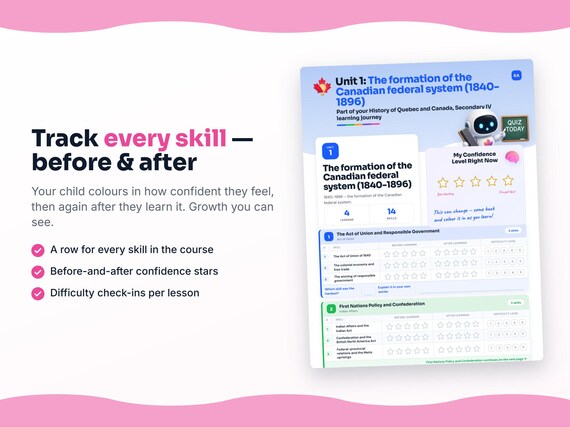
Built from the same official curriculum as this page. Before and after each skill above, your student colours in how sure they feel — so the two of you can see, on one page, what's clicking and what needs another look. It's a quiet way to follow how the year is really going.
By June it's full of their own handwriting: units worked through, confidence grown, a mid-year check-in, notes from parent-teacher night, and a certificate at the end. Less a worksheet, more a record of the year worth keeping on the shelf.
Instant download · see every page, reviews and the full description · five or more workbooks are $2.99 each
What it looks like in the app



Common questions
Can MapleMind help me with History of Quebec and Canada, Secondary IV?
Yes. MapleMind's AI tutor covers all 56 skills in Quebec's History of Quebec and Canada, Secondary IV — you pick the exact skill, and the tutor teaches it step by step: a short lesson, a worked example, solving together, then a skill check to show it stuck.
Is MapleMind aligned to Quebec's official curriculum?
Yes. Every skill in this course maps to an official outcome code from Quebec's Grade 10 Social Studies curriculum, and the ministry's own wording is quoted under each unit on this page — with the official government source linked so you can check it yourself.
What does MapleMind cost?
It's free to start — 5 tutoring chats and a practice quiz every day, no credit card. A Pro subscription ($9.99/month or $49.99/year CAD, 7-day free trial) unlocks unlimited tutoring, practice, and exam simulations.
What if I'm stuck on just one topic?
That's the point of skill-level tutoring: open History of Quebec and Canada, Secondary IV in the app, tap the exact skill from the list on this page, and the tutor teaches just that — no wading through lessons you don't need.
Does MapleMind work in French or other languages?
Yes — 14 languages, including French. Both the app and the tutor's explanations switch to the language you choose.
Where can I see the official Quebec curriculum for History of Quebec and Canada, Secondary IV?
The official source is linked on this page — Québec's official education program. The outline here follows it: every MapleMind skill carries its official outcome code, and the ministry's own wording is quoted under each unit.
Keep exploring
Ready when you are
Pick a skill from this page and see it taught properly — free, in the browser, in under a minute.