Get help with Contemporary World, Secondary 5
Most tutoring makes you sit through material you already know. MapleMind flips that: pick the exact skill that's causing trouble — any of the 30 below — and the tutor teaches just that one, step by step, as many times as it takes. Ask questions in plain words, any time of day, in English, French, or 12 other languages.
The official Quebec Contemporary World, Secondary 5 curriculum
Quebec defines Contemporary World, Secondary 5 by strands and outcomes. MapleMind teaches the same curriculum reorganized for one-skill-at-a-time tutoring — the table shows exactly where every official strand lands, and the ministry's own wording is quoted under each unit below.
Official source Québec's official education programRead it on the government site — quebec.ca ↗| Official strand | Outcomes | Where MapleMind teaches it |
|---|---|---|
| MON | 30 | Population · Tensions and conflicts · Wealth |
Every skill below, taught one on one.
 Try the first session free
How MapleMind teaches Contemporary World, Secondary 5 — every unit, lesson, and skill
Every skill below runs as a short session: a plain-words lesson, a worked example, solving it together, then a five-question skill check that earns up to three stars. Guided Mode keeps it teaching instead of answer-handing — turning it off needs a parent's password.
Unit 1PopulationOfficial strand · MON
How the world's people are distributed, how populations change, and the great question of migration - who moves, why, and how host societies respond.
World Population: Distribution and Change
- Where the world's people liveMON.002 — Describe how the world population is distributed and locate the major population centres on a world map.
- Demographic change: two different worldsMON.005 — Compare the demographic characteristics of less-developed and developed countries and explain what drives population growth or decline.
Migration Across the World
- Migration and its flowsMON.010 — Define migration, describe who migrants tend to be, and locate and explain the main world migration flows.
- Economic migrants and refugeesMON.017 — Distinguish the reasons people migrate, explain what makes someone a refugee, and name the rights refugees hold under international law.
- Illegal immigration networksMON.022 — Explain the factors behind international networks of illegal immigration and what makes illegal immigration possible.
- How states choose and welcome immigrantsMON.025 — Explain the criteria states use to select immigrants and the measures they use to recruit and integrate them.
Migration, Work, and Cities
- Immigrant workers and employment policiesMON.030 — Explain why countries recruit immigrant workers, the difficulties those workers face, and the policies used to help them work.
- The shadow economy of undocumented workMON.039 — Explain why undocumented immigrant workers are used, in which sectors, and the consequences and conditions of that work.
- Migration and the world's citiesMON.044 — Explain how migration reshapes cities, from ethnic neighbourhoods in developed countries to shantytowns in less-developed ones.
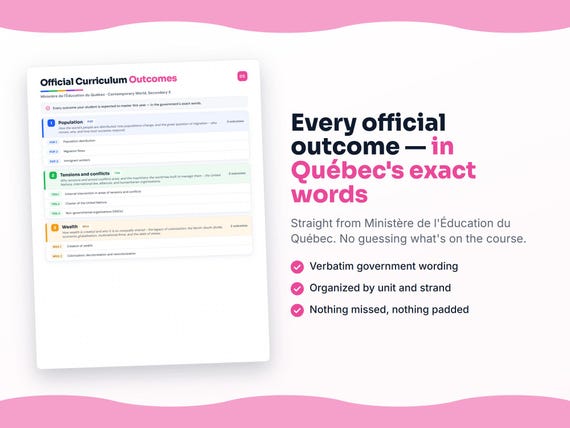
The official wording — 9 outcomes in this unit
- MON.002
Population distribution
- MON.005
Demographic change
- MON.010
Migration flows
- MON.017
Reasons for migration
- MON.022
International networks of illegal immigration
- MON.025
Immigration policies
- MON.030
Immigrant workers
- MON.039
Parallel economies
- MON.044
Organization of urban territories
Unit 2Tensions and conflictsOfficial strand · MON
Why tensions and armed conflicts arise, and the machinery the world has built to manage them - the United Nations, international law, alliances, and humanitarian organizations.
Where Tensions and Conflicts Come From
- Tension zones, sovereignty, and interventionMON.051 — Explain what makes an area a zone of tension, what sovereignty means, and the reasons cited for intervening in a sovereign territory.
- Control of resourcesMON.060 — Explain how the control of natural resources becomes a source of tension and conflict, and how governments assert that control.
- Denied rights as a source of conflictMON.064 — Explain how demands for human rights and freedoms become a source of tension and conflict.
- Identity demands and political autonomyMON.068 — Explain how demands for identity and political autonomy become a source of tension and conflict.
The United Nations and International Law
- The Charter of the United NationsMON.074 — Explain the objective and main goals of the UN Charter, and the sovereignty limit on the UN's power to intervene.
- The General Assembly and the Security CouncilMON.078 — Describe the UN General Assembly - its composition and its role voting on resolutions.
- The Security Council and the vetoMON.081 — Describe the UN Security Council, the permanent members' veto, and its means of intervention.
- International criminal tribunalsMON.086 — Explain how international criminal tribunals prosecute serious violations of humanitarian law.
- Protecting refugeesMON.089 — Explain how the UN protects refugees and the displacement that armed conflict causes.
Responding to Conflict
- Humanitarian NGOs in conflictMON.092 — Explain what humanitarian NGOs do in areas of tension and conflict, the principles that guide them, and their role in humanitarian law.
- Peacekeeping and the peace processMON.097 — Explain how UN peacekeeping works, the conditions and limits on Blue Helmet missions, and the steps of a peace process.
- Alliances and regional organizationsMON.104 — Explain how alliances such as NATO and regional organizations such as the Arab League and African Union respond to conflict.
- Conventions, treaties, and agreementsMON.117 — Explain how international conventions, treaties, and agreements regulate the use of force and help end conflicts.
The official wording — 13 outcomes in this unit
- MON.051
External intervention in areas of tensions and conflicts
- MON.060
Control of resources
- MON.064
Exercise of rights and freedoms
- MON.068
Identity-based demands and political autonomy
- MON.074
Charter of the United Nations
- MON.078
General Assembly of the UN
- MON.081
UN Security Council
- MON.086
International Criminal Tribunals (ICT)
- MON.089
Office of the United Nations High Commissioner for Refugees
- MON.092
Non-governmental organizations (NGOs)
- MON.097
Peacekeeping missions and the peace process
- MON.104
International alliances
- MON.117
Conventions, treaties and agreements
Unit 3WealthOfficial strand · MON
How wealth is created and why it is so unequally shared - the legacy of colonization, the North-South divide, economic globalization, multinational firms, and the debt of states.
Creating and Sharing Wealth
- How wealth is createdMON.123 — Explain the factors that create wealth, how states promote it, and what limits it.
- Measuring the wealth gapMON.128 — Explain how the disparity in wealth is measured and located, and how states try to reduce it.
- Organizations that shape the economyMON.135 — Explain the objectives of the economic groups, international organizations, and NGOs that shape the global economy.
Development and Globalization
- Colonization, decolonization, neocolonizationMON.139 — Explain the objectives of colonization, the causes and consequences of decolonization, and what neocolonization means.
- North-South relationsMON.144 — Compare developed, less-developed, and emerging economies, and explain the objectives of fair trade.
- Globalization of the economyMON.150 — Explain what economic globalization is and its effects on firms and on developed and less-developed economies.
- The power of multinational firmsMON.156 — Explain why states welcome multinational firms, how they attract them, and why firms relocate.
- The debt of statesMON.160 — Explain why states go into debt, who their creditors are, and the effects of debt on economy and society.
The official wording — 8 outcomes in this unit
- MON.123
Creation of wealth
- MON.128
Disparity in the distribution of wealth
- MON.135
International organizations
- MON.139
Colonization, decolonization and neocolonization
- MON.144
North-South relations
- MON.150
Globalization of the economy
- MON.156
Power of multinational firms
- MON.160
Indebtedness of states
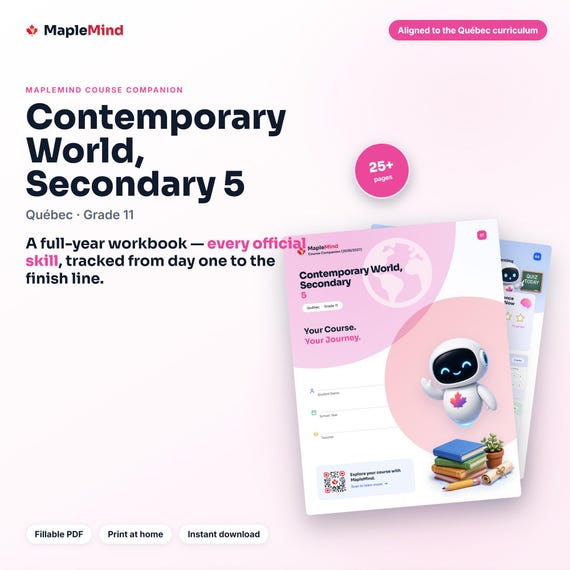
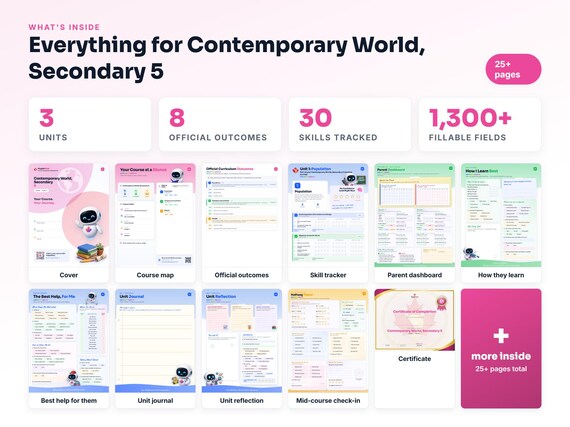
Printable workbook · A keepsake of the year
A Contemporary World, Secondary 5 workbook worth keeping
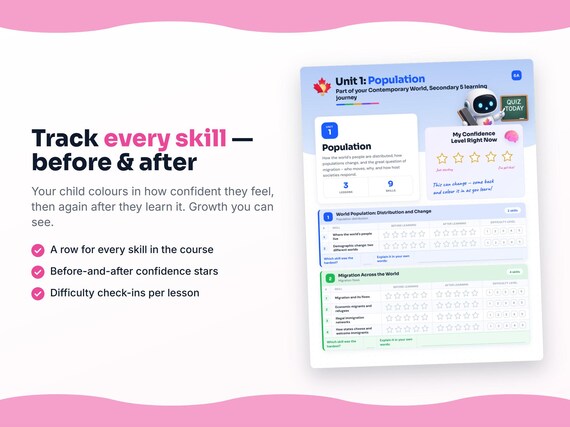
Built from the same official curriculum as this page. Before and after each skill above, your student colours in how sure they feel — so the two of you can see, on one page, what's clicking and what needs another look. It's a quiet way to follow how the year is really going.
By June it's full of their own handwriting: units worked through, confidence grown, a mid-year check-in, notes from parent-teacher night, and a certificate at the end. Less a worksheet, more a record of the year worth keeping on the shelf.
Instant download · see every page, reviews and the full description · five or more workbooks are $2.99 each
What it looks like in the app



Common questions
Can MapleMind help me with Contemporary World, Secondary 5?
Yes. MapleMind's AI tutor covers all 30 skills in Quebec's Contemporary World, Secondary 5 — you pick the exact skill, and the tutor teaches it step by step: a short lesson, a worked example, solving together, then a skill check to show it stuck.
Is MapleMind aligned to Quebec's official curriculum?
Yes. Every skill in this course maps to an official outcome code from Quebec's Grade 11 Social Studies curriculum, and the ministry's own wording is quoted under each unit on this page — with the official government source linked so you can check it yourself.
What does MapleMind cost?
It's free to start — 5 tutoring chats and a practice quiz every day, no credit card. A Pro subscription ($9.99/month or $49.99/year CAD, 7-day free trial) unlocks unlimited tutoring, practice, and exam simulations.
What if I'm stuck on just one topic?
That's the point of skill-level tutoring: open Contemporary World, Secondary 5 in the app, tap the exact skill from the list on this page, and the tutor teaches just that — no wading through lessons you don't need.
Does MapleMind work in French or other languages?
Yes — 14 languages, including French. Both the app and the tutor's explanations switch to the language you choose.
Where can I see the official Quebec curriculum for Contemporary World, Secondary 5?
The official source is linked on this page — Québec's official education program. The outline here follows it: every MapleMind skill carries its official outcome code, and the ministry's own wording is quoted under each unit.
Keep exploring
Ready when you are
Pick a skill from this page and see it taught properly — free, in the browser, in under a minute.