Get help with History of Quebec and Canada, Secondary III
Most tutoring makes you sit through material you already know. MapleMind flips that: pick the exact skill that's causing trouble — any of the 46 below — and the tutor teaches just that one, step by step, as many times as it takes. Ask questions in plain words, any time of day, in English, French, or 12 other languages.
The official Quebec History of Quebec and Canada, Secondary III curriculum
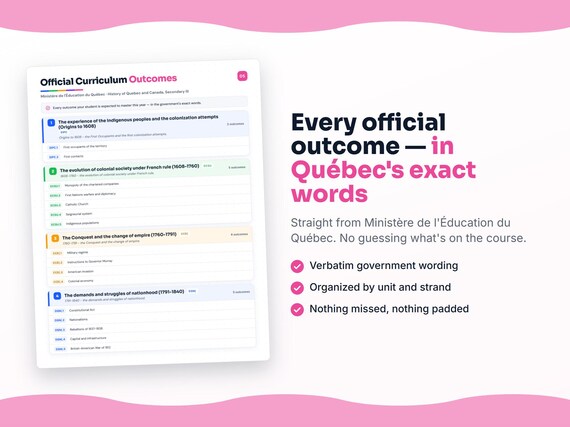
Quebec defines History of Quebec and Canada, Secondary III by strands and outcomes. MapleMind teaches the same curriculum reorganized for one-skill-at-a-time tutoring — the table shows exactly where every official strand lands, and the ministry's own wording is quoted under each unit below.
Official source Québec's official education programRead it on the government site — quebec.ca ↗| Official strand | Outcomes | Where MapleMind teaches it |
|---|---|---|
| Course outcomes | 46 | The experience of the Indigenous peoples and the colonization attempts (Origins to 1608) · The evolution of colonial society under French rule (1608-1760) · The Conquest and the change of empire (1760-1791) · The demands and struggles of nationhood (1791-1840) |
Every skill below, taught one on one.
 Try the first session free
How MapleMind teaches History of Quebec and Canada, Secondary III — every unit, lesson, and skill
Every skill below runs as a short session: a plain-words lesson, a worked example, solving it together, then a five-question skill check that earns up to three stars. Guided Mode keeps it teaching instead of answer-handing — turning it off needs a parent's password.
Unit 1The experience of the Indigenous peoples and the colonization attempts (Origins to 1608)
Origins to 1608 - the First Occupants and the first colonization attempts.
First Occupants of the Territory
- The First Occupants and their ways of lifeHQC.001 — Explain who the First Peoples of northeastern America were around the time of first contact - the migrations that settled the continent, the language families, the First Nations and Inuit, their territories and ways of life.
- Decision making among the First PeoplesHQC.014 — Explain how First Peoples made collective decisions - how chiefs were appointed and the roles of chiefs and elders.
- Indigenous trade networksHQC.017 — Describe the trade networks First Peoples built across the continent - the economic activities, trade among nations, the vast scope of the networks, and the use of waterways.
- Alliances and rivalries among the First NationsHQC.022 — Explain the systems of alliance and the sources of rivalry among First Nations - alliances, objects of rivalry, warfare, and the fate of prisoners.
First Contacts and Exploration
- First contacts between First Peoples and EuropeansHQC.027 — Explain the first contacts between First Peoples and Europeans - the situation in Europe that drove exploration, European voyages and fisheries in America, the goods traded, and above all the perspectives of the First Peoples on these newcomers.
- French exploration and the Franco-Aboriginal allianceHQC.033 — Explain the French exploration and attempted occupation of the territory - Cartier's voyages, the settlement attempt at Cap-Rouge, other French attempts, and the crucial Franco-Aboriginal alliance of 1603.
The official wording — 7 outcomes in this unit
- HQC.001
First occupants of the territory
- HQC.007
Social relationships among the Indigenous peoples
- HQC.014
Decision making among the Indigenous peoples
- HQC.017
Indigenous trade networks
- HQC.022
Alliances and rivalries among the First Nations
- HQC.027
First contacts
- HQC.033
Exploration and occupation of the territory by the French
Unit 2The evolution of colonial society under French rule (1608-1760)
1608-1760 - the evolution of colonial society under French rule.
From Chartered Companies to Royal Government
- The monopoly of the chartered companiesHQC.038 — Explain how New France was first run by chartered companies - their privileges and obligations, the mercantilist idea behind them, and the first governors.
- The Royal Government of New FranceHQC.042 — Describe how New France was governed after 1663 under Royal Government - absolutism and the divine right of kings, the Minister of the Marine, the Governor, the Intendant, the Sovereign Council, and the colony's military organization.
- French territory in AmericaHQC.049 — Describe the extent of French territory in America - the first settlements in the St. Lawrence Valley, fishing and claimed and occupied territories, neighbouring British possessions, and the Treaty of Saint-Germain-en-Laye (1632).
Alliances, Diplomacy and the Fur Trade
- First Nations warfare and diplomacyHQC.056 — Explain the central role of First Nations in the wars and diplomacy of the period - alliances with Europeans, the Iroquois wars, and the Great Peace of Montreal (1701).
- The fur trade in New FranceHQC.060 — Explain the fur trade as the economic engine of New France - the exploitation of the resource, the exploration of the territory it drove, the role of agents (including coureurs de bois), and the congé de traite (trade licence).
Church, Population and Society
- The Catholic Church in New FranceHQC.065 — Describe the central role of the Catholic Church in New France - the religious orders, the (attempted) evangelization of First Peoples, social services and health care, the role of the bishop, guidance of colonists, and the establishment of parishes.
- Population growth in the colonyHQC.072 — Explain the slow growth of the colony's population - the social and geographic origins of immigrants, settlement policy, the Filles du Roy, and natural increase.
- Cities in the colonyHQC.077 — Describe the towns of New France - their land use, urban population, the presence of slavery, their role as administrative and cultural centres, and the public square.
Land, Economy and Adaptation
- The seigneurial systemHQC.083 — Explain the seigneurial system that organized rural New France - its social organization, its territorial organization, the social diversity of seigneurs, and daily life on the land.
- Attempts at economic diversificationHQC.088 — Explain the colony's efforts and obstacles in diversifying beyond furs - the obstacles to diversification, measures taken by intendants, agricultural and artisanal activities, and the triangular trade.
- Adaptation of the colonistsHQC.094 — Explain how the colonists adapted to life in America - the European cultural footprint they brought, the distance from the mother country, acclimatization, and relations with First Peoples.
First Peoples under Colonization and the Conquest War
- First Peoples and the impact of colonizationHQC.099 — Explain the impact of colonization on First Peoples during French rule - the domicilies (mission communities), acculturation, metissage, and the devastating effect of infectious diseases.
- The intercolonial warsHQC.104 — Explain the wars between the French and British colonial empires - the colonial empires themselves, the objects of their rivalries, the shifting power relations, the Treaty of Utrecht, and the Seven Years' War.
- The War of the ConquestHQC.110 — Explain the War of the Conquest that ended French rule - the clashes in Ohio, the deportation of the Acadians, the capture of Louisbourg, the British advance up the St. Lawrence, the siege of Quebec, the Battle of the Plains of Abraham, the Battle of Sainte-Foy, and the role of the Canadian militia.
The official wording — 14 outcomes in this unit
- HQC.038
Monopoly of the chartered companies
- HQC.042
Royal Government
- HQC.049
French territory in America
- HQC.056
First Nations warfare and diplomacy
- HQC.060
Fur trade
- HQC.065
Catholic Church
- HQC.072
Population growth
- HQC.077
Cities in Canada
- HQC.083
Seigneurial system
- HQC.088
Economic diversification
- HQC.094
Adaptation of the colonists
- HQC.099
Indigenous populations
- HQC.104
Intercolonial wars
- HQC.110
War of the Conquest
Unit 3The Conquest and the change of empire (1760-1791)
1760-1791 - the Conquest and the change of empire.
Military Regime and Royal Proclamation
- The military regimeHQC.119 — Describe the military regime after the Conquest - the capitulation of Montreal, the emigration of some Canadiens, the reconstruction of the colony, its military administration, and the conditions imposed on the Canadiens.
- The Royal Proclamation of 1763HQC.125 — Explain the Royal Proclamation of 1763 - the Treaty of Paris (1763), the new political, legal and administrative structures, the shrunken Province of Quebec, the territorial rights of First Nations recognized in it, and the other British colonies.
- The status and demands of First NationsHQC.131 — Explain the situation of First Nations under British rule in this period - what the source calls the 'Status of Indians', Pontiac's resistance, the Indian Department, and First Nations' demands.
Governing the Canadiens: the Quebec Act
- Governing under Murray and the CanadiensHQC.135 — Explain the early British civil government and its tension with assimilation - the instructions to Governor Murray, the establishment of civil government, the goal of assimilating the Canadiens, the Test Act barrier, and the concessions made to the Canadiens.
- Protest movements and petitionsHQC.140 — Describe the protest movements of the period - the interest groups involved (British merchants and Canadiens) and the purposes of their petitions.
- The Quebec Act of 1774HQC.143 — Explain the Quebec Act of 1774 - its restoration of religion and civil rights, its distribution of executive, legislative and judicial powers, the role of the governor, the reactions of various groups, and its enlargement of the Province of Quebec.
Revolution, Migration and the Loyalists
- The American Revolution and the invasion of QuebecHQC.149 — Explain how the American Revolution touched the Province of Quebec - the Intolerable (Coercive) Acts, the letters urging the Canadiens to join, the American occupation of Montreal and siege of Quebec, the Declaration of Independence, and the territorial changes under the Treaty of Paris (1783).
- The arrival of the LoyalistsHQC.157 — Explain the arrival of the Loyalists after the American Revolution - their living conditions as migrants and their settlements.
Economy, Society and the Churches (to 1791)
- The colonial economy under British ruleHQC.160 — Describe the colonial economy under early British rule - British economic policy, the control exercised by British merchants, the fur trade, agricultural production, and the fisheries.
- The people of the colony after the ConquestHQC.166 — Describe the colony's population after the Conquest - British immigration, Acadian refugees, the composition of the population, the continued use of French, the natural increase of the Canadiens, and the rise of a Canadien professional bourgeoisie.
- The Catholic and Anglican Churches after the ConquestHQC.173 — Compare the two churches in the colony after the Conquest - the Catholic Church (clergy, religious orders, schools, hospitals) that served the majority, and the newly established Anglican Church (places of worship and schools) of the British minority.
The official wording — 11 outcomes in this unit
- HQC.119
Military regime
- HQC.125
Royal Proclamation
- HQC.131
Status of Indians
- HQC.135
Instructions to Governor Murray
- HQC.140
Protest movements
- HQC.143
Quebec Act
- HQC.149
American invasion
- HQC.157
Loyalists
- HQC.160
Colonial economy
- HQC.166
Sociodemographic situation
- HQC.173
Catholic Church
Unit 4The demands and struggles of nationhood (1791-1840)
1791-1840 - the demands and struggles of nationhood.
The Constitutional Act and Parliamentary Politics
- The Constitutional Act of 1791HQC.181 — Explain the Constitutional Act of 1791 - the creation of a Legislative Assembly and a Legislative Council, the Governor and Executive Council, who could vote and stand for election (including women), and the division into Lower and Upper Canada.
- Parliamentary debates and partiesHQC.186 — Describe the parliamentary politics of Lower Canada - the authority of the governor, the subjects debated in the Assembly, and the emergence of political parties.
Nationalisms, Ideas and Population
- The rise of nationalismsHQC.190 — Explain the nationalisms that grew in this period - the colony's linguistic duality, British nationalism, and Canadien nationalism.
- Liberal and republican ideasHQC.194 — Explain the liberal and republican ideas spreading in this period - the national liberation movements in the Western world, political liberalism, republicanism, and the role of newspapers.
- The population of Lower and Upper CanadaHQC.199 — Describe the population of Lower and Upper Canada - its composition, its growth, the social groups within it, the Indian agents managing First Nations relations, and the abolition of slavery.
The Rebellions of 1837-1838
- The Rebellions of 1837-1838HQC.206 — Explain the Rebellions of 1837-1838 - the 92 Resolutions, the Russell Resolutions, the popular assemblies, the colonial state's repressive measures, the divided Catholic clergy, the armed conflict, the Declaration of Independence of Lower Canada, the suspension of the constitution, and the parallel rebellions in Upper Canada.
Economy, Transport and Migration
- Capital and infrastructureHQC.216 — Describe the growth of capital and infrastructure in this period - the founding of banks and the construction of roads, bridges, canals and railways.
- Agriculture and its crisisHQC.221 — Explain agriculture in this period - the organization of the territory, the Corn Laws, intensive wheat farming, and the agricultural crisis of the 1830s.
- The fur trade transformedHQC.226 — Explain the changing fur trade of this period - the expansion of fur territories, the fur market, and the merger of the great companies.
- The rise of the timber tradeHQC.230 — Explain the rise of the timber trade - preferential tariffs, the effect of the Continental Blockade, wood processing, shipbuilding, the trades it created, and the exploitation of timberland.
- Migration and immigrationHQC.237 — Explain the migratory movements of the period - the social and economic conditions in Great Britain that drove emigration, the epidemics and quarantine that accompanied it, where immigrants settled, emigration to the United States, migration to cities, and the opening of colonization regions.
War, Church and the Durham Report
- The War of 1812 and First Nations alliancesHQC.244 — Explain the War of 1812 as it touched the colony - the alliance with First Nations, the role of the Catholic Church, and the participation of the Canadiens.
- The Anglican Church and the Clergy ReservesHQC.248 — Describe the Anglican Church in this period - the diocese of Quebec, the bishop's participation in the councils, the Clergy Reserves, and free public schools.
- The Durham Report and the Act of UnionHQC.253 — Explain the aftermath of the Rebellions - the Durham Report, its view of the exercise of power and of the 'racial crisis', its call for the union of the two Canadas and the assimilation of the Canadiens, and its recommendation of responsible government.
The official wording — 14 outcomes in this unit
- HQC.181
Constitutional Act
- HQC.186
Parliamentary debates
- HQC.190
Nationalisms
- HQC.194
Liberal and republican ideas
- HQC.199
Population
- HQC.206
Rebellions of 1837-1838
- HQC.216
Capital and infrastructure
- HQC.221
Agriculture
- HQC.226
Fur trade
- HQC.230
Timber trade
- HQC.237
Migratory movements
- HQC.244
British-American War of 1812
- HQC.248
Anglican Church
- HQC.253
Durham Report
Printable workbook · A keepsake of the year
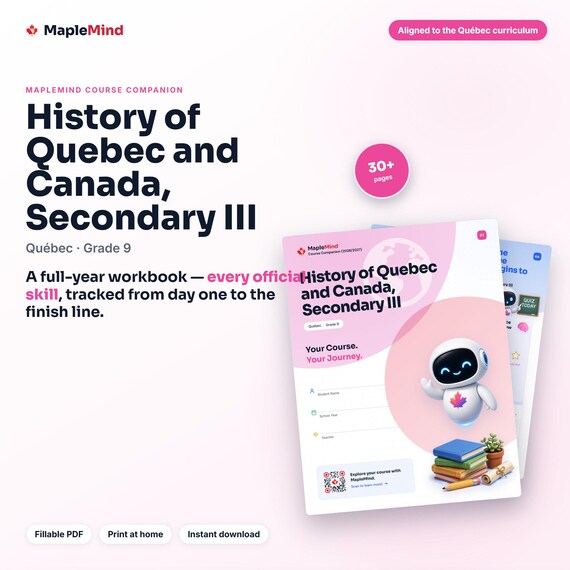
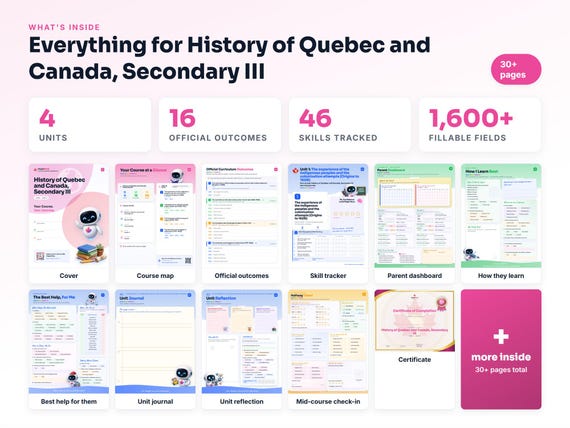
A History of Quebec and Canada, Secondary III workbook worth keeping
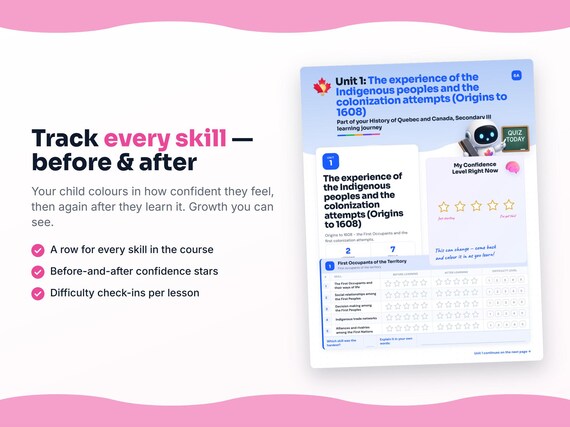
Built from the same official curriculum as this page. Before and after each skill above, your student colours in how sure they feel — so the two of you can see, on one page, what's clicking and what needs another look. It's a quiet way to follow how the year is really going.
By June it's full of their own handwriting: units worked through, confidence grown, a mid-year check-in, notes from parent-teacher night, and a certificate at the end. Less a worksheet, more a record of the year worth keeping on the shelf.
Instant download · see every page, reviews and the full description · five or more workbooks are $2.99 each
What it looks like in the app



Common questions
Can MapleMind help me with History of Quebec and Canada, Secondary III?
Yes. MapleMind's AI tutor covers all 46 skills in Quebec's History of Quebec and Canada, Secondary III — you pick the exact skill, and the tutor teaches it step by step: a short lesson, a worked example, solving together, then a skill check to show it stuck.
Is MapleMind aligned to Quebec's official curriculum?
Yes. Every skill in this course maps to an official outcome code from Quebec's Grade 9 Social Studies curriculum, and the ministry's own wording is quoted under each unit on this page — with the official government source linked so you can check it yourself.
What does MapleMind cost?
It's free to start — 5 tutoring chats and a practice quiz every day, no credit card. A Pro subscription ($9.99/month or $49.99/year CAD, 7-day free trial) unlocks unlimited tutoring, practice, and exam simulations.
What if I'm stuck on just one topic?
That's the point of skill-level tutoring: open History of Quebec and Canada, Secondary III in the app, tap the exact skill from the list on this page, and the tutor teaches just that — no wading through lessons you don't need.
Does MapleMind work in French or other languages?
Yes — 14 languages, including French. Both the app and the tutor's explanations switch to the language you choose.
Where can I see the official Quebec curriculum for History of Quebec and Canada, Secondary III?
The official source is linked on this page — Québec's official education program. The outline here follows it: every MapleMind skill carries its official outcome code, and the ministry's own wording is quoted under each unit.
Keep exploring
Ready when you are
Pick a skill from this page and see it taught properly — free, in the browser, in under a minute.