Get help with History and Citizenship Education, Secondary Cycle One (Secondary 1-2)
Most tutoring makes you sit through material you already know. MapleMind flips that: pick the exact skill that's causing trouble — any of the 50 below — and the tutor teaches just that one, step by step, as many times as it takes. Ask questions in plain words, any time of day, in English, French, or 12 other languages.
The official Quebec History and Citizenship Education, Secondary Cycle One (Secondary 1-2) curriculum
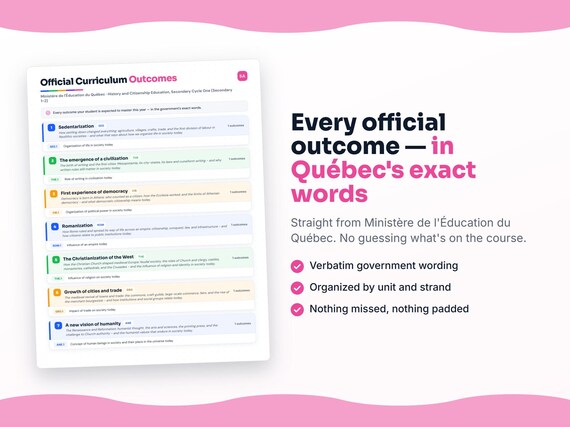
Quebec defines History and Citizenship Education, Secondary Cycle One (Secondary 1-2) by strands and outcomes. MapleMind teaches the same curriculum reorganized for one-skill-at-a-time tutoring — the table shows exactly where every official strand lands, and the ministry's own wording is quoted under each unit below.
Official source Québec's official education programRead it on the government site — quebec.ca ↗Every skill below, taught one on one.
 Try the first session free
How MapleMind teaches History and Citizenship Education, Secondary Cycle One (Secondary 1-2) — every unit, lesson, and skill
Every skill below runs as a short session: a plain-words lesson, a worked example, solving it together, then a five-question skill check that earns up to three stars. Guided Mode keeps it teaching instead of answer-handing — turning it off needs a parent's password.
Unit 1SedentarizationOfficial strand · HCE
How settling down changed everything: agriculture, villages, crafts, trade, and the first division of labour in Neolithic societies - and what that says about how we organize life in society today.
Settling Down: The Neolithic Revolution
- How we organize life in society todayHCE.001 — Describe the relationships and interdependence that organize life in society today.
- Agriculture, villages, and the first craftsHCE.004 — Explain how agriculture led Neolithic societies to settle in villages, develop crafts, and begin trade.
- Sedentary life then and nowHCE.016 — Connect the division of labour to the economic sectors today, and identify change and continuity in sedentary life.
The official wording — 3 outcomes in this unit
- HCE.001
Organization of life in society today
- HCE.004
Sedentarization and organization of life in society
- HCE.016
Relationships between individuals and society today
Unit 2The emergence of a civilizationOfficial strand · HCE
The birth of writing and the first cities: Mesopotamia, its city-states, its laws and cuneiform writing - and why written rules still matter in society today.
Writing and the First Civilization
- The role of writing todayHCE.019 — Explain the role writing plays in civilization today, including the consequences of illiteracy.
- Cuneiform and the spread of cultureHCE.023 — Describe cuneiform writing and explain how writing spread Mesopotamian culture and knowledge.
- Written rules in society todayHCE.040 — Explain the meaning and purpose of written rules and conventions in society today.
The official wording — 3 outcomes in this unit
- HCE.019
Role of writing in civilization today
- HCE.023
Influence of writing on Mesopotamian civilization
- HCE.040
Meaning and purpose of rules and conventions in society today
Unit 3First experience of democracyOfficial strand · HCE
Democracy is born in Athens: who counted as a citizen, how the Ecclesia worked, and the limits of Athenian democracy - and what democratic citizenship means today.
Democracy Begins in Athens
- How political power is organized todayHCE.045 — Explain how political power is organized today, including elected offices and the constitution.
- Democracy in fifth-century AthensHCE.048 — Explain how democracy worked in fifth-century Athens, who counted as a citizen, and its real limits.
- Being a citizen in a democracy todayHCE.061 — Explain the rights, responsibilities, and principles of democratic citizenship today.
The official wording — 3 outcomes in this unit
- HCE.045
Organization of political power in society today
- HCE.048
First experience of democracy and political life in Athens in the fifth century
- HCE.061
Relationships between individuals and democratic society today
Unit 4RomanizationOfficial strand · HCE
How Rome ruled and spread its way of life across an empire: citizenship, conquest, law, and infrastructure - and how citizens relate to public institutions today.
Rome and the Making of an Empire
- How empires exert influence todayHCE.066 — Explain how one state exerts influence over others today.
- Roman society, citizenship, and conquestHCE.070 — Explain Roman society and citizenship and how Rome conquered and governed its empire.
- Roman law, infrastructure, and legacyHCE.070 — Explain Roman law, infrastructure, and cultural legacy, and why the empire fell.
- Citizens and public institutions todayHCE.086 — Explain the rights of citizenship and the public institutions citizens encounter today.
The official wording — 3 outcomes in this unit
- HCE.066
Influence of an empire today
- HCE.070
Romanization and role of the state in the Romanization of the Empire
- HCE.086
Relationships between citizens and public institutions today
Unit 5The Christianization of the WestOfficial strand · HCE
How the Christian Church shaped medieval Europe: feudal society, the roles of Church and clergy, castles, monasteries, cathedrals, and the Crusades - and the influence of religion and identity in society today.
The Church and the Medieval West
- The influence of religion on society todayHCE.090 — Explain the influence of religion on society today, including freedom of religion.
- The Church and feudal societyHCE.094 — Explain how the Church shaped feudal society - its institutions, social roles, and relationships of dependence.
- Castles, cathedrals, and the CrusadesHCE.094 — Describe the great buildings of the medieval Church and explain the Crusades and pilgrimages.
- Identity and values in Western society todayHCE.114 — Explain the characteristics of identity and the marks of religious life in Western society today.
The official wording — 3 outcomes in this unit
- HCE.090
Influence of religion on society today
- HCE.094
Influence of the Church on the development of the West
- HCE.114
Values and characteristics of identity in Western society today
Unit 6Growth of cities and tradeOfficial strand · HCE
The medieval revival of towns and trade: the commune, craft guilds, large-scale commerce, fairs, and the rise of the merchant bourgeoisie - and how institutions and social groups relate today.
Towns, Trade, and the Merchant Bourgeoisie
- The impact of trade on society todayHCE.117 — Explain the impact of trade on society today, including its effect on cities.
- Medieval towns, guilds, and the bourgeoisieHCE.122 — Explain how medieval towns, guilds, and large-scale trade grew and gave rise to the merchant bourgeoisie.
The official wording — 3 outcomes in this unit
- HCE.117
Impact of trade on society today
- HCE.122
Growth of cities and trade and the rise of the merchant bourgeoisie in the Middle Ages
- HCE.137
Relationships between institutions and social groups today
Unit 7A new vision of humanityOfficial strand · HCE
The Renaissance and Reformation: humanist thought, the arts and sciences, the printing press, and the challenge to Church authority - and the humanist values that endure in society today.
Humanism, the Renaissance, and the Reformation
- Our concept of human beings todayHCE.143 — Explain different concepts of human beings and their place in the universe today.
- Humanist thought and Renaissance art and scienceHCE.146 — Explain humanist thought and the art, science, and printing of the Renaissance.
- The Reformation and the challenge to the ChurchHCE.146 — Explain the Reformation - why people challenged the Church, the Protestant churches, and the Catholic response.
- Humanist values in society todayHCE.164 — Explain the humanist values that endure in Western society today.
The official wording — 3 outcomes in this unit
- HCE.143
Concept of human beings in society and their place in the universe today
- HCE.146
New vision of humanity and contribution of humanist ideas to the development of Western culture
- HCE.164
Humanist values in Western society today
Unit 8European expansion in the worldOfficial strand · HCE
The age of European exploration and its first world economy: the great voyages, colonial empires, the triangular trade including the trade in enslaved people, and the devastating consequences of European expansion for the Native peoples of the Americas. Taught truthfully and unsoftened.
Exploration, Empire, and the First World Economy
- Commercial colonialism todayHCE.168 — Explain the major economic powers and the effects of the globalized economy today.
- The great explorations and colonial empiresHCE.171 — Explain the great European explorations and the colonial empires they built.
- The triangular trade and its consequences for the AmericasHCE.171 — Explain the triangular trade, including the forced trade in enslaved people, and the devastating consequences of European expansion for the Native peoples of the Americas.
- Economic and cultural relationships between societies todayHCE.185 — Explain the lasting economic and cultural relationships between societies today.
The official wording — 3 outcomes in this unit
- HCE.168
Commercial colonialism today
- HCE.171
European expansion in the world and the effects of an initial form of world economy on the societies
- HCE.185
Economic and cultural relationships between societies today
Unit 9The American or French revolutionOfficial strand · HCE
The age of revolutions: Enlightenment ideas, the separation of powers, and how the American or French revolution won and recognized fundamental rights - and how rights are affirmed and guaranteed today.
Revolution and the Rights of Citizens
- The affirmation of fundamental rights todayHCE.188 — Explain how fundamental rights are affirmed today through charters and declarations.
- Enlightenment ideas and the age of revolutionHCE.191 — Explain the Enlightenment ideas behind the American or French revolution and how revolutions won fundamental rights.
- Guarantees of rights and freedoms todayHCE.196 — Explain how rights and freedoms are guaranteed in society today, including internationally.
The official wording — 3 outcomes in this unit
- HCE.188
Affirmation of fundamental rights today
- HCE.191
The American or French revolution and the role of revolutions in the conquest and recognition of
- HCE.196
Guarantees of rights and freedoms in society today
Unit 10Industrialization : an economic and social revolutionOfficial strand · HCE
The Industrial Revolution in Britain: mechanized production, new social classes, harsh working conditions, and the rise of unions and socialism - and the effort to improve living conditions today.
The Industrial Revolution
- The impact of industrialization todayHCE.199 — Explain the impact of industrialization on society today, including which countries are industrializing.
- Industrial Britain: production and new classesHCE.203 — Explain how industrialization transformed production and created new social classes in Britain.
- Improving living conditions todayHCE.223 — Explain how individuals and institutions work to improve living conditions in society today.
The official wording — 3 outcomes in this unit
- HCE.199
Impact of industrialization on society today
- HCE.203
Industrialization, an economic and social revolution, and its effects on British society
- HCE.223
Contribution of individuals and institutions to the improvement of living conditions in society
Unit 11Imperialism and colonizationOfficial strand · HCE
The expansion of the industrial world into Africa: the motives and justifications of imperialism, the Berlin Conference's division of Africa, and how European domination affected and was resisted by African populations. Taught truthfully and unsoftened.
Imperialism and the Division of Africa
- Imperialism and colonization todayHCE.228 — Explain sovereignty and global wealth disparity in the world today.
- The motives of imperialism and the division of AfricaHCE.232 — Explain the motives and justifications of European imperialism in Africa and how the Berlin Conference divided the continent.
- The African experience of colonization and resistanceHCE.232 — Explain how colonization affected African populations and how they reacted to European dominance.
- Relationships among societies todayHCE.246 — Explain the political, economic, and cultural relationships among societies today, including between former colonies and colonial powers.
The official wording — 3 outcomes in this unit
- HCE.228
Imperialism and colonization today
- HCE.232
Expansion of the industrial world and the effects of European imperialism on African populations
- HCE.246
Political, economic and cultural relationships among societies today
Unit 12Winning of civil rights and freedomsOfficial strand · HCE
The 20th-century struggles that won civil rights and freedoms: the feminist movement, the Black civil rights movement, and decolonization - their wrongs, figures, actions, and gains - and the individual's responsibility in defending rights today.
Winning Civil Rights and Freedoms
- Civil rights and freedoms todayHCE.251 — Explain what civil rights and freedoms are today, and how they can be denied or limited.
- The feminist movementHCE.255 — Explain how the feminist movement fought for and won women's rights in the 20th century.
- The Black civil rights movement and decolonizationHCE.255 — Explain how the Black civil rights movement and decolonization won rights and independence in the 20th century.
- The individual's responsibility for rights todayHCE.277 — Explain the individual's responsibility in the struggle for and recognition of civil rights and freedoms today.
The official wording — 3 outcomes in this unit
- HCE.251
Civil rights and freedoms today: denial, struggle and recognition
- HCE.255
Recognition of civil rights and freedoms and impact on societies of the winning of civil rights
- HCE.277
Responsibilities of individual in the struggle for and recognition of civil rights and freedoms
Unit 13Techniques used in History and Citizenship EducationOfficial strand · HCE
The historian's toolkit: reading and building timelines, drawing and interpreting historical maps, and interpreting written, illustrated, and statistical sources. Method skills taught in their own right, woven through the study of every phenomenon.
Working with Timelines
- Reading a chronological scaleHCE.281 — Interpret a chronological scale to find information, compare durations, and identify continuity and change.
- Constructing a timelineHCE.287 — Construct a timeline with its axis, scale, segments, and title.
Drawing and Interpreting Historical Maps
- Drawing a historical mapHCE.297 — Draw a historical map with the essential elements a map needs.
- Interpreting a historical mapHCE.306 — Interpret a historical map using its title, scale, orientation, and legend.
Interpreting Historical Sources
- Interpreting written and illustrated documentsHCE.313 — Interpret written and illustrated historical documents by checking their source, nature, and main ideas.
- Interpreting and constructing a table and graphHCE.329 — Interpret and construct a table and graph to read and present historical data.
The official wording — 6 outcomes in this unit
- HCE.281
learning situations that allow students to use different techniques
- HCE.287
Constructs a time line
- HCE.297
Draws a map
- HCE.306
Interprets a map
- HCE.313
Interprets a written document
- HCE.329
Interprets a table and diagram
Printable workbook · A keepsake of the year
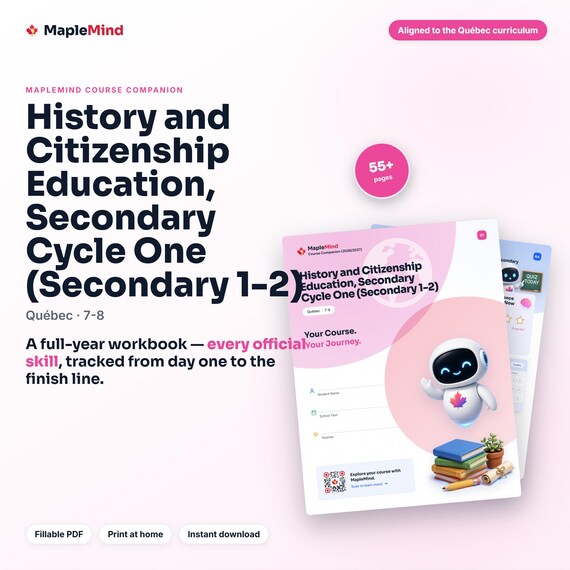
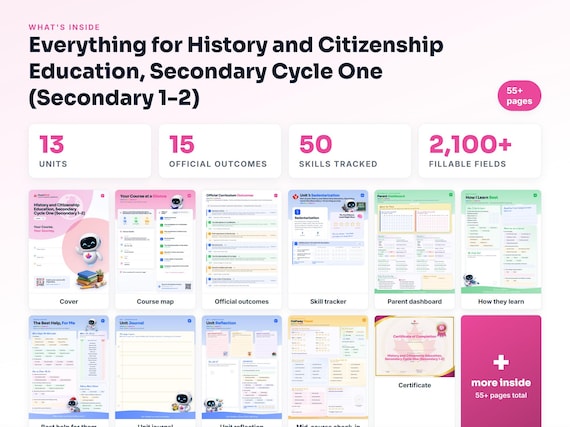
A History and Citizenship Education, Secondary Cycle One (Secondary 1-2) workbook worth keeping
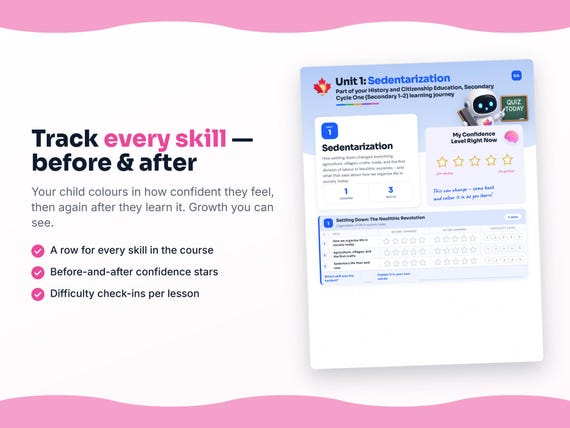
Built from the same official curriculum as this page. Before and after each skill above, your student colours in how sure they feel — so the two of you can see, on one page, what's clicking and what needs another look. It's a quiet way to follow how the year is really going.
By June it's full of their own handwriting: units worked through, confidence grown, a mid-year check-in, notes from parent-teacher night, and a certificate at the end. Less a worksheet, more a record of the year worth keeping on the shelf.
Instant download · see every page, reviews and the full description · five or more workbooks are $2.99 each
What it looks like in the app



Common questions
Can MapleMind help me with History and Citizenship Education, Secondary Cycle One (Secondary 1-2)?
Yes. MapleMind's AI tutor covers all 50 skills in Quebec's History and Citizenship Education, Secondary Cycle One (Secondary 1-2) — you pick the exact skill, and the tutor teaches it step by step: a short lesson, a worked example, solving together, then a skill check to show it stuck.
Is MapleMind aligned to Quebec's official curriculum?
Yes. Every skill in this course maps to an official outcome code from Quebec's Grades 7–8 Social Studies curriculum, and the ministry's own wording is quoted under each unit on this page — with the official government source linked so you can check it yourself.
What does MapleMind cost?
It's free to start — 5 tutoring chats and a practice quiz every day, no credit card. A Pro subscription ($9.99/month or $49.99/year CAD, 7-day free trial) unlocks unlimited tutoring, practice, and exam simulations.
What if I'm stuck on just one topic?
That's the point of skill-level tutoring: open History and Citizenship Education, Secondary Cycle One (Secondary 1-2) in the app, tap the exact skill from the list on this page, and the tutor teaches just that — no wading through lessons you don't need.
Does MapleMind work in French or other languages?
Yes — 14 languages, including French. Both the app and the tutor's explanations switch to the language you choose.
Where can I see the official Quebec curriculum for History and Citizenship Education, Secondary Cycle One (Secondary 1-2)?
The official source is linked on this page — Québec's official education program. The outline here follows it: every MapleMind skill carries its official outcome code, and the ministry's own wording is quoted under each unit.
Ready when you are
Pick a skill from this page and see it taught properly — free, in the browser, in under a minute.