Prince Edward Island · For parents

What your child learns in Grade 12 in Prince Edward Island

Every subject, unit by unit, from Prince Edward Island’s curriculum: 477 skills in plain words.

Subjects
5
Skills
477
Provincial exams
None
Official curriculum
princeedwardisland.ca

Math in Grade 12

5 courses. Choose the one your child takes.

Applied Mathematics

MAT801A · 6 units · 46 skills

  1. Unit 1

    Number

    A fraction names equal parts of a whole or a set.

    • Simple fractional parts
    • Fractions and mixed numbers
    • Renaming fractions
    1 more skill
    • Comparing and ordering fractions
  2. Unit 2

    Operations

    Rounding to friendly numbers makes an estimate quick.

    • Mental math and estimation strategies
    • Applying estimation in problems
    • Operations with integers and decimals
    13 more skills
    • Adding and subtracting fractions
    • Fraction problems
    • Common fractions to decimals
    • Decimals to sixteenths
    • Adding and subtracting denominate numbers
    • Multiplying and dividing denominate numbers
    • Converting measurements mentally
    • Converting measurements using rate
    • Ratio and rafter proportions
    • Estimating materials and cost
    • Percent in problems
    • Lineal feet and board feet
    • Dry cells in series and parallel
  3. Unit 3

    Patterns and Relations

    In a right triangle, a squared plus b squared equals c squared.

    • Identifying right angles
    • Scale developments
    • Rafter length with Pythagoras
    7 more skills
    • Solving for a side with Pythagoras
    • Equivalent resistance
    • Ohm's Law
    • Analysing series and parallel circuits
    • Electrical power
    • Electrical energy
    • Perimeter and surface area patterns
  4. Unit 4

    Measurement

    Metric rulers and tapes read in millimetres, centimetres, and metres.

    • Metric measuring devices
    • Imperial measuring devices
    • Scale measuring devices
    1 more skill
    • Electrical measuring devices
  5. Unit 5

    Geometry (Spatial Sense)

    A mat plan shows how many cubes stand on each square of a base.

    • Shapes from mat plans and orthographic drawings
    • Orthographic drawings from mat plans
    • Isometric drawings from mat plans
    8 more skills
    • Identifying composite isometric drawings
    • Hidden and missing lines
    • Isometric and orthographic conversion
    • Perimeter of polygons and circles
    • Surface areas of polygons, circles and prisms
    • Volumes of right prisms
    • Surface area and volume patterns
    • Constructing right prisms
  6. Unit 6

    Data Management

    A table, tally, or chart makes data easier to read and total.

    • Organizing and compiling data

Apprenticeship and Workplace Mathematics 12

MAT621K · 4 units · 26 skills

  1. Unit 1

    Geometry

    The sine law says each side over the sine of its opposite angle is equal.

    • Solving problems with the sine law
    • Solving problems with the cosine law
    • Choosing the right law for the job
    9 more skills
    • Problems involving triangles
    • Problems involving quadrilaterals
    • Problems involving regular polygons
    • Composite and irregular figures
    • Translations of shapes and objects
    • Rotations of shapes and objects
    • Reflections of shapes and objects
    • Dilations of shapes and objects
    • Combining transformations to map a figure
  2. Unit 2

    Measurement

    Precision is the smallest division an instrument can read.

    • Precision of a measuring instrument
    • Accuracy of a measurement
    • Uncertainty in a measurement
    2 more skills
    • Tolerance and solving problems
    • Tolerance stack-up problems
  3. Unit 3

    Number

    Looking at small or end cases first reveals a pattern.

    • Finding a winning strategy
    • Problem-solving techniques for puzzles
    • Logical reasoning on the job
    3 more skills
    • Buying a vehicle
    • Leasing a vehicle
    • Leasing to buy, and comparing options
  4. Unit 4

    Permutations, Combinations and Binomial Theorem

    A probability is a number from 0 to 1, or a percent, giving the chance of an event.

    • Interpreting a probability
    • Odds and likelihood
    • Using probability to make decisions

Calculus 12

MAT611B · 1 unit · 22 skills

  1. Unit 1

    Calculus

    A limit is the value a function approaches as x approaches a point.

    • Solving problems involving limits
    • Asymptotic and end behaviour
    • Continuity
    19 more skills
    • The derivative as instantaneous rate of change
    • The derivative from the definition
    • The basic derivative rules
    • Product and quotient rules
    • Rates of change and motion
    • Derivatives of trigonometric functions
    • The chain rule
    • Inverse trigonometric functions
    • Exponential and logarithmic functions
    • Analysing a function for its graph
    • Sketching the graph of a function
    • Setting up an optimization problem
    • Solving an optimization problem
    • Linearization and Newton's Method
    • Related rates
    • The indefinite integral
    • The definite integral
    • Area between curves
    • Accumulation and other applications
See the course: Calculus 12

Foundations of Mathematics 12

MAT621A · 4 units · 30 skills

  1. Unit 1

    Financial Mathematics

    Compound interest earns interest on both the principal and past interest.

    • Calculating compound interest
    • Compound interest in decisions
    • Costs of renting, leasing and buying
    3 more skills
    • Benefits and choosing an option
    • Interest rate and rate of return
    • Total return of a portfolio
  2. Unit 2

    Logical Reasoning

    Number puzzles reveal patterns that a strategy can exploit.

    • Numerical reasoning in puzzles
    • Logical reasoning in games
    • Sets and set operations
    3 more skills
    • Solving set-theory problems
    • Conditional statements and their forms
    • Reasoning with conditional statements
  3. Unit 3

    Permutations, Combinations and Binomial Theorem

    Probability is favourable outcomes over all outcomes.

    • Interpreting odds and probability
    • Assessing the validity of claims
    • Mutually exclusive and non-mutually exclusive events
    9 more skills
    • Applying the addition rule
    • Probability of two events
    • Conditional probability of two events
    • The fundamental counting principle
    • The counting principle with restrictions
    • Permutations
    • Permutations with restrictions
    • Combinations
    • Applying combinations
  4. Unit 4

    Relations and Functions

    A polynomial of degree at most 3 can model curved data.

    • Fitting a polynomial model to data
    • Solving problems with a polynomial model
    • Fitting exponential and logarithmic models
    3 more skills
    • Solving problems with exponential and logarithmic models
    • Fitting a sinusoidal model to data
    • Solving problems with a sinusoidal model

Pre-Calculus 12

MAT621B · 3 units · 37 skills

  1. Unit 1

    Permutations, Combinations and Binomial Theorem

    The counting principle multiplies the options at each independent stage.

    • Counting principle and permutations
    • Combinations
    • The binomial theorem
    1 more skill
    • A specific term of a binomial expansion
  2. Unit 2

    Relations and Functions

    Function operations combine outputs for each common input.

    • Operations on functions
    • Composition of functions
    • Translations of graphs
    19 more skills
    • Stretches of graphs
    • Applying translations and stretches
    • Transformed equations
    • Reflections in the axes
    • Reflection in the line y = x
    • Inverses of relations
    • Understanding logarithms
    • The product, quotient and power laws
    • The power law and change of base
    • Graphing exponential functions
    • Graphing logarithmic functions
    • Exponential equations
    • Logarithmic equations
    • Factoring higher-degree polynomials
    • Graphing polynomial functions
    • Roots and intercepts of polynomials
    • Graphing radical functions
    • Graphing rational functions
    • Sketching rational functions
  3. Unit 3

    Trigonometry

    An angle in standard position starts on the positive x-axis.

    • Angles in standard position
    • The unit circle
    • The six trigonometric ratios
    8 more skills
    • Reciprocal trigonometric ratios
    • Graphing sine and cosine
    • Graphing tangent
    • Solving trigonometric equations
    • Second-degree trigonometric equations
    • Reciprocal, quotient and Pythagorean identities
    • Sum and difference identities
    • Double-angle identities

Science in Grade 12

5 courses. Choose the one your child takes.

Biology 12 (BIO621A)

5 units · 29 skills

  1. Unit 1

    Working Like a Biologist

    Biology technologies are developed through research over time.

    • Evaluating a biology technology
    • Safe laboratory protocols
    • Collecting and analysing data
    5 more skills
    • Uncertainty in measurement
    • Evaluating phenomena with argumentation
    • Designing a controlled experiment
    • Communicating research and results
    • Constructing an argument from evidence and perspectives
  2. Unit 2

    Reproduction and Cell Division

    The cell cycle includes interphase (growth and DNA copying) and division.

    • The cell cycle and mitosis
    • Meiosis and genetic diversity
    • Plant reproduction
    3 more skills
    • Human reproductive systems and hormones
    • Fertilization and embryonic development
    • Birth and positive feedback
  3. Unit 3

    Genetics

    Mendel's principles: dominance, segregation, and independent assortment.

    • Mendelian inheritance and crosses
    • Non-Mendelian and sex-linked inheritance
    • DNA and RNA structure and replication
    2 more skills
    • The central dogma of gene expression
    • Genetic variation and mutation
  4. Unit 4

    Evolution and Biodiversity

    Before the modern era, species were thought to be fixed and unchanging.

    • The history of evolutionary thought
    • Mechanisms of evolution and natural selection
    • The evidence for evolution
    6 more skills
    • How new species form
    • Hardy-Weinberg and microevolution
    • Taxonomy and classification
    • Phylogeny and evolutionary relationships
    • The diversity of the kingdoms
    • Animal diversity and the chordates
  5. Unit 5

    Disease and Homeostasis

    • Disease and its impact on homeostasis

Chemistry, Grade 12 (CHM621A)

5 units · 33 skills

  1. Unit 1

    Working Like a Chemist

    Technology is the application of scientific knowledge to a practical purpose.

    • Analysing the development of a chemical technology
    • Safe laboratory protocols and WHMIS
    • Collecting and analysing data
    5 more skills
    • Measurement uncertainty and error propagation
    • Evaluating phenomena with argumentation
    • Designing a controlled experiment
    • Communicating plans, data, and results
    • Evaluating the risks and benefits of a technology
  2. Unit 2

    Thermochemistry

    An exothermic change releases energy to the surroundings; an endothermic change absorbs it.

    • Thermochemistry terms and the first law
    • Specific heat capacity and temperature change
    • Molar enthalpy, heating curves, and change of state
    2 more skills
    • Potential-energy diagrams and thermochemical equations
    • Calorimetry, bond energies, and Hess's Law
  3. Unit 3

    Solutions, Kinetics, and Equilibrium

    Molarity (mol/L, M) is moles of solute divided by litres of solution.

    • Molarity of solutions
    • Dilutions and standard curves
    • Collision theory and factors affecting reaction rate
    4 more skills
    • Reaction mechanisms and catalysts
    • Equilibrium and the equilibrium constant expression
    • Kc calculations with ICE tables
    • Le Chatelier's Principle and predicting shifts
  4. Unit 4

    Acids and Bases

    An Arrhenius acid produces H+ (H3O+) in water; an Arrhenius base produces OH- in water.

    • Arrhenius and Bronsted-Lowry definitions
    • Classifying and naming acids and bases
    • Proton transfer and conjugate acid-base pairs
    4 more skills
    • Strong and weak acids and Ka/Kb
    • pH, pOH, and Kw calculations
    • Evaluating weak acid-base equilibria
    • Titrations, indicators, and titration curves
  5. Unit 5

    Redox and Electrochemistry

    Oxidation is loss of electrons; reduction is gain of electrons (OIL RIG).

    • Redox definitions and oxidation numbers
    • Identifying oxidizing and reducing agents
    • Balancing redox in neutral solution
    3 more skills
    • Balancing redox in acidic and basic solution
    • Structure and function of an electrochemical cell
    • Cell potential and spontaneity

Environmental Science 621A

ENV621A · 6 units · 62 skills

  1. Unit 1

    Inquiry Skills (Project Based Learning)

    Guided inquiry means working through a question step by step with support.

    • Investigating an issue with guided inquiry
    • Planning an investigation
    • Conducting investigations of relationships
    2 more skills
    • Analysing data and explanations
    • Communicating information and results
  2. Unit 2

    Introduction to Environmental Science

    Environmental science studies how humans and the natural world interact.

    • Understanding environmental science
    • Factors of sustainable development
    • Stewardship and sustainability
    3 more skills
    • Interpretations of environmental science
    • The precautionary principle
    • Critical thinking about environmental issues
  3. Unit 3

    Ecological Principles

    A system is a set of interacting parts that work as a whole.

    • The concept and scale of systems
    • Abiotic and biotic factors
    • Earth's life-support system
    7 more skills
    • How balance is maintained in ecosystems
    • Cycling of matter and biogeochemical cycles
    • Measuring abiotic factors
    • Human impact on living and nonliving systems
    • Types of biodiversity
    • Loss of diversity and sustainability
    • Organizations preserving ecosystems
  4. Unit 4

    Human Population and Carrying Capacity

    Every ecosystem has limited resources such as food, water, and space.

    • Resource limits and natural populations
    • Population growth, resource demand, and consumerism
    • Ecological footprint
    4 more skills
    • PEI resource and land use over time
    • Landowner rights and responsibilities
    • From natural resources to natural capital
    • Earth's carrying capacity
  5. Unit 5

    Natural Resources

    Responsible development balances use with conservation.

    • Responsibly developing Earth's resources
    • Types of agriculture
    • Strategies affecting global food production
    16 more skills
    • Agriculture in Prince Edward Island
    • Organic and traditional farming
    • Soil conservation, erosion, and degradation
    • Environmental impacts from agriculture
    • Sustainable water use
    • Water resources and international relations
    • Global fishery management
    • Environmental impacts of fishing techniques
    • Ocean resources and Prince Edward Island
    • Major forest regions of Canada
    • Forests as natural capital
    • Forest history on Prince Edward Island
    • Managing forests sustainably
    • Renewable and non-renewable energy
    • Future energy use on Prince Edward Island
    • Improving home energy efficiency
  6. Unit 6

    Environmental Challenges and Successes

    The atmosphere is layered by temperature and altitude.

    • The troposphere and stratosphere
    • How Earth's climate has changed over time
    • Greenhouse gases in the atmosphere
    12 more skills
    • Greenhouse effect versus global warming
    • Catastrophic effects of climate change
    • Climate change effects on Prince Edward Island
    • Anthropogenic carbon dioxide and climate change
    • Challenges and successes addressing climate change
    • Types, sources, and effects of air pollution
    • Types, sources, and effects of water pollution
    • Reducing air and water pollution
    • Testing for water pollutants
    • Types of solid domestic waste
    • Managing solid waste on Prince Edward Island
    • A course of action on waste management

Human Biology 801A

BIO801A · 11 units · 51 skills

  1. Unit 1

    Homeostasis

    Living things share features such as organization, metabolism, growth, response to stimuli, reproduction, homeostasis, and the use of energy.

    • The characteristics of living things
    • Cells, tissues, organs, and systems
    • Interdependence of body systems
  2. Unit 2

    Nutrition

    Essential nutrients include carbohydrates, proteins, fats, vitamins, minerals, and water.

    • Diseases from insufficient nutrients
    • Nutrition and the maintenance of homeostasis
    • Using apparatus and materials safely
    1 more skill
    • Compiling and organizing nutrition data
  3. Unit 3

    Digestive System

    Digestion mechanically and chemically breaks food into absorbable nutrients.

    • How digestion maintains homeostasis
    • Impact of disease on homeostasis
    • Careers in nutrition and digestion
  4. Unit 4

    Circulatory System

    The heart pumps blood through arteries, capillaries, and veins.

    • How circulation maintains homeostasis
    • Drugs and environmental factors on homeostasis
    • Designing an experiment with variables
    3 more skills
    • Communicating with multiple representations
    • Development of circulatory treatment technology
    • Alternative solutions to lifestyle disorders
  5. Unit 5

    Blood and Immunity

    Blood banking allows transfusions that save lives.

    • Risks and benefits of blood technologies
    • How blood maintains homeostasis
    • Careers in blood and circulation
    3 more skills
    • Allergens and homeostasis
    • How the immune system maintains homeostasis
    • Benefits of applying scientific knowledge
  6. Unit 6

    Respiratory System

    The lungs exchange oxygen and carbon dioxide with the blood at the alveoli.

    • How respiration maintains homeostasis
    • Careers related to respiration
    • Allergens and respiratory homeostasis
    2 more skills
    • Constructing evidence-based arguments
    • Scientific versus non-scientific questions
  7. Unit 7

    Excretory System

    The kidneys filter blood, removing wastes such as urea while keeping useful substances.

    • How excretion maintains homeostasis
    • Development of excretory treatment technology
    • Drugs and excretory homeostasis
    3 more skills
    • Perspectives in a science-related issue
    • How the skeletal system maintains homeostasis
    • Development of skeletal treatment technology
  8. Unit 8

    Muscular and Nervous Systems

    Muscles produce movement, maintain posture, and move materials inside the body.

    • How the muscular system maintains homeostasis
    • Impact of disease on muscular homeostasis
    • Drug technology and muscular performance
    5 more skills
    • Defending a position from findings
    • Careers related to movement
    • How the nervous system maintains homeostasis
    • Drugs and nervous-system homeostasis
    • Development of nervous-system treatment technology
  9. Unit 9

    Endocrine System

    Endocrine glands release hormones into the bloodstream.

    • How the endocrine system maintains homeostasis
    • Canadian contributions to science and technology
  10. Unit 10

    Reproductive Systems and Embryonic Development

    The male system produces and delivers sperm; the female system produces eggs and supports pregnancy.

    • Structure and function of the reproductive systems
    • Careers related to reproduction
    • The human reproductive cycle
    3 more skills
    • Evaluating reproductive technologies
    • Health risks of sexually transmitted infections
    • Conditions during pregnancy and delivery
  11. Unit 11

    Genetics

    Chromosomes carry genes made of DNA.

    • Chromosomes and the transmission of heredity
    • Circumstances that lead to genetic disease

Physics, Grade 12 (PHY621A)

4 units · 39 skills

  1. Unit 1

    Working Like a Physicist

    A prototype is a working model built to test a design idea.

    • Building and testing a prototype
    • Evaluating a device you designed
    • Designing an experiment
    19 more skills
    • Carrying out procedures and controlling variables
    • Using instruments accurately
    • Compiling and organizing data
    • Displaying evidence in varied formats
    • Interpreting patterns and relationships in data
    • Choosing modes of representation
    • Defining and delimiting problems
    • Stating predictions and hypotheses
    • Designing an experiment and identifying variables
    • Estimating quantities
    • Using apparatus and materials safely
    • Communicating and responding to ideas
    • Distinguishing scientific questions and technological problems
    • How a technology developed over time
    • Technologies developed from scientific understanding
    • Canadian contributions to science and technology
    • Evidence, theories, and paradigms
    • The importance of peer review
    • How a milestone revolutionized thinking
  2. Unit 2

    Application of Vectors

    Projectile motion separates into independent horizontal and vertical components.

    • Horizontal and vertical motion of a projectile
    • Two-dimensional vector analysis of masses and relative motion
    • Static equilibrium and static torque
  3. Unit 3

    Circular and Planetary Motion

    In uniform circular motion, speed is constant but velocity changes because direction changes.

    • Describing uniform circular motion
    • Circular motion with Newton's laws
    • Simple harmonic motion: displacement, velocity, acceleration
    1 more skill
    • Energy in SHM and Kepler's laws
  4. Unit 4

    Electricity and Magnetism

    Static charge is produced when electrons transfer between materials.

    • Producing static electric charge
    • Properties of static electric charges
    • Static electricity versus electric current
    7 more skills
    • Fields as regions that affect mass and charge
    • Field lines: source and direction
    • Electric fields by charge, magnetic fields by poles
    • Newton's law of gravitation and Coulomb's law
    • Electromagnetic induction
    • Force on a moving charge and current
    • Magnetic field of a solenoid and conductor

English in Grade 12

English Language Arts 12 (ENG621A)

3 units · 31 skills

  1. Unit 1

    Speaking and Listening

    At Grade 12, responding to complex questions is used to extend thinking, not just answer.

    • Roles and responsibilities of an effective speaker and listener
    • Analysing others' viewpoints through active listening
    • Responding to complex questions to extend own and others' ideas
    6 more skills
    • Examining a mentor defence with spontaneous conversation
    • Interacting with a critical audience to defend a viewpoint
    • Using language and rhetoric to influence and question
    • Examining a mentor text for critically evaluating oral text
    • Analysing verbal and nonverbal language in oral text
    • Identifying strengths and areas for improvement in oral language
  2. Unit 2

    Reading and Viewing

    Grade 12 moves from ENG10/11's 'examine' to ASSESS — a judgment about how effectively a text manipulates and persuades.

    • Comprehending complex texts using strategies
    • Identifying a text's purpose, structure, and characteristics
    • Assessing how texts manipulate and shape belief and power
    10 more skills
    • Making textual connections across a multi-genre study
    • Identifying the full range of literary devices
    • Inferring the author's purpose for a literary device
    • Making judgments about the effectiveness of literary devices
    • Identifying an author's portrayal of ideology
    • Analysing ideology across texts
    • Assessing the reliability of information
    • Selecting a wide variety of sophisticated, reliable sources
    • Balancing quantity with quality of resources
    • Evaluating the research and inquiry process
  3. Unit 3

    Writing and Other Ways of Representing

    Grade-12 forms centre on persuasion — expressive, persuasive, persuasive research, visual/multimedia, and creative multi-genre.

    • Using the writing process to develop a text
    • Selecting form, style, and content for audience and purpose
    • Using literary and rhetorical devices to persuade
    6 more skills
    • Developing a creative multi-genre collection
    • Assessing a text against success criteria
    • Giving specific, respectful suggestions for improvement
    • Understanding critical feedback as a powerful revision tool
    • Independently seeking feedback from others
    • Revising a text in response to feedback

French in Grade 12

Core French, Grade 12

FRE621A · 3 units · 13 skills

  1. Unit 1

    La production orale et l'ecoute

    Follow a complex argument on a world issue independently.

    • Active listening on world issues (autonomous)
    • Full comprehension of complex speech
    • Critically interpreting speaker intent
    4 more skills
    • Structuring autonomous speech on world issues
    • Speaking with autonomous fluency and precision
    • Debating world issues autonomously
    • Presenting a persuasive argument on a world issue
  2. Unit 2

    La lecture et le visionnement

    Handle abstract vocabulary by morphology, context and cognates.

    • Reading strategies for complex texts (autonomous)
    • Critically comprehending everyday text
    • Reading and interpreting a francophone-world text
  3. Unit 3

    L'ecriture et la representation

    Run the whole process independently: plan -> draft -> revise -> edit.

    • Autonomous self- and peer-revision
    • Writing a persuasive text on a world issue
    • Writing an analytical or reflective text

Social studies in Grade 12

2 courses. Choose the one your child takes.

Canadian History 621A

HIS621A · 7 units · 38 skills

  1. Unit 1

    Introduction

    Some questions recur throughout Canada's history.

    • Continuing and persistent questions
    • Significance of individuals, events, and symbols
  2. Unit 2

    Globalization

    Several theories explain how people first reached the Americas.

    • Theories of the peopling of the Americas
    • Indigenous accounts and emerging theories
    • The effects of Contact
    5 more skills
    • The effects of colonization
    • Evolving relationships shaping Canada
    • WWI and Canada's identity
    • WWII and Canada's identity
    • Canada's evolving late-20th-century roles
  3. Unit 3

    Development

    Aboriginal economies were adapted to the land and its resources.

    • How Aboriginal economies worked
    • Aboriginal trade and exchange
    • The Staple Trade and colonial development
    3 more skills
    • The National Policy and industrial growth
    • Free trade and Canada's development
    • Trends and policies shaping Canada's future
  4. Unit 4

    Governance

    First Nations had their own governing structures before Contact.

    • First Nations governing structures and worldviews
    • Treaties and post-Contact governance
    • Merging governing philosophies in BNA
    4 more skills
    • Political and economic roads to Confederation
    • Federalism from Confederation to Patriation
    • The shift to a multi-party system
    • The purpose of the Constitution
  5. Unit 5

    Sovereignty

    Sovereignty is a people's authority to govern themselves.

    • Global struggles for sovereignty
    • Conflict and compromise over sovereignty
    • Treaties, land claims, and re-establishing sovereignty
    3 more skills
    • Self-government and self-determination
    • The emergence of Quebec nationalism
    • External pressures on Canadian sovereignty
  6. Unit 6

    Justice

    First Nations had their own legal traditions and justice concepts.

    • First Nations contributions to the legal system
    • French and British contributions to the legal system
    • The relationship between land and culture
    4 more skills
    • The effects of displacement
    • Origins and effects of immigration policy
    • Inequities of power and responses to them
    • The evolution of rights and freedoms
  7. Unit 7

    Independent Study (Inquiry)

    The historical method starts with a focused research question.

    • Researching with the historical method
    • Communicating research findings

Prince Edward Island History 621B

HIS621B · 4 units · 20 skills

  1. Unit 1

    Unit 1: Land and Resources

    Epekwitk is the Mi'kmaq name for Prince Edward Island; 'Abegweit' is the anglicized historical form.

    • Mi'kmaq settlement and place names on Epekwitk
    • Site and situation in later settlement
    • Goods, colonial lands, and the Island's history
    2 more skills
    • Impact on the Island's resources and environment
    • Impact of a resource development initiative
  2. Unit 2

    Unit 2: People and Culture

    Material culture is the tangible things people make and use.

    • Material culture and the Island heritage
    • Non-material culture and the Island heritage
    • Mi'kmaq and Acadian foundations of the mosaic
    3 more skills
    • Later peoples of the cultural mosaic
    • Factors of cultural change
    • Globalization's future impact on Island culture
  3. Unit 3

    Unit 3: Power and Government

    The Mi'kmaq governed the Island long before colonial rule.

    • How decision making evolved on the Island
    • The impact of external governance
    • Federal governance and the marginalization of the Island's Mi'kmaq
    2 more skills
    • Factors that led the Island into Confederation
    • Factors influencing decision making today
  4. Unit 4

    Unit 4: Economies and Technologies

    The pre-Confederation economy rested on farming, fishing, timber, and shipbuilding.

    • Pre-Confederation Island industries
    • Economic impact of joining Confederation
    • Factors changing post-Confederation industries
    1 more skill
    • Globalization's impact on Island economies

MapleMind

See Grade 12 in MapleMind

Real screens from the app your child would use.

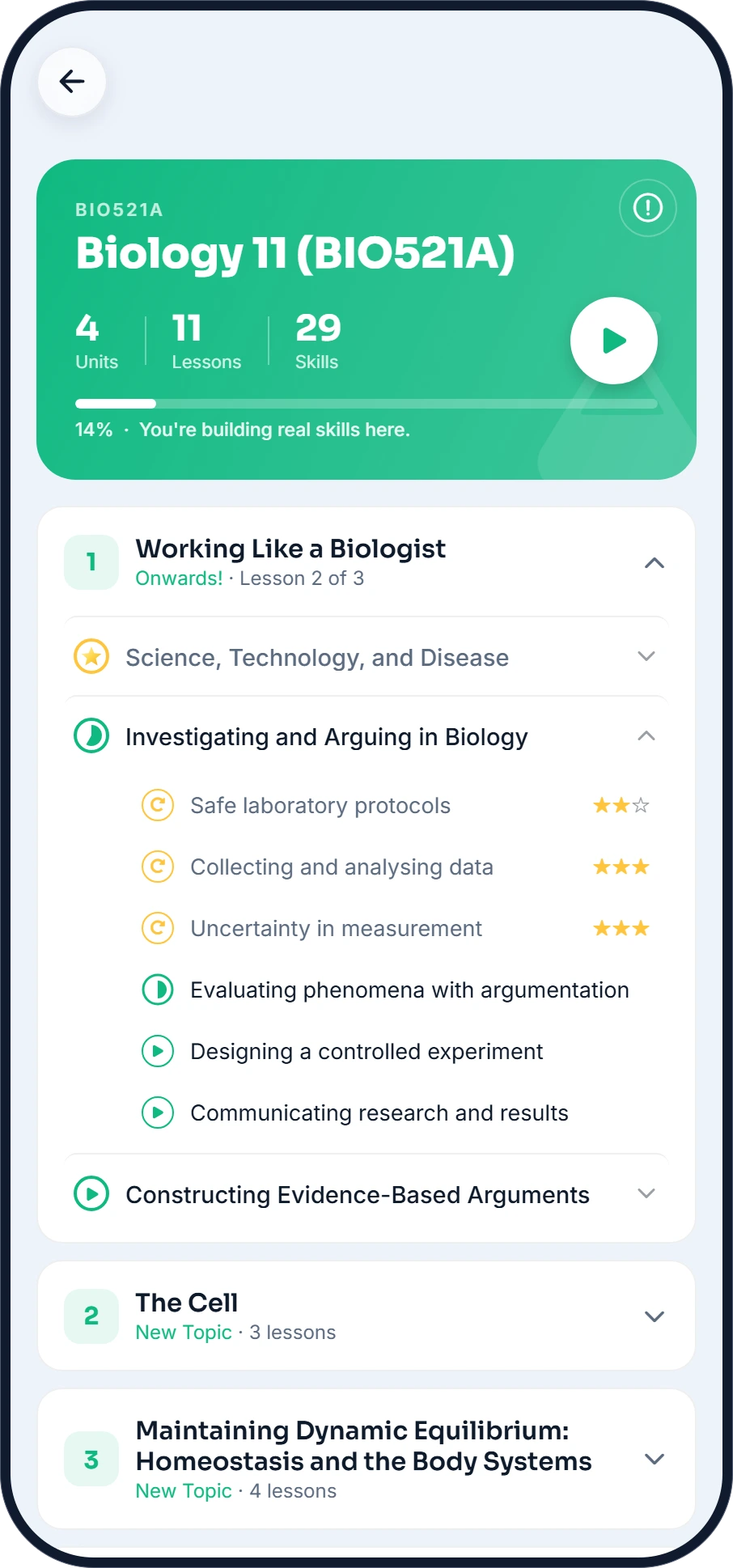
Biology 11 (BIO521A) in MapleMind on a tablet: its units and lessons in order, a student partway through.Biology 11 (BIO521A) in MapleMind on a phone: its units and lessons in order, a student partway through.
Their course, unit by unit, the way Prince Edward Island teaches it.Shown: Biology 11 (BIO521A)
Homework Help on a tablet: a photo of a worksheet, the tutor’s worked example of a two-step equation, and a question back to the student.Homework Help on a phone: a photo of a worksheet, the tutor’s worked example of a two-step equation, and a question back to the student.
Homework Help: they take a photo of the question, and the tutor works through it with them.
The Parent Dashboard on a tablet: a student’s days studied, streak, lessons, quiz average and recent activity.The Parent Dashboard on a phone: a student’s days studied, streak, lessons, quiz average and recent activity.
The Parent Dashboard: how each child’s week went, in lessons, quizzes and days studied.
A Grade 9 provincial mathematics exam on a tablet: a readiness score, the exam’s time and its next sitting.A Grade 9 provincial mathematics exam on a phone: a readiness score, the exam’s time and its next sitting.
A provincial exam: a practice sitting under the real time, and how ready they are.
The Learn tab on a tablet: a four-day streak, the week’s days, Homework Help, the next lesson and a review.The Learn tab on a phone: a four-day streak, the week’s days, Homework Help, the next lesson and a review.
The Learn tab: their week so far, and the next thing to do.

Help at home

Questions parents ask

What will my child learn in Grade 12 in Prince Edward Island?

Math: Applied Mathematics, Apprenticeship and Workplace Mathematics 12, Calculus 12, Foundations of Mathematics 12 and Pre-Calculus 12. Science: Biology 12 (BIO621A), Chemistry, Grade 12 (CHM621A), Environmental Science 621A, Human Biology 801A and Physics, Grade 12 (PHY621A). English: English Language Arts 12 (ENG621A). French: Core French, Grade 12. Social studies: Canadian History 621A and Prince Edward Island History 621B. That’s 477 skills in all, from Prince Edward Island’s curriculum.

Does my child write a provincial exam in Grade 12?

No. Prince Edward Island has no provincial exam in Grade 12.

Where does this list come from?

From Prince Edward Island’s official curriculum, the documents its education ministry publishes for each course. Each skill here is one of their expectations, written in plain words.

Can MapleMind help my child in Grade 12?

Yes. Every course on this page is in MapleMind, with lessons, practice and a tutor that works through each step with them. A free account gets 30 messages and 4 activities a day.

Help with Grade 12, one skill at a time.

Every course on this page is in MapleMind, free with daily limits.