Alberta · For parents

What your child learns in Grade 10 in Alberta

Every subject, unit by unit, from Alberta’s curriculum: 243 skills in plain words.

Subjects
5
Skills
243
Provincial exams
None
Official curriculum
alberta.ca

Math in Grade 10

2 courses. Choose the one your child takes.

Mathematics 10-3

MAT1793 · 4 units · 29 skills

  1. Unit 1

    Measurement

    The metric system was designed in France in the 1790s so that every unit steps by ten, and in 1960 it became the SI used around the world, Canada included since the 1970s.

    • Describing the SI (metric) units
    • Converting SI units to imperial
    • Describing and comparing imperial units
    8 more skills
    • Converting imperial units to SI
    • Estimating and measuring lengths
    • Solving linear measurement problems
    • Fractional measurements and midpoints
    • Area units, referents and conversions
    • Area of regular 2-D shapes
    • Area of composite and irregular shapes
    • Surface area of cylinders and cones
  2. Unit 2

    Geometry

    Angles are classed by size: acute under 90°, right exactly 90°, obtuse between 90° and 180°, straight exactly 180°, and reflex between 180° and 360°, so two arms always make two angles, such as 110° and 250°.

    • Drawing, replicating and constructing angles
    • Replicating and bisecting angles
    • Perpendicular and parallel lines, and angle pairs
    8 more skills
    • Angles from parallel, perpendicular and transversal lines
    • Identifying right triangles and verifying the theorem
    • Applying the Pythagorean theorem
    • Similarity of convex polygons
    • Developing the trig ratios from similar triangles
    • Applying the primary trigonometric ratios
    • Strategies for spatial puzzles and games
    • Correcting and varying spatial puzzles
  3. Unit 3

    Number

    A unit price is the price divided by the amount, in dollars for one unit: 750 g of cheese at $4.29 is 4.29 ÷ 7.5 = $0.572 for every 100 g.

    • Unit pricing and best buys
    • Currency exchange
    • Ways of earning an income
    2 more skills
    • Wages, salary, commission, piecework and gross pay
    • Deductions and net pay
  4. Unit 4

    Algebra

    A formula is used by putting each known value in for its letter, with its unit: P = 2l + 2w with l = 3.2 m and w = 1.5 m gives 2(3.2) + 2(1.5) = 9.4 m.

    • Applying formulas on the job
    • Rearranging formulas and checking solutions
Mathematics 10C

MAT1791 · 3 units · 41 skills

  1. Unit 1

    Measurement

    SI runs on powers of ten (mm, cm, m, km); imperial uses inches, feet, yards and miles with mixed factors (12 in = 1 ft, 3 ft = 1 yd, 5280 ft = 1 mi).

    • SI and imperial units
    • Estimation and measurement strategies
    • Converting within and between systems
    7 more skills
    • Conversion problem solving
    • Prisms and cylinders
    • Pyramids and cones
    • Spheres and mixed problems
    • The three primary ratios
    • Finding missing sides
    • Finding angles and solving problems
  2. Unit 2

    Algebra and Number

    Every whole number has one prime factorization (24 = 2³ × 3). The GCF takes the LOWEST power of each shared prime; the LCM takes the HIGHEST power of every prime present.

    • Prime factors, GCF and LCM
    • Square roots and cube roots
    • Identifying and simplifying radicals
    8 more skills
    • Ordering irrational numbers
    • Integral exponents and exponent laws
    • Rational exponents
    • Multiplying binomials
    • Multiplying larger polynomials
    • Common factors
    • Factoring trinomials
    • Difference of squares and perfect-square trinomials
  3. Unit 3

    Relations and Functions

    Read the AXES first — what quantities, what units. Then read segments as events: steepness is rate, flat is no change, falling is decrease.

    • Interpreting graphs in context
    • Graphs from descriptions
    • Relations and how to represent them
    17 more skills
    • Functions as special relations
    • Slope as rise over run
    • Slope as rate of change
    • Parallel and perpendicular slopes
    • Five representations
    • Moving between representations
    • Intercepts
    • Slope, domain and range
    • Slope–intercept form
    • General and slope–point forms
    • From a graph, or a point and slope
    • From two points, or a parallel/perpendicular line
    • Reading and writing f(x)
    • Function notation and graphs
    • Solving systems graphically
    • Substitution and elimination
    • Problem solving with systems

Science in Grade 10

2 courses. Choose the one your child takes.

Science 10

SCN1270 · 4 units · 18 skills

  1. Unit 1

    Energy & Matter in Chemical Change

    Atoms are built from three subatomic particles: protons (positive) and neutrons (neutral) in the nucleus, and electrons (negative) around it.

    • Particles that make up matter
    • How elements combine to form compounds
    • Naming ionic compounds (IUPAC)
    3 more skills
    • Naming simple molecular compounds (IUPAC)
    • Identifying and classifying chemical changes
    • Writing balanced equations & conservation of mass
  2. Unit 2

    Energy Flow in Technological Systems

    Technologies like the steam engine and Newcomen pump converted heat into useful work by trial and improvement, long before energy was understood as a conserved quantity.

    • Technology developed before the laws
    • Defining the measures of energy
    • Calculating energy and work
    1 more skill
    • Energy conservation and efficiency of transformations
  3. Unit 3

    Cycling of Matter in Living Systems

    The light microscope revealed that living things are made of cells (the cell theory: all living things are made of cells, cells are the units of life, and cells come from pre-existing cells).

    • Imaging technology and understanding of the cell
    • Function of cell organelles and structures
    • Modelling transport across the cell
    1 more skill
    • Specialized structures in plants
  4. Unit 4

    Energy Flow in Global Systems

    Earth receives short-wave solar energy and radiates long-wave terrestrial energy back to space; the net radiation budget (input minus output) sets the planet’s temperature.

    • Solar energy, terrestrial energy and the biosphere
    • Net solar energy, global transfer and climate
    • Climate and the world’s major biomes
    1 more skill
    • Environmental factors and climate change
See the course: Science 10

Science 14

SCN1288 · 4 units · 21 skills

  1. Unit 1

    Investigating Properties of Matter

    Every substance has properties you can observe — state (solid/liquid/gas), colour, smell, whether it burns, whether it is acidic (like vinegar) or basic (like bleach) — and those properties are how you tell substances apart and group them.

    • Classifying matter by its properties
    • Safe use, storage and disposal
    • Solutions, solubility, solutes and solvents
    3 more skills
    • Solutions in prepared foods and everyday materials
    • Properties of elements and compounds
    • Reading trends on the periodic table
  2. Unit 2

    Understanding Energy Transfer

    Thermal energy (heat) always flows from the hotter object to the colder one until they even out — a hot coffee cools to room temperature because heat leaves it, not because "cold gets in".

    • How heating & cooling systems move heat
    • Devices that control heat transfer
    • Simple machines that transfer energy
    1 more skill
    • Multiplying force or distance
  3. Unit 3

    Investigating Matter & Energy in Living Systems

    The digestive system breaks food into small nutrients and absorbs them into the blood; the circulatory system (heart, blood, vessels) then delivers those nutrients and oxygen to every cell and carries waste away.

    • How the two systems exchange matter
    • How digestion and circulation work together
    • Why a healthy diet and lifestyle matter
    4 more skills
    • Disorders of the digestive & circulatory systems
    • Plant and animal cell parts
    • How the cell theory developed
    • Life functions common to all living systems
  4. Unit 4

    Investigating Electromagnetic Energy

    Matter (water, carbon, nitrogen) is not used up — it moves through the biosphere along set cyclical pathways: water evaporates, forms clouds, rains, and returns; carbon moves between air, plants, animals and back.

    • Cyclical flow of matter along set pathways
    • How human activity disrupts the cycles
    • Biotic and abiotic components of an ecosystem
    1 more skill
    • What keeps an ecosystem in balance
See the course: Science 14

English in Grade 10

2 courses. Choose the one your child takes.

English Language Arts 10-1

ELA1105 · 4 units · 28 skills

  1. Unit 1

    Exploring Ideas & Perspectives

    A tentative understanding is a working idea held lightly — you commit enough to explore, not so hard you stop noticing evidence against it.

    • Forming tentative understandings
    • Experimenting with language, image and structure
    • Considering new perspectives
    2 more skills
    • Expressing preferences and expanding interests
    • Setting personal goals for language growth
  2. Unit 2

    Comprehending Literature & Other Texts

    Every text is made FOR someone, to do something: inform, persuade, entertain or inspire — spotting which reframes how you read it.

    • Discerning and analyzing context
    • Understanding and interpreting content
    • Using reference strategies
    6 more skills
    • Engaging prior knowledge
    • Relating form to purpose and content
    • Devices, techniques and their effects
    • Connecting self, text, culture and milieu
    • Evaluating texts with criteria
    • Appreciating effectiveness and artistry
  3. Unit 3

    Managing Ideas & Information (Inquiry & Research)

    Scope is a decision: too broad drowns you, too narrow starves you — define the parameters up front.

    • Focusing purpose and form
    • Planning and identifying sources
    • Selecting, recording and organizing information
    3 more skills
    • Evaluating sources and detecting bias
    • Forming generalizations and conclusions
    • Reviewing the inquiry process and findings
  4. Unit 4

    Creating Oral, Print & Multimedia Texts

    Every writing choice flows from two anchors: what am I trying to do (inform, persuade, entertain, inspire) and who am I doing it for — set these before anything else.

    • Assessing the text-creation context
    • Choosing form, structure and medium
    • Developing content
    5 more skills
    • Producing and presenting the text
    • Enhancing thought, support and detail
    • Enhancing organization
    • Addressing matters of stylistic choice
    • Editing for correctness

English Language Arts 10-2

ELA1104 · 4 units · 28 skills

  1. Unit 1

    Exploring Ideas & Perspectives

    A working understanding is a first take you test — not a final verdict.

    • Forming tentative understandings
    • Experimenting with language, image and structure
    • Considering new perspectives
    2 more skills
    • Expressing preferences and expanding interests
    • Setting personal goals for language growth
  2. Unit 2

    Comprehending Everyday & Workplace Texts

    Texts aim to inform, persuade, entertain or inspire — spotting which reframes how you read.

    • Discerning context
    • Understanding and interpreting content
    • Engaging prior knowledge
    6 more skills
    • Using reference strategies
    • Relating form to purpose
    • Devices that create clarity and emphasis
    • Connecting self, text, culture and milieu
    • Evaluating texts with criteria
    • Appreciating effectiveness and artistry
  3. Unit 3

    Managing Ideas & Information (Inquiry & Research)

    Scope is a decision — too broad drowns you, too narrow starves you.

    • Focusing purpose and form
    • Planning and identifying sources
    • Selecting, recording and organizing information
    3 more skills
    • Evaluating sources and detecting bias
    • Forming generalizations and conclusions
    • Reviewing the inquiry process and findings
  4. Unit 4

    Creating Texts

    Every writing choice flows from two anchors: what am I trying to do, and who am I doing it for — set these first.

    • Assessing the text-creation context
    • Choosing form, structure and medium
    • Developing content
    5 more skills
    • Producing and presenting the text
    • Enhancing thought, support and detail
    • Enhancing organization
    • Addressing matters of stylistic choice
    • Editing for correctness

French in Grade 10

French Language Arts 10-2 (immersion)

FLA1132 · 5 units · 21 skills · Taught in French

  1. Unit 1

    Valorisation du français

    • Valoriser son apprentissage du français
  2. Unit 2

    Compréhension orale

    • Comprendre des discours oraux pour s'informer
    • Comprendre des discours oraux — imaginaire et divertissement
    • L'écoute et les cultures francophones
    2 more skills
    • Planifier son écoute
    • Gérer son écoute
  3. Unit 3

    Compréhension écrite

    • Comprendre des textes écrits pour s'informer
    • Comprendre des textes — imaginaire et esthétique
    • La lecture et les cultures francophones
    2 more skills
    • Planifier sa lecture
    • Gérer sa lecture
  4. Unit 4

    Production orale

    • Parler pour transmettre de l'information
    • Parler pour explorer le langage et divertir
    • Parler clairement et correctement
    2 more skills
    • Planifier sa production orale
    • Gérer sa production orale
  5. Unit 5

    Production écrite

    • Rédiger des textes pour transmettre de l'information
    • Rédiger des textes — imaginaire et vision du monde
    • Écrire correctement
    2 more skills
    • Planifier sa production écrite
    • Gérer sa production écrite

Social studies in Grade 10

2 courses. Choose the one your child takes.

Social Studies 10-1

SST1771 · 4 units · 29 skills

  1. Unit 1

    Globalization & Identity

    Identity is expressed through many channels: traditions, language, religion, the arts, attire, relationship to land, and ideological beliefs.

    • How identities are expressed
    • Dimensions of globalization
    • Communications technology, media and diversity
    3 more skills
    • Opportunities globalization presents
    • Challenges globalization presents
    • Promoting languages and cultures
  2. Unit 2

    Legacies of Historical Globalization

    Contact brought exchange of goods and technologies — but also depopulation (disease) and lasting changes to government and social institutions.

    • Impacts of cultural contact
    • Foundations: capitalism, imperialism, Eurocentrism
    • Historical globalization and imperialism
    5 more skills
    • Multiple perspectives on impacts
    • Contemporary legacies (residential schools)
    • Addressing the consequences
    • Imperialist policies affecting Indigenous peoples
    • Legacies that still influence globalization
  3. Unit 3

    Globalization & Sustainable Prosperity

    Economic globalization is the worldwide integration of markets, production and trade.

    • Understanding economic globalization
    • Foundations of contemporary globalization
    • Factors expanding globalization
    4 more skills
    • Challenges and opportunities
    • Globalization and the environment
    • People, the land and globalization
    • Perspectives on sustainability
  4. Unit 4

    Citizenship & Globalization

    Globalization shapes youth through awareness of global issues, employment prospects, and identity.

    • Impacts on children and youth
    • Globalization, democratization and human rights
    • Effects on individuals and communities
    5 more skills
    • Understandings of quality of life
    • Impacts of globalization on women
    • Means to address globalization
    • Perspectives on civic responsibilities
    • Active, responsible global citizenship

Social Studies 10-2

SST1772 · 4 units · 28 skills

  1. Unit 1

    Globalization & Identity

    People in Canada express their identities in many ways: traditions, language, religion, spirituality, the arts, attire, relationship to land and role-modelling.

    • How people express their identities
    • Dimensions of globalization
    • Communications technology, media and diversity
    3 more skills
    • Opportunities globalization presents
    • Challenges globalization presents
    • Promoting languages and cultures
  2. Unit 2

    Historical Globalization & Imperialism

    The effects of cultural contact between Europeans and Indigenous peoples in Canada and one other location included the exchange of goods and technologies, depopulation and influences on government.

    • Effects of cultural contact
    • Foundations: capitalism, imperialism, Eurocentrism
    • Historical globalization and imperialism
    4 more skills
    • Perspectives on the impacts of imperialism
    • Consequences of imperialism for Aboriginal Peoples
    • Attempts to address the consequences
    • Legacies that still influence globalization
  3. Unit 3

    Globalization, the Economy & the Environment

    There are various understandings of contemporary economic globalization — the growing flow of goods, money, jobs and investment across borders.

    • Understanding economic globalization
    • Foundations of contemporary globalization
    • Factors expanding globalization
    4 more skills
    • Challenges and opportunities
    • People, the land and globalization
    • Globalization and the environment
    • Perspectives on sustainability and prosperity
  4. Unit 4

    Quality of Life & Global Citizenship

    There are various understandings of quality of life — different people and societies define a "good life" in different ways, not by income alone.

    • Understandings of quality of life
    • Impacts on children and youth
    • Impacts on women
    5 more skills
    • Globalization, democratization and human rights
    • Effects on individuals and communities
    • Perspectives on civic responsibilities
    • Means to address globalization
    • Active, responsible global citizenship

MapleMind

See Grade 10 in MapleMind

Real screens from the app your child would use.

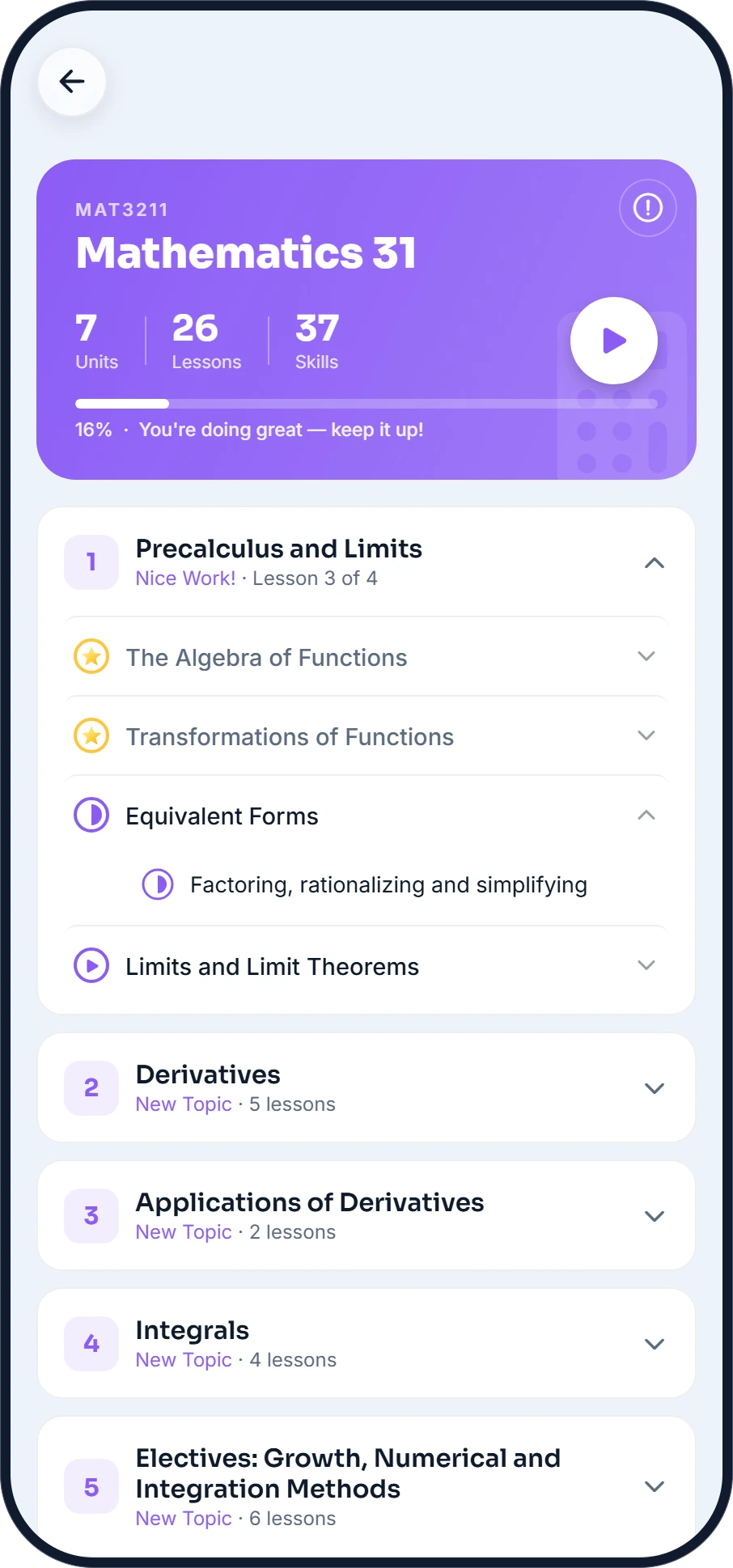
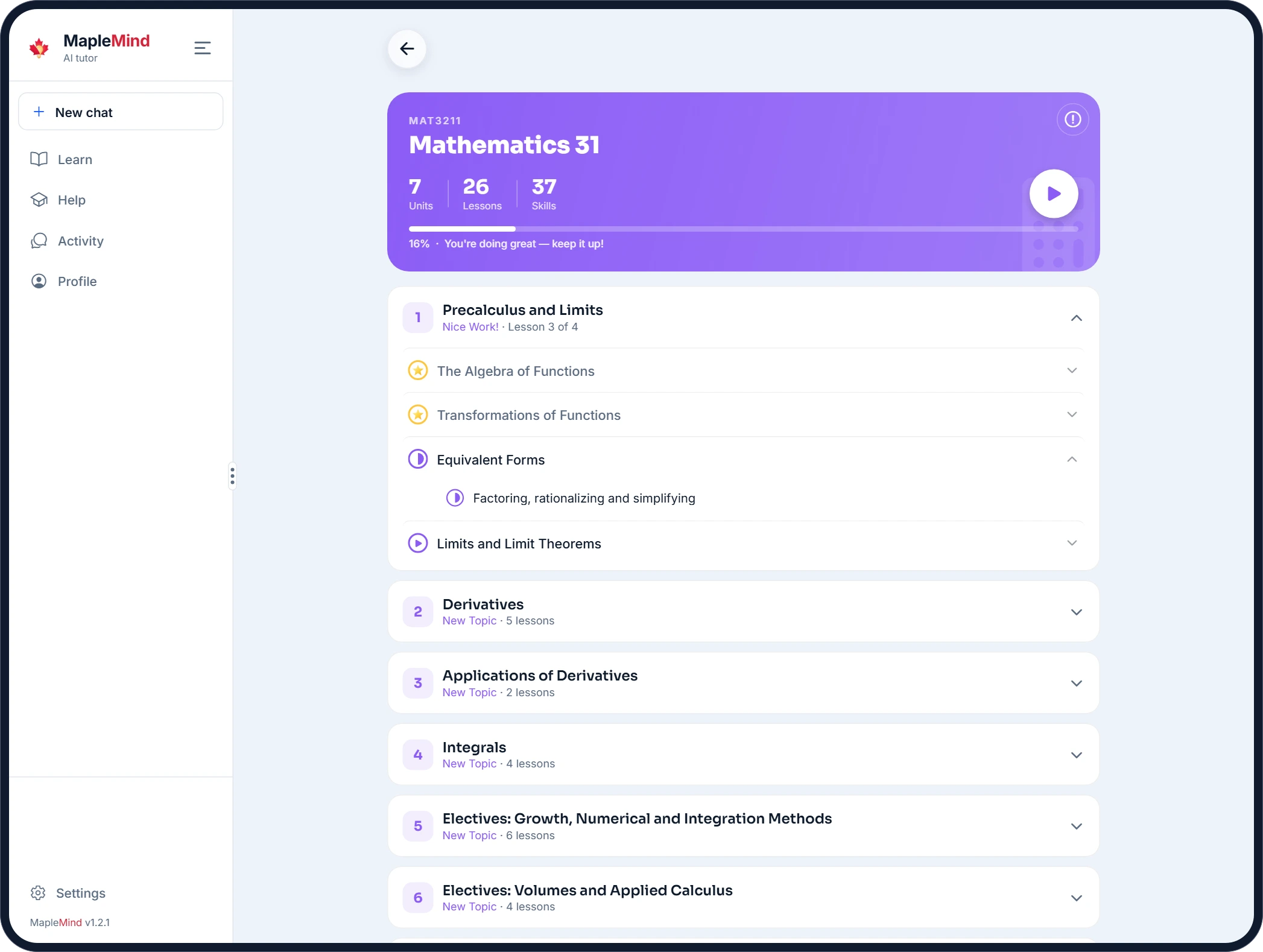
Mathematics 31 in MapleMind on a tablet: its units and lessons in order, a student partway through.Mathematics 31 in MapleMind on a phone: its units and lessons in order, a student partway through.
Their course, unit by unit, the way Alberta teaches it.Shown: Mathematics 31
Homework Help on a tablet: a photo of a worksheet, the tutor’s worked example of a two-step equation, and a question back to the student.Homework Help on a phone: a photo of a worksheet, the tutor’s worked example of a two-step equation, and a question back to the student.
Homework Help: they take a photo of the question, and the tutor works through it with them.
The Parent Dashboard on a tablet: a student’s days studied, streak, lessons, quiz average and recent activity.The Parent Dashboard on a phone: a student’s days studied, streak, lessons, quiz average and recent activity.
The Parent Dashboard: how each child’s week went, in lessons, quizzes and days studied.
A Grade 9 provincial mathematics exam on a tablet: a readiness score, the exam’s time and its next sitting.A Grade 9 provincial mathematics exam on a phone: a readiness score, the exam’s time and its next sitting.
A provincial exam: a practice sitting under the real time, and how ready they are.
The Learn tab on a tablet: a four-day streak, the week’s days, Homework Help, the next lesson and a review.The Learn tab on a phone: a four-day streak, the week’s days, Homework Help, the next lesson and a review.
The Learn tab: their week so far, and the next thing to do.

Help at home

Questions parents ask

What will my child learn in Grade 10 in Alberta?

Math: Mathematics 10-3 and Mathematics 10C. Science: Science 10 and Science 14. English: English Language Arts 10-1 and English Language Arts 10-2. French: French Language Arts 10-2 (immersion). Social studies: Social Studies 10-1 and Social Studies 10-2. That’s 243 skills in all, from Alberta’s curriculum.

Does my child write a provincial exam in Grade 10?

No. Alberta has no provincial exam in Grade 10.

Where does this list come from?

From Alberta’s official curriculum, the documents its education ministry publishes for each course. Each skill here is one of their expectations, written in plain words.

Can MapleMind help my child in Grade 10?

Yes. Every course on this page is in MapleMind, with lessons, practice and a tutor that works through each step with them. A free account gets 30 messages and 4 activities a day.

Help with Grade 10, one skill at a time.

Every course on this page is in MapleMind, free with daily limits.