Nova Scotia · For parents

What your child learns in Grade 11 in Nova Scotia

Every subject, unit by unit, from Nova Scotia’s curriculum: 396 skills in plain words.

Subjects
5
Skills
396
Provincial exams
None
Official curriculum
curriculum.novascotia.ca

Math in Grade 11

3 courses. Choose the one your child takes.

Mathematics 11

4 units · 26 skills

  1. Unit 1

    Geometry

    Corresponding angles are equal; alternate angles are equal; co-interior angles are supplementary.

    • Angles from parallel lines and transversals
    • Triangle angle-sum and exterior angles
    • Similar and congruent triangles
    4 more skills
    • Solving angle and triangle problems
    • The sine law
    • The cosine law
    • Choosing and applying the laws in context
  2. Unit 2

    Logical Reasoning

    Inductive reasoning generalizes from observed cases to a conjecture.

    • Inductive reasoning and conjectures
    • Inductive versus deductive reasoning
    • Deductive proof of relationships
    1 more skill
    • Testing validity and solving reasoning problems
  3. Unit 3

    Statistics

    Standard deviation measures how spread out data is around the mean.

    • Standard deviation and the normal curve
    • Recognizing normal distributions
    • Z-scores
    5 more skills
    • Using standard deviation to make decisions
    • Confidence levels and margin of error
    • Making inferences from sample data
    • Interpreting statistics in the media
    • Critically analyzing statistical claims
  4. Unit 4

    Relations and Functions

    Each inequality's boundary line splits the plane into two half-planes.

    • Graphing systems of linear inequalities
    • Optimization with linear programming
    • Intercepts and roots of quadratics
    4 more skills
    • Vertex and axis of symmetry
    • Domain and range of quadratics
    • Sketching and applying quadratic functions
    • How many x-intercepts a quadratic has
Mathematics at Work 11

5 units · 25 skills

  1. Unit 1

    Measurement

    Surface area is the total area of an object's outer faces; volume is the space inside.

    • Estimating surface area
    • Solving surface-area problems
    • Volume vs. capacity and referents
    2 more skills
    • Volume of 3-D objects
    • Capacity of containers
  2. Unit 2

    Geometry

    A complex figure often contains several right triangles that share a side.

    • Sketching and identifying right triangles
    • Solving with elevation, depression, and trig
    • Reading dimensions from a scale
    1 more skill
    • Constructing scale drawings and models
  3. Unit 3

    Number

    A budget lists all income and all expenses over a period.

    • Building a personal budget
    • Modifying a budget toward goals
    • Simple vs. compound interest
    5 more skills
    • Solving compound-interest problems
    • Accounts and banking services
    • Banking fees, safety, and security
    • Comparing credit options
    • Solving credit-card and loan problems
  4. Unit 4

    Algebra

    Rearranging a formula isolates the quantity you need.

    • Manipulating and applying formulas
    • Slope as rise over run
    • Slope as rate of change
    3 more skills
    • Solving slope problems
    • Unit analysis
    • Proportional reasoning within and between systems
  5. Unit 5

    Statistics

    Bar graphs compare categories; histograms show the distribution of grouped data.

    • Creating graphs from data
    • Interpreting graphs and trends

Pre-Calculus 11

3 units · 28 skills

  1. Unit 1

    Algebra and Number

    The absolute value of a number is its distance from zero on the number line.

    • Understanding absolute value
    • Simplifying and converting radical expressions
    • Rationalizing denominators
    4 more skills
    • Solving radical equations
    • Equivalent forms of rational expressions
    • Operations on rational expressions
    • Solving rational equations
  2. Unit 2

    Trigonometry

    An angle in standard position has its vertex at the origin and initial arm on the positive x-axis.

    • Sketching angles in standard position
    • Reference angles and reflections
    • Trig ratios from a point on the terminal arm
    4 more skills
    • Solving trigonometric equations and problems
    • Radian measure and degree-radian conversion
    • Coterminal angles and arc length
    • The equation of the unit circle
  3. Unit 3

    Relations and Functions

    The greatest common factor comes out of every term first.

    • Common factors and quadratic trinomials
    • Difference of squares
    • Quadratic-pattern factoring by substitution
    11 more skills
    • Graphing absolute value functions
    • Solving absolute value equations
    • Quadratic functions in vertex form
    • Quadratic functions in standard form
    • Solving quadratic equations by several methods
    • The discriminant and the roots-zeros-intercepts link
    • Systems involving quadratics
    • Linear and quadratic inequalities
    • Arithmetic sequences and series
    • Geometric sequences and series
    • Graphing reciprocal functions

Science in Grade 11

4 courses. Choose the one your child takes.

Biology 11

BIO11 · 4 units · 24 skills

  1. Unit 1

    Matter and Energy for Life

    Cell theory's three tenets: all living things are made of one or more cells; the cell is the basic unit of structure and function; all cells arise from pre-existing cells (biogenesis).

    • How cell theory developed
    • Microscope technique and recording data
    • Observing and describing organelles
    5 more skills
    • Prokaryotic vs eukaryotic cells
    • Organelles and cell processes
    • Investigating cell size
    • Investigating photosynthesis and respiration
    • Matter and energy in photosynthesis and respiration
  2. Unit 2

    Biodiversity

    The taxonomic hierarchy: Domain, Kingdom, Phylum, Class, Order, Family, Genus, Species — each level a nested group.

    • Classification systems and nomenclature
    • Applying taxonomy to local organisms
    • How classification knowledge changes
    3 more skills
    • Arguing biodiversity decisions from evidence
    • Anatomy and physiology across kingdoms
    • Life cycles across kingdoms
  3. Unit 3

    Maintaining Dynamic Equilibrium I

    Homeostasis is the active maintenance of a stable internal environment (temperature, blood glucose, pH, water balance) within narrow limits.

    • Nutrition, fitness, and homeostasis
    • Behaviour and homeostasis
    • Investigating body systems
    4 more skills
    • How body-support systems improved over time
    • How plant and animal systems maintain homeostasis
    • Chemicals in body systems
    • Viruses, disease, and disrupted homeostasis
  4. Unit 4

    Interactions among Living Things

    A biome is a large region defined by its climate and characteristic vegetation (e.g. tundra, boreal forest, grassland, desert, tropical rainforest).

    • Comparing biomes across continents
    • Population growth and interactions
    • Carrying capacity and resource demand
See the course: Biology 11

Chemistry 11

CHE11 · 3 units · 57 skills

  1. Unit 1

    Stoichiometry

    One mole = 6.02 x 10^23 particles (Avogadro's number); it links the particle count to a measurable mass.

    • Molar mass and mole-mass conversions
    • The mole as a scientific milestone
    • Mole ratios from balanced equations
    13 more skills
    • Equations in practical technology
    • Predictions and hypotheses from evidence
    • Stoichiometric calculations
    • Designing stoichiometric experiments
    • Using instruments to collect data
    • Error, precision, and accuracy
    • Constraints and trade-offs in technology
    • Stoichiometric applications
    • Maximizing yield
    • Data supporting or refuting predictions
    • Science versus technology processes
    • Society's influence on science and technology
    • Communicating stoichiometry ideas
  2. Unit 2

    From Structures to Properties

    Selecting sources means judging credibility, relevance, and currency.

    • Integrating information from sources
    • Properties of ionic, molecular, and metallic substances
    • Classifying substances by properties
    13 more skills
    • Investigating consumer product claims
    • Formation of ionic, covalent, and metallic bonds
    • Structural model from bonds
    • How bonding knowledge evolves
    • Canadian contributions to bonding
    • Technologies developed from bonding
    • Limits of electronegativity classification
    • Evidence for bond energies
    • Bonds explaining properties
    • Hydrogen bonds and van der Waals forces
    • Research tools for bonding information
    • Displaying evidence and information
    • Risks and benefits of applying bonding knowledge
  3. Unit 3

    Organic Chemistry

    Carbon has four valence electrons and forms four strong covalent bonds.

    • The uniqueness of carbon
    • Synthesizing organic molecules
    • How organic chemistry evolved
    22 more skills
    • Constraints and trade-offs in organic technology
    • Organic chemistry in daily life
    • Organic compounds and society
    • Classifying organic families
    • IUPAC names and formulas
    • Limits of IUPAC classification
    • Scientific questions vs technological problems
    • Using apparatus and materials safely
    • Relating bonding to organic chemistry
    • Evaluating a technology's design
    • Evaluating evidence and sources for bias
    • Isomers and structural formulas
    • Equations for organic reactions
    • Communicating organic-chemistry ideas
    • Framing investigations of polymers
    • Designing a controlled polymer experiment
    • Polymerization and important polymers
    • Evaluating technological solutions
    • Defending a position on organic chemistry
    • Synthesizing information and making inferences
    • Debating research funding
    • Risks and benefits of applying organic chemistry

Oceans 11

OCE11 · 5 units · 28 skills

  1. Unit 1

    Structure and Motion

    There is one continuous global ocean divided into five named basins: Pacific, Atlantic, Indian, Arctic, and Southern (Antarctic).

    • The world's oceans and ocean careers
    • The structure of Earth's waters
    • The unique properties of water
    3 more skills
    • Currents, the Coriolis effect, and thermohaline circulation
    • Wave motion in the sea
    • Tides and tide theory
  2. Unit 2

    Marine Biome

    The marine biome is the ocean life zone - the largest biome on Earth - divided into open-ocean (pelagic) and bottom (benthic) realms and by depth.

    • The marine biome and its interconnections
    • Comparing marine organisms and communities
    • Open ocean versus coastal zones
    2 more skills
    • Sampling and classifying marine organisms
    • How an organism functions in its habitat
  3. Unit 3

    Coastal Zones

    A coastal zone is the transition area where land and sea meet and interact - from the nearshore waters to the land affected by the sea.

    • The concept of coastal zones and how they vary
    • Causes and characteristics of coastal-zone types
    • Sustainability and human use of the coast
    2 more skills
    • Human interactions and competing views on the coast
    • Integrated coastal zone management
  4. Unit 4

    Aquaculture

    Aquaculture is the farming of aquatic organisms - finfish, shellfish, and aquatic plants - in controlled conditions.

    • Aquaculture locations and species
    • The biology of cultured organisms
    • Conditions for aquaculture operations
    3 more skills
    • Site planning: risks and benefits
    • Aquaculture business opportunities
    • Aquaculture-related issues
  5. Unit 5

    Fisheries

    A fishery is a renewable resource - it can keep producing if harvested no faster than the stock replaces itself.

    • The fishery as a sustainable resource
    • Anatomy of a commercial fishery species
    • Ecological factors in the fishery
    3 more skills
    • Fish-population dynamics
    • Risks and benefits of fishery technology
    • Fisheries research and management organizations
See the course: Oceans 11

Physics 11

PHY11 · 4 units · 53 skills

  1. Unit 1

    Kinematics

    A frame of reference is the vantage point from which motion is measured.

    • Frames of reference
    • Questions about motion
    • Vectors for motion
    2 more skills
    • Vertical motion
    • Solving kinematics problems
  2. Unit 2

    Dynamics

    A force is a vector with magnitude (newtons) and direction.

    • Vectors for forces
    • Newton's laws
    • Analyzing dynamic systems
    11 more skills
    • Momentum-based devices
    • Designing a dynamics experiment
    • Selecting instruments and processes
    • Carrying out procedures
    • Collecting data accurately
    • Displaying data
    • Interpreting relationships
    • Society and dynamics science
    • Evaluating technological solutions
    • Technology revising dynamics
    • Scientific milestone in dynamics
  3. Unit 3

    Momentum and Energy

    Total momentum before equals total momentum after in an isolated system: sum(m*v) is conserved.

    • Conservation of momentum (1D)
    • Force, distance, and work
    • Work, time, and power
    14 more skills
    • Efficiency of machines
    • Percentage efficiency
    • Mass, speed, and thermal energy
    • Mechanical energy
    • Empirical vs theoretical energy
    • Mechanical energy in problems
    • Work-energy theorem
    • Conservation of energy experiment
    • Choosing conservation laws
    • Physics technology limits
    • Technology from understanding
    • Energy/momentum technologies over time
    • Evaluating energy/momentum solutions
    • Language for momentum and energy
  4. Unit 4

    Waves

    A mechanical wave transfers energy through a medium without transferring matter.

    • Mechanical waves
    • Universal wave equation
    • Operational definitions (waves)
    14 more skills
    • Integrating wave information
    • Reflection of waves
    • Refraction of waves
    • Wave phenomena
    • Prediction and hypothesis (waves)
    • Sampling and data reliability (waves)
    • EM radiation vs sound
    • Producing and transmitting energy waves
    • Analyzing wave systems
    • Risks and benefits of applying wave science
    • Society and wave science
    • Prototype a device
    • Wave technology development
    • Technology enhancing wave understanding
See the course: Physics 11

English in Grade 11

English 11

ENG11 · 3 units · 38 skills

  1. Unit 1

    Speaking and Listening

    Probing questions go beneath the surface — they test assumptions and open up complexity.

    • Asking perceptive and probing questions
    • Presenting and defending points of view with evidence
    • Interacting effectively in formal structured situations
    3 more skills
    • Adapting language and delivery to achieve goals
    • Critically evaluating uses of language
    • Adapting communication style to audience, purpose, and situation
  2. Unit 2

    Reading and Viewing

    Grade 11 moves from viewing widely to comparing and analyzing across media texts.

    • Comparing and analyzing media and visual texts
    • Synthesizing meaning across diverse perspectives
    • Applying strategies for complex print and multimedia texts
    19 more skills
    • Articulating author's purpose behind devices and techniques
    • Acquiring and selecting information from varied sources
    • Synthesizing information across a range of sources
    • Articulating what triggers personal responses
    • Connecting text ideas to personal experience
    • Connecting themes and ideas across texts
    • Exploring multiple perspectives on a text
    • Justifying points of view on print and media texts
    • Articulating feelings about ambiguities in complex texts
    • Recognizing commonalities and differences across texts
    • Recognizing how language and genre influence or manipulate
    • Examining relationships among language, purpose, and audience
    • Analyzing the merits of texts and genres
    • Exploring diverse ways texts reveal and produce ideologies
    • Reflecting on responses across social and cultural contexts
    • Investigating intersectionality and gender-based violence
    • Questioning how societal norms perpetuate or prevent harm
    • Analysing how authors reflect or challenge attitudes
    • Evaluating factors that impact a bystander's opportunity to intervene
  3. Unit 3

    Writing and Other Ways of Representing

    Grade-11 reflective writing interprets experiences with a range of texts and issues, not just records them.

    • Writing to explore and reflect on experiences and learning
    • Using note-making strategies to reconstruct knowledge
    • Making informed choices to enhance imaginative writing
    7 more skills
    • Creating a clear and coherent structure
    • Choosing form and style and engaging the reader
    • Using audience feedback to improve products
    • Applying strategies to construct complex texts
    • Demonstrating control of conventions
    • Committing to crafting a range of work
    • Using information from varied sources to construct meaning
See the course: English 11

French in Grade 11

Core French 11

2 units · 19 skills

  1. Unit 1

    Communication

    You now select repair strategies yourself rather than reaching for a fixed frame - reformulate, give an example, or ask a targeted question.

    • Negotiating for understanding
    • Varying language for the audience
    • Participating in interviews
    10 more skills
    • Developing descriptions and comparisons
    • Presenting a point of view logically
    • Defending a point of view
    • Choosing pertinent information
    • Organizing information
    • Interpreting and analyzing information
    • Telling stories
    • Giving summaries
    • Using your own words
    • Discussing Acadian and other francophone cultures
  2. Unit 2

    Linguistic Elements

    Nuance agreement: 'Je suis tout a fait d'accord' (I completely agree), 'Je suis plutot d'accord' (I rather agree), 'pas vraiment' (not really).

    • Using expressions that support interaction
    • Using verb tenses suited to the context
    • Refuting, rejecting, and contradicting to express an opinion
    3 more skills
    • Narrating events in the past
    • Summarizing the main ideas of a text
    • Reacting critically and creatively

Social studies in Grade 11

3 courses. Choose the one your child takes.

African Canadian Studies 11

ACS11 · 7 units · 46 skills

  1. Unit 1

    Module 1: Evolution and Change

    Everyone begins this course with some knowledge and some assumptions about African heritage.

    • Background knowledge about African heritage
    • The diversity of Africa
    • Describing your own cultural identity
    4 more skills
    • The meaning and elements of culture
    • Historiography, ethnocentrism, and Afrocentrism
    • The roots of Afrocentricity
    • Africa as the birthplace of humankind
  2. Unit 2

    Module 2: Elements of the African Diaspora

    Africa was home to many ancient civilizations in different regions.

    • Locating ancient African civilizations
    • Systems of ancient African kingdoms
    • Elements of pre-colonial African cultures
    1 more skill
    • From pre-colonial to colonial Africa
  3. Unit 3

    Module 3A: Impact of Colonial Expansion

    Slavery was driven by colonial and imperial economic systems.

    • Colonial systems causing slavery
    • The Transatlantic Slave Trade
    • Displacement, migration, and forced migration
    3 more skills
    • How enslavement shaped the world
    • Slave culture and the effects of enslavement
    • Resistance to enslavement
  4. Unit 4

    Module 3B: Struggle for Identity

    The American Revolution reshaped North America.

    • The American Revolution and people of African descent
    • Black Loyalists, Maroons, and Black Refugees
    • The Underground Railroad
    4 more skills
    • The Civil War and its aftermath
    • Problems Black settlers experienced in Canada
    • Confederation and African Canadian contributions
    • Black communities across a changing Canada
  5. Unit 5

    Module 4: Independent Study

    A proposal states what you will investigate and why.

    • Developing an inquiry proposal
    • Building a work plan
    • Formulating a research question
    5 more skills
    • Conducting organized research
    • Organizing research findings
    • Identifying bias and stereotyping
    • Comparing interpretations
    • Explaining connections in the data
  6. Unit 6

    Module 5: In Pursuit of Justice

    Power imbalances underlie disenfranchisement, segregation, and racism.

    • Power, disenfranchisement, segregation, and racism
    • The Civil-Rights Movement compared
    • The Civil-Rights Movement in Nova Scotia
    2 more skills
    • Legal documents and the Canadian context
    • The Black church as an instrument of leadership
  7. Unit 7

    Module 6: The Journey toward Empowerment

    Empowerment is gaining control over one's own life and community.

    • The empowerment model and institutional change
    • Global empowerment and independence
    • Grassroots organizations over time
    6 more skills
    • Contributions in social and educational institutions
    • Contributions in political and religious institutions
    • Contributions in judicial institutions
    • The evolution of Black families in Canada
    • Challenges facing African Canadians and African Nova Scotians today
    • Collective consciousness across the diaspora

Canadian History 11

7 units · 31 skills

  1. Unit 1

    Introduction

    Some questions recur throughout Canada's history rather than being answered once.

    • Continuing questions in Canada's history
    • Individuals, events, and symbols of significance
  2. Unit 2

    Globalization

    There are multiple theories about how the Americas were first peopled.

    • Theories of the peopling of the Americas
    • The effects of contact and colonization
    • Relationships with France, Britain, and the USA
    3 more skills
    • WWI and Canadian identity
    • WWII and Canadian identity
    • Canada's roles in the late twentieth century
  3. Unit 3

    Development

    Aboriginal societies had sophisticated economic systems before contact.

    • Economic systems of Aboriginal societies
    • The Staple Trade and colonial development
    • The National Policy and industrialization
    2 more skills
    • The free trade debate
    • Economic trends and Canada's future
  4. Unit 4

    Governance

    First Nations had governing structures long before European contact.

    • First Nations governing structures
    • Merging French, British, and American philosophies
    • The road to Confederation
    3 more skills
    • The evolution of federalism
    • From two parties to many
    • The purpose of the constitution
  5. Unit 5

    Independent Study

    The historical method starts with a focused question.

    • Conducting and communicating historical research
  6. Unit 6

    Sovereignty

    Sovereignty is a people's right to govern themselves.

    • Sovereignty struggles around the world
    • Sovereignty, conflict, and compromise
    • First Nations struggles to re-establish sovereignty
    2 more skills
    • The emergence of Quebec nationalism
    • External factors and Canadian sovereignty
  7. Unit 7

    Justice

    Canada's legal system draws on First Nations, French, and British traditions.

    • Contributions to Canada's legal system
    • The relationship between land and culture
    • The effects of displacement
    3 more skills
    • Canada's immigration policies
    • Power, inequities, and responses
    • The evolution of rights and freedoms

Mi'kmaw Studies 11

6 units · 21 skills

  1. Unit 1

    Introductory

    Worldview = the whole set of beliefs, values, and relationships through which a people understands the world; it is not the same as 'opinion.'.

    • Worldview and perspective in history and culture
    • Mi'kmaw society before European contact
    • Early relationships with other nations
  2. Unit 2

    Independent Study

    A good inquiry starts with a focused, open question about a real issue (e.g. a treaty right, language revitalization, a community initiative).

    • Designing and conducting a Mi'kmaw research project
  3. Unit 3

    Governance

    Mi'kma'ki spanned the Maritimes and part of the Gaspe, organized into seven traditional districts.

    • Pre-contact territories and civilization
    • Inherent rights as first occupants
    • Comparing pre- and post-contact governance
    4 more skills
    • Pre-Contact Mi'kmaq Nationhood
    • The Concordat of 1610
    • The Peace and Friendship Treaties
    • Discriminatory policies and social injustices
  4. Unit 4

    Culture

    Cultural bias is judging another culture by your own culture's assumptions - it produced harmful, false images of the Mi'kmaq.

    • Cultural bias and views of First Nations
    • Oral tradition and cultural continuity
    • The continuing role of Mi'kmaw Elders
    1 more skill
    • Traditional and contemporary cultural expression
  5. Unit 5

    Education

    Traditional Mi'kmaw education was experiential and relational: children learned by watching, doing, listening to Elders, and living on the land.

    • Traditional education and how it changed
    • The Indian Residential School System
    • Regaining control of education
  6. Unit 6

    Spirituality

    Traditional Mi'kmaw spirituality is relational: all things are connected (Msit No'kmaq, 'all my relations'), and the Creator, land, and community are woven together.

    • Traditional Mi'kmaw spirituality
    • Creation stories, identity, and sense of place
    • The blend of Catholicism and Mi'kmaw spirituality

MapleMind

See Grade 11 in MapleMind

Real screens from the app your child would use.

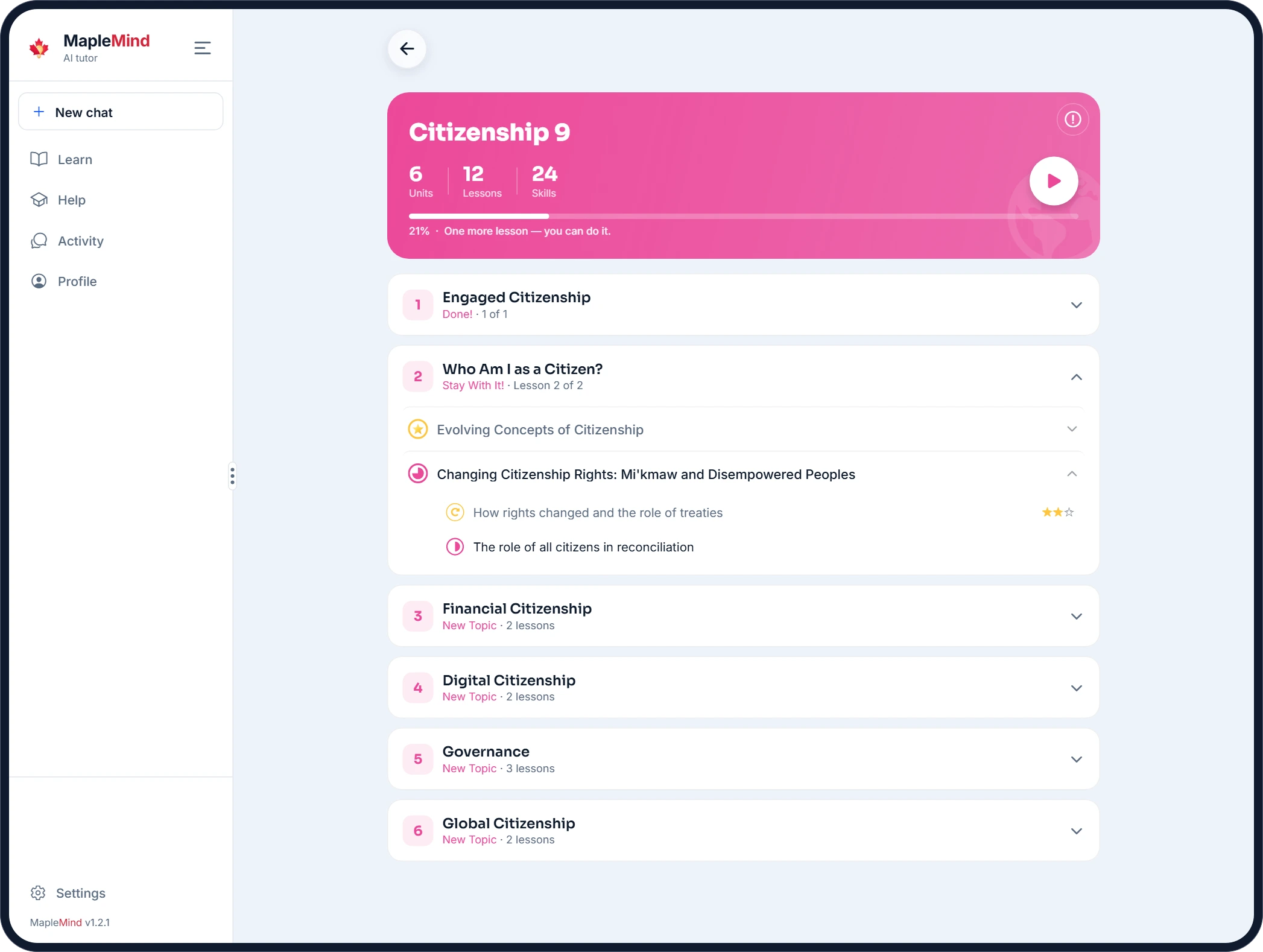
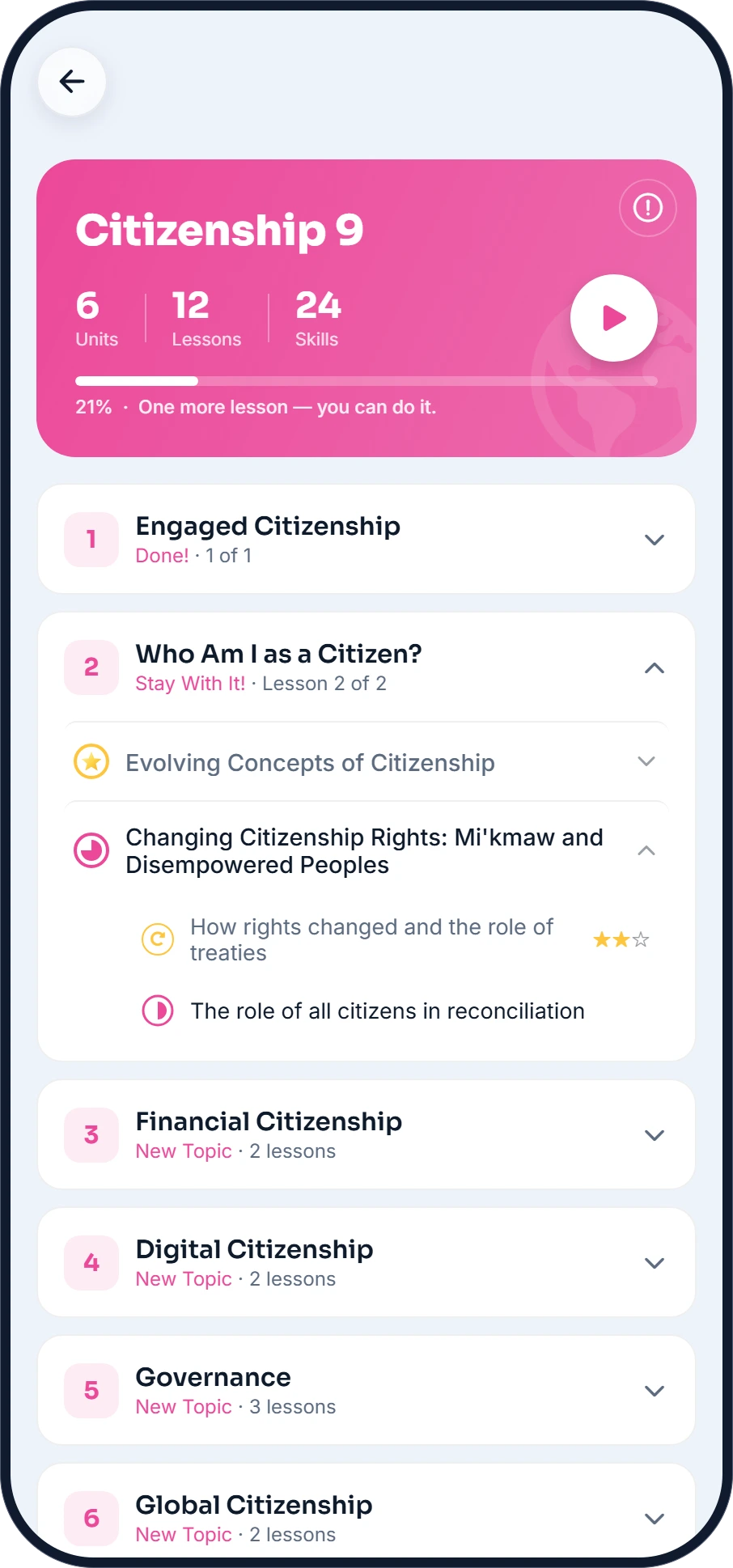
Citizenship 9 in MapleMind on a tablet: its units and lessons in order, a student partway through.Citizenship 9 in MapleMind on a phone: its units and lessons in order, a student partway through.
Their course, unit by unit, the way Nova Scotia teaches it.Shown: Citizenship 9
Homework Help on a tablet: a photo of a worksheet, the tutor’s worked example of a two-step equation, and a question back to the student.Homework Help on a phone: a photo of a worksheet, the tutor’s worked example of a two-step equation, and a question back to the student.
Homework Help: they take a photo of the question, and the tutor works through it with them.
The Parent Dashboard on a tablet: a student’s days studied, streak, lessons, quiz average and recent activity.The Parent Dashboard on a phone: a student’s days studied, streak, lessons, quiz average and recent activity.
The Parent Dashboard: how each child’s week went, in lessons, quizzes and days studied.
A Grade 9 provincial mathematics exam on a tablet: a readiness score, the exam’s time and its next sitting.A Grade 9 provincial mathematics exam on a phone: a readiness score, the exam’s time and its next sitting.
A provincial exam: a practice sitting under the real time, and how ready they are.
The Learn tab on a tablet: a four-day streak, the week’s days, Homework Help, the next lesson and a review.The Learn tab on a phone: a four-day streak, the week’s days, Homework Help, the next lesson and a review.
The Learn tab: their week so far, and the next thing to do.

Help at home

Questions parents ask

What will my child learn in Grade 11 in Nova Scotia?

Math: Mathematics 11, Mathematics at Work 11 and Pre-Calculus 11. Science: Biology 11, Chemistry 11, Oceans 11 and Physics 11. English: English 11. French: Core French 11. Social studies: African Canadian Studies 11, Canadian History 11 and Mi'kmaw Studies 11. That’s 396 skills in all, from Nova Scotia’s curriculum.

Does my child write a provincial exam in Grade 11?

No. Nova Scotia has no provincial exam in Grade 11.

Where does this list come from?

From Nova Scotia’s official curriculum, the documents its education ministry publishes for each course. Each skill here is one of their expectations, written in plain words.

Can MapleMind help my child in Grade 11?

Yes. Every course on this page is in MapleMind, with lessons, practice and a tutor that works through each step with them. A free account gets 30 messages and 4 activities a day.

Help with Grade 11, one skill at a time.

Every course on this page is in MapleMind, free with daily limits.