

Get help with History 20: World Issues
Most tutoring makes you sit through material you already know. MapleMind flips that: pick the exact skill that's causing trouble — any of the 15 below — and the tutor teaches just that one, step by step, as many times as it takes. Ask questions in plain words, any time of day, in English, French, or 12 other languages.
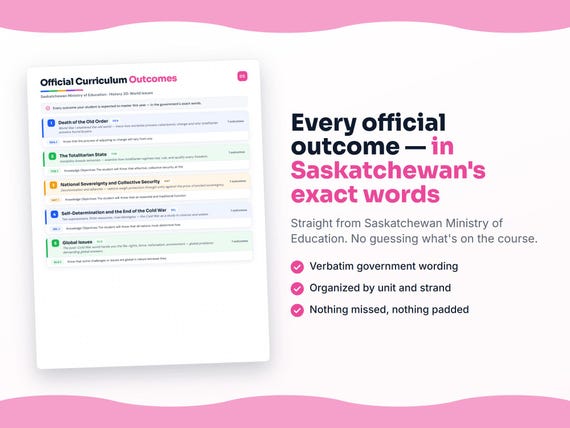
The official Saskatchewan History 20: World Issues curriculum
Saskatchewan defines History 20: World Issues by strands and outcomes. MapleMind teaches the same curriculum reorganized for one-skill-at-a-time tutoring — the table shows exactly where every official strand lands, and the ministry's own wording is quoted under each unit below.
Official source Saskatchewan's official curriculumRead it on the government site — curriculum.gov.sk.ca ↗| Official strand | Outcomes | Where MapleMind teaches it |
|---|---|---|
| Strand U1 | 3 | Death of the Old Order |
| Strand U2 | 3 | The Totalitarian State |
| Strand U3 | 3 | National Sovereignty and Collective Security |
| Strand U4 | 3 | Self-Determination and the End of the Cold War |
| Strand U5 | 3 | Global Issues |
Every skill below, taught one on one.
 Try the first session free
How MapleMind teaches History 20: World Issues — every unit, lesson, and skill
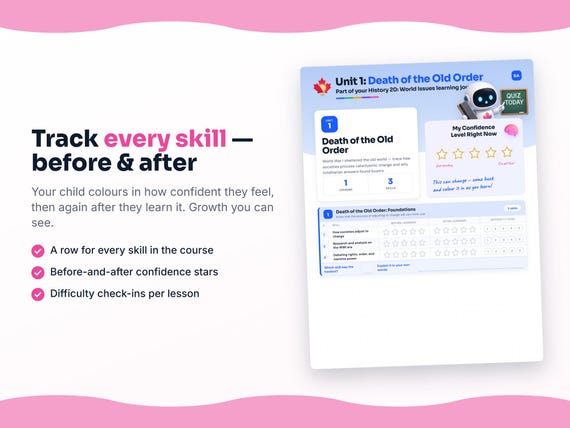
Every skill below runs as a short session: a plain-words lesson, a worked example, solving it together, then a five-question skill check that earns up to three stars. Guided Mode keeps it teaching instead of answer-handing — turning it off needs a parent's password.
Unit 1Death of the Old OrderOfficial strand · Strand U1
World War I shattered the old world — trace how societies process cataclysmic change and why totalitarian answers found buyers.
Death of the Old Order: Foundations
- How societies adjust to changeHIST20-U1-K — The stages of adjusting to change, evolutionary vs revolutionary change, the interplay of social, economic, political and cultural domains, and the early-twentieth-century forces — including a world war — that shattered the traditional order.
- Research and analysis on the WWI eraHIST20-U1-S — The basic research skills — finding, classifying, weighing and summarizing information — and the analytical skills of defining parts, tracing cause and effect, and testing hypotheses, practised on the death of the old order.
- Debating rights, order, and wartime powerHIST20-U1-V — The value debates the era forces: external influence on national decisions, authoritarian versus democratic leadership, and the balance between individual rights and collective rights — including whether order ever outranks rights.
The official wording — 3 outcomes in this unit
- HIST20-U1-K
Know that the process of adjusting to change will vary from one
- HIST20-U1-S
Skills The student will: Learn and practise the basic research skills of:
- HIST20-U1-V
Whether a nation's decision-making processes should be influenced by external conditions such
Unit 2The Totalitarian StateOfficial strand · Strand U2
Instability breeds extremes — examine how totalitarian regimes rise, rule, and qualify every freedom.
The Totalitarian State: Foundations
- The anatomy of totalitarian ruleHIST20-U2-K — How economic and political instability feeds radical movements, how totalitarian and authoritarian regimes control citizens — compliant police, obedient bureaucracies, controlled communication, curtailed participation — and how political paradigms define individual versus collective rights.
- Classifying regimes with criteria and gridsHIST20-U2-S — Using the critical attributes of concepts and paradigms as classification criteria, organizing information with analytical grids, and practising decision-making and conflict-resolution on interwar cases.
- Debating sovereignty, security, and the state's reachHIST20-U2-V — Whether domestic politics drives foreign policy, whether national sovereignty and collective security can be reconciled, and where the line between the individual's domain and the state's belongs.
The official wording — 3 outcomes in this unit
- HIST20-U2-K
Knowledge Objectives The student will: Know that effective, collective security at the
- HIST20-U2-S
public. Skills/Abilities The student will: Learn and practise the basic research skills
- HIST20-U2-V
Learn and practise the skills of decision making and conflict resolution. Values
Unit 3National Sovereignty and Collective SecurityOfficial strand · Strand U3
Decolonization and alliances — nations weigh protection through unity against the price of pooled sovereignty.
National Sovereignty and Collective Security: Foundations
- Security, sovereignty, and alliancesHIST20-U3-K — Government's protective function, genocide as planned destruction of a people, spheres of strategic interest, and why nations both seek and fear collective-security organizations.
- Analysis and argumentation on sovereignty casesHIST20-U3-S — Analytical skills — parts, cause and effect, relations of parts to whole — plus hypothesis testing and supporting opinions with facts, sound argument and reasoning, applied to sovereignty and security cases.
- Debating intervention and national conductHIST20-U3-V — Whether civilian authority may yield to military authority, whether any nation may impose its values by intruding on another's sovereignty, and what criteria leaders owe their own and other peoples.
The official wording — 3 outcomes in this unit
- HIST20-U3-K
Knowledge Objectives The student will: Know that an essential and traditional function
- HIST20-U3-S
Skills The student will: • Learn and practise the following analytical skills:
- HIST20-U3-V
Value Issues The student will discuss: • Whether there are there situations/conditions
Unit 4Self-Determination and the End of the Cold WarOfficial strand · Strand U4
Two superpowers, finite resources, rival ideologies — the Cold War as a study in choices and stakes.
Self-Determination and the End of the Cold War: Foundations
- Superpower rivalry, scarcity, and self-determinationHIST20-U4-K — Scarcity and resource choices under superpower rivalry, distinct populations seeking control of decisions that shape their lives, violent and nonviolent paths to group agendas, and strategic spheres of influence.
- Synthesis and hypothesis-making on the Cold WarHIST20-U4-S — Synthesizing parts into a meaningful whole with a theme and effective presentation, defining and applying decision criteria, and making hypotheses from reasonable assumptions and inferences.
- Debating ends, means, and the nuclear ageHIST20-U4-V — Do ends justify means, do any causes justify violence, can diverse populations share one polity — and can a nuclear war be won, or even limited?
The official wording — 3 outcomes in this unit
- HIST20-U4-K
Knowledge Objectives The student will: Know that all nations must determine how
- HIST20-U4-S
Skills/Abilities The student will: Learn and practise to synthesize parts into a
- HIST20-U4-V
Values Issues The student will discuss: Should domestic considerations take precedence over
Unit 5Global IssuesOfficial strand · Strand U5
The post-Cold War world hands you the file: rights, force, nationalism, environment — global problems demanding global answers.
Global Issues: Foundations
- Global challenges and the paradigms behind responsesHIST20-U5-K — Why some issues are global by nature, how paradigms shape responses, human rights as entitlements of being human, the persistence of force, resurgent ethnic nationalism, and humanity's technological power over the environment.
- Applying the full inquiry toolkit to a global issueHIST20-U5-S — Selecting and applying problem solving, dialectical thinking, decision making and conflict resolution; stating well-grounded propositions; justifying decision criteria; and analyzing with grids.
- Debating rights, force, wealth, and the planetHIST20-U5-V — Whether rights belong to all humans as humans, whether violence is ever justified, the root causes of unequal wealth, and what criteria should govern technology and the earth's resources.
The official wording — 3 outcomes in this unit
- HIST20-U5-K
Know that some challenges or issues are global in nature because they
- HIST20-U5-S
Learn and practise using criteria as a basis for analyzing informatiorn. Learn
- HIST20-U5-V
Values Issues The student will discuss: Whether all persons are entitled to.certain
Printable workbook · A keepsake of the year
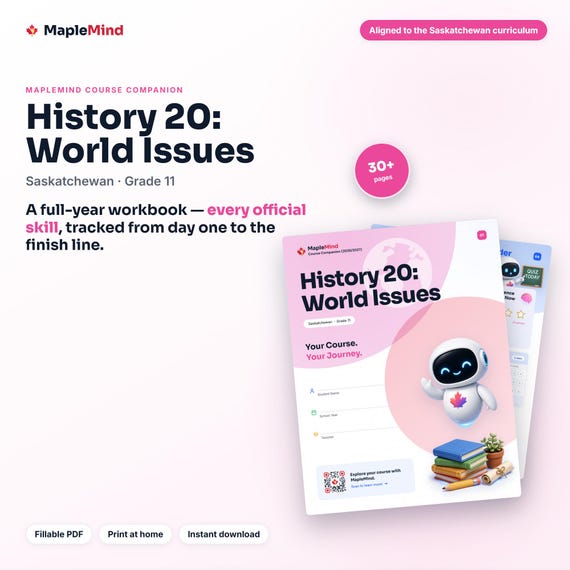
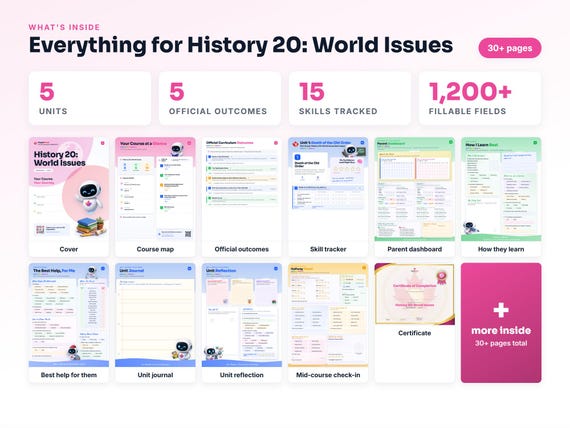
A History 20: World Issues workbook worth keeping
Built from the same official curriculum as this page. Before and after each skill above, your student colours in how sure they feel — so the two of you can see, on one page, what's clicking and what needs another look. It's a quiet way to follow how the year is really going.
By June it's full of their own handwriting: units worked through, confidence grown, a mid-year check-in, notes from parent-teacher night, and a certificate at the end. Less a worksheet, more a record of the year worth keeping on the shelf.
Instant download · see every page, reviews and the full description · five or more workbooks are $2.99 each
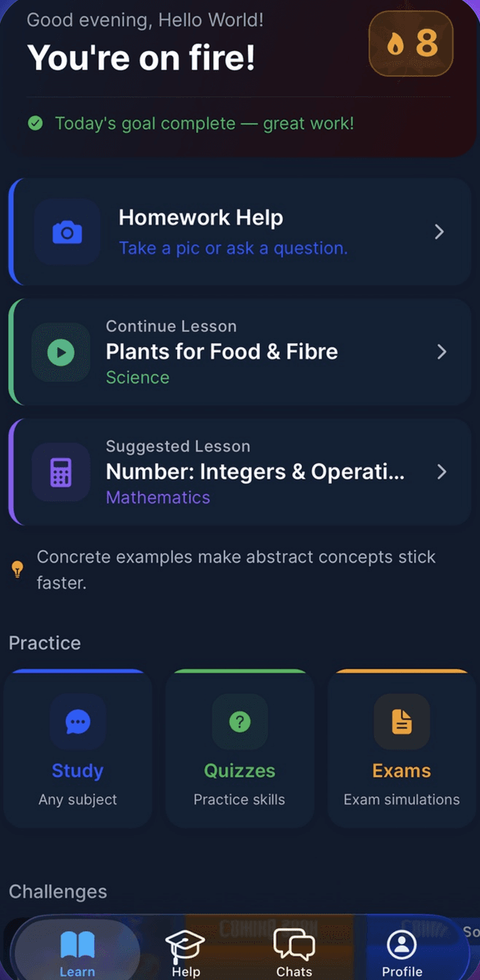
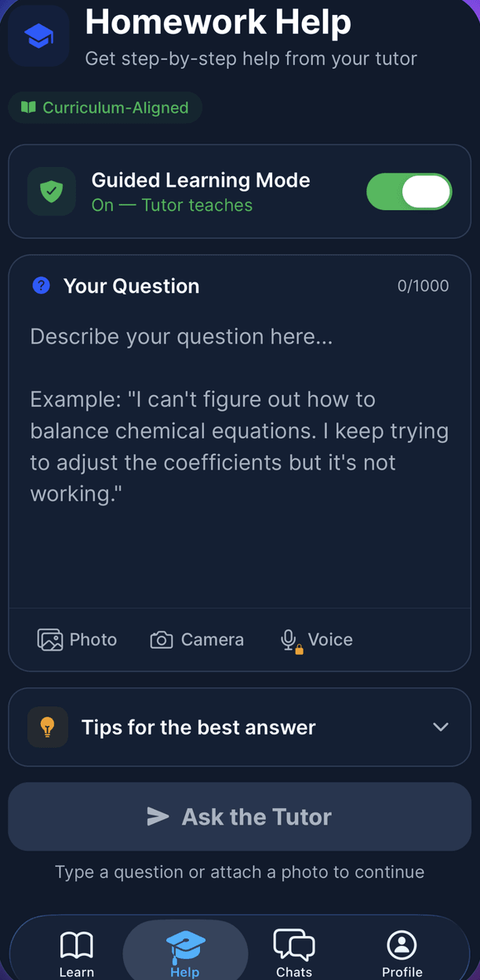
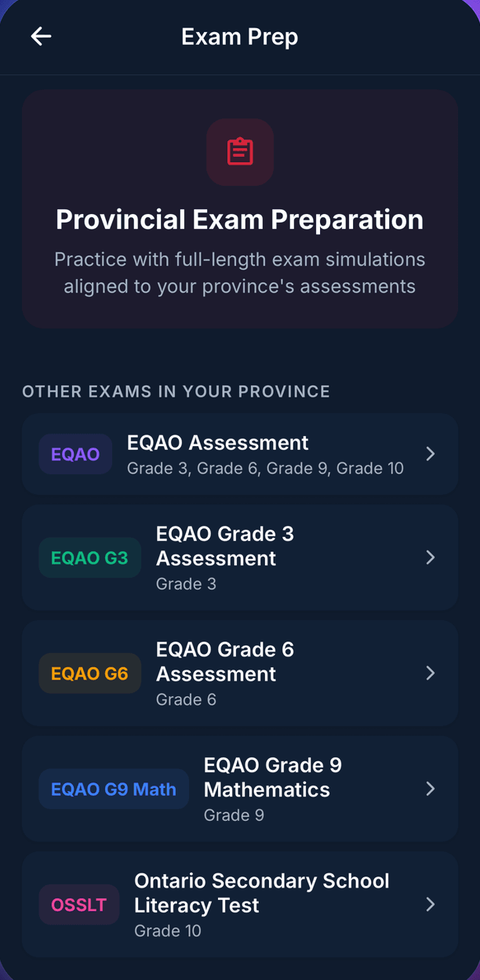
What it looks like in the app
Common questions
Can MapleMind help me with History 20: World Issues?
Yes. MapleMind's AI tutor covers all 15 skills in Saskatchewan's History 20: World Issues — you pick the exact skill, and the tutor teaches it step by step: a short lesson, a worked example, solving together, then a skill check to show it stuck.
Is MapleMind aligned to Saskatchewan's official curriculum?
Yes. Every skill in this course maps to an official outcome code from Saskatchewan's Grade 11 Social Studies curriculum, and the ministry's own wording is quoted under each unit on this page — with the official government source linked so you can check it yourself.
What does MapleMind cost?
It's free to start — 5 tutoring chats and a practice quiz every day, no credit card. A Pro subscription ($9.99/month or $49.99/year CAD, 7-day free trial) unlocks unlimited tutoring, practice, and exam simulations.
What if I'm stuck on just one topic?
That's the point of skill-level tutoring: open History 20: World Issues in the app, tap the exact skill from the list on this page, and the tutor teaches just that — no wading through lessons you don't need.
Does MapleMind work in French or other languages?
Yes — 14 languages, including French. Both the app and the tutor's explanations switch to the language you choose.
Where can I see the official Saskatchewan curriculum for History 20: World Issues?
The official source is linked on this page — Saskatchewan's official curriculum. The outline here follows it: every MapleMind skill carries its official outcome code, and the ministry's own wording is quoted under each unit.
Keep exploring
Ready when you are
Pick a skill from this page and see it taught properly — free, in the browser, in under a minute.