

Get help with Economics 30
Most tutoring makes you sit through material you already know. MapleMind flips that: pick the exact skill that's causing trouble — any of the 29 below — and the tutor teaches just that one, step by step, as many times as it takes. Ask questions in plain words, any time of day, in English, French, or 12 other languages.
The official Saskatchewan Economics 30 curriculum
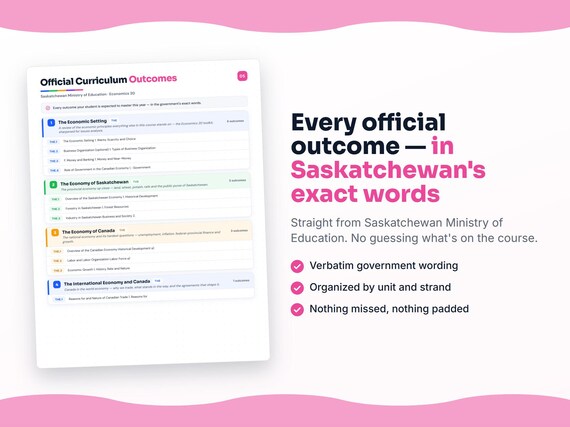
Saskatchewan defines Economics 30 by strands and outcomes. MapleMind teaches the same curriculum reorganized for one-skill-at-a-time tutoring — the table shows exactly where every official strand lands, and the ministry's own wording is quoted under each unit below.
Official source Saskatchewan's official curriculumRead it on the government site — curriculum.gov.sk.ca ↗| Official strand | Outcomes | Where MapleMind teaches it |
|---|---|---|
| Strand U1 | 10 | The Economic Setting |
| Strand U2 | 8 | The Economy of Saskatchewan |
| Strand U3 | 7 | The Economy of Canada |
| Strand U4 | 4 | The International Economy and Canada |
Every skill below, taught one on one.
 Try the first session free
How MapleMind teaches Economics 30 — every unit, lesson, and skill
Every skill below runs as a short session: a plain-words lesson, a worked example, solving it together, then a five-question skill check that earns up to three stars. Guided Mode keeps it teaching instead of answer-handing — turning it off needs a parent's password.
Unit 1The Economic SettingOfficial strand · Strand U1
A review of the economic principles everything else in this course stands on — the Economics 20 toolkit, sharpened for issues analysis.
Economic Foundations Review
- The Economic SettingECON30-U1-S1 — The core toolkit: wants, scarcity, choice, markets, GNP and opportunity cost.
- Production, Specialization and ExchangeECON30-U1-S2 — Why economies specialize and trade — from barter to factors of production.
Business, Labour and Markets
- Business OrganizationECON30-U1-S3 — Types of business organization, bigness, and the relationship between government and business.
- Labour OrganizationECON30-U1-S4 — Unions, collective bargaining, and how labour disputes get settled.
- The Role of the MarketECON30-U1-S5 — Markets, prices, demand and supply, profit and indexing — how prices coordinate an economy.
Money, Finance and Trade
- Money and BankingECON30-U1-S6 — Money and near-money, the banking system, the Bank of Canada, inflation and credit.
- Personal FinanceECON30-U1-S7 — Short- and long-term investments, investment planning, the stock exchange and insurance.
- International TradeECON30-U1-S8 — Comparative advantage, balance of payments, protectionism and foreign exchange.
Government and Economic Systems
- The Role of Government in the Canadian EconomyECON30-U1-S9 — Government revenue and spending, taxation, redistribution, regulation, and monetary and fiscal policy.
- Comparative Economic SystemsECON30-U1-S10 — Why economies need a system at all, and the common systems the world runs on.
The official wording — 10 outcomes in this unit
- ECON30-U1-S1
The Economic Setting 1. Wants, Scarcity and Choice
- ECON30-U1-S2
Production, Specialization and Exchange 1. Direct Production and Barter
- ECON30-U1-S3
Business Organization (optional) 1. Types of Business Organization
- ECON30-U1-S4
Labor Organization (optional) I. Unions
- ECON30-U1-S5
The Role of the Market 1. Market
- ECON30-U1-S6
F. Money and Banking 1. Money and Near-Money
- ECON30-U1-S7
Personal Finance (optional) 1. Short-term Investments
- ECON30-U1-S8
International Trade 1. Absolute and. Comparative Advantage
- ECON30-U1-S9
Role of Government in the Canadian Economy l. : Government
- ECON30-U1-S10
Comparative Economic Systems (optional) l. Need for an Economic System
Unit 2The Economy of SaskatchewanOfficial strand · Strand U2
The provincial economy up close — land, wheat, potash, rails and the public purse of Saskatchewan.
The Province and Its Land
- Overview of the Saskatchewan EconomyECON30-U2-S1 — The province's economic story: from the fur trade through settlement to a diversifying economy.
- Agriculture in SaskatchewanECON30-U2-S2 — The prairie wheat farm, farm management and ownership, grain marketing, and government's role in agriculture.
Resources and Transportation
- Forestry in SaskatchewanECON30-U2-S3 — The province's forest resources, merchantable timber and their place in the provincial economy.
- Mineral Resources in SaskatchewanECON30-U2-S4 — Fossil fuels, potash, uranium and coal — the mineral wealth of the province.
- Transportation in SaskatchewanECON30-U2-S5 — Railways, roads, air and pipelines — the networks a landlocked exporting province depends on.
Industry, Government and Growth
- Industry in SaskatchewanECON30-U2-S6 — Manufacturing and service industries in Saskatchewan, where they locate, and their future growth.
- Government and the Saskatchewan EconomyECON30-U2-S7 — Provincial budgets, government services, Crown corporations and regulation of the provincial economy.
- Economic Growth in SaskatchewanECON30-U2-S8 — What growth means for the provincial economy and where it can come from.
The official wording — 8 outcomes in this unit
- ECON30-U2-S1
Overview of the Saskatchewan Economy 1. Historical Development
- ECON30-U2-S2
B.. Agriculture in Saskatchewan 1. The Prairie Wheat Farm
- ECON30-U2-S3
Forestry in Saskatchewan 1. Forest Resources
- ECON30-U2-S4
Mineral Resources in Saskatchewan 1. Fossil Fuels, Pipelines
- ECON30-U2-S5
Transportation in Saskatchewan 1. Railways
- ECON30-U2-S6
Industry in Saskatchewan Business and Society 2.
- ECON30-U2-S7
Government: and the Economy 1. Budgetary Policies and Financial Management
- ECON30-U2-S8
Economic Growth
Unit 3The Economy of CanadaOfficial strand · Strand U3
The national economy and its hardest questions — unemployment, inflation, federal-provincial finance and growth.
The Canadian Economic Landscape
- Overview of the Canadian EconomyECON30-U3-S1 — Canada's economic development, economic geography, regional disparities and mixed-enterprise system.
- Business and SocietyECON30-U3-S2 — The economic and social responsibilities of business in the Canadian economy.
- Canadian IndustryECON30-U3-S3 — Primary, secondary and tertiary industry, productivity, concentration of power and foreign ownership.
Labour and Government
- Labour and Labour OrganizationECON30-U3-S4 — The Canadian labour force — composition, quality, mobility — and unions and collective bargaining.
- Government and the Canadian EconomyECON30-U3-S5 — Unemployment, inflation, monetary and fiscal balance, federal-provincial fiscal relations and direct intervention.
Growth and Social Policy
- Economic Growth in CanadaECON30-U3-S6 — The history, rate and nature of Canadian growth — and its trade-offs with population, region and nation.
The official wording — 7 outcomes in this unit
- ECON30-U3-S1
Overview of the Canadian Economy Historical Development a)
- ECON30-U3-S2
Business and Society Role of Business in the Economy a)
- ECON30-U3-S3
Industry 1. Primary, Secondary, Tertiary: Tndustrial Mix
- ECON30-U3-S4
Labor and Labor Organization Labor Force a)
- ECON30-U3-S5
Government and the Economy 1. Unemployment
- ECON30-U3-S6
Economic Growth 1. History, Rate and Nature
- ECON30-U3-S7
G. The Economic Implications of Social Policies (optional) 1. Poverty
Unit 4The International Economy and CanadaOfficial strand · Strand U4
Canada in the world economy — why we trade, what stands in the way, and the agreements that shape it.
Canada and World Trade
- Reasons for and Nature of Canadian TradeECON30-U4-S1 — Absolute, comparative and natural advantage; the patterns of Canada's imports, exports and balance of payments.
- Trade BarriersECON30-U4-S2 — Tariffs, quotas, exchange controls, dumping and embargoes — and the pros and cons of restricting trade.
- Trade AgreementsECON30-U4-S3 — Bilateral and multilateral agreements, producer cartels, and Canadian trade policy.
- International ConcernsECON30-U4-S4 — International aid and investment — Canada's obligations in the world economy.
The official wording — 4 outcomes in this unit
- ECON30-U4-S1
Reasons for and Nature of Canadian Trade 1. Reasons for
- ECON30-U4-S2
Trade Barriers 1. Types of Barriers to Trade
- ECON30-U4-S3
Trade Agreements 1. Types of Agreements
- ECON30-U4-S4
International Concerns 1. International Aid
Printable workbook · A keepsake of the year
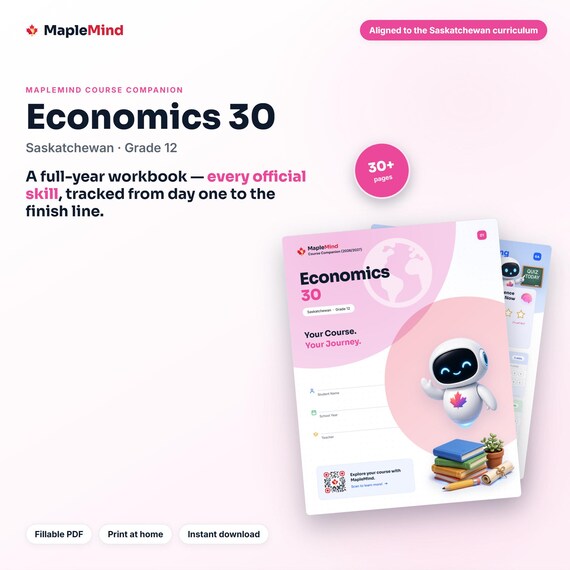
A Economics 30 workbook worth keeping
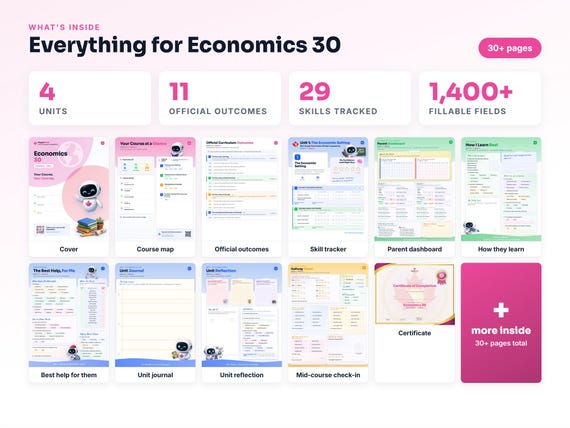
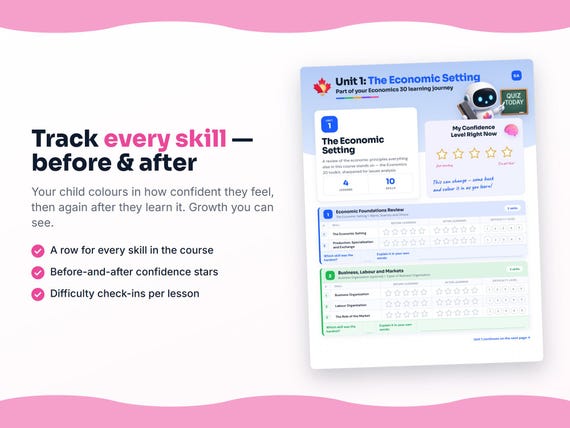
Built from the same official curriculum as this page. Before and after each skill above, your student colours in how sure they feel — so the two of you can see, on one page, what's clicking and what needs another look. It's a quiet way to follow how the year is really going.
By June it's full of their own handwriting: units worked through, confidence grown, a mid-year check-in, notes from parent-teacher night, and a certificate at the end. Less a worksheet, more a record of the year worth keeping on the shelf.
Instant download · see every page, reviews and the full description · five or more workbooks are $2.99 each
What it looks like in the app



Common questions
Can MapleMind help me with Economics 30?
Yes. MapleMind's AI tutor covers all 29 skills in Saskatchewan's Economics 30 — you pick the exact skill, and the tutor teaches it step by step: a short lesson, a worked example, solving together, then a skill check to show it stuck.
Is MapleMind aligned to Saskatchewan's official curriculum?
Yes. Every skill in this course maps to an official outcome code from Saskatchewan's Grade 12 Social Studies curriculum, and the ministry's own wording is quoted under each unit on this page — with the official government source linked so you can check it yourself.
What does MapleMind cost?
It's free to start — 5 tutoring chats and a practice quiz every day, no credit card. A Pro subscription ($9.99/month or $49.99/year CAD, 7-day free trial) unlocks unlimited tutoring, practice, and exam simulations.
What if I'm stuck on just one topic?
That's the point of skill-level tutoring: open Economics 30 in the app, tap the exact skill from the list on this page, and the tutor teaches just that — no wading through lessons you don't need.
Does MapleMind work in French or other languages?
Yes — 14 languages, including French. Both the app and the tutor's explanations switch to the language you choose.
Where can I see the official Saskatchewan curriculum for Economics 30?
The official source is linked on this page — Saskatchewan's official curriculum. The outline here follows it: every MapleMind skill carries its official outcome code, and the ministry's own wording is quoted under each unit.
Keep exploring
Ready when you are
Pick a skill from this page and see it taught properly — free, in the browser, in under a minute.