

Get help with Economics 20
Most tutoring makes you sit through material you already know. MapleMind flips that: pick the exact skill that's causing trouble — any of the 60 below — and the tutor teaches just that one, step by step, as many times as it takes. Ask questions in plain words, any time of day, in English, French, or 12 other languages.
The official Saskatchewan Economics 20 curriculum
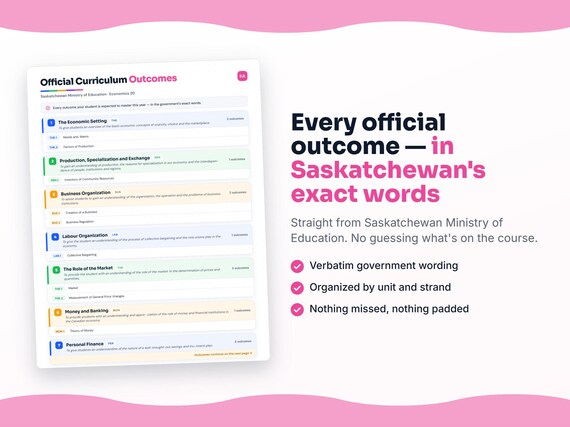
Saskatchewan defines Economics 20 by strands and outcomes. MapleMind teaches the same curriculum reorganized for one-skill-at-a-time tutoring — the table shows exactly where every official strand lands, and the ministry's own wording is quoted under each unit below.
Official source Saskatchewan's official curriculumRead it on the government site — curriculum.gov.sk.ca ↗| Official strand | Outcomes | Where MapleMind teaches it |
|---|---|---|
| Strand U1 | 7 | The Economic Setting |
| Strand U2 | 4 | Production, Specialization and Exchange |
| Strand U3 | 8 | Business Organization |
| Strand U4 | 3 | Labour Organization |
| Strand U5 | 6 | The Role of the Market |
| Strand U6 | 5 | Money and Banking |
| Strand U7 | 7 | Personal Finance |
| Strand U8 | 6 | International Trade |
| Strand U9 | 10 | The Role of Government in the Canadian Economy |
| U10 | 4 | Comparative Economic Systems |
Every skill below, taught one on one.
 Try the first session free
How MapleMind teaches Economics 20 — every unit, lesson, and skill
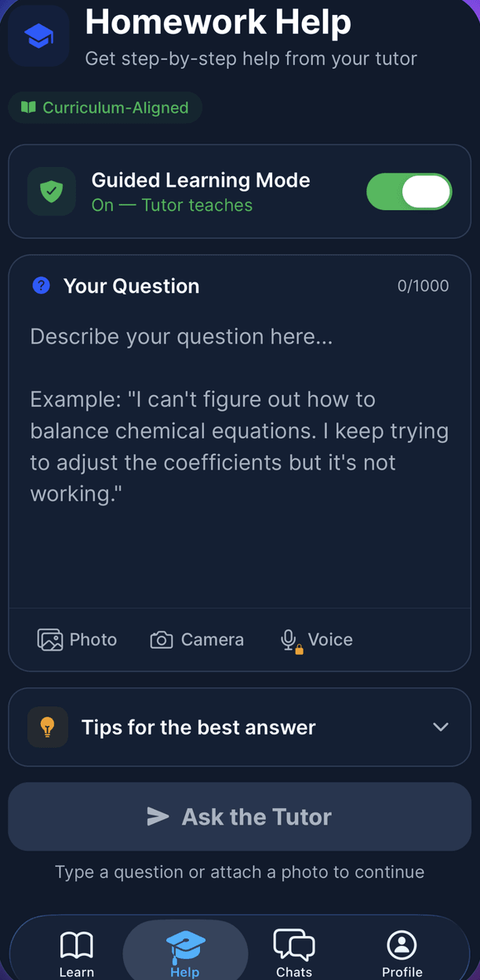
Every skill below runs as a short session: a plain-words lesson, a worked example, solving it together, then a five-question skill check that earns up to three stars. Guided Mode keeps it teaching instead of answer-handing — turning it off needs a parent's password.
Unit 1The Economic SettingOfficial strand · Strand U1
To give students an overview of the basic economic concepts of scarcity, choice and the marketplace.
Scarcity, Choice and Markets
- Needs and WantsECON20-U1-S1 — Distinguish basic needs from culturally shaped wants, and see why no economy can satisfy them all.
- Scarcity, Wants and ChoiceECON20-U1-S2 — Scarcity forces choice — weigh alternatives and meet opportunity cost, the value of the option you give up.
- The MarketplaceECON20-U1-S3 — How buyers and sellers meet, and how markets coordinate the choices of producers and consumers.
How an Economy Produces
- Factors of ProductionECON20-U1-S4 — Land, labour, capital and management — the inputs every good and service is built from.
- The Circular Flow ModelECON20-U1-S5 — Trace money, resources and products flowing between households and businesses in the circular flow model.
- Aggregate ProductionECON20-U1-S6 — Measure what a whole economy produces — from single markets up to Gross National Product.
- The Economic SystemECON20-U1-S7 — Put the pieces together: how a whole economic system organizes scarcity, choice and exchange.
The official wording — 7 outcomes in this unit
- ECON20-U1-S1
Needs and. Wants
- ECON20-U1-S2
Scarcity, Wants and Choice
- ECON20-U1-S3
Marketplace
- ECON20-U1-S4
Factors of Production
- ECON20-U1-S5
circular Flow Model
- ECON20-U1-S6
Aggregate Production
- ECON20-U1-S7
Economic System
Unit 2Production, Specialization and ExchangeOfficial strand · Strand U2
To gain an understanding of production, the reasons for specialization in our economy, and the interdepen- dence of people, institutions and regions.
Specialization and Exchange
- Inventory of Community ResourcesECON20-U2-S1 — Survey the productive resources of your own community and how they shape what it produces.
- Comparative Study of AgricultureECON20-U2-S2 — Compare farming across regions to see how climate, soil and markets drive what farmers grow.
- Regional SpecializationECON20-U2-S3 — Why regions specialize and trade instead of trying to produce everything locally.
- A Grain FarmECON20-U2-S4 — A working grain farm as an economic case study — inputs, decisions, risks and returns.
The official wording — 4 outcomes in this unit
- ECON20-U2-S1
Inventory of Community Resources
- ECON20-U2-S2
Comparative Study of Agriculture
- ECON20-U2-S3
Regional Specialization
- ECON20-U2-S4
A Grain Farm
Unit 3Business OrganizationOfficial strand · Strand U3
To assist students to gain an understanding of the organization, the operation and the problems of business institutions.
Starting and Owning a Business
- Creation of a BusinessECON20-U3-S1 — Sole proprietorships, partnerships, corporations and co-ops — how a business is created and financed.
- StockholdersECON20-U3-S2 — What it means to own shares: stockholders, boards of directors, risk and return.
- Mergers and Holding CompaniesECON20-U3-S3 — How firms combine — mergers and holding companies — and what that concentration means.
- Interlocking DirectoratesECON20-U3-S4 — When the same people sit on many boards: interlocking directorates and corporate control.
Business in the Marketplace
- Business RegulationECON20-U3-S5 — Why and how governments regulate business behaviour in the marketplace.
- CompetitionECON20-U3-S6 — Competition as the discipline of the market — and what happens when it weakens.
- Crown CorporationsECON20-U3-S7 — Publicly owned business: why Crown corporations exist and how they operate in Saskatchewan and Canada.
- Co-operativesECON20-U3-S8 — The co-operative model — member-owned businesses and their role in the prairie economy.
The official wording — 8 outcomes in this unit
- ECON20-U3-S1
Creation of a Business
- ECON20-U3-S2
Stockholders
- ECON20-U3-S3
and Holding Company
- ECON20-U3-S4
Interlocking Directorates
- ECON20-U3-S5
Business Regulation
- ECON20-U3-S6
Competition
- ECON20-U3-S7
Crown Corporations
- ECON20-U3-S8
Co-operation
Unit 4Labour OrganizationOfficial strand · Strand U4
To give the student an understanding of the process of collective bargaining and the roie unions play in the economy.
Labour and Collective Bargaining
- Collective BargainingECON20-U4-S1 — How unions and management negotiate agreements — bargaining, conciliation, mediation and arbitration.
- Why Unions?ECON20-U4-S2 — Why workers organize: the history and purpose of the labour movement.
- StrikesECON20-U4-S3 — Strikes and lockouts — the tools of last resort, their costs, and how disputes get settled.
The official wording — 3 outcomes in this unit
- ECON20-U4-S1
Collective Bargaining
- ECON20-U4-S2
Why Unions?
- ECON20-U4-S3
Strikes
Unit 5The Role of the MarketOfficial strand · Strand U5
To provide the student with an understanding of the role of the market 'in the determination of prices and quantities.
Markets and Prices
- The MarketECON20-U5-S1 — Supply meets demand: how a market sets price and quantity.
- Price TheoryECON20-U5-S2 — The theory of price — how supply and demand curves explain price changes.
- Comparative PricingECON20-U5-S3 — Compare prices across sellers and markets to see competition working — or failing.
Prices in the Real World
- Measuring General Price ChangesECON20-U5-S4 — Price indexes: how economists measure inflation and general price change over time.
- AdvertisingECON20-U5-S5 — How advertising shapes demand — information, persuasion, and the consumer's defences.
- A Market EconomyECON20-U5-S6 — Step back and evaluate the market economy as a system for answering the economic questions.
The official wording — 6 outcomes in this unit
- ECON20-U5-S1
Market
- ECON20-U5-S2
Price Theory
- ECON20-U5-S3
Comparative Pricing
- ECON20-U5-S4
Measurement of General Price 'changes
- ECON20-U5-S5
Advertising
- ECON20-U5-S6
A Market Economy
Unit 6Money and BankingOfficial strand · Strand U6
To proyide students witn an understanding and appre- ciation of the role of money and financial institutions in the Canadian economy.
Money and the Banking System
- The Theory of MoneyECON20-U6-S1 — What money is and does: medium of exchange, standard of value, store of value.
- The Banking SystemECON20-U6-S2 — How chartered banks and the Bank of Canada form a system that manages the money supply.
- History of Canadian BankingECON20-U6-S3 — How Canada's banking system grew — from colonial banks to the Bank of Canada.
- Banking ServicesECON20-U6-S4 — Accounts, loans, cheques and credit — the services banks provide to people and businesses.
- Monetary PolicyECON20-U6-S5 — How the central bank manages the money supply to fight inflation and unemployment.
The official wording — 5 outcomes in this unit
- ECON20-U6-S1
Theory of Money
- ECON20-U6-S2
The Banking System
- ECON20-U6-S3
History of Canadian Banking
- ECON20-U6-S4
Banking Services
- ECON20-U6-S5
. Monetary Policy
Unit 7Personal FinanceOfficial strand · Strand U7
To give students an understandine of the nature of a well-tnought-out savings and inv:..tment plan.
Credit and Investments
- Personal CreditECON20-U7-S1 — Borrowing wisely: credit, loans, mortgages, interest and your credit rating.
- Stocks, Mutual Funds and BondsECON20-U7-S2 — The main investment vehicles — stocks, mutual funds and bonds — and their risk and return.
- The Stock Market: A Case StudyECON20-U7-S3 — Follow real shares through the stock market to see how investing actually works.
Planning Your Financial Future
- InsuranceECON20-U7-S4 — How insurance spreads risk — and how to judge what coverage is worth buying.
- Retirement PlanningECON20-U7-S5 — Planning decades ahead: pensions, savings and the arithmetic of retirement.
- Real PropertyECON20-U7-S6 — Real estate as an investment — owning, renting and property value.
- Building an Investment PortfolioECON20-U7-S7 — Bring it together: design a balanced investment portfolio for a set of life goals.
The official wording — 7 outcomes in this unit
- ECON20-U7-S1
Personai Credit
- ECON20-U7-S2
Stocks, Mutual Funds and Bonds
- ECON20-U7-S3
The Stock Market - A Case Study
- ECON20-U7-S4
Insurance
- ECON20-U7-S5
Retirement Planning
- ECON20-U7-S6
Real Property
- ECON20-U7-S7
Investment Portfolio
Unit 8International TradeOfficial strand · Strand U8
To assist students in acquiring an appreciation of the role and importance of international trade in the Canadian economy.. To provide an understanding of the nature'of barriers to trade.
Why Nations Trade
- Comparative AdvantageECON20-U8-S1 — Why countries trade even when one can produce everything more cheaply — comparative advantage.
- The Development of Canada's Foreign TradeECON20-U8-S2 — How Canada's foreign trade grew from fur and fish into a modern trading economy.
- Balance of PaymentsECON20-U8-S3 — The national ledger: how the balance of payments records everything Canada buys from and sells to the world.
Trade Barriers and Agreements
- Barriers to TradeECON20-U8-S4 — Tariffs, quotas and other barriers — why governments restrict trade and who pays for it.
- The Canada–U.S. Automotive AgreementECON20-U8-S5 — The Auto Pact as a case study in managed trade between Canada and the United States.
- Free Trade vs. ProtectionECON20-U8-S6 — The great debate: weigh the arguments for free trade against the case for protection.
The official wording — 6 outcomes in this unit
- ECON20-U8-S1
Comparative Advantage
- ECON20-U8-S2
Historical Development of Canada's Foreign Trade
- ECON20-U8-S3
Balance of Payments
- ECON20-U8-S4
Barriers to Trade
- ECON20-U8-S5
Canada-U.S. Automotive Agreement
- ECON20-U8-S6
Free Trade vs. Protection
Unit 9The Role of Government in the Canadian EconomyOfficial strand · Strand U9
To give students an understanding of the role of government in the economy.
Government Revenue and Spending
- Business CyclesECON20-U9-S1 — Boom and bust: what business cycles are and why economies swing.
- Fiscal PoliciesECON20-U9-S2 — How government taxing and spending decisions steer the economy — fiscal policy.
- TaxationECON20-U9-S3 — Who pays and how: income, sales and property taxes, and what makes a tax fair.
- Government ExpendituresECON20-U9-S4 — Where public money goes — the major categories of government spending.
- Local Government Revenue and ExpenditureECON20-U9-S5 — How municipalities raise and spend money — the level of government closest to home.
Government in the Economy
- Price and Income ControlsECON20-U9-S6 — When governments cap prices and incomes — how controls work and what they cost.
- Consumer ProtectionECON20-U9-S7 — Laws and agencies that protect consumers — and the limits of that protection.
- Government and Economic GrowthECON20-U9-S8 — Can government make an economy grow? Policies that try, and their track record.
- Income RedistributionECON20-U9-S9 — Transfers, taxes and programs that move income between Canadians — and the debates around them.
- How Much Government?ECON20-U9-S10 — The culminating question: how much government involvement should the Canadian economy have?
The official wording — 10 outcomes in this unit
- ECON20-U9-S1
Business Cycles
- ECON20-U9-S2
Fiscal Policies
- ECON20-U9-S3
Taxation
- ECON20-U9-S4
Government Expenditures
- ECON20-U9-S5
Local Government Revenue and Expenditure
- ECON20-U9-S6
Price: and Income Controls
- ECON20-U9-S7
Consumer Protection
- ECON20-U9-S8
Government and Economic Growth
- ECON20-U9-S9
Income Redistribution
- ECON20-U9-S10
Government Involvement
Unit 10Comparative Economic SystemsOfficial strand · U10
To give students an understanding and appreciation of our own and alternative economic systems.
Comparing Economic Systems
- Types of Economic SystemsECON20-U10-S1 — Traditional, command and market economies — the three basic answers to the economic questions.
- Economic ModelsECON20-U10-S2 — How economists use simplified models to compare whole economic systems.
- Contrasting Economic SystemsECON20-U10-S3 — Compare real economies — capitalist, socialist and communist — on freedom, efficiency and equity.
- Judging Economic SystemsECON20-U10-S4 — Weigh the systems against each other: which trade-offs would you accept, and why?
The official wording — 4 outcomes in this unit
- ECON20-U10-S1
Types of Economic systems
- ECON20-U10-S2
Economic Models
- ECON20-U10-S3
Contrasting Economic Systems
- ECON20-U10-S4
Comparative Economic Systems
Printable workbook · A keepsake of the year
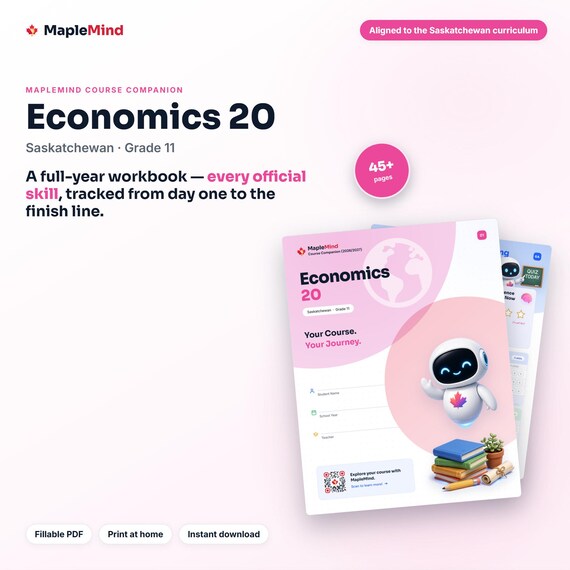
A Economics 20 workbook worth keeping
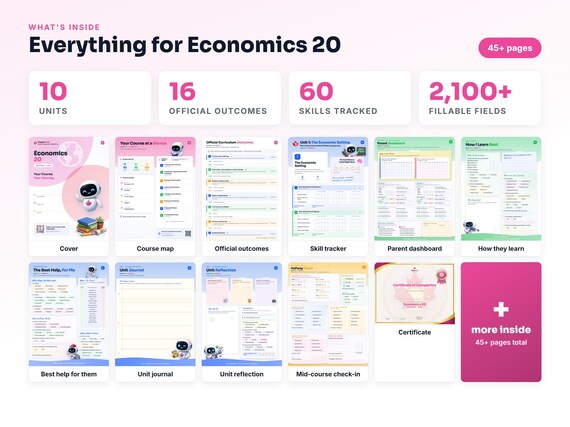
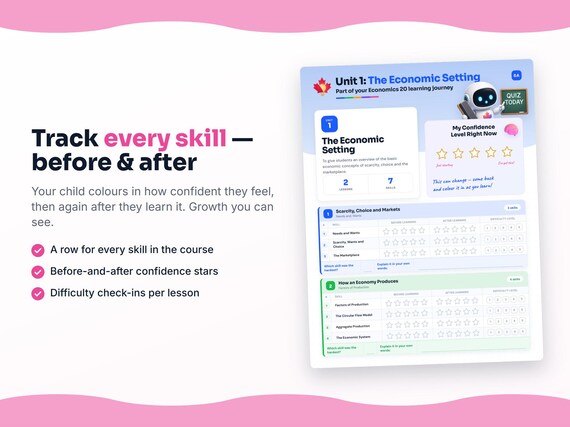
Built from the same official curriculum as this page. Before and after each skill above, your student colours in how sure they feel — so the two of you can see, on one page, what's clicking and what needs another look. It's a quiet way to follow how the year is really going.
By June it's full of their own handwriting: units worked through, confidence grown, a mid-year check-in, notes from parent-teacher night, and a certificate at the end. Less a worksheet, more a record of the year worth keeping on the shelf.
Instant download · see every page, reviews and the full description · five or more workbooks are $2.99 each
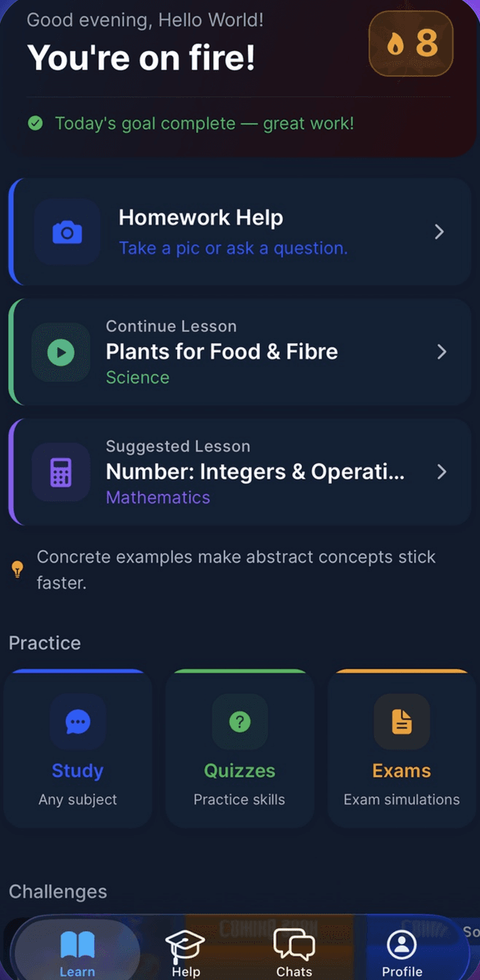
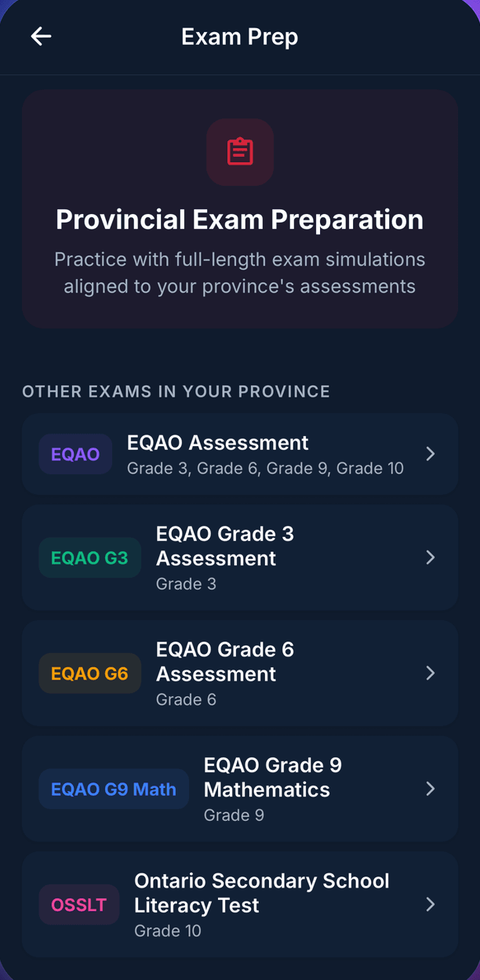
What it looks like in the app
Common questions
Can MapleMind help me with Economics 20?
Yes. MapleMind's AI tutor covers all 60 skills in Saskatchewan's Economics 20 — you pick the exact skill, and the tutor teaches it step by step: a short lesson, a worked example, solving together, then a skill check to show it stuck.
Is MapleMind aligned to Saskatchewan's official curriculum?
Yes. Every skill in this course maps to an official outcome code from Saskatchewan's Grade 11 Social Studies curriculum, and the ministry's own wording is quoted under each unit on this page — with the official government source linked so you can check it yourself.
What does MapleMind cost?
It's free to start — 5 tutoring chats and a practice quiz every day, no credit card. A Pro subscription ($9.99/month or $49.99/year CAD, 7-day free trial) unlocks unlimited tutoring, practice, and exam simulations.
What if I'm stuck on just one topic?
That's the point of skill-level tutoring: open Economics 20 in the app, tap the exact skill from the list on this page, and the tutor teaches just that — no wading through lessons you don't need.
Does MapleMind work in French or other languages?
Yes — 14 languages, including French. Both the app and the tutor's explanations switch to the language you choose.
Where can I see the official Saskatchewan curriculum for Economics 20?
The official source is linked on this page — Saskatchewan's official curriculum. The outline here follows it: every MapleMind skill carries its official outcome code, and the ministry's own wording is quoted under each unit.
Keep exploring
Ready when you are
Pick a skill from this page and see it taught properly — free, in the browser, in under a minute.