Get help with Social Studies 10
Most tutoring makes you sit through material you already know. MapleMind flips that: pick the exact skill that's causing trouble — any of the 5 below — and the tutor teaches just that one, step by step, as many times as it takes. Ask questions in plain words, any time of day, in English, French, or 12 other languages.
The official Saskatchewan Social Studies 10 curriculum
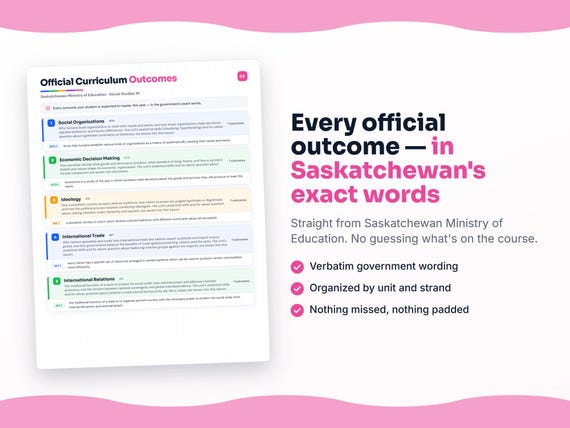
Saskatchewan defines Social Studies 10 by strands and outcomes. MapleMind teaches the same curriculum reorganized for one-skill-at-a-time tutoring — the table shows exactly where every official strand lands, and the ministry's own wording is quoted under each unit below.
Official source Saskatchewan's official curriculumRead it on the government site — curriculum.gov.sk.ca ↗| Official strand | Outcomes | Where MapleMind teaches it |
|---|---|---|
| Strand U1 | 1 | Social Organizations |
| Strand U2 | 1 | Economic Decision Making |
| Strand U3 | 1 | Ideology |
| Strand U4 | 1 | International Trade |
| Strand U5 | 1 | International Relations |
Every skill below, taught one on one.
 Try the first session free
How MapleMind teaches Social Studies 10 — every unit, lesson, and skill
Every skill below runs as a short session: a plain-words lesson, a worked example, solving it together, then a five-question skill check that earns up to three stars. Guided Mode keeps it teaching instead of answer-handing — turning it off needs a parent's password.
Unit 1Social OrganizationsOfficial strand · Strand U1
Why humans build organizations to meet their needs and wants, and how those organizations make decisions, regulate behaviour, and resolve differences. The unit's analytical skills (classifying, hypothesizing) and its values question about legitimate constraints on behaviour are woven into this lesson.
Why We Build Organizations
- Why humans build organizationsU1-KNOWLEDGE — Understand that humans establish various kinds of organizations as a means of systematically meeting their needs and wants, and how those organizations make and enforce decisions.
The official wording — 1 outcome in this unit
- U1-KNOWLEDGE
Know that humans establish various kinds of organizations as a means of systematically meeting their needs and wants.
Unit 2Economic Decision MakingOfficial strand · Strand U2
How societies decide what goods and services to produce, what standard of living means, and how a society's beliefs and values shape its economic organization. The unit's analytical skills and its values question about honest comparison are woven into this lesson.
How Societies Make Economic Decisions
- How societies make economic decisionsU2-KNOWLEDGE — Understand that economics is the study of how societies decide about the goods and services they will produce, and how a society's beliefs and values shape its economic organization.
The official wording — 1 outcome in this unit
- U2-KNOWLEDGE
economics is a study of the way in which societies make decisions about the goods and services they will produce to meet the wants
Unit 3IdeologyOfficial strand · Strand U3
How a pluralistic society accepts diverse traditions, how claims to power are judged legitimate or illegitimate, and how the political process resolves conflicting ideologies. The unit's analytical skills and its values question about ranking freedom, order, hierarchy, and equality are woven into this lesson.
Ideology and Legitimate Power
- Pluralism, legitimacy, and ideologyU3-KNOWLEDGE — Understand that a pluralistic society accepts diverse cultural traditions, that societies judge some claims to power legitimate and others not, and that the political process resolves conflicting ideologies.
The official wording — 1 outcome in this unit
- U3-KNOWLEDGE
a pluralistic society is one in which diverse cultural traditions, with different norms and values are accepted.
Unit 4International TradeOfficial strand · Strand U4
Why nations specialize and trade, how international trade lets nations export surpluses and import scarce goods, and how governments balance the benefits of trade against protecting citizens and the state. The unit's analytical skills and its values question about balancing interest groups against the majority are woven into this lesson.
Why Nations Trade
- Why nations specialize and tradeU4-KNOWLEDGE — Understand that each nation has resources suited to producing certain commodities efficiently, that specialization and international trade let nations export surpluses and import scarce goods, and that governments also protect their citizens' interests.
The official wording — 1 outcome in this unit
- U4-KNOWLEDGE
every nation has a specific set of resources arranged in certain patterns which can be used to produce certain commodities more efficiently.
Unit 5International RelationsOfficial strand · Strand U5
The traditional function of a state to protect its social order, how national power and alliances maintain autonomy, and the tension between national sovereignty and global interdependence. The unit's analytical skills and its values question about whether a state should be bound by law like a citizen are woven into this lesson.
States, Power, and Sovereignty
- The state, national power, and sovereigntyU5-KNOWLEDGE — Understand that the traditional function of a state is to protect its social order, that a state's autonomy depends on its national power and alliances, and that national sovereignty is in tension with global interdependence.
The official wording — 1 outcome in this unit
- U5-KNOWLEDGE
the traditional function of a state is to organize and arm society with the necessary power to protect the social order from internal disruption and external attack.
Printable workbook · A keepsake of the year
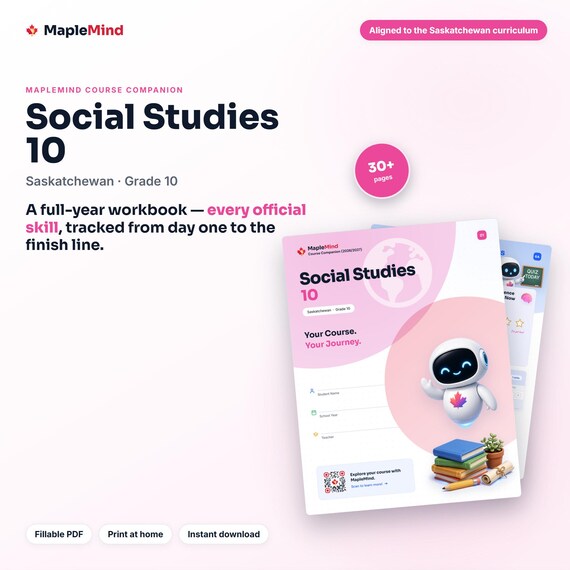
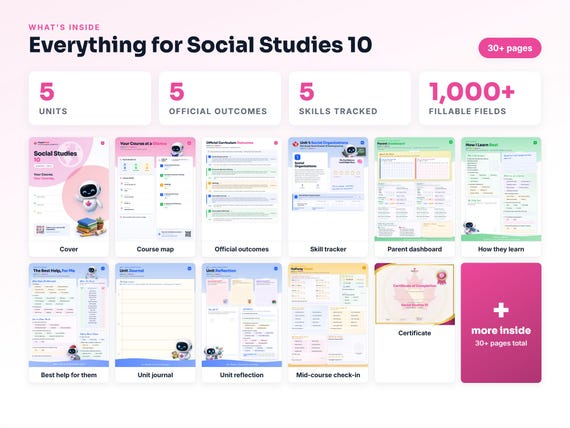
A Social Studies 10 workbook worth keeping
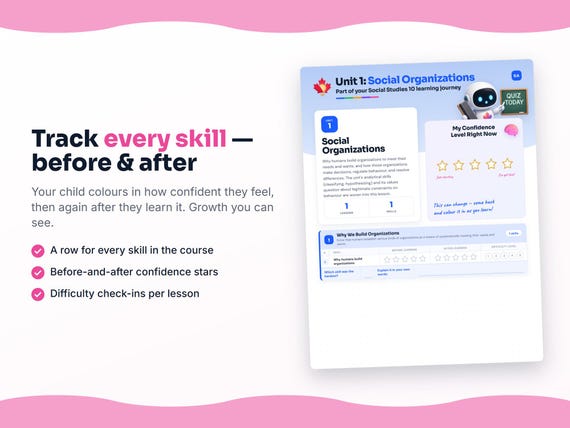
Built from the same official curriculum as this page. Before and after each skill above, your student colours in how sure they feel — so the two of you can see, on one page, what's clicking and what needs another look. It's a quiet way to follow how the year is really going.
By June it's full of their own handwriting: units worked through, confidence grown, a mid-year check-in, notes from parent-teacher night, and a certificate at the end. Less a worksheet, more a record of the year worth keeping on the shelf.
Instant download · see every page, reviews and the full description · five or more workbooks are $2.99 each
What it looks like in the app



Common questions
Can MapleMind help me with Social Studies 10?
Yes. MapleMind's AI tutor covers all 5 skills in Saskatchewan's Social Studies 10 — you pick the exact skill, and the tutor teaches it step by step: a short lesson, a worked example, solving together, then a skill check to show it stuck.
Is MapleMind aligned to Saskatchewan's official curriculum?
Yes. Every skill in this course maps to an official outcome code from Saskatchewan's Grade 10 Social Studies curriculum, and the ministry's own wording is quoted under each unit on this page — with the official government source linked so you can check it yourself.
What does MapleMind cost?
It's free to start — 5 tutoring chats and a practice quiz every day, no credit card. A Pro subscription ($9.99/month or $49.99/year CAD, 7-day free trial) unlocks unlimited tutoring, practice, and exam simulations.
What if I'm stuck on just one topic?
That's the point of skill-level tutoring: open Social Studies 10 in the app, tap the exact skill from the list on this page, and the tutor teaches just that — no wading through lessons you don't need.
Does MapleMind work in French or other languages?
Yes — 14 languages, including French. Both the app and the tutor's explanations switch to the language you choose.
Where can I see the official Saskatchewan curriculum for Social Studies 10?
The official source is linked on this page — Saskatchewan's official curriculum. The outline here follows it: every MapleMind skill carries its official outcome code, and the ministry's own wording is quoted under each unit.
Keep exploring
Ready when you are
Pick a skill from this page and see it taught properly — free, in the browser, in under a minute.