Get help with Functions, Grade 11 (University)
Most tutoring makes you sit through material you already know. MapleMind flips that: pick the exact skill that's causing trouble — any of the 68 below — and the tutor teaches just that one, step by step, as many times as it takes. Ask questions in plain words, any time of day, in English, French, or 12 other languages.
The official Ontario Functions, Grade 11 (University) curriculum
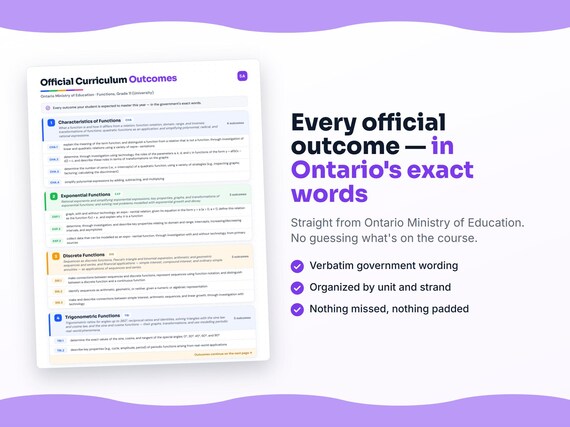
Ontario defines Functions, Grade 11 (University) by strands and outcomes. MapleMind teaches the same curriculum reorganized for one-skill-at-a-time tutoring — the table shows exactly where every official strand lands, and the ministry's own wording is quoted under each unit below.
Official source Ontario's official mathematics curriculumRead it on the government site — dcp.edu.gov.on.ca ↗| Official strand | Outcomes | Where MapleMind teaches it |
|---|---|---|
| Strand A | 18 | Characteristics of Functions |
| Strand B | 12 | Exponential Functions |
| Strand C | 18 | Discrete Functions |
| Strand D | 20 | Trigonometric Functions |
Every skill below, taught one on one.
 Try the first session free
How MapleMind teaches Functions, Grade 11 (University) — every unit, lesson, and skill
Every skill below runs as a short session: a plain-words lesson, a worked example, solving it together, then a five-question skill check that earns up to three stars. Guided Mode keeps it teaching instead of answer-handing — turning it off needs a parent's password.
Unit 1Characteristics of FunctionsOfficial strand · Strand A
What a function is and how it differs from a relation; function notation, domain, range, and inverses; transformations of functions; quadratic functions as an application; and simplifying polynomial, radical, and rational expressions.
Representing Functions
- What makes a relation a functionmcr3u.1.1 — Explain what a function is and distinguish a function from a relation that is not a function, using tables, mapping diagrams, graphs, function machines, and equations.
- Using function notation and evaluating functionsmcr3u.1.2 — Represent linear and quadratic functions using function notation, and substitute into and evaluate functions given their equations, tables, or graphs.
- Explaining domain and rangemcr3u.1.3 — Explain the meanings of domain and range using several function types, and describe any real-world restrictions on a function's domain and range.
- Connecting a function's inverse to reverse processesmcr3u.1.4 — Relate finding the inverse of a function to the familiar idea of reverse processes, like undoing an operation.
- Finding a function's inverse numerically and graphicallymcr3u.1.5 — Find the numeric or graphical representation of the inverse of a linear or quadratic function, and connect a function's graph to its inverse's graph as a reflection in the line y = x.
- Domain and range of an inverse relationmcr3u.1.6 — Investigate the relationship between a function's domain and range and its inverse relation's domain and range, and determine whether the inverse relation is itself a function.
- Finding a function's inverse algebraicallymcr3u.1.7 — Determine the algebraic representation of the inverse of a linear or quadratic function, using function notation when appropriate.
Transformations of Functions
- The roles of a, k, d, and c in y = af(k(x − d)) + cmcr3u.1.8 — Investigate the roles of the parameters a, k, d, and c in y = af(k(x − d)) + c, and describe them as translations, reflections, and stretches/compressions on several base functions.
- Sketching transformed functionsmcr3u.1.9 — Sketch graphs of y = af(k(x − d)) + c by applying one or more transformations to a base function, and state the domain and range of the result.
Solving Problems Involving Quadratic Functions
- Finding the number of zeros of a quadratic functionmcr3u.1.10 — Determine the number of zeros (x-intercepts) of a quadratic function using strategies such as inspecting graphs, factoring, or calculating the discriminant.
- Finding the maximum or minimum of a quadratic function algebraicallymcr3u.1.11 — Determine the maximum or minimum value of a quadratic function given in the form f(x) = ax² + bx + c, using an algebraic method such as completing the square.
- Solving real-world quadratic function problemsmcr3u.1.12 — Solve real-world problems involving quadratic functions represented using function notation, such as maximizing profit.
- The family of quadratic functions sharing the same zerosmcr3u.1.13 — Investigate the transformational relationship among quadratic functions that share the same zeros, and determine a quadratic function's equation given its roots and a point.
- Solving the intersection of a linear and a quadratic functionmcr3u.1.14 — Solve problems involving the intersection of a linear function and a quadratic function graphically and algebraically.
Determining Equivalent Algebraic Expressions
- Simplifying polynomial expressionsmcr3u.1.15 — Simplify polynomial expressions by adding, subtracting, and multiplying.
- Simplifying radicals and radical expressionsmcr3u.1.16 — Verify that √ab = √a × √b for a, b ≥ 0, and use this relationship to simplify radicals and radical expressions.
- Simplifying rational expressions and stating restrictionsmcr3u.1.17 — Simplify rational expressions by adding, subtracting, multiplying, and dividing, and state the restrictions on the variable values.
- Checking whether two algebraic expressions are equivalentmcr3u.1.18 — Determine whether two given algebraic expressions are equivalent, by simplifying or by substituting values.
The official wording — 18 outcomes in this unit
- mcr3u.1.1
explain the meaning of the term function, and distinguish a function from a relation that is not a function, through investigation of linear and quadratic relations using a variety of repre- sentations
- mcr3u.1.2
represent linear and quadratic functions using function notation, given their equations, tables of values, or graphs, and substitute into and evaluate functions
- mcr3u.1.3
explain the meanings of the terms domain and range, through investigation using numer- ic, graphical, and algebraic representations
- mcr3u.1.4
relate the process of determining the inverse of a function to their understanding of reverse processes
- mcr3u.1.5
determine, through investigation, the numeric or graphical represen- tation of the inverse of a linear or quadratic function, given the numeric, graphical, or algebraic representation of the function, and make connections
- mcr3u.1.6
determine, through investigation, the relation- ship between the domain and range of a func- tion and the domain and range of the inverse relation, and determine whether or not the inverse relation is a function
- mcr3u.1.7
determine, using function notation when appropriate, the algebraic representation of the inverse of a linear or quadratic function, given the algebraic representation of the function
- mcr3u.1.8
determine, through investigation using technology, the roles of the parameters a, k, d, and c in functions of the form y = af(k(x – d)) + c, and describe these roles in terms of transformations on the graphs
- mcr3u.1.9
sketch graphs of y = af(k(x – d)) + c by applying one or more transformations to the graphs of f(x) = x
- mcr3u.1.10
determine the number of zeros (i.e., x-intercepts) of a quadratic function, using a variety of strategies (e.g., inspecting graphs; factoring; calculating the discriminant)
- mcr3u.1.11
determine the maximum or minimum value of a quadratic function whose equation is given in the form f(x) = ax + bx + c, using an algebraic method
- mcr3u.1.12
solve problems involving quadratic functions arising from real-world applications and represented using function notation
- mcr3u.1.13
determine, through investigation, the trans- formational relationship among the family of quadratic functions that have the same zeros, and determine the algebraic representation of a quadratic function, given the real roots of the corresponding quadratic equation and a point on the function
- mcr3u.1.14
solve problems involving the intersection of a linear function and a quadratic function graphically and algebraically
- mcr3u.1.15
simplify polynomial expressions by adding, subtracting, and multiplying
- mcr3u.1.16
verify, through investigation with and without technology, that √ab = √a x √b, a ≥ 0, b ≥ 0, and use this relationship to simplify radicals
- mcr3u.1.17
simplify rational expressions by adding, subtracting, multiplying, and dividing, and state the restrictions on the variable values
- mcr3u.1.18
determine if two given algebraic expressions are equivalent (i.e., by simplifying; by substituting values)
Unit 2Exponential FunctionsOfficial strand · Strand B
Rational exponents and simplifying exponential expressions; key properties, graphs, and transformations of exponential functions; and solving real problems modelled with exponential growth and decay.
Representing Exponential Functions
- Graphing an exponential relation and defining it as a functionmcr3u.2.1 — Graph an exponential relation given as y = aˣ, define it as the function f(x) = aˣ, and explain why it is a function.
- Finding the value of a power with a rational exponentmcr3u.2.2 — Investigate and determine the value of a power with a rational exponent, using patterns, a graph, or the exponent laws.
- Simplifying and evaluating expressions with integer and rational exponentsmcr3u.2.3 — Simplify algebraic expressions containing integer and rational exponents, and evaluate numeric expressions with integer and rational exponents and rational bases.
Connecting Graphs and Equations of Exponential Functions
- Key properties of exponential functionsmcr3u.2.4 — Investigate and describe an exponential function's domain, range, intercepts, increasing/decreasing intervals, and asymptotes, given various representations.
- Distinguishing exponential from linear and quadratic functionsmcr3u.2.5 — Distinguish exponential functions from linear and quadratic functions by comparing rates of change, ratios in a table, graphs, and equations.
- The roles of a, k, d, and c in exponential transformationsmcr3u.2.6 — Investigate the roles of the parameters a, k, d, and c in y = af(k(x − d)) + c for exponential functions, and describe them as transformations.
- Sketching transformed exponential functionsmcr3u.2.7 — Sketch graphs of y = af(k(x − d)) + c by applying transformations to f(x) = aˣ, and state the domain and range of the result.
- Expressing an exponential function using a different basemcr3u.2.8 — Investigate that an exponential function's equation can be expressed using different bases, and explain the connection between equivalent forms.
- Writing an exponential function's equation from its graph or propertiesmcr3u.2.9 — Represent an exponential function with an equation, given its graph or its properties, such as a known y-intercept and asymptote.
Solving Problems Involving Exponential Functions
- Collecting and graphing exponential datamcr3u.2.10 — Collect data that can be modelled as an exponential function, from primary or secondary sources, and graph the data.
- Identifying real-world exponential growth and decaymcr3u.2.11 — Identify exponential functions that arise from real-world growth and decay situations, given various representations, and explain any restrictions the context places on domain and range.
- Solving real-world exponential function problemsmcr3u.2.12 — Solve problems using given graphs or equations of exponential functions from real-world applications, by interpreting graphs or substituting into equations.
The official wording — 12 outcomes in this unit
- mcr3u.2.1
graph, with and without technology, an expo- nential relation, given its equation in the form y = a (a > 0, a ≠ 1), define this relation as the function f(x) = a , and explain why it is a function
- mcr3u.2.2
determine, through investigation using a variety of tools (e.g., calculator, paper and pencil, graphing technology) and strategies (e.g., patterning; finding values from a graph; interpreting the exponent laws), the value of a power with a rational exponent
- mcr3u.2.3
simplify algebraic expressions containing integer and rational exponents
- mcr3u.2.4
determine, through investigation, and describe key properties relating to domain and range, intercepts, increasing/decreasing intervals, and asymptotes
- mcr3u.2.5
distinguish exponential functions from linear and quadratic functions by making compar- isons in a variety of ways
- mcr3u.2.6
determine, through investigation using tech- nology, the roles of the parameters a, k, d, and c in functions of the form y = af(k(x – d)) + c, and describe these roles in terms of transfor- mations on the graph of f(x) = a (a > 0, a ≠ 1)
- mcr3u.2.7
sketch graphs of y = af(k(x – d)) + c by applying one or more transformations to the graph of f(x) = a (a > 0, a ≠ 1), and state the domain and range of the transformed functions
- mcr3u.2.8
determine, through investigation using techno- logy, that the equation of a given exponential function can be expressed using different bases
- mcr3u.2.9
represent an exponential function with an equation, given its graph or its properties
- mcr3u.2.10
collect data that can be modelled as an expo- nential function, through investigation with and without technology, from primary sources
- mcr3u.2.11
identify exponential functions, including those that arise from real-world applications involving growth and decay
- mcr3u.2.12
solve problems using given graphs or equations of exponential functions arising from a variety of real-world applications
Unit 3Discrete FunctionsOfficial strand · Strand C
Sequences as discrete functions, Pascal's triangle and binomial expansion, arithmetic and geometric sequences and series, and financial applications — simple interest, compound interest, and ordinary simple annuities — as applications of sequences and series.
Representing Sequences
- Connecting sequences to discrete functionsmcr3u.3.1 — Connect sequences to discrete functions, represent sequences using function notation, and distinguish a discrete function from a continuous function.
- Describing a recursive procedure for a sequencemcr3u.3.2 — Determine and describe a recursive procedure for generating a sequence given its initial terms, and represent sequences as discrete functions in tables or graphs.
- Connecting the nth-term formula to function notationmcr3u.3.3 — Connect the formula for the nth term of a sequence to function notation, and write terms of a sequence given one representation or a recursion formula.
- Representing a sequence algebraically in multiple waysmcr3u.3.4 — Represent a sequence algebraically using a recursion formula, function notation, or the formula for the nth term, and describe what each representation reveals.
- Recursive patterns in the Fibonacci sequence and Pascal's trianglemcr3u.3.5 — Investigate recursive patterns in the Fibonacci sequence, related sequences, and Pascal's triangle, and represent the patterns in tables or algebraic notation.
- Pascal's triangle and expanding binomialsmcr3u.3.6 — Investigate the relationship between Pascal's triangle and binomial expansion, and apply it to expand binomials raised to whole-number exponents.
Investigating Arithmetic and Geometric Sequences and Series
- Identifying a sequence as arithmetic, geometric, or neithermcr3u.3.7 — Identify a sequence as arithmetic, geometric, or neither, given a numeric or algebraic representation.
- Finding the general-term formula for arithmetic and geometric sequencesmcr3u.3.8 — Determine the formula for the general term of an arithmetic or geometric sequence, and apply it to calculate any term.
- Finding the sum formula for arithmetic and geometric seriesmcr3u.3.9 — Determine the formula for the sum of an arithmetic or geometric series, and apply it to calculate the sum of a given number of consecutive terms.
- Solving problems with arithmetic and geometric sequences and seriesmcr3u.3.10 — Solve problems involving arithmetic and geometric sequences and series, including those from real-world applications.
Solving Problems Involving Financial Applications
- Connecting simple interest to arithmetic sequences and linear growthmcr3u.3.11 — Investigate and describe the connections between simple interest, arithmetic sequences, and linear growth, using technology.
- Connecting compound interest to geometric sequences and exponential growthmcr3u.3.12 — Investigate and describe the connections between compound interest, geometric sequences, and exponential growth, using technology.
- Solving for amount, principal, or interest rate with the compound interest formulamcr3u.3.13 — Solve problems that involve calculating the amount, the principal, or the interest rate per compounding period, using the compound interest formula A = P(1+i)ⁿ.
- Solving for the number of compounding periodsmcr3u.3.14 — Investigate strategies for finding the number of compounding periods, n, using the compound interest formula, and solve related problems.
- What an annuity is, with real examplesmcr3u.3.15.a — Explain the meaning of the term annuity, including ordinary simple annuities where payments are made at the end of each period.
- Connecting annuities to geometric series and exponential growthmcr3u.3.15.b — Investigate, using technology, how the relationships between ordinary simple annuities, geometric series, and exponential growth connect — such as how each payment's contribution to future value relates to the terms of a geometric series.
- Effects of changing an annuity's conditionsmcr3u.3.16 — Investigate, using technology, the effects of changing the payments, frequency, interest rate, or compounding period of an ordinary simple annuity.
- Solving for the amount, present value, or payment of an annuitymcr3u.3.17 — Solve problems, using technology, that involve the amount, the present value, and the regular payment of an ordinary simple annuity.
The official wording — 18 outcomes in this unit
- mcr3u.3.1
make connections between sequences and discrete functions, represent sequences using function notation, and distinguish between a discrete function and a continuous function
- mcr3u.3.2
determine and describe (e.g., in words; using flow charts) a recursive procedure for gen- erating a sequence, given the initial terms
- mcr3u.3.3
connect the formula for the nth term of a sequence to the representation in function notation, and write terms of a sequence given one of these representations or a recursion formula
- mcr3u.3.4
represent a sequence algebraically using a recursion formula, function notation, or the formula for the nth term
- mcr3u.3.5
determine, through investigation, recursive patterns in the Fibonacci sequence, in related sequences, and in Pascal’s triangle, and represent the patterns in a variety of ways
- mcr3u.3.6
determine, through investigation, and describe the relationship between Pascal’s triangle and the expansion of binomials, and apply the relationship to expand bino- mials raised to whole-number exponents
- mcr3u.3.7
identify sequences as arithmetic, geometric, or neither, given a numeric or algebraic representation
- mcr3u.3.8
determine the formula for the general term of an arithmetic sequence
- mcr3u.3.9
determine the formula for the sum of an arithmetic or geometric series, through inves- tigation using a variety of tools
- mcr3u.3.10
solve problems involving arithmetic and geo- metric sequences and series, including those arising from real-world applications
- mcr3u.3.11
make and describe connections between simple interest, arithmetic sequences, and linear growth, through investigation with technology
- mcr3u.3.12
make and describe connections between compound interest, geometric sequences, and exponential growth, through investiga- tion with technology
- mcr3u.3.13
solve problems, using a scientific calculator, that involve the calculation of the amount, A (also referred to as future value, FV), the principal, P (also referred to as present value, PV), or the interest rate per compounding period, i, using the compound interest formula
- mcr3u.3.14
determine, through investigation using technology (e.g., scientific calculator, the TVM Solver on a graphing calculator, online tools), the number of compounding periods, n, using the compound interest formula
- mcr3u.3.15.a
explain the meaning of the term annuity, and determine the relationships between ordinary simple annuities (i.e., annuities in which pay- ments are made at the end of each period, and compounding and payment periods are the same)
- mcr3u.3.15.b
through investigation with techno- logy (e.g., use a spreadsheet to determine and graph the future value of an ordinary simple annuity for varying numbers of compounding periods; investigate how the contributions of each payment to the future value of an ordi- nary simple annuity are related to the terms of a geometric series)
- mcr3u.3.16
determine, through investigation using technology (e.g., the TVM Solver on a graph- ing calculator, online tools), the effects of changing the conditions (i.e., the payments, the frequency of the payments, the interest rate, the compounding period) of ordinary simple annuities
- mcr3u.3.17
solve problems, using technology (e.g., scien- tific calculator, spreadsheet, graphing calcula- tor), that involve the amount, the present value, and the regular payment of an ordinary simple annuity
Unit 4Trigonometric FunctionsOfficial strand · Strand D
Trigonometric ratios for angles up to 360°, reciprocal ratios and identities, solving triangles with the sine law and cosine law, and the sine and cosine functions — their graphs, transformations, and use modelling periodic real-world phenomena.
Determining and Applying Trigonometric Ratios
- Exact trig values for the special anglesmcr3u.4.1 — Determine the exact values of sine, cosine, and tangent for the special angles: 0°, 30°, 45°, 60°, and 90°.
- Finding trig values for angles from 0° to 360°mcr3u.4.2 — Determine the values of sine, cosine, and tangent for angles from 0° to 360°, using the unit circle and angles related to special angles.
- Finding two angles with the same trig ratio valuemcr3u.4.3 — Determine the measures of two angles from 0° to 360° for which a given trigonometric ratio has the same value.
- Defining the secant, cosecant, and cotangent ratiosmcr3u.4.4 — Define the secant, cosecant, and cotangent ratios in terms of a right triangle's sides, and relate them to the cosine, sine, and tangent ratios.
- Proving simple trigonometric identitiesmcr3u.4.5 — Prove simple trigonometric identities using the Pythagorean identity sin²x + cos²x = 1.
- Solving right and oblique triangle problems in two dimensionsmcr3u.4.6 — Pose and solve problems involving right and oblique triangles in two-dimensional settings, using the primary trig ratios, the cosine law, and the sine law (including the ambiguous case).
- Solving right and oblique triangle problems in three dimensionsmcr3u.4.7 — Pose and solve problems involving right and oblique triangles in three-dimensional settings, using the primary trig ratios, the cosine law, and the sine law.
Connecting Graphs and Equations of Sinusoidal Functions
- Key properties of periodic functionsmcr3u.4.8 — Describe key properties (cycle, amplitude, period) of periodic functions arising from real-world applications, given a numeric or graphical representation.
- Predicting future behaviour of a periodic relationshipmcr3u.4.9 — Predict, by extrapolating, the future behaviour of a relationship modelled with a periodic function, given a numeric or graphical representation.
- Connecting the sine and cosine ratios to the sine and cosine functionsmcr3u.4.10 — Connect the sine ratio to the sine function and the cosine ratio to the cosine function by graphing angles from 0° to 360° against their ratios, and explain why the relationship is a function.
- Sketching sine and cosine graphs and their key propertiesmcr3u.4.11 — Sketch the graphs of f(x) = sin x and f(x) = cos x for angles in degrees, and determine their cycle, domain, range, intercepts, amplitude, period, and max/min values.
- The roles of a, k, d, and c in sinusoidal transformationsmcr3u.4.12 — Investigate the roles of the parameters a, k, d, and c in y = af(k(x − d)) + c for sine or cosine functions, and describe them as transformations.
- Finding amplitude, period, phase shift, domain, and range from an equationmcr3u.4.13 — Determine the amplitude, period, phase shift, domain, and range of sinusoidal functions given in the form f(x) = a sin(k(x − d)) + c or f(x) = a cos(k(x − d)) + c.
- Sketching transformed sine and cosine graphsmcr3u.4.14 — Sketch graphs of y = af(k(x − d)) + c by applying transformations to f(x) = sin x or f(x) = cos x, and state the domain and range of the result.
- Writing a sinusoidal function's equation from its graph or propertiesmcr3u.4.15 — Represent a sinusoidal function with an equation, given its graph or its properties, such as amplitude, period, and a maximum point.
Solving Problems Involving Sinusoidal Functions
- Collecting and graphing sinusoidal datamcr3u.4.16 — Collect data that can be modelled as a sinusoidal function, from primary or secondary sources, and graph the data.
- Identifying real-world periodic and sinusoidal functionsmcr3u.4.17 — Identify periodic and sinusoidal functions from real-world applications, given various representations, and explain any restrictions the context places on domain and range.
- Using sinusoidal functions to model phenomena without anglesmcr3u.4.18 — Investigate how sinusoidal functions can model periodic phenomena that do not involve angles, such as tides over time.
- Predicting the effect of varying conditions on a periodic modelmcr3u.4.19 — Predict the effects on a mathematical model of periodic phenomena when the real-world conditions of the application are varied.
- Solving real-world sinusoidal function problemsmcr3u.4.20 — Pose and solve problems based on applications involving a sinusoidal function, using a given or technology-generated graph.
The official wording — 20 outcomes in this unit
- mcr3u.4.1
determine the exact values of the sine, cosine, and tangent of the special angles: 0º, 30º, 45º, 60º, and 90º
- mcr3u.4.2
determine the values of the sine, cosine, and tangent of angles from 0º to 360º, through investigation using a variety of tools
- mcr3u.4.3
determine the measures of two angles from 0º to 360º for which the value of a given trigonometric ratio is the same
- mcr3u.4.4
define the secant, cosecant, and cotangent ratios for angles in a right triangle in terms of the sides of the triangle
- mcr3u.4.5
prove simple trigonometric identities, using the Pythagorean identity sin x + cos x = 1
- mcr3u.4.6
pose problems involving right triangles and oblique triangles in two- dimensional settings, and solve these and other such problems using the primary trigonometric ratios, the cosine law, and the sine law
- mcr3u.4.7
pose problems involving right triangles and oblique triangles in three-dimensional set- tings, and solve these and other such pro- blems using the primary trigonometric ratios, the cosine law, and the sine law
- mcr3u.4.8
describe key properties (e.g., cycle, amplitude, period) of periodic functions arising from real-world applications
- mcr3u.4.9
predict, by extrapolating, the future behaviour of a relationship modelled using a numeric or graphical representation of a periodic function
- mcr3u.4.10
make connections between the sine ratio and the sine function and between the cosine ratio and the cosine function by graphing the relationship between angles from 0º to 360º and the corresponding sine ratios or cosine ratios
- mcr3u.4.11
sketch the graphs of f(x) =sinx and f(x) =cosx for angle measures expressed in degrees, and determine and describe their key properties
- mcr3u.4.12
determine, through investigation using tech- nology, the roles of the parameters a, k, d, and c in functions of the form y =af(k(x – d)) + c, where f(x) =sinx or f(x) =cosx with angles expressed in degrees, and describe these roles in terms of transformations
- mcr3u.4.13
determine the amplitude, period, phase shift, domain, and range of sinusoidal functions whose equations are given in the form f(x) = asin(k(x – d)) + c
- mcr3u.4.14
sketch graphs of y = af(k(x – d)) + c by applying one or more transformations to the graphs of f(x) =sinx and f(x) =cosx, and state the domain and range of the transformed functions
- mcr3u.4.15
represent a sinusoidal function with an equation, given its graph or its properties
- mcr3u.4.16
collect data that can be modelled as a sinu- soidal function (e.g., voltage in an AC circuit, sound waves), through investigation with and without technology
- mcr3u.4.17
identify periodic and sinusoidal functions, including those that arise from real-world applications involving periodic phenomena
- mcr3u.4.18
determine, through investigation, how sinu- soidal functions can be used to model periodic phenomena that do not involve angles
- mcr3u.4.19
predict the effects on a mathematical model (i.e., graph, equation) of an application involving periodic phenomena when the conditions in the application are varied
- mcr3u.4.20
pose problems based on applications involving a sinusoidal function, and solve these and other such problems by using a given graph or a graph generated with technology from a table of values or from its equation
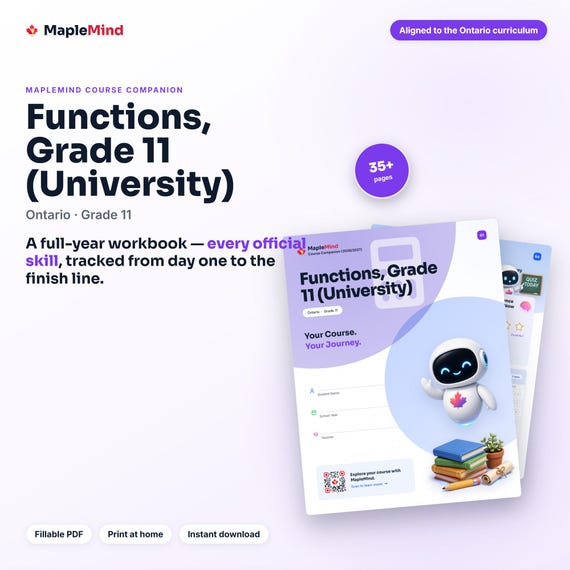


Printable workbook · A keepsake of the year
A Functions, Grade 11 (University) workbook worth keeping
Built from the same official curriculum as this page. Before and after each skill above, your student colours in how sure they feel — so the two of you can see, on one page, what's clicking and what needs another look. It's a quiet way to follow how the year is really going.
By June it's full of their own handwriting: units worked through, confidence grown, a mid-year check-in, notes from parent-teacher night, and a certificate at the end. Less a worksheet, more a record of the year worth keeping on the shelf.
Instant download · see every page, reviews and the full description · five or more workbooks are $2.99 each
What it looks like in the app



Common questions
Can MapleMind help me with Functions, Grade 11 (University)?
Yes. MapleMind's AI tutor covers all 68 skills in Ontario's Functions, Grade 11 (University) — you pick the exact skill, and the tutor teaches it step by step: a short lesson, a worked example, solving together, then a skill check to show it stuck.
Is MapleMind aligned to Ontario's official curriculum?
Yes. Every skill in this course maps to an official outcome code from Ontario's Grade 11 Mathematics curriculum, and the ministry's own wording is quoted under each unit on this page — with the official government source linked so you can check it yourself.
What does MapleMind cost?
It's free to start — 5 tutoring chats and a practice quiz every day, no credit card. A Pro subscription ($9.99/month or $49.99/year CAD, 7-day free trial) unlocks unlimited tutoring, practice, and exam simulations.
What if I'm stuck on just one topic?
That's the point of skill-level tutoring: open Functions, Grade 11 (University) in the app, tap the exact skill from the list on this page, and the tutor teaches just that — no wading through lessons you don't need.
Does MapleMind work in French or other languages?
Yes — 14 languages, including French. Both the app and the tutor's explanations switch to the language you choose.
Where can I see the official Ontario curriculum for Functions, Grade 11 (University)?
The official source is linked on this page — Ontario's official mathematics curriculum. The outline here follows it: every MapleMind skill carries its official outcome code, and the ministry's own wording is quoted under each unit.
Keep exploring
Ready when you are
Pick a skill from this page and see it taught properly — free, in the browser, in under a minute.