Get help with Functions and Applications, Grade 11 (University/College)
Most tutoring makes you sit through material you already know. MapleMind flips that: pick the exact skill that's causing trouble — any of the 53 below — and the tutor teaches just that one, step by step, as many times as it takes. Ask questions in plain words, any time of day, in English, French, or 12 other languages.
The official Ontario Functions and Applications, Grade 11 (University/College) curriculum
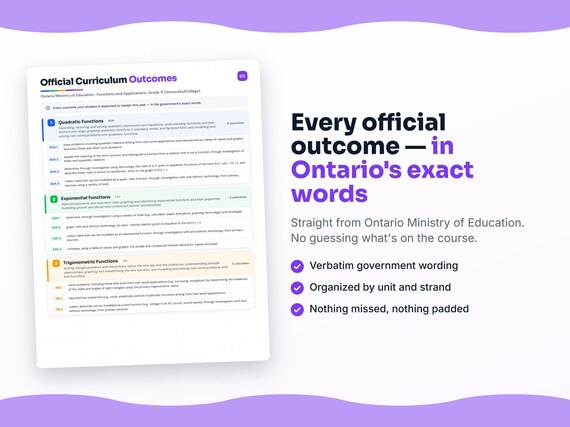
Ontario defines Functions and Applications, Grade 11 (University/College) by strands and outcomes. MapleMind teaches the same curriculum reorganized for one-skill-at-a-time tutoring — the table shows exactly where every official strand lands, and the ministry's own wording is quoted under each unit below.
Official source Ontario's official mathematics curriculumRead it on the government site — dcp.edu.gov.on.ca ↗| Official strand | Outcomes | Where MapleMind teaches it |
|---|---|---|
| Strand A | 22 | Quadratic Functions |
| Strand B | 16 | Exponential Functions |
| Strand C | 15 | Trigonometric Functions |
Every skill below, taught one on one.
 Try the first session free
How MapleMind teaches Functions and Applications, Grade 11 (University/College) — every unit, lesson, and skill
Every skill below runs as a short session: a plain-words lesson, a worked example, solving it together, then a five-question skill check that earns up to three stars. Guided Mode keeps it teaching instead of answer-handing — turning it off needs a parent's password.
Unit 1Quadratic FunctionsOfficial strand · Strand A
Expanding, factoring, and solving quadratic expressions and equations; understanding functions and their domain and range; graphing quadratic functions in standard, vertex, and factored form; and modelling and solving real-world problems with quadratic functions.
Solving Quadratic Equations
- Posing and solving real-world quadratic problemsmcf3m.1.1 — Pose problems involving quadratic relations from real-world situations, given as tables of values or graphs, and solve them.
- Representing situations with quadratic expressions and expanding themmcf3m.1.2 — Represent real-world situations, like the area of a variable-width picture frame, using a quadratic expression in one variable, then expand and simplify it.
- Factoring quadratic expressionsmcf3m.1.3 — Factor quadratic expressions in one variable, including cases where the leading coefficient is not 1, differences of squares, and perfect square trinomials, choosing an appropriate strategy.
- Solving quadratic equations by factoringmcf3m.1.4 — Solve quadratic equations by choosing and applying a factoring strategy.
- Connecting factors to the graph's x-interceptsmcf3m.1.5 — Investigate and describe how the factors used to solve a quadratic equation connect to the x-intercepts of the corresponding graph.
- Exploring and applying the quadratic formulamcf3m.1.6 — Explore how the quadratic formula is developed algebraically, then apply the formula to solve quadratic equations using technology.
- The discriminant and the number of real rootsmcf3m.1.7 — Relate the real roots of a quadratic equation to the x-intercepts of its graph, and connect the number of real roots to the value of the discriminant.
- Comparing strategies for finding real rootsmcf3m.1.8 — Determine the real roots of a variety of quadratic equations, and describe the advantages and disadvantages of graphing, factoring, and using the quadratic formula.
Understanding Functions, Domain, and Range
- What makes a relation a functionmcf3m.1.9 — Explain the meaning of the term function and distinguish a function from a relation that is not one, using tables, mapping diagrams, graphs, function machines, equations, and the vertical-line test.
- Substituting into and evaluating function notationmcf3m.1.10 — Substitute into and evaluate linear and quadratic functions written in function notation, including functions from real-world applications.
- What domain and range meanmcf3m.1.11 — Explain what domain and range mean, using numeric, graphical, and algebraic representations of linear and quadratic functions, and describe them appropriately.
- Domain and range restrictions in real-world contextsmcf3m.1.12 — Explain any restrictions that a real-world context places on the domain and range of a quadratic function.
Connecting Graphs and Equations of Quadratic Functions
- What a, h, and k do to a parabola's graphmcf3m.1.13 — Investigate the roles of a, h, and k in f(x) = a(x - h)² + k, and describe them as translations, reflections, and vertical stretches/compressions of f(x) = x².
- Sketching quadratic graphs using transformationsmcf3m.1.14 — Sketch graphs of g(x) = a(x - h)² + k by applying one or more transformations to the graph of f(x) = x².
- Converting vertex form to standard formmcf3m.1.15 — Express a quadratic function's equation in standard form given its vertex form, and verify with graphing technology that the two forms are equivalent.
- Converting standard form to vertex form by completing the squaremcf3m.1.16 — Express a quadratic function's equation in vertex form given its standard form, by completing the square, then verify with graphing technology that the forms are equivalent.
- Sketching a quadratic graph from factored formmcf3m.1.17.a — Sketch the graph of a quadratic function given in factored form by using the x-intercepts to determine the vertex.
- Comparing what standard, vertex, and factored form each revealmcf3m.1.17.b — Describe the information, like the maximum and the intercepts, that can be obtained by inspecting the standard, vertex, and factored forms of a quadratic function's equation.
- Sketching a quadratic graph from standard form and identifying its key featuresmcf3m.1.17.c — Sketch the graph of a quadratic function given in standard form by using a suitable strategy, such as completing the square or factoring, and identify the key features of the graph.
Solving Problems Involving Quadratic Functions
- Collecting and graphing data that fits a quadratic modelmcf3m.1.18 — Collect data that can be modelled with a quadratic function, from primary or secondary sources, using a variety of tools, and graph the data.
- Finding the quadratic equation that best fits a data setmcf3m.1.19 — Determine, using a variety of strategies, the equation of the quadratic function that best models a data set graphed as a scatter plot, and compare it to a technology-generated curve of best fit.
- Solving real-world problems from a quadratic function's equationmcf3m.1.20 — Solve real-world problems given the algebraic representation of a quadratic function, such as maximum height, time to reach the ground, or time interval above a given height.
The official wording — 22 outcomes in this unit
- mcf3m.1.1
pose problems involving quadratic relations arising from real-world applications and represented by tables of values and graphs, and solve these and other such problems
- mcf3m.1.2
represent situations (e.g., the area of a picture frame of variable width) using quadratic expressions in one variable, and expand and simplify quadratic expressions in one variable
- mcf3m.1.3
factor quadratic expressions in one variable, including those for which a ≠ 1
- mcf3m.1.4
solve quadratic equations by selecting and applying a factoring strategy
- mcf3m.1.5
determine, through investigation, and describe the connection between the factors used in solving a quadratic equation and the x-intercepts of the graph of the corresponding quadratic relation
- mcf3m.1.6
explore the algebraic development of the quadratic formula
- mcf3m.1.7
relate the real roots of a quadratic equation to the x-intercepts of the corresponding graph, and connect the number of real roots to the value of the discriminant
- mcf3m.1.8
determine the real roots of a variety of quad- ratic equations
- mcf3m.1.9
explain the meaning of the term function, and distinguish a function from a relation that is not a function, through investigation of linear and quadratic relations
- mcf3m.1.10
substitute into and evaluate linear and quadratic functions represented using function notation
- mcf3m.1.11
explain the meanings of the terms domain and range, through investigation using numeric, graphical, and algebraic representations of lin- ear and quadratic functions
- mcf3m.1.12
explain any restrictions on the domain and the range of a quadratic function in contexts arising from real-world applications
- mcf3m.1.13
determine, through investigation using technology, the roles of a, h, and k in quadratic functions of the form f(x) = a(x – h) + k, and describe these roles in terms of transforma- tions on the graph of f(x) = x
- mcf3m.1.14
sketch graphs of g(x) = a(x – h) + k by applying one or more transformations to the graph of f(x) = x
- mcf3m.1.15
express the equation of a quadratic function in the standard form f(x) = ax + bx + c, given the vertex form f(x) = a(x – h) + k, and verify, using graphing technology, that these forms are equivalent representations
- mcf3m.1.16
express the equation of a quadratic function in the vertex form f(x) = a(x – h) + k, given the standard form f(x) = ax + bx + c, by completing the square
- mcf3m.1.17.a
sketch graphs of quadratic functions in the factored form f(x) = a(x – r)(x – s) by using the x-intercepts to determine the vertex
- mcf3m.1.17.b
describe the information (e.g., maximum, intercepts) that can be obtained by inspecting the standard form f(x) = ax + bx + c, the vertex form f(x) = a(x – h) + k, and the factored form f(x) = a(x – r)(x – s) of a quadratic function
- mcf3m.1.17.c
sketch the graph of a quadratic function whose equation is given in the standard form f(x) = ax + bx + c by using a suitable strategy
- mcf3m.1.18
collect data that can be modelled as a quad- ratic function, through investigation with and without technology, from primary sources, using a variety of tools
- mcf3m.1.19
determine, through investigation using a vari- ety of strategies
- mcf3m.1.20
solve problems arising from real-world appli- cations, given the algebraic representation of a quadratic function
Unit 2Exponential FunctionsOfficial strand · Strand B
Rational exponents and exponent rules; graphing and identifying exponential functions and their properties; modelling growth and decay; and compound interest and annuities.
Rational Exponents and Evaluating Powers
- What a power with a rational exponent meansmcf3m.2.1 — Investigate, using tools like patterning, graphs, and exponent laws, the value of a power with a rational exponent.
- Evaluating expressions with integer and rational exponentsmcf3m.2.2 — Evaluate, with and without technology, numerical expressions containing integer and rational exponents and rational bases.
- Exponent rules for multiplying, dividing, and powers of powersmcf3m.2.5 — Investigate, through patterning, the exponent rules for multiplying and dividing numeric expressions with exponents and for a power of a power, and use them to simplify expressions with integer exponents.
Connecting Graphs and Equations of Exponential Functions
- Graphing an exponential relation and defining it as a functionmcf3m.2.3 — Graph, with and without technology, an exponential relation given its equation in the form y = aˣ, define this relation as the function f(x) = aˣ, and explain why it is a function.
- Key properties of exponential functionsmcf3m.2.4 — Investigate and describe key properties of exponential functions, including domain and range, intercepts, increasing/decreasing intervals, and asymptotes, across a variety of representations.
- Telling exponential, linear, and quadratic functions apartmcf3m.2.6 — Distinguish exponential functions from linear and quadratic functions by comparing rates of change, ratios, graphs, and equations in the same context.
Solving Problems Involving Exponential Functions
- Collecting and graphing data that fits an exponential modelmcf3m.2.7 — Collect data that can be modelled as an exponential function, from primary or secondary sources, using a variety of tools, and graph the data.
- Identifying exponential growth and decay in real-world contextsmcf3m.2.8 — Identify exponential functions arising from real-world growth and decay situations, given various representations, and explain any restrictions the context places on domain and range.
- Solving real-world problems with exponential graphs and equationsmcf3m.2.9 — Solve problems using given graphs or equations of exponential functions from real-world applications, by interpreting the graph or substituting values into the equation.
Solving Financial Problems Involving Exponential Functions
- Comparing simple and compound interestmcf3m.2.10 — Compare, using a table of values and graphs, the simple and compound interest earned for a given principal and fixed interest rate over time.
- Using the compound interest formula to find amount or principalmcf3m.2.11 — Solve problems, using a scientific calculator, that involve calculating the amount (future value) or the principal (present value) using A = P(1 + i)ⁿ.
- Compound interest is exponential growthmcf3m.2.12 — Investigate, using spreadsheets and graphs, how compound interest and present value formulas are themselves exponential functions of the number of compounding periods.
- Using the TVM Solver to find interest rate or number of periodsmcf3m.2.13 — Solve problems, using a TVM Solver, that involve calculating the interest rate per compounding period or the number of compounding periods in the compound interest formula.
- What an annuity ismcf3m.2.14 — Explain the meaning of the term annuity through investigation of numeric and graphical representations using technology.
- How changing an annuity's conditions affects itmcf3m.2.15 — Investigate, using technology, the effects of changing payments, payment frequency, interest rate, or compounding period on an ordinary simple annuity.
- Solving for an annuity's amount, present value, or paymentmcf3m.2.16 — Solve problems, using technology, that involve the amount, the present value, and the regular payment of an ordinary simple annuity.
The official wording — 16 outcomes in this unit
- mcf3m.2.1
determine, through investigation using a variety of tools (e.g., calculator, paper and pencil, graphing technology) and strategies
- mcf3m.2.2
evaluate, with and without technology, numerical expressions containing integer and rational exponents and rational bases
- mcf3m.2.5
determine, through investigation (e.g., by patterning with and without a calculator), the exponent rules for multiplying and dividing numeric expressions involving exponents
- mcf3m.2.3
graph, with and without technology, an expo- nential relation, given its equation in the form y = a
- mcf3m.2.4
determine, through investigation, and describe key properties relating to domain and range, intercepts, increasing/decreasing intervals, and asymptotes
- mcf3m.2.6
distinguish exponential functions from linear and quadratic functions by making comparisons in a variety of ways
- mcf3m.2.7
collect data that can be modelled as an exponential function, through investigation with and without technology, from primary sources
- mcf3m.2.8
identify exponential functions, including those that arise from real-world applications involving growth and decay
- mcf3m.2.9
solve problems using given graphs or equations of exponential functions arising from a variety of real-world applications
- mcf3m.2.10
compare, using a table of values and graphs, the simple and compound interest earned for a given principal
- mcf3m.2.11
solve problems, using a scientific calculator, that involve the calculation of the amount, A
- mcf3m.2.12
determine, through investigation (e.g., using spreadsheets and graphs), that compound interest is an example of exponential growth
- mcf3m.2.13
solve problems, using a TVM Solver on a graphing calculator or on a website, that involve the calculation of the interest rate per compounding period
- mcf3m.2.14
explain the meaning of the term annuity, through investigation of numeric and graphical representations using technology
- mcf3m.2.15
determine, through investigation using technology (e.g., the TVM Solver on a graph- ing calculator, online tools), the effects of changing the conditions
- mcf3m.2.16
solve problems, using technology (e.g., scien- tific calculator, spreadsheet, graphing calcula- tor), that involve the amount, the present value, and the regular payment of an ordinary simple annuity
Unit 3Trigonometric FunctionsOfficial strand · Strand C
Solving triangle problems with the primary ratios, the sine law, and the cosine law; understanding periodic relationships; graphing and transforming the sine function; and modelling and solving real-world problems with sine functions.
Applying the Sine Law and the Cosine Law in Acute Triangles
- Solving right-triangle problems with primary trig ratiosmcf3m.3.1 — Solve problems, including real-world ones like surveying and navigation, by finding the sides and angles of right triangles using the primary trigonometric ratios.
- Solving problems with two right trianglesmcf3m.3.2 — Solve problems involving two right triangles in two dimensions.
- Verifying the sine law and the cosine lawmcf3m.3.3 — Verify the sine law and the cosine law through investigation using dynamic geometry software or a spreadsheet.
- Choosing between the sine law and the cosine lawmcf3m.3.4 — Describe the conditions that guide when to use the sine law or the cosine law, and use these laws to calculate sides and angles in acute triangles.
- Solving real-world problems with the sine or cosine lawmcf3m.3.5 — Solve problems, including real-world ones like surveying, navigation, and building construction, that require the sine law or cosine law in acute triangles.
Connecting Graphs and Equations of Sine Functions
- Key properties of periodic functionsmcf3m.3.6 — Describe key properties, like cycle, amplitude, and period, of periodic functions from real-world applications, given a numeric or graphical representation.
- Predicting future behaviour of a periodic relationshipmcf3m.3.7 — Predict, by extrapolating, the future behaviour of a relationship modelled with a numeric or graphical representation of a periodic function.
- Connecting the sine ratio to the sine functionmcf3m.3.8 — Make connections between the sine ratio and the sine function by graphing angles from 0 to 360 degrees against their sine ratios, defining this as the function f(x) = sin x.
- Sketching f(x) = sin x and its key propertiesmcf3m.3.9 — Sketch the graph of f(x) = sin x for angles in degrees, and determine and describe its key properties: cycle, domain, range, intercepts, amplitude, period, max/min, and increasing/decreasing intervals.
- Connecting real-world changes to graph transformationsmcf3m.3.10 — Investigate, with technology, connections between changes in a real-world periodic situation and transformations of the corresponding graph.
- What a, c, and d do to the sine function's graphmcf3m.3.11 — Investigate the roles of the parameters a, c, and d in f(x) = a sin x, f(x) = sin x + c, and f(x) = sin(x - d), and describe them as transformations of f(x) = sin x.
- Sketching sine function transformations and stating domain/rangemcf3m.3.12 — Sketch graphs of f(x) = a sin x, f(x) = sin x + c, and f(x) = sin(x - d) by applying transformations, and state the domain and range of the transformed functions.
Solving Problems Involving Sine Functions
- Collecting and graphing data that fits a sine modelmcf3m.3.13 — Collect data that can be modelled as a sine function, like AC circuit voltage or sound waves, from primary or secondary sources, and graph the data.
- Identifying periodic and sinusoidal functions in real-world contextsmcf3m.3.14 — Identify periodic and sinusoidal functions from real-world periodic phenomena, given various representations, and explain any restrictions on domain and range.
- Posing and solving problems with sine functionsmcf3m.3.15 — Pose problems based on applications involving a sine function, and solve them using a given or generated graph from a table of values or equation.
The official wording — 15 outcomes in this unit
- mcf3m.3.1
solve problems, including those that arise from real-world applications (e.g., surveying, navigation), by determining the measures of the sides and angles of right triangles using the primary trigonometric ratios
- mcf3m.3.2
solve problems involving two right triangles in two dimensions
- mcf3m.3.3
verify, through investigation using technol- ogy (e.g., dynamic geometry software, spreadsheet), the sine law and the cosine law
- mcf3m.3.4
describe conditions that guide when it is appropriate to use the sine law or the cosine law, and use these laws to calculate sides and angles in acute triangles
- mcf3m.3.5
solve problems that require the use of the sine law or the cosine law in acute triangles, including problems arising from real-world applications
- mcf3m.3.6
describe key properties (e.g., cycle, amplitude, period) of periodic functions arising from real-world applications
- mcf3m.3.7
predict, by extrapolating, the future behaviour of a relationship modelled using a numeric or graphical representation of a periodic function
- mcf3m.3.8
make connections between the sine ratio and the sine function by graphing the relationship between angles from 0º to 360º and the corresponding sine ratios
- mcf3m.3.9
sketch the graph of f(x) = sinx for angle measures expressed in degrees, and determine and describe its key properties
- mcf3m.3.10
make connections, through investigation with technology, between changes in a real-world situation that can be modelled using a periodic function and transformations of the correspon- ding graph
- mcf3m.3.11
determine, through investigation using technology, the roles of the parameters a, c, and d in functions in the form f(x) = a sinx, f(x) = sinx + c, and f(x) = sin(x – d)
- mcf3m.3.12
sketch graphs of f(x) = a sinx, f(x) = sinx + c, and f(x) = sin(x – d) by applying transforma- tions to the graph of f(x) = sinx
- mcf3m.3.13
collect data that can be modelled as a sine function (e.g., voltage in an AC circuit, sound waves), through investigation with and without technology, from primary sources
- mcf3m.3.14
identify periodic and sinusoidal functions, including those that arise from real-world applications involving periodic phenomena
- mcf3m.3.15
pose problems based on applications involving a sine function, and solve these and other such problems by using a given graph or a graph generated with technology from a table of values or from its equation

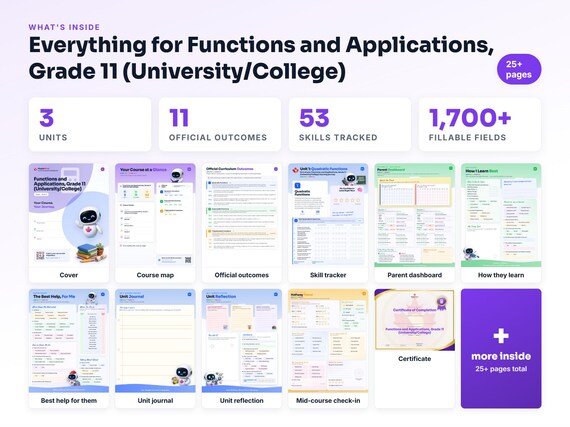

Printable workbook · A keepsake of the year
A Functions and Applications, Grade 11 (University/College) workbook worth keeping
Built from the same official curriculum as this page. Before and after each skill above, your student colours in how sure they feel — so the two of you can see, on one page, what's clicking and what needs another look. It's a quiet way to follow how the year is really going.
By June it's full of their own handwriting: units worked through, confidence grown, a mid-year check-in, notes from parent-teacher night, and a certificate at the end. Less a worksheet, more a record of the year worth keeping on the shelf.
Instant download · see every page, reviews and the full description · five or more workbooks are $2.99 each
What it looks like in the app


Common questions
Can MapleMind help me with Functions and Applications, Grade 11 (University/College)?
Yes. MapleMind's AI tutor covers all 53 skills in Ontario's Functions and Applications, Grade 11 (University/College) — you pick the exact skill, and the tutor teaches it step by step: a short lesson, a worked example, solving together, then a skill check to show it stuck.
Is MapleMind aligned to Ontario's official curriculum?
Yes. Every skill in this course maps to an official outcome code from Ontario's Grade 11 Mathematics curriculum, and the ministry's own wording is quoted under each unit on this page — with the official government source linked so you can check it yourself.
What does MapleMind cost?
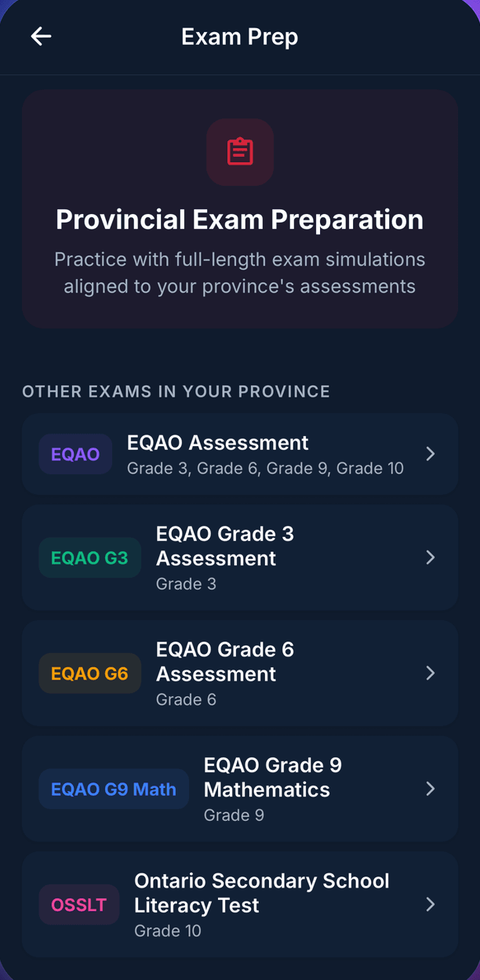
It's free to start — 5 tutoring chats and a practice quiz every day, no credit card. A Pro subscription ($9.99/month or $49.99/year CAD, 7-day free trial) unlocks unlimited tutoring, practice, and exam simulations.
What if I'm stuck on just one topic?
That's the point of skill-level tutoring: open Functions and Applications, Grade 11 (University/College) in the app, tap the exact skill from the list on this page, and the tutor teaches just that — no wading through lessons you don't need.
Does MapleMind work in French or other languages?
Yes — 14 languages, including French. Both the app and the tutor's explanations switch to the language you choose.
Where can I see the official Ontario curriculum for Functions and Applications, Grade 11 (University/College)?
The official source is linked on this page — Ontario's official mathematics curriculum. The outline here follows it: every MapleMind skill carries its official outcome code, and the ministry's own wording is quoted under each unit.
Keep exploring
Ready when you are
Pick a skill from this page and see it taught properly — free, in the browser, in under a minute.